Page 196 of 340
Downloaded from www.Manualslib.com manuals search engine If a Tire Goes Flat
It’s unusual for a tire to “blow out” while you’re driving,
especially if
you maintain your tires properly. If air goes
out of a tire, it’s much more likely
to leak out slowly.
But if you should ever have a “blowout,” here are a few
tips about what to expect and what to do:
If a front tire fails, the flat tire will create a drag that
pulls the vehicle toward that side. Take your foot off the
accelerator pedal and grip the steering wheel firmly.
Steer to maintain lane position, then gently brake to a
stop well out
of the traffic lane.
A rear blowout, particularly on a curve, acts much like a
skid and
may require the same correction you’d use in a
skid. In any rear blowout, remove your foot from the
accelerator pedal. Get the vehicle under control by
steering the way you want the vehicle to
go. It may be
very bumpy and noisy, but you can still steer. Gently
brake to
a stop, well off the road if possible.
If a tire goes flat, the next part shows how to use your
jacking equipment
to change a flat tire safely.
Changing a Flat Tire
If a tire goes flat, avoid further tire and wheel damage
by driving slowly
to a level place. Turn on your hazard
warning flashers.
5-20
Page 197 of 340
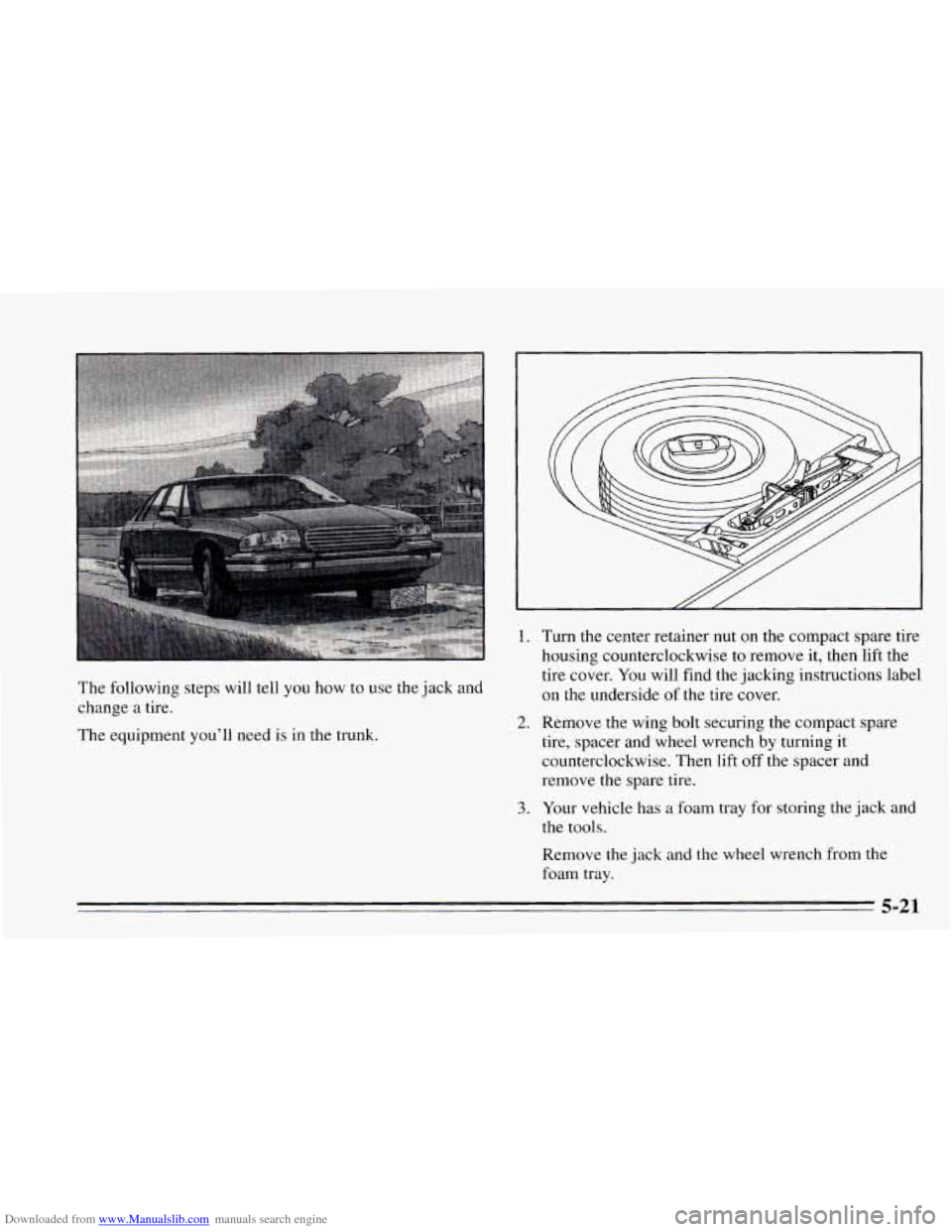
Downloaded from www.Manualslib.com manuals search engine The following steps will tell you how to use the jack and
change a tire.
The equipment you'll need is in the trunk.
1.
2.
3.
Turn the center retainer nut on the compact spare tire
housing counterclockwise to remove it, then lift the
tire cover. You will find the jacking instructions label
on the underside of the tire cover.
Remove the wing bolt securing the compact spare
tire, spacer and wheel wrench by turning it
counterclockwise. Then lift
off the spacer and
remove the spare tire.
Your vehicle has a foam tray for storing the jack and
the tools.
Remove the jack and the wheel wrench from the
foam tray.
5-21
Page 198 of 340
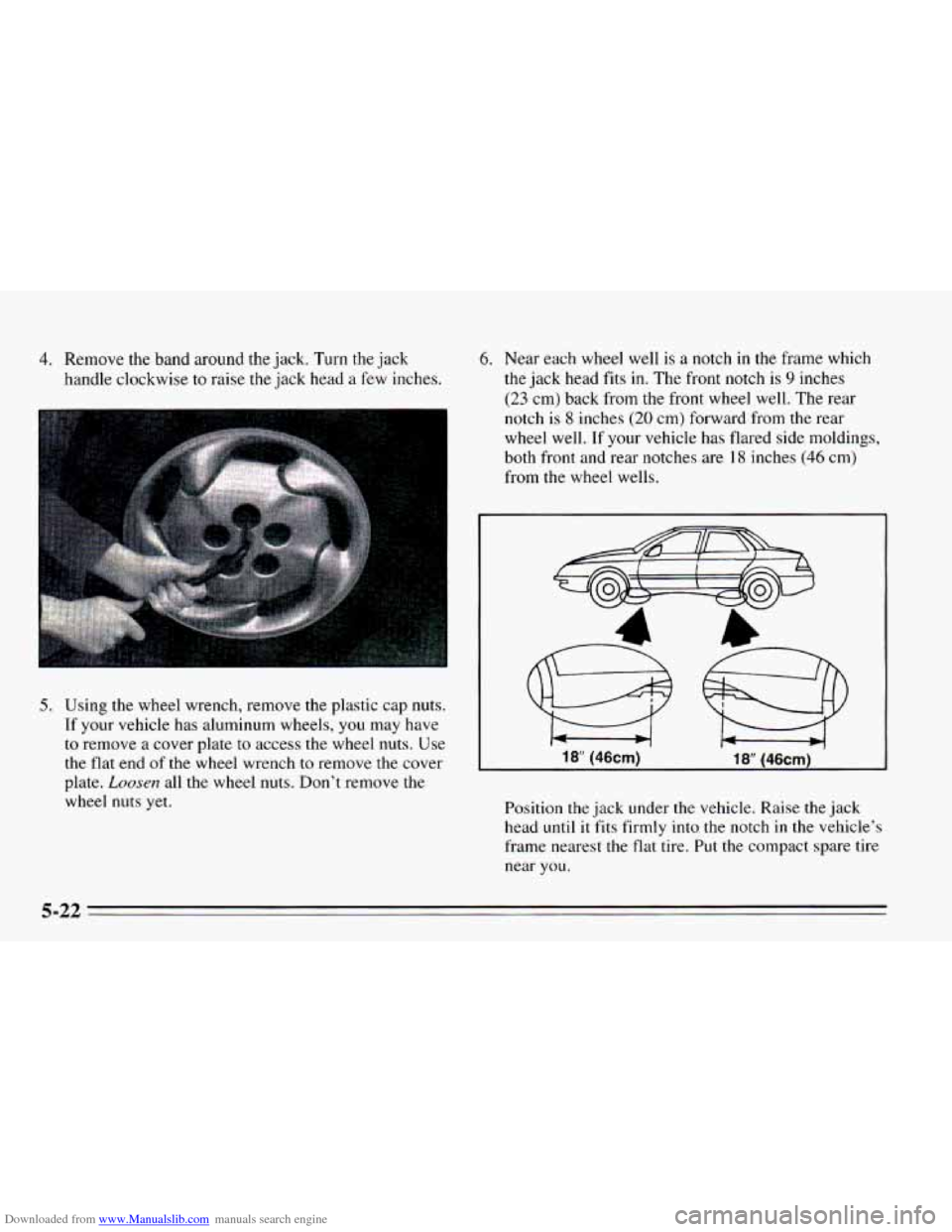
Downloaded from www.Manualslib.com manuals search engine 4. Remove the band around the jack. Turn the jack
handle clockwise
to raise the jack head a few inches.
5. Using the wheel wrench, remove the plastic cap nuts.
If your vehicle has aluminum wheels,
you may have
to remove a cover plate to access the wheel nuts. Use
the flat end
of the wheel wrench to remove the cover
plate.
Loosen all the wheel nuts. Don’t remove the
wheel nuts yet.
6. Near each wheel well is a notch in the frame which
the jack head fits in. The front notch
is 9 inches
(23 cm) back from the front wheel well. The rear
notch
is 8 inches (20 cm) forward from the rear
wheel well. If your vehicle has flared side moldings,
both front and rear notches are 18 inches
(46 cm)
from the wheel wells.
Position the jack under the vehicle. Raise the jack
head
until it fits firmly into the notch in the vehicle’s
frame nearest the flat tire. Put the compact spare tire
near
you.
5-22
Page 200 of 340
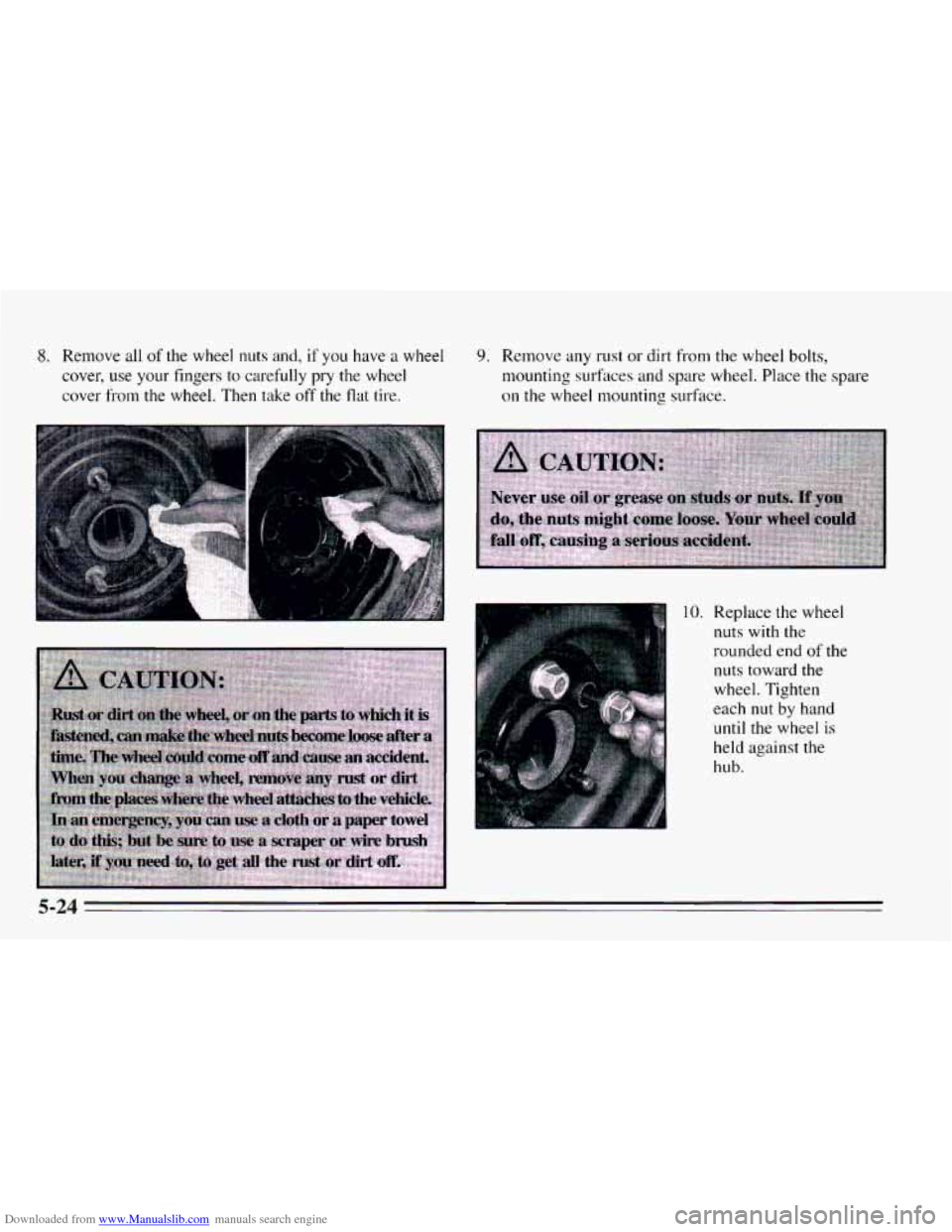
Downloaded from www.Manualslib.com manuals search engine 8. Remove all of the wheel nuts and, if you have a wheel
cover, use your fingers to carefully pry the wheel
cover from
the wheel. Then take off the flat tire.
9. Remove any rust or dirt from the wheel bolts,
mounting surfaces and spare wheel. Place the spare
on the wheel mounting surface.
10. Replace the wheel
nuts with the
rounded end
of the
nuts toward the wheel. Tighten
each
nut by hand
until the wheel is
held against the
hub.
5-24
Page 201 of 340
Downloaded from www.Manualslib.com manuals search engine c
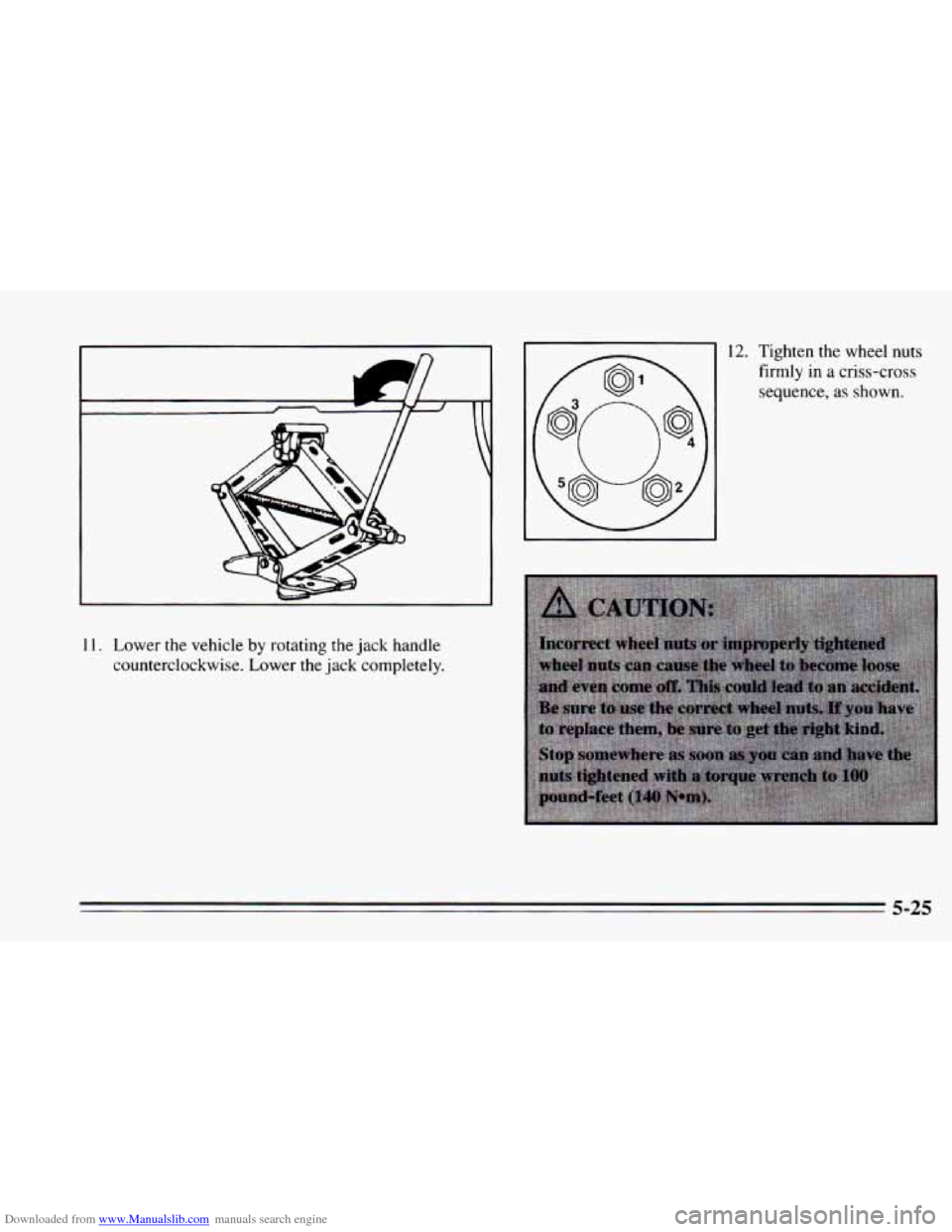
11. Lower the vehicle by rotating the jack handle
counterclockwise. Lower the jack completely.
12. Tighten the wheel nuts
firmly in
a criss-cross
sequence, as shown.
5-25
Page 202 of 340
Downloaded from www.Manualslib.com manuals search engine ~ Don’t try
to put a wheel cover on your compact spare
~ tire, It won’t fit. Store the wheel cover and plastic cap ! nuts in the trunk or rear area until you have the flat tire
repaired or replaced.
NOTICE:
Wheel covers won’t fit on your compact spare. If
you try to put a wheel cover on your compact
spare, you could damage the cover or the spare.
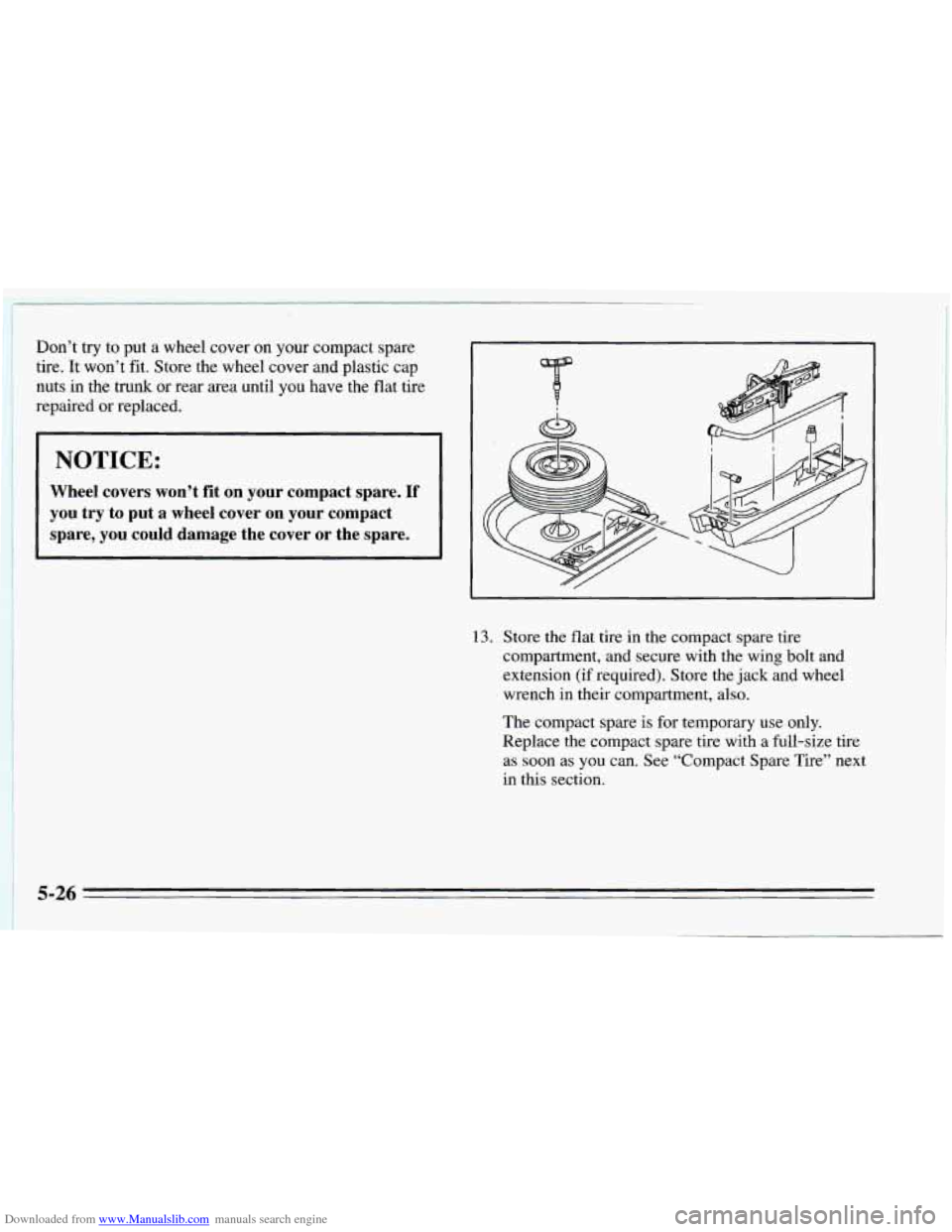
13. Store the flat tire in the compact spare tire
compartment, and secure with the wing bolt and
extension (if required). Store the jack and wheel
wrench in their compartment, also.
The compact spare is for temporary use only.
Replace the compact spare tire with a full-size tire
as soon as you can. See “Compact Spare Tire” next
in this section.
5-26
Page 203 of 340
Downloaded from www.Manualslib.com manuals search engine I NOTICE:
Compact Spare Tire
Although the compact spare was fully inflated when
your vehicle was new, it can lose air after a time. Check
the inflation pressure regularly. It should be
60 psi
(420 Pa). After installing the compact spare on your
vehicle, you should stop
as soon as possible and make
sure your spare tire is correctly inflated. The compact
spare
is made to perform well at posted speed limits for
distances up
to 3,000 miles (5 000 km), so you can
finish your trip and have your full-size tire repaired or
replaced where you want. Of course,
it’s best to replace
your spare with a full-size tire as soon as you can. Your
spare will last longer and be in good shape in case you
need
it again.
Don’t take your compact spare through an
automatic car wash with guide rails. The
compact spare can get caught on the rails. That
can damage the tire and wheel, and maybe other
parts
of your vehicle.
Don’t use your compact spare on some other vehicle.
And don’t mix your compact spare or wheel with other
wheels or tires. They won’t fit. Keep your spare and its
wheel together.
NOTICE:
Tire chains won’t fit your compact spare. Using
them will damage your vehicle and destroy the
chains too. Don’t use tire chains on your compact
spare.
5-27
Page 204 of 340
Downloaded from www.Manualslib.com manuals search engine If You’re Stuck: In Sand, Mud, Ice or
Snow
What you don’t want to do when your vehicle is stuck is
to spin your wheels too fast. The method known as
“rocking” can help you get out when you’re stuck, but
you must use caution.
I NOTICE:
Spinning your wheels can destroy parts of your
vehicle as well as the tires.
If you spin the wheels
too fast while shifting your transaxle back and
forth, you can destroy your transaxle.
For information about using tire chains on your vehicle,
see “Tire Chains”
in the Index.
Rocking your vehicle to get it out:
First, turn your steering wheel left and right. That will
clear the area around your front wheels. Then shift back
and forth between REVERSE (R) and a forward gear
(or with a manual transaxle, between FIRST
(1) or
SECOND (2) gear and REVERSE), spinning the wheels
as little as possible. Release the accelerator pedal while
you shift, and press lightly on the accelerator pedal
when the transaxle is in gear. If that doesn’t get
you out
after a few tries, you may need to be towed out. If you
do need to be towed out, see “Towing Your Vehicle” in
the Index.
5-28