1995 CHEVROLET CAVALIER light
[x] Cancel search: lightPage 125 of 340
Downloaded from www.Manualslib.com manuals search engine NOTICE:
If you keep driving your vehicle with this light
on, after a while the emission controls won’t
work as well, your fuel economy won’t
be as good
and your engine may not run as smoothly. This
could lead to costly repairs not covered by your
warranty.
If Your Vehicle
Is Equipped with OBD I1
(2.3L Code D Engine Only)
Certain vehicles are equipped with a new emission
diagnostic system. You can tell whether your vehicle has
this system by reading your tune-up label located under
the hood. If the label says
“OBD 11” on it. the following
instructions apply.
Your Chevrolet
is equipped with an onboard computer
which monitors operation
of the emission control
system. This system
is called OBD I1 (On-Board
Diagnostics
-- Second Generation) and is intended to
assure that emissions are at acceptable levels for the life
of the vehicle, helping to produce a cleaner
environment. The
CHECK ENGINE light comes on to
indicate when service is require.d. Malfunctions often
will be indicated by the system before any problem is apparent,
which may prevent more serious damage
tc,
your vehicle. This system is also designed to assist your
service technician
in correctly diagnosing any
malfunction.
The
CHECK ENGINE light should come on, as a check
to show
you it is working, when the ignition is on and
the engine is
not running. This light will also come on
during a malfunction in one of two ways:
Light On Steady: This indicates a system
malfunction has been detected. Drive the vehicle
to
the dealer for service at your first opportunity.
Light Flashing: This indicates a misfire has been
detected which may damage the emission control
system. The damage may be reduced by Iowering the
vehicle speed, reducing the amount
of cargo being
hauled or trailered, avoiding hard acceleration,
or by
avoiding steep uphill grades.
If these actions are
effective,
the light will stop flashing and remain on
steady. Drive the vehicle to a dealer for service. If
the light continues to flash, stop the vehicle. Wait for
a steady light to come on, then drive the vehicle to
a
dealer for service.
2-69
Page 126 of 340
Downloaded from www.Manualslib.com manuals search engine These following conditions also may cause the CHECK
ENGINE light to come
on:
0
0
Low Fuel/Out of Fuel: As the vehicle starts to run
out of fuel, the CHECK ENGINE light may come on
as a result of an engine misfire. Filling your fuel tank
should correct this condition. Make sure to install
the
gas cap fully. It will require a few driving trips to
turn the light off.
Poor Quality Fuel: Be sure to fuel your vehicle with
quality fuel. Your engine may
not run efficiently on
poor fuel. Poor fuel may cause stalling, hesitation or
misfire. These conditions may
go away when the
engine
is warmed-up. However, poor quality fuel
may cause the
CHECK ENGINE light to come on.
Have a dealer check the vehicle. If no problems are
found, you may want
to change to another brand of
fuel.
Driving Through Standing Water: Driving your
vehicle through puddles
of deep standing water may
result in
a temporary misfire condition. This
condition will usually correct itself shortly after
the
electrical system dries out. it will require a few
driving trips
to turn the light off.
Passlock Warning Light
THEFT
SYSTEM
This light will come on
when you turn the key
towards the
START
position. The light will stay
on until the vehicle starts.
If the light flashes, the Passlock system has entered a
tamper mode.
If the vehicle fails to start, see “Passlock”
in the Index.
If
the light comes on continuously while driving and
stays
on, there may be a problem with the Passlock
system. Your vehicle will not be protected
by Passlock,
and
you should see your dealer.
2-70
Page 128 of 340
Downloaded from www.Manualslib.com manuals search engine Mode Knob
The right knob has several settings to control the
direction
of air flow. For each setting, set the
temperature to a comfortable setting.
0 MAX (Option): This setting recirculates much of
the air inside your vehicle and sends it through the
instrument panel outlets. The air conditioning
compressor will run automatically
in this setting when it
is needed to help dry the air in the vehicle.
2 VENT: This setting brings in outside air and
directs it through the instrument panel.
BI-LEVEL: This setting brings in outside air and
directs
it two ways. Some air is directed through the
instrument panel outlets. Most of the air is directed
through the floor ducts and a little
to the defrost and side
window vents.
1j FLOOR: This setting sends most of the air through
the ducts near the floor. The rest comes
out of the
defroster and side window vents.
9 DEFOG: This setting allows half of the air to go to
the floor ducts and half to the defrost and side window
vents.
9 DEFROST: This setting directs most of the air
through the defroster and side window vents. Some
of
the air goes to the floor ducts. If your vehicle is
equipped with an
air conditioner, the air conditioning
compressor will
run automatically in this setting when it
is needed to help dry
the air in the vehicle.
Air Conditioning Compressor Button
Press the A/C button to operate the air conditioner
compressor. The indicator light above the button will
glow when the button
is pressed. You don’t have to
press
the button to run the compressor in MAX or
DEFROST.
Air Conditioning (Option)
On very hot days, open the windows long enough to let
hot, inside air escape. This reduces the time it takes for
your vehicle to cool down, which should help fuel
economy.
For quick cool-down on very hot days, use
MAX with
the temperature
knob all the way in the blue area. If this
3-2
Page 129 of 340
Downloaded from www.Manualslib.com manuals search engine setting is used for long periods of time, the air in your
vehicle may become too dry.
For normal cooling
on hot days, use VENT with the
temperature knob in the blue area and the
NC button
pushed in. The system will bring in outside air and cool it.
On cool but sunny days, the sun may warm your upper
body, but your lower body may not be warm enough.
You can use BI-LEVEL with the temperature knob in
the middle and the A/C button pushed
in. The system
will bring in outside air and direct slightly warmer air to
your lower body. You may notice this temperature
difference more at some times
than others.
Heating
On cold days use FLOOR with the temperature all the
way in the red area. The system will bring in outside air,
heat it and send
it to the floor ducts.
Your vehicle has heat ducts that are directed toward the
rear seat. Keep the area under the front seats clear
of
obstructions so the heated air can reach the rear seat
passengers.
If your vehicle has an engine coolant heater, you can use
it to help your system provide warm air faster when it’s
cold outside (0°F (-18°C) or lower). An engine coolant
heater warms
the coolant your engine and heating
system use
to provide heat. See “Engine Coolant
Heater” in the Index.
Ventilation
For mild outside temperatures when little heating or
cooling is needed, use VENT to direct outside air
through your vehicle. Your vehicle also has the
flow-through ventilation system described later
in this
section.
Defogging and Defrosting Windows
Your system has two settings for clearing the front and
side windows. To defrost
the windows quickly, use
DEFROST with the temperature knob all
the way in the
red area. To warm passengers while keeping the
windows clean, use
DEFOG.
To defog the side windows while using the air
conditioner, set the right control to BI-LEVEL, the fan
control
to the highest setting, and press the A/C button.
Aim
the side vents toward the side windows. For
increased air flow
to the side vents, close the center
vents.
3-3
Page 139 of 340
Downloaded from www.Manualslib.com manuals search engine Care of Your Cassette Tape Player
A tape player that is not cleaned regularly is subject to
reduced sound quality, ruined cassettes, or a damaged
mechanism. Tape cassettes that are
not properly stored
in their plastic cases away from contaminants, direct
sunlight, and extreme heat may not operate properly and
could cause premature failure of
the tape player.
Your tape player should be cleaned after
50 hours of use.
If you notice a reduction in sound quality, try a known
good cassette
to see if the tape or the tape player is at
fault. If this other cassette has no improvement in sound
quality, clean
the tape player. Cleaning
may be done with
a scrubbing action,
non-abrasive cleaning cassette. This system uses a
cleaning cassette with pads which scrub the tape head as
the hubs of the cleaner cassette turn.
A scrubbing action
cleaning cassette is available through your Chevrolet dealership.
You may also choose a non-scrubbing action, wet-type
cleaner which uses
a cassette with a fabric belt to clean
the tape head. It may not clean as thoroughly as the
scrubbing type cleaner.
Cassettes are subject to wear and
the sound quality may
degrade over time. Always verify that
the cassette tape
is
in good condition before you have your tape player
serviced.
3-13
Page 140 of 340
Downloaded from www.Manualslib.com manuals search engine Care of Your Compact Discs
! Handle discs carefully. Store them in their original cases
or other protective cases and away from direct sunlight
and dust. If the surface of a disc is soiled, dampen a
clean, soft cloth in a mild, neutral detergent solution and
clean it, wiping from the center to the edge.
Be sure never
to touch the signal surface when handling
discs. Pick up discs by grasping the outer edges
or the
edge
of the hole and the outer edge.
I
Fixed Mast Antenna
The fixed mast antenna can withstand most car washes
without being damaged. If the mast should ever become
slightly bent,
you can straighten it out by hand. If the
mast is badly bent, as it might be by vandals,
you should
replace it.
Check every once in a while
to be sure the mast is still
tightened to the fender.
3-14
Page 146 of 340
Downloaded from www.Manualslib.com manuals search engine Avoid needless heavy braking. Some people drive in
spurts
-- heavy acceleration followed by heavy braking
-- rather than keeping pace with traffic. This is a
mistake. Your brakes may not have time to cool between
hard stops. Your brakes will wear out much faster
if you
do a lot of heavy braking. If you keep pace with the
traffic and allow realistic following distances, you will
eliminate a lot
of unnecessary braking. That means
better braking and longer brake life.
If your engine ever stops while you’re driving, brake
normally but don’t pump
your brakes. If you do, the
pedal may get harder to push down. If your engine
stops,
you will still have some power brake assist. But
you will
use it when you brake. Once the power assist is
used up, it may take longer to stop and the brake pedal
will be harder to push.
Anti-Lock Brakes (ABS)
Your Chevrolet has an advanced electronic braking
system that will help prevent
a braking skid.
This light on
the
instrument panel will
come on briefly when
you start your vehicle.
When you start
your vehicle, or when you begin to drive
away,
you may hear a momentary motor or clicking
noise. And you may even notice that
your brake pedal
moves
a little while this is going on. This is the ABS
system testing itself. If there’s a problem with the
anti-lock brake system,
the anti-lock brake system
warning light will stay
on or flash.
See “Anti-Lock Brake System Warning Light” in the
Index.
Page 150 of 340
Downloaded from www.Manualslib.com manuals search engine Off-Road Recovery Passing
You may find sometime that your right wheels have
dropped off‘ the edge
of a road onto the shoulder while
you’re driving.
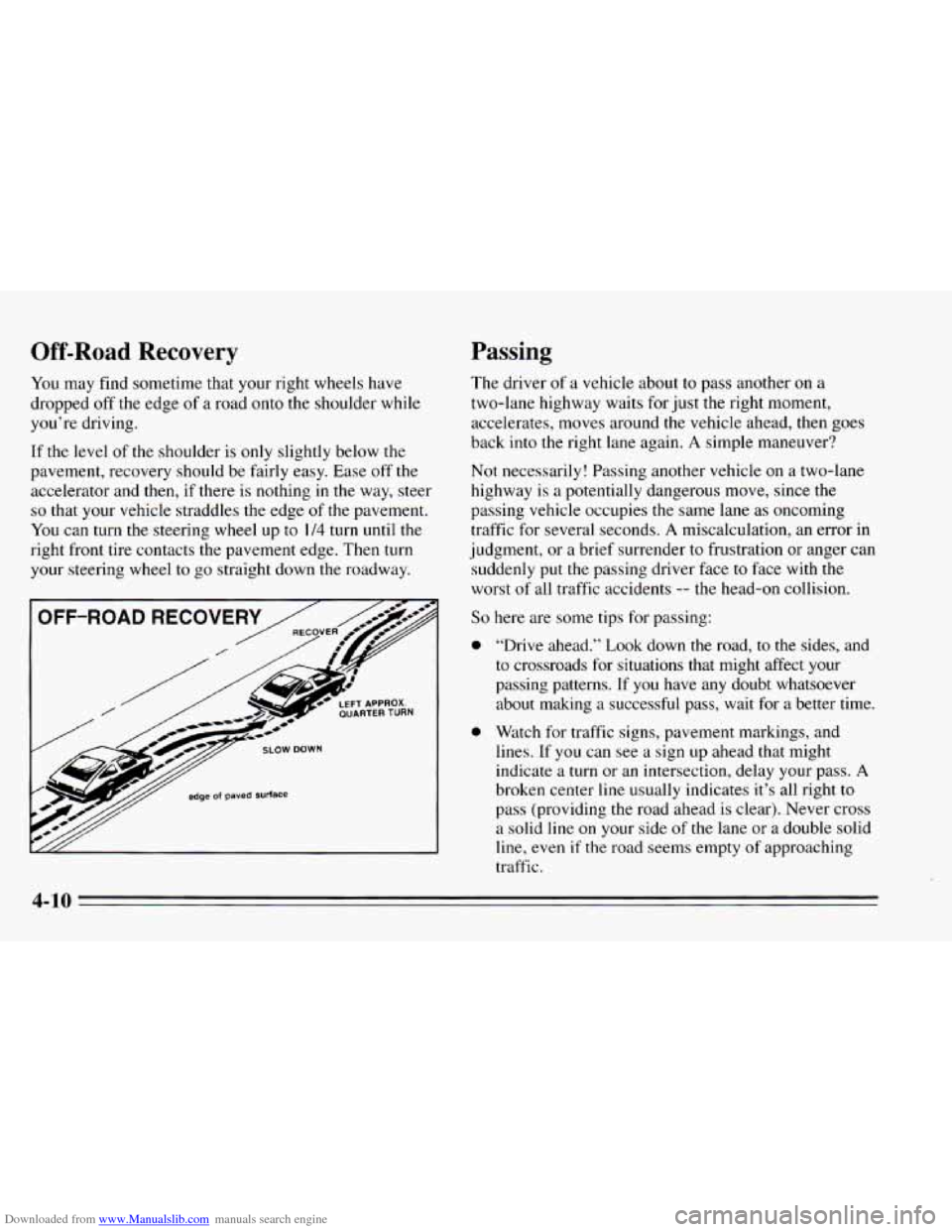
If the level of the shoulder
is only slightly below the
pavement, recovery should be fairly easy. Ease off
the
accelerator and then, if there is nothing in the way, steer
so that your vehicle straddles the edge of the pavement.
You can turn the steering
wheel up to 1/4 turn until the
right front tire contacts the pavement edge. Then turn
your steering wheel to go straight down the roadway.
I
SLOW DOWN
edge of paved surface
.- LEFT QUARTEH lunm
The driver of a vehicle about to pass another on a
two-lane highway waits for just the right moment,
accelerates, moves around
the vehicle ahead, then goes
back
into the right lane again. A simple maneuver?
Not necessarily! Passing another vehicle on a two-lane
highway
is a potentially dangerous move, since the
passing vehicle occupies the same lane as oncoming
traffic for several seconds,
A miscalculation, an error in
judgment, or a brief surrender
to frustration or anger can
suddenly
put the passing driver face to face with the
worst
of all traffic accidents -- the head-on collision.
So here are some tips for passing:
0 “Drive ahead.” Look down the road, to the sides, and
to crossroads for situations that might affect your
passing patterns. If
you have any doubt whatsoever
about making a successful pass, wait for a better time.
0 Watch for traffic signs, pavement markings, and
lines. If you can see a sign up ahead that might
indicate
a turn or an intersection, delay your pass. A
broken center line usually indicates it’s all right to
pass (providing
the road ahead is clear). Never cross
a solid line
on your side of the lane or a double solid
line, even
if the road seems empty of approaching
traffic.
4-10