1995 CHEVROLET CAVALIER steering wheel
[x] Cancel search: steering wheelPage 184 of 340
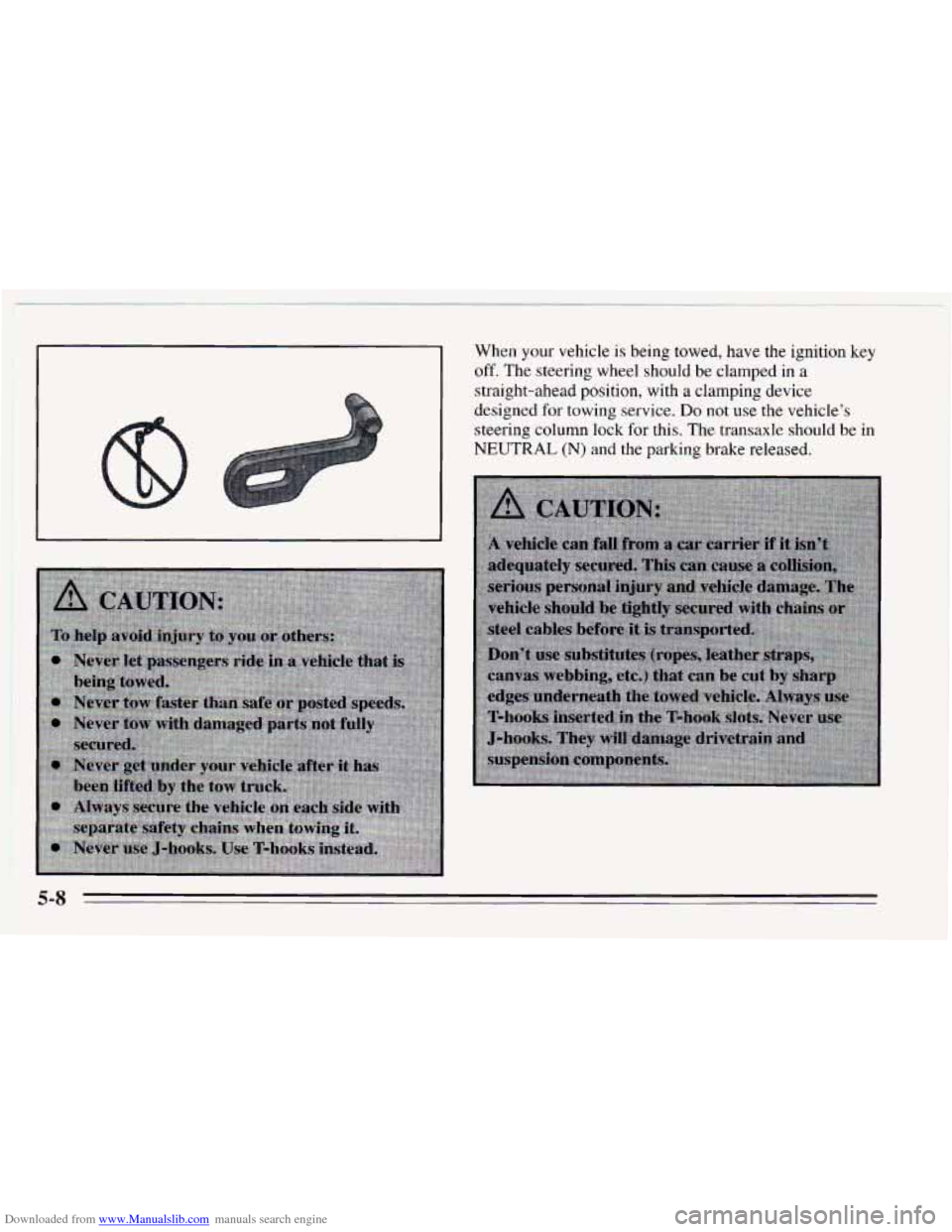
Downloaded from www.Manualslib.com manuals search engine When your vehicle is being towed, have the ignition key
off, The steering wheel should be clamped in a
straight-ahead position, with a clamping device
designed for towing service.
Do not use the vehicle’s
steering column lock
for this. The transaxle should be in
NEUTRAL (N) and the
parking brake released.
5-8
Page 196 of 340
Downloaded from www.Manualslib.com manuals search engine If a Tire Goes Flat
It’s unusual for a tire to “blow out” while you’re driving,
especially if
you maintain your tires properly. If air goes
out of a tire, it’s much more likely
to leak out slowly.
But if you should ever have a “blowout,” here are a few
tips about what to expect and what to do:
If a front tire fails, the flat tire will create a drag that
pulls the vehicle toward that side. Take your foot off the
accelerator pedal and grip the steering wheel firmly.
Steer to maintain lane position, then gently brake to a
stop well out
of the traffic lane.
A rear blowout, particularly on a curve, acts much like a
skid and
may require the same correction you’d use in a
skid. In any rear blowout, remove your foot from the
accelerator pedal. Get the vehicle under control by
steering the way you want the vehicle to
go. It may be
very bumpy and noisy, but you can still steer. Gently
brake to
a stop, well off the road if possible.
If a tire goes flat, the next part shows how to use your
jacking equipment
to change a flat tire safely.
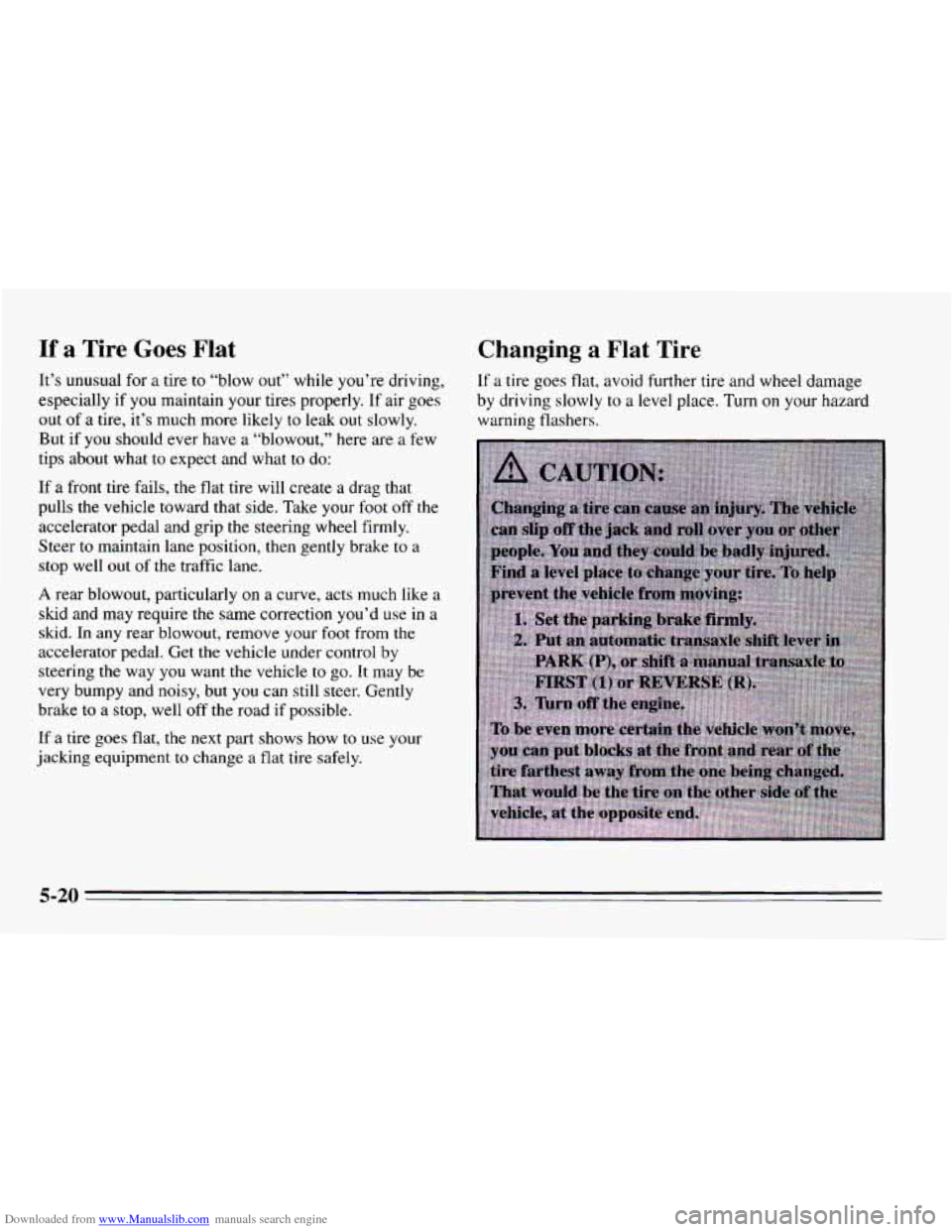
Changing a Flat Tire
If a tire goes flat, avoid further tire and wheel damage
by driving slowly
to a level place. Turn on your hazard
warning flashers.
5-20
Page 204 of 340
Downloaded from www.Manualslib.com manuals search engine If You’re Stuck: In Sand, Mud, Ice or
Snow
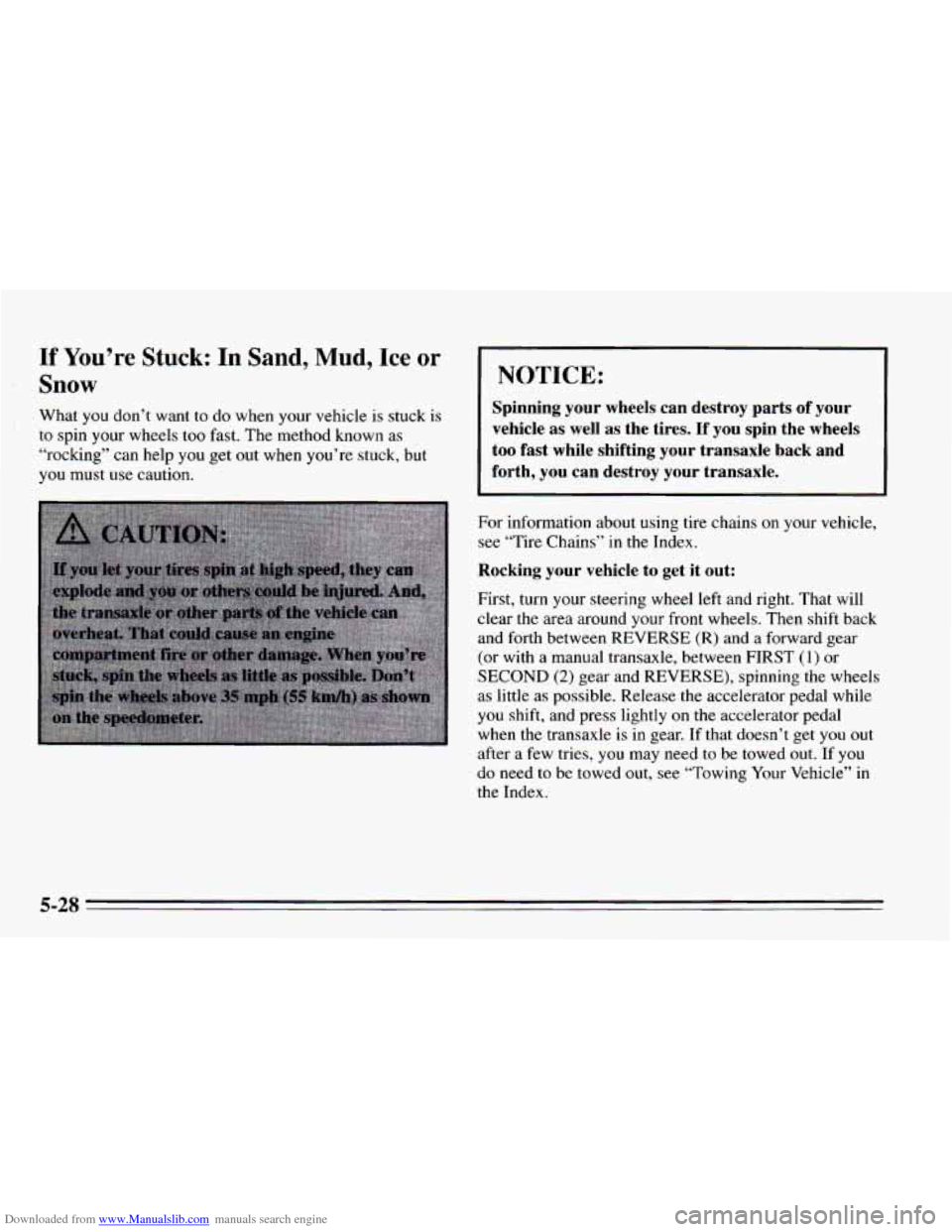
What you don’t want to do when your vehicle is stuck is
to spin your wheels too fast. The method known as
“rocking” can help you get out when you’re stuck, but
you must use caution.
I NOTICE:
Spinning your wheels can destroy parts of your
vehicle as well as the tires.
If you spin the wheels
too fast while shifting your transaxle back and
forth, you can destroy your transaxle.
For information about using tire chains on your vehicle,
see “Tire Chains”
in the Index.
Rocking your vehicle to get it out:
First, turn your steering wheel left and right. That will
clear the area around your front wheels. Then shift back
and forth between REVERSE (R) and a forward gear
(or with a manual transaxle, between FIRST
(1) or
SECOND (2) gear and REVERSE), spinning the wheels
as little as possible. Release the accelerator pedal while
you shift, and press lightly on the accelerator pedal
when the transaxle is in gear. If that doesn’t get
you out
after a few tries, you may need to be towed out. If you
do need to be towed out, see “Towing Your Vehicle” in
the Index.
5-28
Page 259 of 340
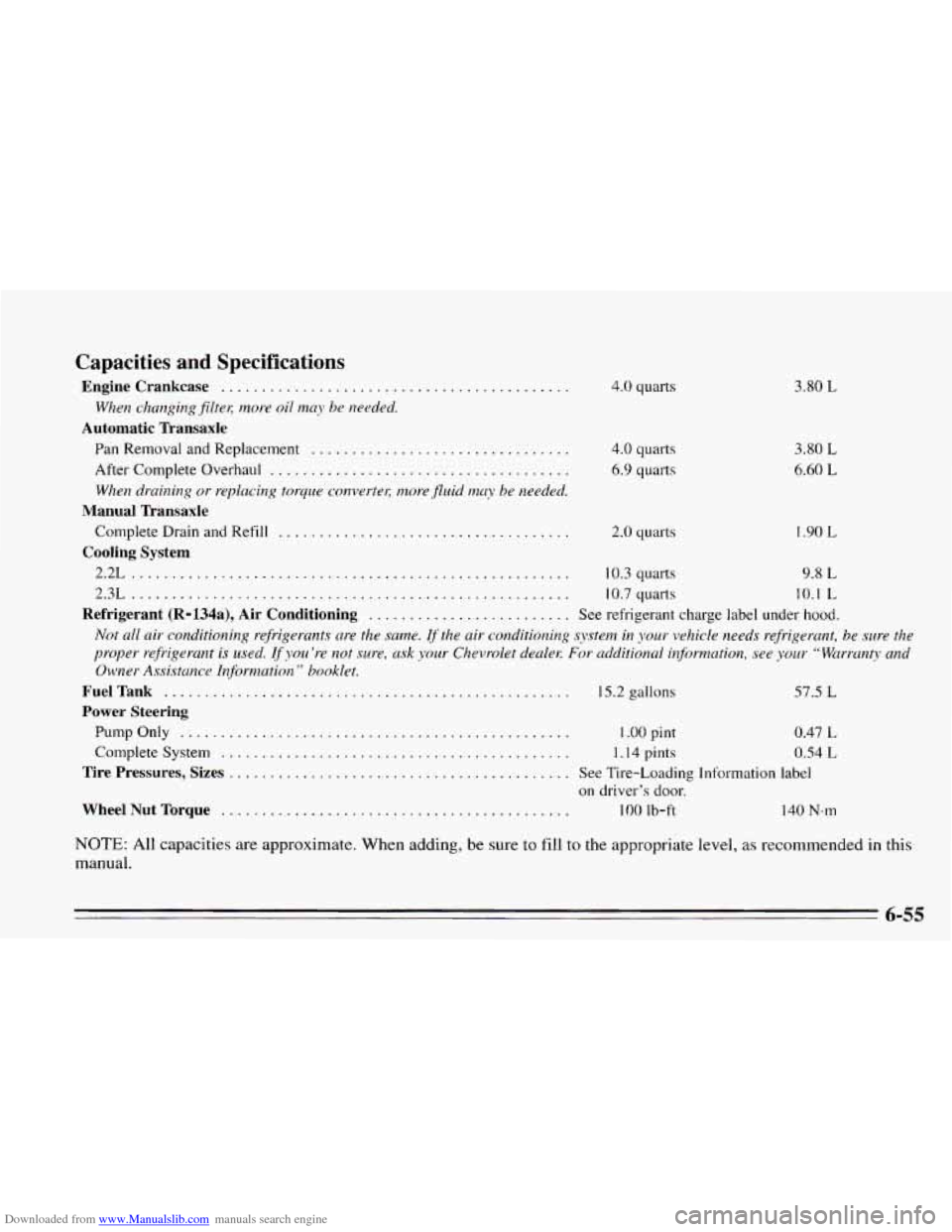
Downloaded from www.Manualslib.com manuals search engine 4.0 quarts 3.80 L
Capacities and Specifications
Enginecrankcase ...........................................
Automatic Transaxle
When chcwging$lte& more oil! rnuy be needed.
Pan Removal and Replacement ................................
When draining or replacing torque convertec 1nore.fluid may be needed.
Complete Drain and Refill ....................................
After Complete Overhaul .....................................
Manual Transaxle
Cooling System
2.2L ...................................................... 10.3 quarts 9.8 L
2.3L
...................................................... 10.7 quarts 10.1 L
Refrigerant (R-l34a), Air Conditioning ......................... See refrigerant charge label under hood.
Not all air conditioning refrigerants are the same. If the air conditioning system in your vehicle needs refrigerant, he sure the
proper refrigerant is used. IJ’you ’re not sure, ask your Chevrolet dealer:
For additionul information, see your “Warrunty and
Owner Assistunce Infixmution, ” booklet.
FuelTank ...............................................
Power Steering
PumpOnly ................................................ 1 .OO pint 0.47 L
Complete System ........................................... 1.14 pints 0.54 L
Tire Pressures, Sizes
.......................................... See Tire-Loading Information label
on driver’s door.
WheelNutTorque ........................................... 100 Ib-ft
4.0 quarts
6.9 quarts
2.0 quarts
15.2 gallons
3.80 L
6.60 L
I .90 L
57.5 L
140 N.m
NOTE: All capacities are approximate. When adding, be sure to fill to the appropriate level, as reconmended in this
manual.
6-55
Page 302 of 340
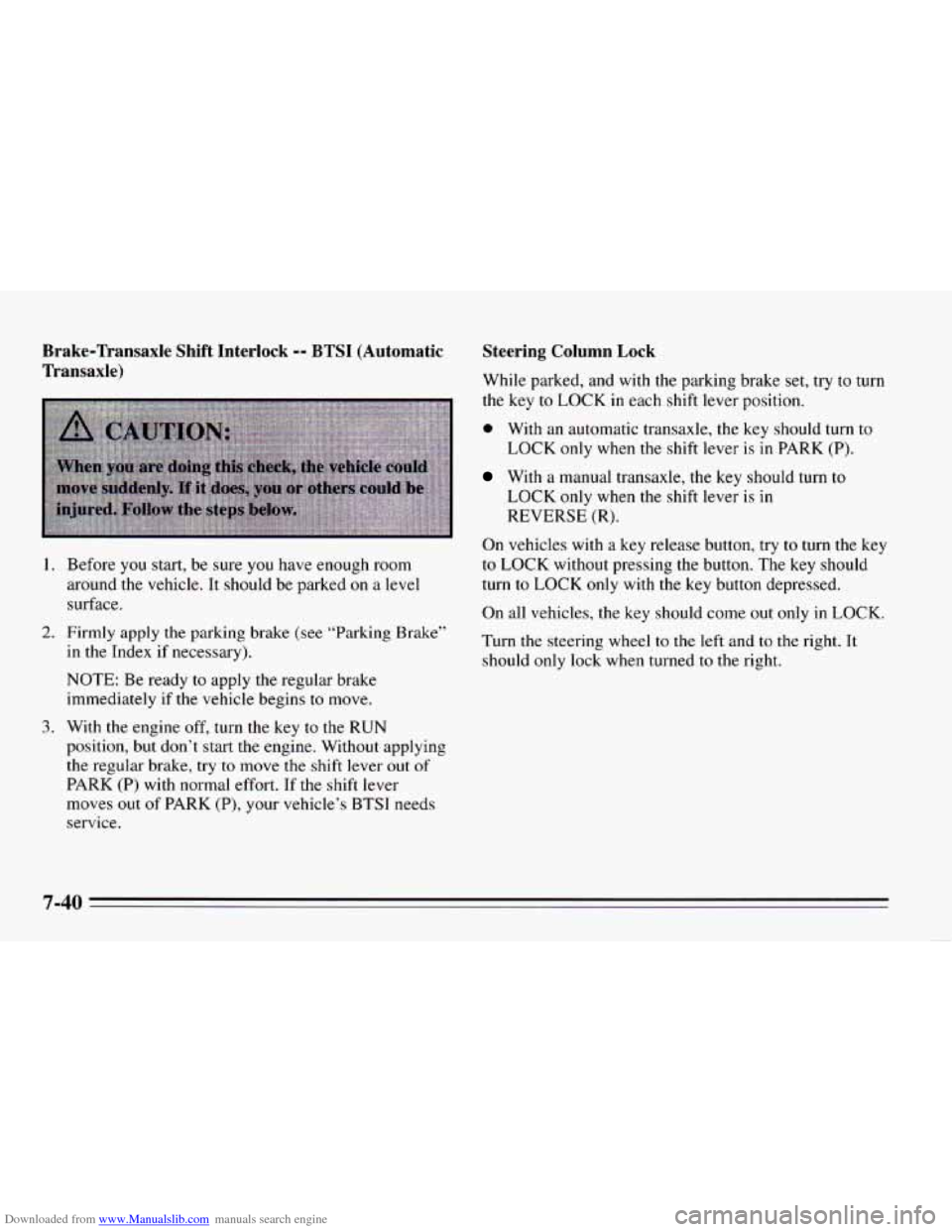
Downloaded from www.Manualslib.com manuals search engine Brake-Transaxle Shift Interlock -- BTSI (Automatic
Transaxle)
1.
2.
3.
Before you start, be sure you have enough room
around the vehicle. It should be parked
on a level
surface.
Firmly apply the parking brake (see “Parking Brake”
in the Index
if necessary).
NOTE: Be ready to apply the regular brake
immediately
if the vehicle begins to move.
With the engine off, turn the key to the RUN
position, but don’t start the engine. Without applying
the regular brake, try
to move the shift lever out of
PARK (P) with normal effort, If the shift lever
moves
out of PARK (P), your vehicle’s BTSI needs
service.
Steering Column Lock
While parked, and with the parking brake set, try to turn
the key to
LOCK in each shift lever position.
0 With an automatic transaxle, the key should turn to
LOCK only when the shift lever
is in PARK (P).
With a manual transaxle, the key should turn to
LOCK only when the shift lever is in
REVERSE
(R).
On vehicles with a key release button, try to turn the key
to LOCK without pressing the button. The key should
turn to
LOCK only with the key button depressed.
On all vehicles, the
key should come out only in LOCK.
Turn the steering wheel to
the left and to the right. It
should only lock when turned
to the right.
7-40
Page 304 of 340
Downloaded from www.Manualslib.com manuals search engine Part C: Periodic Maintenance
Inspections
Listed below are inspections and services which should
be performed at least twice a year (for instance, each
spring and fall). You should let your
GM dealer’s
service department or other qualified service center do
these
jobs. Make sure any necessary repairs are
completed at once.
Restraint Systems
Now and then, make sure all your belts, buckles, latch
plates, retractors, anchorages and reminder systems are
working properly. Look for any loose parts or damage.
If you see anything that might keep a restraint system
from doing its job, have it repaired.
Steering, Suspension and Front-Wheel-Drive
Axle Boot and Seal Inspection
Inspect the front and rear suspension and steering
system for damaged, loose or missing parts, signs
of
wear, or lack of lubrication. Inspect the power steering
lines and hoses for proper hookup, binding, leaks,
cracks, chafing, etc. Clean and then inspect the drive
axle boot seals for damage, tears or leakage. Replace
seals if necessary.
Exhaust System Inspection
Inspect the complete exhaust system. Inspect the body near
the exhaust system.
Look for broken, damaged, missing or
out-of-position
parts as well as open seams, holes, loose
connections, or other conditions which could cause a heat
build-up in the floor pan or could let exhaust fumes into
the vehicle. See “Engine Exhaust”
in the Index.
Throttle Linkage Inspection
Inspect the throttle linkage for interference or binding, and f\
or
damaged or missing parts. Replace parts
as needed.
Accelerator and cruise control cables should not
be lubricated.
Manual Transaxle
Check the transaxle fluid level; add if needed. See
“Manual Transaxle” in the Index.
A fluid loss may
indicate a problem. Check the system and repair
if needed.
Brake System Inspection
Inspect the complete system. Inspect brake lines and
hoses for proper hookup, binding, leaks, cracks, chafing,
etc. Inspect disc brake pads for wear and rotors for
surface condition.
Also inspect drum brake linings for
wear and cracks. Inspect other brake parts, including
drums, wheel cylinders, calipers, parking brake, etc.
Check parking brake adjustment.
You may need to have
your brakes inspected more often if your driving habits
or conditions result in frequent braking.
7-42
~
Page 327 of 340
Downloaded from www.Manualslib.com manuals search engine 0 Section 9 Index
Adding Automatic Transaxle Fluid
................ 6- 18. 6- 19
BrakeFluid ................................. 6-27
Electrical Equipment
.......... 2-1 1 , 2- 12, 3- 12, 6-5 1
Engine Coolant ......................... 5- 16, 6-22
Engineoil
.................................. 6-11
Hydraulic Clutch Fluid ........................ 6-20
Manual Transaxle Fluid
....................... 6- 19
Power Steering Fluid ......................... 6-24
SoundEquipment
............................ 3-12
Windshield Washer Fluid
................. 2-32, 6-25
AirBag
....................................... 1-18
How Does
it Restrain ......................... 1-22
Howitworks
............................... 1-20
Location
................................... 1-20
Servicing
................................... 1-24
What Makes
it Inflate ......................... 1-22
What Will You See After it inflates .............. 1-22
When Should
it Inflate ........................ 1-2 1
Air Bag Readiness Light .................... 1-20, 2-61
Aircleaner
.................................... 6-15
Air Conditioning ................................ 3-2
Air Conditioning Compressor Button
................ 3-2
Alignment and Balance, Tires
..................... 6-39
Aluminum Wheels, Cleaning ...................... 6-48
Antenna. Fixed Mast ............................ 3-14
Anti-Lock Brake System Warning Light
......... 2.63. 4.6
Anti-Lock Brakes
............................... 4-6
Anti-Theft Feature.
CD Player .................... 3-10
Antifreeze ..................................... 6-21
Adding
............................... 5.16. 6.22
Checking
................................... 6-23
Appearance Care
............................... 6-42
Appearance Care and Materials
.................... 6-50
Ashtray and Lighter ............................. 2-44
Audiosystems
.................................. 3-5
Auto Down Feature
............................. 2-27
Automatic Transaxle.
Four Speed
Automatic Overdrive
......................... 2-17
First(1)
.................................... 2-18
Neutral
(N) ................................. 2-15
Park(P) .................................... 2-14
Reverse(R)
................................. 2-15
Second(2)
.................................. 2-16
Shifting
.................................... 2-14
Third (3)
................................... 2-17
Drive(D)
................................... 2-16
First(1)
.................................... 2-16
Neutral (N)
................................. 2-15
Automatic Transaxle. Three Speed
9-1
Page 335 of 340
Downloaded from www.Manualslib.com manuals search engine SafetyChains .................................. 4-33
Safety Defects Reporting to General Motors
.................... 8-5
Reporting to the Canadian Government
............ 8-5
Reporting to the United States Government ........ 8-4
Safety Warnings and Symbols
....................... vi
Scheduled Maintenance Services .................... 7-3
Seats .......................................... 1-1
Driver’s Seat Manual Lumbar Support ............. 1-2
Easy Entry
................................... 1-4
Fold-Down Rear
.............................. 1-5
ManualFrontSeat ............................. 1-1
Securing a Child Restraint ..................... 1-32
Seats and Restraint Systems
........................ 1 - I
Seats and Seat Controls ........................... 1 - 1
Second (2). 3 Speed
Automatic Transaxle
........................... 2- 16
Second (2), 4 Speed
Automatic Transaxle
........................... 2- 17
Second Gear. Manual Transaxle ................... 2- 19
Service
........................................ 6-1
Service and Appearance Care
...................... 6- 1
Service and Owner Publications .................... 8-8
Service Bulletins, Ordering
........................ 8-8
Service Manuals, Ordering ........................ 8-8
Service Parts Identification Label
.................. 6-5 1
Service Publications .............................. 8-8
Service Work, Doing Your Own .................... 6-1
Servicing Your Air Bag-Equipped Chevrolet
......... 1-24
Sheet Metal Damage
............................ 6-48
Shift Light. Manual Transaxle
................ 2-20. 2-68 Shift Speeds. Manual Transaxle
.................... 2-20
Shifting Into Park (P)
............................ 2-22
Shifting. Automatic Transaxle
.....................
Skidding ...................................... 4-12
Sound Equipment. Adding
........................ 3-12
Spare Tire. Compact
............................. 5-27
Specifications Chart
............................. 6-57
Speedometer ................................... 2-59
Starter Switch
.................................. 7-39
Starting Your Engine
............................ 2-10
2.2 Liter
.................................... 2-10
2.3Liter
.................................... 2-11
Steam.
If Coming From Your Engine ............... 5-12
Steering
....................................... 4-8
In Emergencies
............................... 4-9
Power
...................................... 4-8
Tips
........................................ 4-8
Steering Column Lock
........................... 7-40
Steering Wheel. Tilt
............................. 2-28
Storage. Of Your Vehicle ......................... 6-29
Stuck. If You Are ............................... 5-28
Sunvisors .................................... 2-44
Sunroof
....................................... 2-46
Supplemental Restraint System
(SRS) ............... 1-18
Surge Tank Pressure Cap ......................... 6-23
Symbols. Vehicle
................................ vm
Shifting Out of Park (P) .......................... 2-24
Shoulder Belt Height Adjuster
..................... 1 . 13
Stains. Cleaning ................................ 6-44
...
9-9