1995 CHEVROLET CAVALIER brake light
[x] Cancel search: brake lightPage 146 of 340
Downloaded from www.Manualslib.com manuals search engine Avoid needless heavy braking. Some people drive in
spurts
-- heavy acceleration followed by heavy braking
-- rather than keeping pace with traffic. This is a
mistake. Your brakes may not have time to cool between
hard stops. Your brakes will wear out much faster
if you
do a lot of heavy braking. If you keep pace with the
traffic and allow realistic following distances, you will
eliminate a lot
of unnecessary braking. That means
better braking and longer brake life.
If your engine ever stops while you’re driving, brake
normally but don’t pump
your brakes. If you do, the
pedal may get harder to push down. If your engine
stops,
you will still have some power brake assist. But
you will
use it when you brake. Once the power assist is
used up, it may take longer to stop and the brake pedal
will be harder to push.
Anti-Lock Brakes (ABS)
Your Chevrolet has an advanced electronic braking
system that will help prevent
a braking skid.
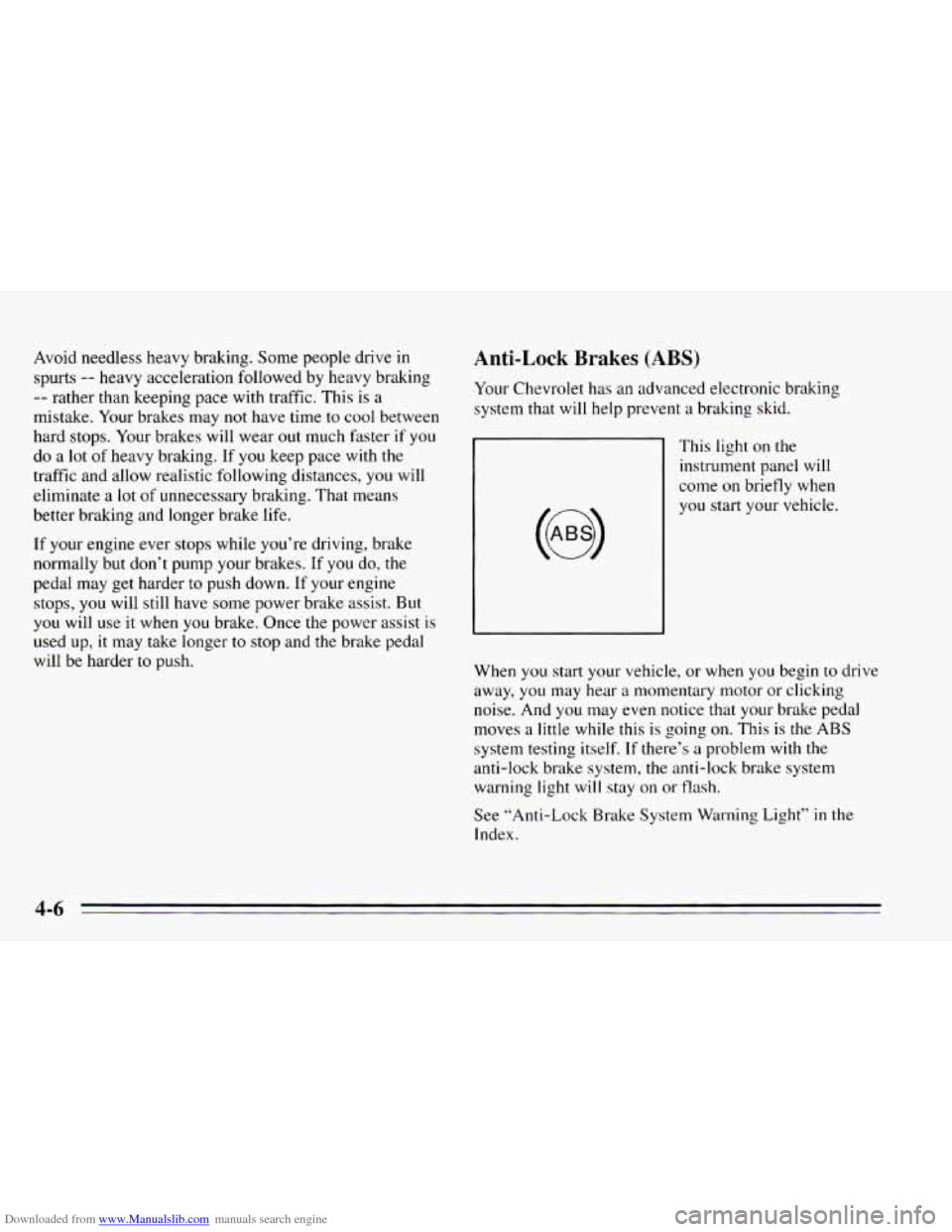
This light on
the
instrument panel will
come on briefly when
you start your vehicle.
When you start
your vehicle, or when you begin to drive
away,
you may hear a momentary motor or clicking
noise. And you may even notice that
your brake pedal
moves
a little while this is going on. This is the ABS
system testing itself. If there’s a problem with the
anti-lock brake system,
the anti-lock brake system
warning light will stay
on or flash.
See “Anti-Lock Brake System Warning Light” in the
Index.
Page 179 of 340
Downloaded from www.Manualslib.com manuals search engine To Jump Start Your Chevrolet
1. Check the other vehicle. It must have a 12-volt
battery with
a negative ground system.
3. Turn off the ignition on both vehicles. Turn off all
lights that aren’t needed, and radios. This will avoid
sparks and help save both batteries. And it could
save your radio!
NOTICE:
If the other system isn’t a 12-volt system with a
negative ground, both vehicles can be damaged.
2. Get the vehicles close enough so the jumper cables
can reach, but be sure the vehicles aren’t touching
each other.
If they are, it could cause a ground
connection you don’t want. You wouldn’t be able to
start your Chevrolet, and the bad grounding could
damage the electrical systems.
You could be injured if the vehicles roll. Set the
parking
brake firmly on each vehicle. Put an
automatic transaxle in PARK (P) or a manual
transaxle
in NEUTRAL (N).
NOTICE:
If you leave your radio on, it could be badly
damaged. The repairs wouldn’t be covered by
your warranty.
4. Open the hoods and locate the batteries.
5-3
Page 230 of 340
Downloaded from www.Manualslib.com manuals search engine Brakes
Brake Master Cylinder
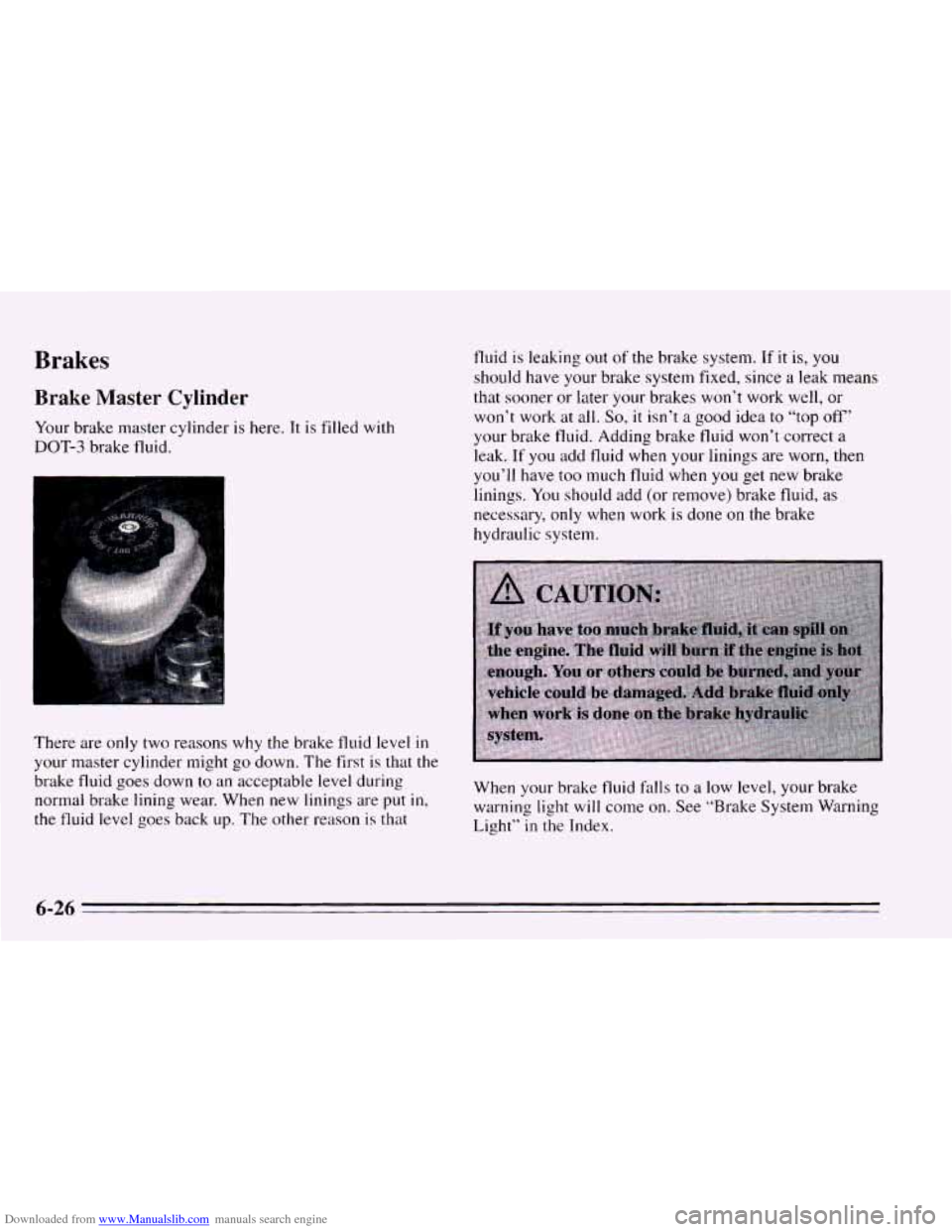
Your brake master cylinder is here. It is filled with
DOT-3 brake fluid.
There are only two reasons why the brake
fluid level in
your master cylinder might go down. The first is that the
brake fluid goes down to an acceptable level during
normal brake lining wear. When new linings are put
in,
the fluid level goes back up. The other reason is that fluid
is leaking out
of the brake system. If it is, you
should have your brake system fixed, since a leak means
that sooner or later your brakes won’t work well, or
won’t work
at all. So, it isn’t a good idea to “top off’
your brake fluid. Adding brake fluid won’t correct
a
leak. If you add fluid when your linings are worn, then
you’ll have too much fluid when you get new brake
linings.
You should add (or remove) brake fluid, as
necessary, only when work is done on the brake
hydraulic system.
When your brake fluid falls to a low level, your brake
warning light will come on. See “Brake System Warning
Light”
in the Index,
6-26
Page 232 of 340
Downloaded from www.Manualslib.com manuals search engine Some driving conditions or climates may cause a brake
squeal when the brakes are first applied or lightly
applied. This does not mean something is wrong with
your brakes.
Your rear drum brakes don’t have wear indicators, but if
you ever hear a rear brake rubbing noise, have the rear
brake linings inspected. Also, the rear brake drums
should be removed and inspected each time the tires are
removed for rotation or changing. When
you have the
front brakes replaced, have the rear brakes inspected, too.
Brake linings should always be replaced as complete
axle sets.
Brake Pedal Travel
See your dealer if the brake pedal does not return to
normal height, or if there is a rapid increase in pedal
travel. This could be a sign of brake trouble.
Brake Adjustment
Every time you make a moderate brake stop, your disc
brakes adjust for wear.
If you rarely make a moderate or
heavier stop, then your brakes might not adjust correctly.
If you drive in that way, then -- very carefully -- make
a few moderate brake stops about every
1,000 miles
(1 600 km), so your brakes will adjust properly. If
your brake pedal goes down farther than normal, your
rear drum brakes may need adjustment. Adjust them
by
backing up and firmly applying the brakes a few times.
Replacing Brake System Parts
The braking system on a modern vehicle is complex. Its
many parts have
to be of top quality and work well
together if the vehicle is to have really good braking.
Vehicles we design and test have top-quality
GM brake
parts in them, as your Chevrolet does when it
is new.
When
you replace parts of your braking system -- for
example, when your brake linings wear down and you
have to have new ones put in
-- be sure you get new
genuine
GM replacement parts. If you don’t, your
brakes may no longer work properly. For example,
if
someone puts in brake linings that are wrong for your
vehicle, the balance between your front and rear brakes
can change
-- for the worse. The braking performance
you’ve come
to expect can change in many other ways if
someone puts in the wrong replacement brake parts.
6-28
Page 257 of 340
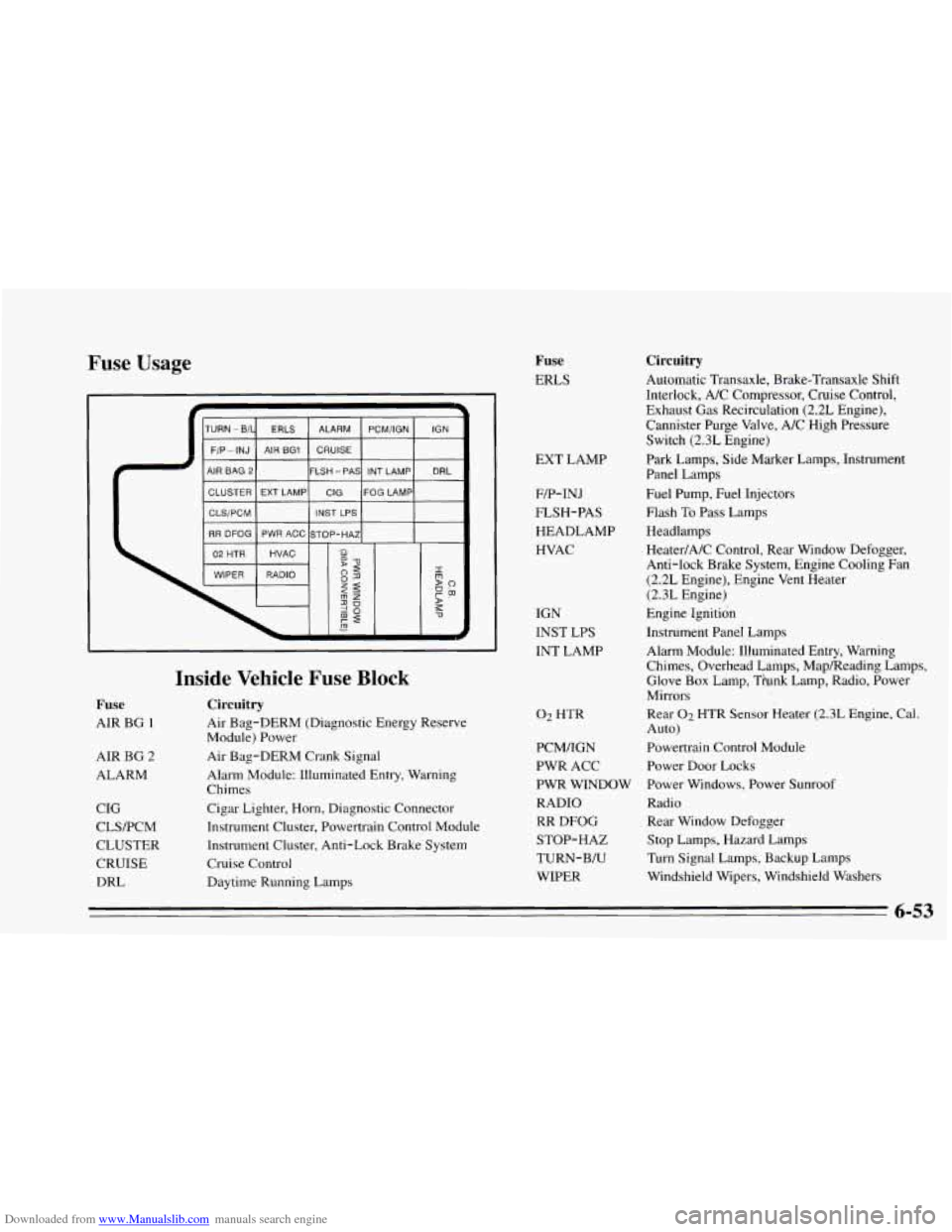
Downloaded from www.Manualslib.com manuals search engine Fuse Usage
S ALARM PCM/IGN IGN
Fuse
AIR BG 1
AIR BG 2
ALARM
CIG
CLSPCM
CLUSTER
CRUISE DRL
Inside Vehicle Fuse Block
Circuitry
Air Bag-DERM (Diagnostic Energy Reserve
Module) Power
Air Bag-DERM Crank Signal
Alarm Module: Illuminated Entry, Warning
Chimes
Cigar Lighter, Horn, Diagnostic Connector
Instrument Cluster, Powertrain Control Module
Instrument Cluster, Anti-Lock Brake System Cruise Control
Daytime Running Lamps IGN
INST
LPS
INT LAMP
Fuse
ERLS
EXT LAMP
F/P-INJ
FLSH-PAS
HEADLAMP
HVAC
Circuitry
Automatic Transaxle, Brake-Transaxle Shift
Interlock, A/C Compressor, Cruise Control,
Exhaust Gas Recirculation (2.2L Engine),
Cannister Purge Valve, A/C High Pressure
Switch (2.3L Engine)
Park Lamps, Side Marker Lamps, Instrument
Panel Lamps
Fuel Pump, Fuel Injectors
Flash To Pass Lamps
Headlamps
Heater/A/C Control, Rear Window Defogger,
Anti-lock Brake System, Engine Cooling Fan
(2.2L Engine), Engine Vent Heater
(2.3L Engine)
Engine Ignition
Instrument PaneiLamps
Alarm Module: 11,luminated Entry, Warning
Chimes, Overhead Lamps, MapReading Lamps,
Glove Box Lamp, Thnk Lamp, Radio, Power
Mirrors
Auto)
02 HTR Rear 02 HTR Sensor keater (2.3L Engine, Cal.
PCM/IGN Powertrain Control Module
PWR ACC Power
Door Locks
PWR WINDOW Power Windows, Power Sunroof
RADIO Radio
RR DFOG Rear Window Defogger
STOP-HAZ Stop Lamps, Hazard Lamps
TURN-B/U Turn
Signal Lamps, Backup Lamps
WIPER Windshield
Wipers, Windshield Washers
6-53
Page 258 of 340
Downloaded from www.Manualslib.com manuals search engine I 1
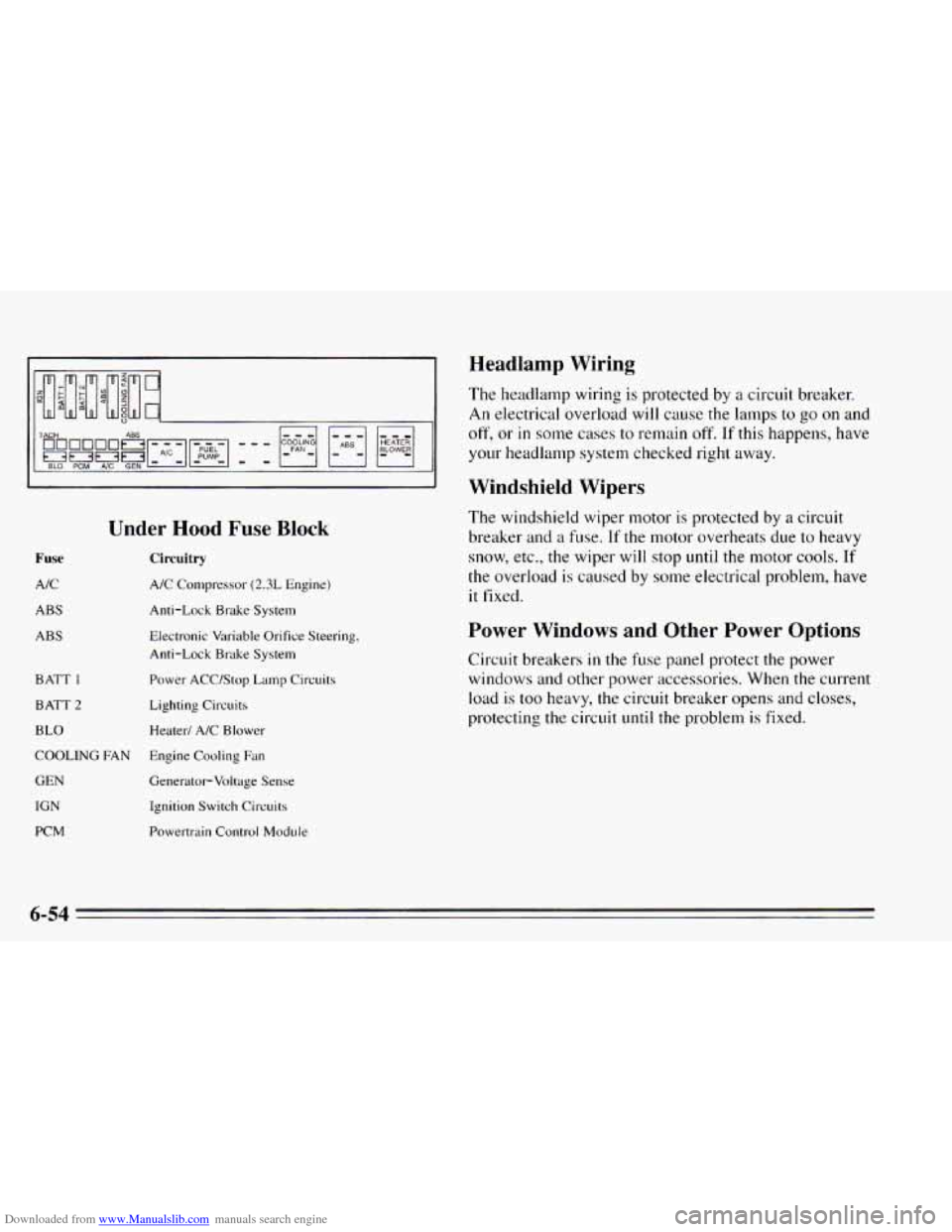
Under Hood Fuse Block
Fuse
AIC
ABS
ABS
BATT 1
BATT 2
BLO
COOLING FAN
GEN
IGN
PCM
Circuitry
A/C Compressor (2.3L Engine)
Anti-Lock Brake System
Electronic Variable Orifice Steering,
Anti-Lock Brake System
Power ACC/Stop
Lamp Circuits
Lighting Circuits
Heater/ A/C Blower
Engine Cooling Fan
Generator-Voltage Sense
Ignition Switch Circuits
Powertrain Control Module
Headlamp Wiring
The headlamp wiring is protected by a circuit breaker.
An electrical overload will cause the lamps to go on and
off, or
in some cases to remain off. If this happens, have
your headlamp system checked right away.
Windshield Wipers
The windshield wiper motor is protected by a circuit
breaker and a fuse.
If the motor overheats due to heavy
snow, etc., the wiper will stop until the motor cools. If
the overload is caused by some electrical problem, have
it fixed.
Power Windows and Other Power Options
Circuit breakers in the fuse panel protect the power
windows and other power accessories. When the current
load is too heavy, the circuit breaker
opens and closes,
protecting the circuit
until the problem is fixed.
Page 327 of 340
Downloaded from www.Manualslib.com manuals search engine 0 Section 9 Index
Adding Automatic Transaxle Fluid
................ 6- 18. 6- 19
BrakeFluid ................................. 6-27
Electrical Equipment
.......... 2-1 1 , 2- 12, 3- 12, 6-5 1
Engine Coolant ......................... 5- 16, 6-22
Engineoil
.................................. 6-11
Hydraulic Clutch Fluid ........................ 6-20
Manual Transaxle Fluid
....................... 6- 19
Power Steering Fluid ......................... 6-24
SoundEquipment
............................ 3-12
Windshield Washer Fluid
................. 2-32, 6-25
AirBag
....................................... 1-18
How Does
it Restrain ......................... 1-22
Howitworks
............................... 1-20
Location
................................... 1-20
Servicing
................................... 1-24
What Makes
it Inflate ......................... 1-22
What Will You See After it inflates .............. 1-22
When Should
it Inflate ........................ 1-2 1
Air Bag Readiness Light .................... 1-20, 2-61
Aircleaner
.................................... 6-15
Air Conditioning ................................ 3-2
Air Conditioning Compressor Button
................ 3-2
Alignment and Balance, Tires
..................... 6-39
Aluminum Wheels, Cleaning ...................... 6-48
Antenna. Fixed Mast ............................ 3-14
Anti-Lock Brake System Warning Light
......... 2.63. 4.6
Anti-Lock Brakes
............................... 4-6
Anti-Theft Feature.
CD Player .................... 3-10
Antifreeze ..................................... 6-21
Adding
............................... 5.16. 6.22
Checking
................................... 6-23
Appearance Care
............................... 6-42
Appearance Care and Materials
.................... 6-50
Ashtray and Lighter ............................. 2-44
Audiosystems
.................................. 3-5
Auto Down Feature
............................. 2-27
Automatic Transaxle.
Four Speed
Automatic Overdrive
......................... 2-17
First(1)
.................................... 2-18
Neutral
(N) ................................. 2-15
Park(P) .................................... 2-14
Reverse(R)
................................. 2-15
Second(2)
.................................. 2-16
Shifting
.................................... 2-14
Third (3)
................................... 2-17
Drive(D)
................................... 2-16
First(1)
.................................... 2-16
Neutral (N)
................................. 2-15
Automatic Transaxle. Three Speed
9-1
Page 328 of 340
Downloaded from www.Manualslib.com manuals search engine Park(P) .................................... 2-14
Reverse(R)
................................. 2-15
Second(2)
.................................. 2-16
Shifting
.................................... 2-14
Automatic Transaxle Fluid ................... 6- 16. 6- 19
Adding
............................... 6- 18. 6- 19
Checking .............................. 6.16. 6.19
Battery.
LOW Maintenance ....................... 6-29
Battery Rundown Protection
...................... 2-4 1
Battery Warnings ............................ 5.2. 5.4
BBB Auto Line
................................. 8-3
Brake Adjustment
.............................. 6-28
Brake Fluid. Adding
............................. 6-27
Brake Master Cylinder
........................... 6-26
BrakePedalTravel
.............................. 6-28
Brake System Parts. Replacing
.................... 6-28
Brake System Warning Light
...................... 2-62
Brake-Transaxle Shift Interlock
............... 2-24. 7-40
BrakeWear
.................................... 6-27
Brake. Parking
................................. 2-21
Brakes. Anti-Lock
............................... 4-6
Brakes. Trailer
................................. 4-33
Braking
........................................ 4-5
Braking
in Emergencies ........................... 4-8
BTSI (Brake-Transaxle Shift Interlock)
......... 2-24. 7-40
Bulbs, Replacement
............................. 6-56
Headlamps
................................. 6-29
Taillamps
................................... 6-31 Canadian
Roadside Assistance
.................... 8-8
Capacities and Specifications ...................... 6-55
Carbon Monoxide .................... 2.25.4.25. 4.33
Cassette Tape Player Care
........................ 3-13
CDErrors
...................................... 3-9
CD Player Anti-Theft Feature
..................... 3- IO
Center Console Compartment ..................... 2-46
Center Passenger Position
........................ 1-31
Certification/TIre Label
.......................... 4-28
Chains. Safety
................................. 4-33
Chains. Tire
................................... 6-41
Changing a Flat Tire
............................. 5-20
Charging System Light
.......................... 2-66
Check Engine Light
............................. 2-68
Check Gages Light
.............................. 2-64
CheckOilLight
................................ 2-66
Checking Automatic Transaxle Fluid
................ 6- 16. 6- 19
BrakeFluid ................................. 6-26
Enginecoolant
.............................. 6-23
Engineoil
.................................. 6-10
Hydraulic Clutch Fluid
........................ 6-20
Manual Transaxle Fluid
....................... 6-19
Power Steering Fluid
......................... 6-24
Things Under the Hood
........................ 6-6
Checking Your Restraint Systems
.................. 1-45
Chemical Paint Spotting
.......................... 6-49
Child Restraints
................................ 1-34
Securing
in a Rear Outside Seat Position .......... 1-36
Securing
in the Center Rear Seat Position ......... 1-38
Securing
in the Right Front Seat Position .......... 1-40
9-2