1995 CHEVROLET CAMARO service
[x] Cancel search: servicePage 257 of 388
Downloaded from www.Manualslib.com manuals search engine now to Add Fluid Manual Transmlssion Fluid
Refer to the Maintenance Schedule to determine what
kind of transmission fluid to use. See “Recommended
Fluids and Lubricants” in the Index.
Add fluid only after checking the transmission fluid
HOT. (A COLD check is used only as a reference.) If
the fluid level is low, add only enough of
the proper
fluid to bring the level up to the
HOT area for a hot
check. It doesn’t take much fluid, generally less than
a
pint. Don ’t over$iZZ. We recommend you use only fluid
labeled DEXRON@-111, because fluid with that label is
made especially for your automatic transmission.
Damage caused by fluid other than DEXRON@-I11 is
not covered by your new vehicle warranty.
After adding fluid, recheck the fluid level as
described under
“How to Check.”
When the correct fluid level is obtained, push the
dipstick back
in all the way.
How to Check
Because this operation can be difficult, you may choose
to have this done at your Chevrolet dealer Service
Department.
If you do
it yourself, be sure to follow all the
instructions here, or you could get a false reading.
I NOTICE:
Too much or too little fluid can damage your
transmission.
Too much can mean that some of
the fluid could come out and fall on hot engine
parts or exhaust system parts, starting
a fire. Be
sure to get an accurate reading if you check your
transmission fluid.
Check the fluid level only when your engine is off, the
vehicle is parked
on a level place and the transmission is
cool enough for you to rest your fingers on the
transmission case.
6-25
Page 258 of 388
Downloaded from www.Manualslib.com manuals search engine Then, follow these steps:
1. Remove the filler plug.
2. Check that the lubricant level is up to the bottom of
the filler plug hole.
3. If the fluid level is good, install the plug and be sure
it is fully seated.
If the fluid level is low, add more
fluid as described in the next steps.
How to Add Fluid
Here’s how to add fluid. Refer to the Maintenance
Schedule to determine what kind of fluid to use. See
“Recommended Fluids and Lubricants”
in the Index.
1. Remove the filler plug.
2. Add fluid at the filler plug hole. Add only enough
fluid
to bring the fluid level up to the bottom of the
filler plug hole.
3. Install the filler plug. Be sure the plug is fully seated.
Hydraulic Clutch
The hydraulic clutch linkage In your vehicle is
self-adjusting. The clutch master cylinder reservoir is
filled with hydraulic clutch fluid.
It isn’t a good idea
to “top off’ your clutch fluid. Adding
fluid won’t correct a leak. A fluid
loss in this
system could indicate a problem.
Have the system inspected and repaired.
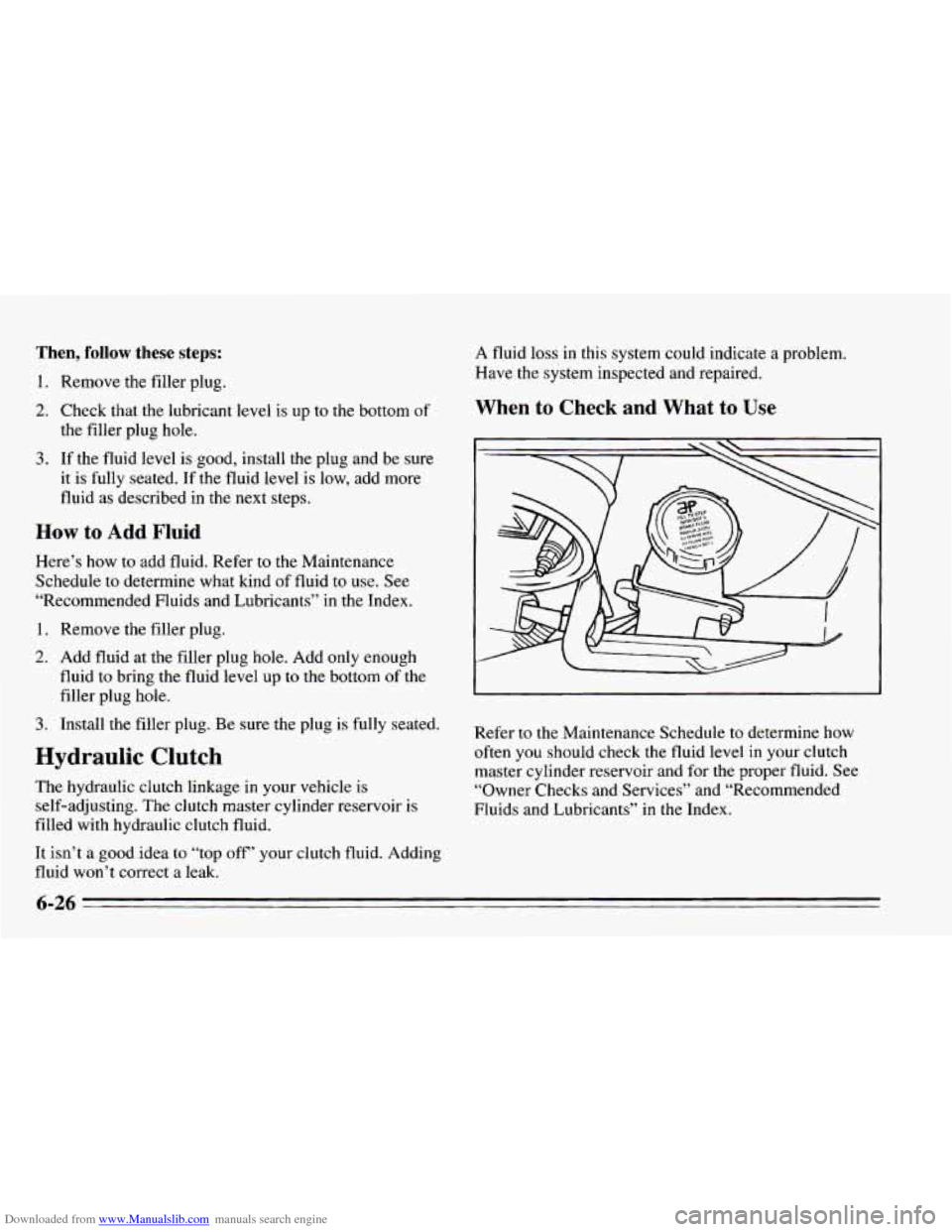
When to Check and What to Use
Refer to the Maintenance Schedule to determine how
often
you should check the fluid level in your clutch
master cylinder reservoir
and for the proper fluid. See
“Owner Checks and Services” and “Recommended
Fluids and Lubricants” in the Index.
6-26
Page 283 of 388
Downloaded from www.Manualslib.com manuals search engine When to Check
Check your tires once a month or more.
Don’t forget your compact spare tire. It should be at
60 psi (420 kPa).
DW to Check
use a good quality pocket-type gage to check tire
pressure. Simply looking at the tires will not tell you the
pressure, especially if you have radial tires
-- which
may look properly inflated even if they’re underinflated.
If your tires have valve caps, be sure to put them back
on. They help prevent leaks by keeping out dirt and
moisture.
Tire Inspection and Rotation
Tires should be inspected every 6,000 to 8,000 miles
(1 0 000 to 13 000 km) for any signs of unusual wear.
If unusual wear is present, rotate your tires as soon as
possible and check wheel alignment. Also check for
damaged tires or wheels. See “When it’s Time
for New Tires”
and “Wheel Replacement” later
in this section for
more information.
The purpose
of regular rotation is to achieve more
uniform wear for all tires on the vehicle. The first
rotation
is the most important. See “Scheduled
Maintenance Services”
in the Index for scheduled
rotation intervals.
-7 [*
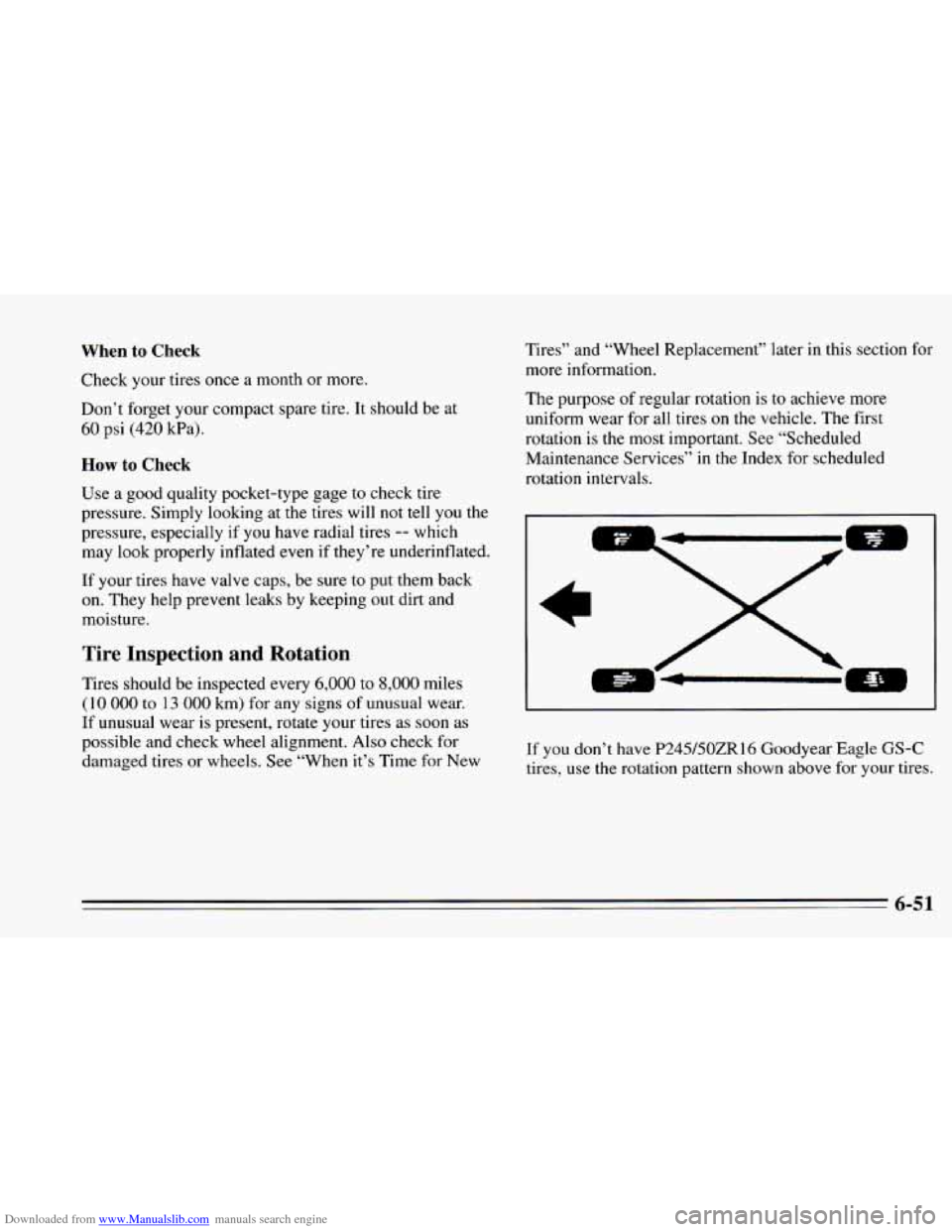
If you don’t have P245/5OZR16 Goodyear Eagle GS-C
ires, use the rotation pattern shown above for your tires.
6-51
Page 285 of 388
Downloaded from www.Manualslib.com manuals search engine When it’s Time for New Tires
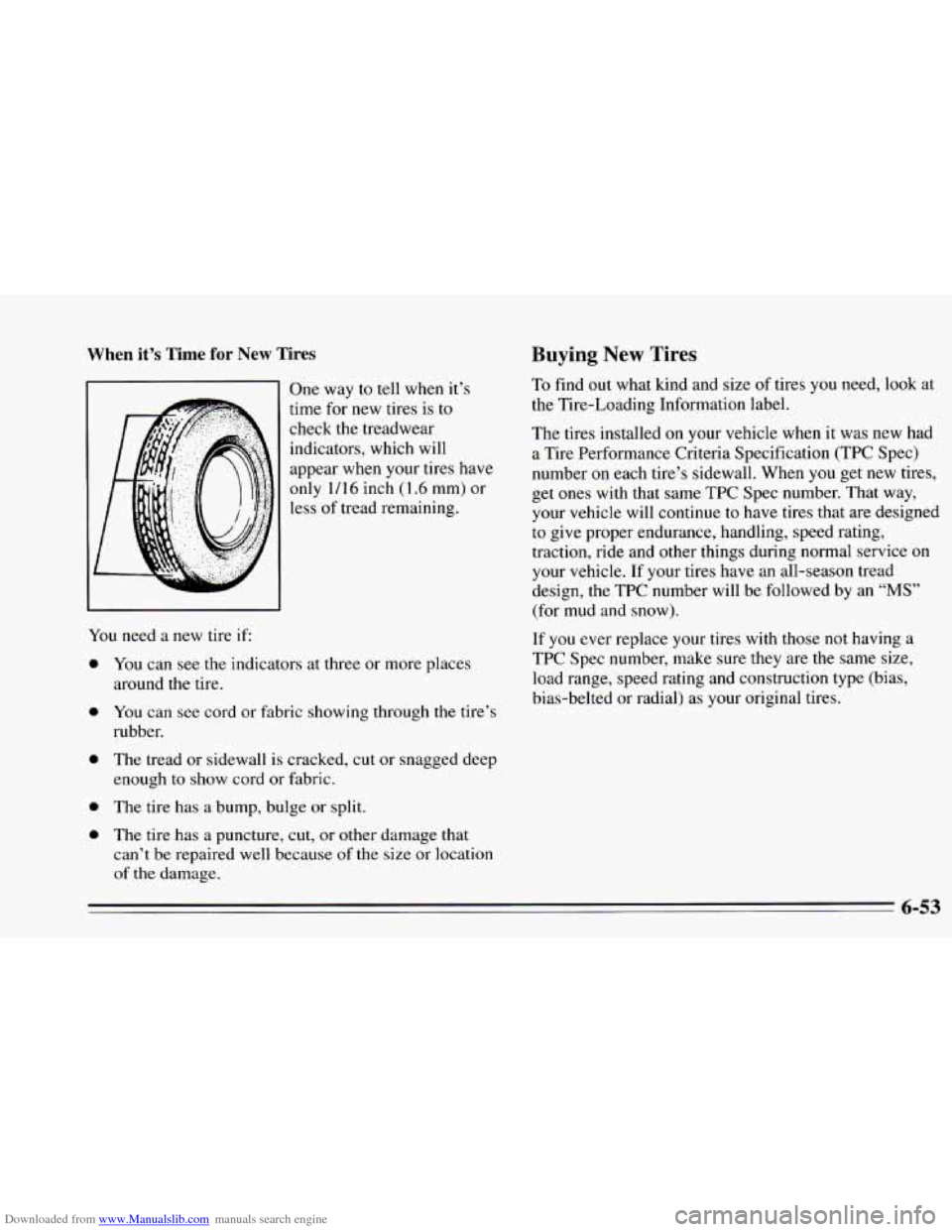
One way to tell when it’s
time for new tires is
to
check the treadwear
indicators, which will
appear when your tires have
only 1/16 inch (1.6 mm) or
less of tread remaining.
You need a new tire
if
a
a
a
e
a
You can see the indicators at three or more places
around the tire.
You can see cord or fabric showing through the tire’s
rubber.
The tread or sidewall is cracked, cut or snagged deep
enough to show cord or fabric.
The tire has a bump, bulge or split.
The tire has
a puncture, cut, or other damage that
can’t be repaired
well because of the size or location
of
the damage.
Buying New Tires
To find out what kind and size of tires you need, look at
the Tire-Loading Information label.
The tires installed
on your vehicle when it was new had
a Tire Performance Criteria Speci€ication (TPC Spec)
number on each tire’s sidewall. When
you get new tires,
get ones with that same TPC Spec number. That way,
your vehicle will continue to have tires that are designed
to give proper endurance, handling, speed rating,
traction, ride and other things during normal service on
your vehicle.
If your tires have an all-season tread
design, the TPC number will be followed by an
“MS”
(for mud and snow).
If you ever replace your tires with those not having a
TPC Spec number, make sure they are the same size,
load range, speed rating
and construction type (bias,
bias-belted or radial) as your original tires.
6-53
Page 286 of 388
Downloaded from www.Manualslib.com manuals search engine Uniform Tire Quality Grading
I The following information relates to the system
I developed by the United States National Highway
i Traffic Safety Administration which grades tires by
~ treadwear, traction and temperature performance. (This
applies only to vehicles sold in the United States.)
Treadwear
The treadwear grade is a comparative rating based on
the wear rate
of the tire when tested under controlled
conditions on a specified government test course. For
example, a tire graded 150 would wear one and a half
(1 1/2) times as well on the government course as a tire
graded
100. The relative performance of tires depends
upon the actual conditions of their use, however, and
may depart significantly from the norm due to variations
in driving habits, service practices and differences in
road characteristics and climate.
Traction - A, B, C
The traction grades, from highest to lowest are: A, B,
and C. They represent the tire’s ability to stop on wet
pavement as measured under controlled conditions
on
specified government test surfaces of asphalt and
concrete. A tire marked
C may have poor traction
performance.
Warning: The traction grade assigned to this tire is based
on braking (straight-ahead) traction tests and does not
include cornering (turning) traction.
6-54
Page 297 of 388
Downloaded from www.Manualslib.com manuals search engine Sheet Metal Damage
If your vehicle is damaged and requires sheet metal
repair or replacement, make sure the body repair shop
applies anti-corrosion material to the parts repaired or
replaced to restore corrosion protection.
Finish Damage
Any stone chips, fractures or deep scratches in the finish
should be repaired right away. Bare metal will corrode
quickly and may develop into a major repair expense.
Minor chips and scratches can be repaired with touch-up
materials available from your dealer or other service
outlets. Larger areas of finish damage can be corrected
in your dealer’s body and paint shop.
Underbody Maintenance
Chemicals used for ice and snow removal and dust
control can collect on the underbody.
If these are not
removed, accelerated corrosion (rust) can occur on the
underbody parts such as fuel lines, frame, floor pan, and exhaust
system even though they have corrosion
protection.
At least every spring, flush these materials from the
underbody with plain water. Clean any areas where mud
and other debris can collect. Dirt packed in closed areas
of the frame should be loosened before being flushed.
Your dealer or an underbody vehicle washing system
can do this for you.
Chemical Paint Spotting
Some weather and atmospheric conditions can create a
chemical fallout. Airborne pollutants can fall upon and
attack painted surfaces on your vehicle. This damage
can take two forms: blotchy, ringlet-shaped
discolorations, and small irregular dark spots etched into
the paint surface.
Although no defect in the paint job causes this,
Chevrolet
will repair, at no charge to the owner, the
surfaces of new vehicles damaged by this fallout
condition within 12 months or 12,000 miles
(20 000 km)
of purchase, whichever comes first.
6-65
Page 299 of 388
Downloaded from www.Manualslib.com manuals search engine Vehicle Identification Number (VIN)
r
1111 111111I IIII 11111111IIIIIIII IIIIIllll11111I1111111111Ill I IllIIIII
I #
ENGINE /
’gg5 PLANT
CODE MODEL YEAR ASSEMBLY
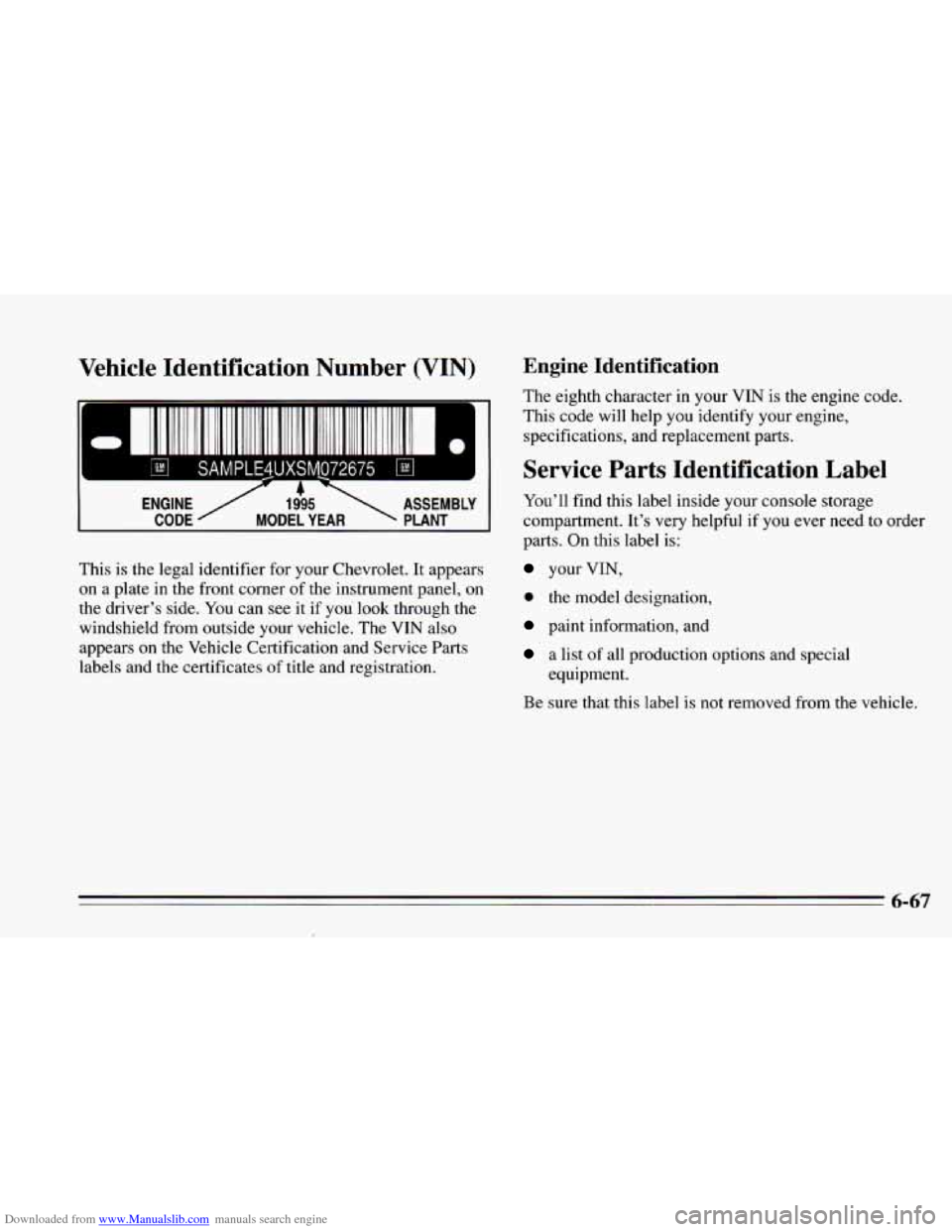
This
is the legal identifier for your Chevrolet. It appears
on a plate in the front corner of the instrument panel, on
the driver’s side. You can see it if you look through the
windshield from outside your vehicle.
The VIN also
appears on the Vehicle Certification and Service Parts
labels and the certificates
of title and registration.
Engine Identification
The eighth character in your VIN is the engine code.
This code will help you identify your engine,
specifications, and replacement parts.
Service Parts Identification Label
You’ll find this label inside your console storage
compartment. It’s very helpful
if you ever need to order
parts. On this label
is:
your VIN,
0 the model designation,
paint information, and
a list of all production options and special
equipment.
Be sure that this label
is not removed from the vehicle.
6-67
Page 309 of 388
Downloaded from www.Manualslib.com manuals search engine 0 Section 7 Maintenance Schedule
IMPORTANT:
KEEP ENGINE OIL
AT THE PROPER
LEVELANDCHANGEAS
RECOMMENDED
This section covers the maintenance required for your
Chevrolet. Your vehicle needs these services to retain its
safety, dependability and emission control performance.
Protection
Plan
Introduction
Your Vehicle and the Environment
Proper vehicle maintenance not only helps to keep your
vehicle in good working condition, but also helps the
environment.
All recommended maintenance procedures
are important. Improper vehicle maintenance or the
removal
of important components can significantly
affect the quality
of the air we breathe. Improper fluid
levels or even the wrong tire inflation can increase the
level
of emissions from your vehicle. To help protect our
environment, and to help keep your vehicle in good
condition, please maintain your vehicle properly.
Have you purchased the GM Protection Plan? The Plan
supplements
your new vehicle warranties. See your
Chevrolet dealer for details.
7-1