Page 254 of 380
Downloaded from www.Manualslib.com manuals search engine While reassembling the air cleaner assembly, ensure that the air cleaner
cover tabs are fully inserted into the slots in the air cleaner housing. On the
4.3L (VIN W) engine, also make certain that the PCV air tube is properly
seated in the left hand valve cover.
Refer to the Maintenance Schedule to determine
when to redace the air
filter.
See “Scheduled Maintenance Services” in the Index.
NOTICE:
If the air cleaner is off, a backfire can cause a damaging engine
fire. And, dirt can easily get into your engine, which will d\
amage
it. Always have the air cleaner in place when you’re driving.
Automatic Transmission Fluid
-When to Check and Change
A good time to check your automatic transmission fluid level is when the
engine oil is changed. Refer to the Maintenance Schedule to determine
when to change your fluid. See “Scheduled Maintenance Services” in the
Index.
How to Check
Because this operation can be a little difficult, you may choose to have this
done at your GM dealership Service Department.
If you do it yourself, be sure to follow all the instructions here, or you could
get a false reading on the dipstick.
6- 14
Page 257 of 380
Downloaded from www.Manualslib.com manuals search engine How to Add Fluid
Refer to the Maintenance Schedule to determine what kind of transmission
fluid to use. See “Recommended Fluids and Lubricants” in the Index.
Add fluid only after checking the transmission fluid
HOT. (A COLD check
is used only
as a reference.) If the fluid level is low, add only enough of the
proper fluid to bring the level up to the
HOT area for a hot check. It doesn’t
take much fluid, generally less than a int.
Don ’t overfill. We recommend
you use only fluid labeled DEXRON -111, because fluid with that label is
made especially for your automatic transmission. Damage caused by fluid
other than DEXRON@-I11 is not covered by your new vehicle warranty. 8
After adding fluid, recheck the fluid level as described under “How to
Check.”
0 When the correct fluid level is obtained, push the dipstick back in all
the way; then flip the handle down to lock the dipstick in place.
Manual Transmission Fluid
When to Check
A good time to have it checked is when the engine oil is changed. However,
the fluid in your manual transmission doesn’t require changin\
g.
How to Check
Because this operation can be a little difficult, you may choose to have this
done at your GM dealership Service Department.
If you do it yourself, be sure
to follow all the instructions here, or you could
get a false reading.
I NOTICE:
Too much or too little fluid can damage your transmission. Too
much can mean that some of the fluid could come out and fall on
hot engine parts or exhaust system parts, starting
a fire. Be sure
to get an accurate reading if you check your transmission fluid.
Check the fluid level only when your engine is off, the vehicle is parked on
a level place and the transmission is cool enough for you to rest your fingers
on the transmission case.
6-17
Page 259 of 380
Downloaded from www.Manualslib.com manuals search engine When to Checkand What to Use
P
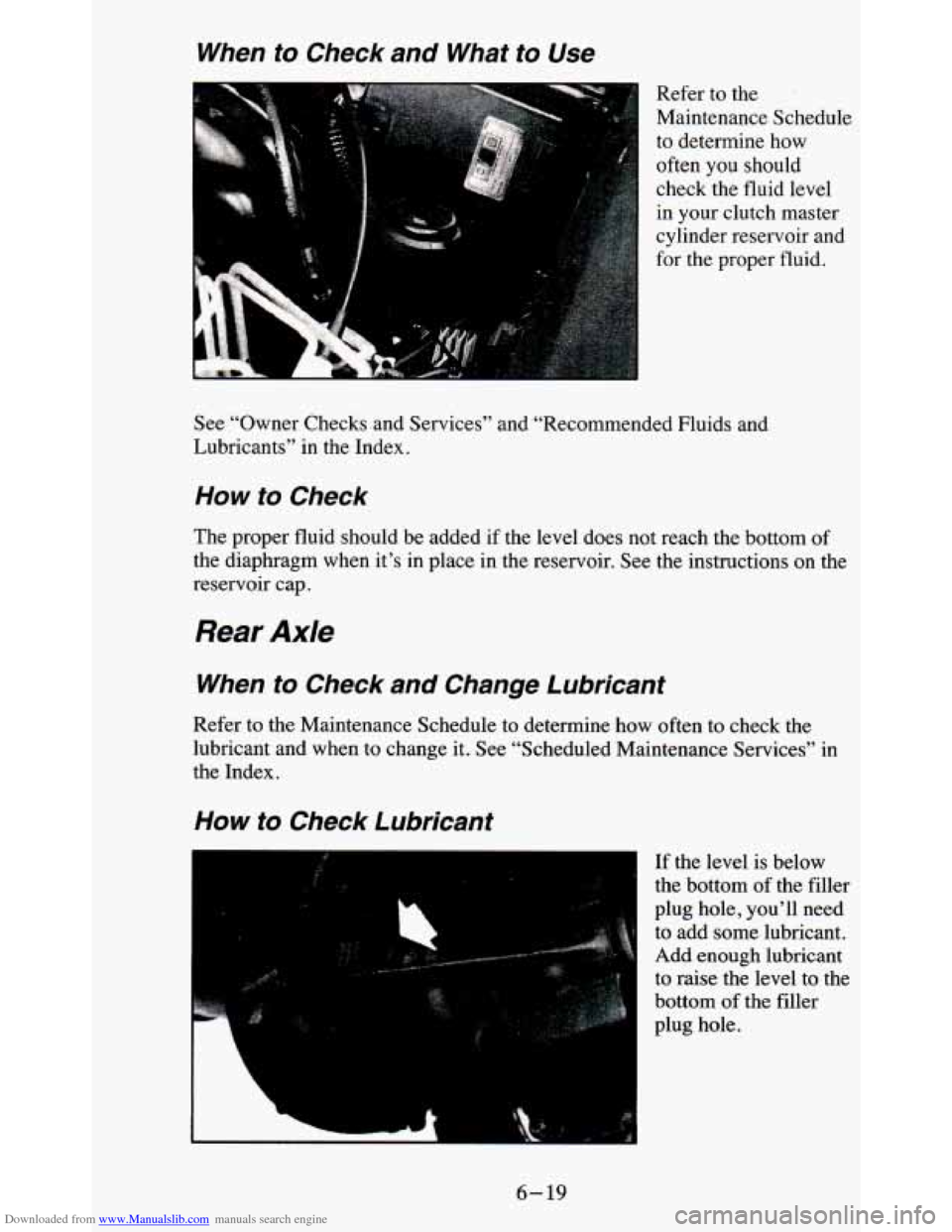
Refer to the
Maintenance Schedule
to determine how
often you should
check the fluid level
in your clutch master
cylinder reservoir and
for the proper fluid.
See “Owner Checks and Services” and “Recommended Fluids and
Lubricants” in the Index.
How to Check
The proper fluid should be added if the level does not reach the bottom of
the diaphragm when it’s in place in the reservoir. See the instructions on the
reservoir cap.
Rear Axle
When to Check and Change Lubricant
Refer to the Maintenance Schedule to determine how often to check the
lubricant and when to change it. See “Scheduled Maintenance Services” in
the Index.
How to Check Lubricant
If the level is below
the bottom of the filler
plug hole, you’ll need
to add some lubricant.
Add enough lubricant
to raise the level to the
bottom of
the filler
plug hole.
6- 19
Page 260 of 380
Downloaded from www.Manualslib.com manuals search engine What to Use
Refer to the Maintenance Schedule to determine what kind of lubricant to
use. See “Recommended Fluids and Lubricants” in the Index.
Four- Wheel and All- Wheel Drive
Most lubricant checks in this section also apply to four-wheel-drive and
all-wheel-drive vehicles. However, they have two additional syste\
ms that
need lubrication.
Transfer Case
When io Check Lubricani
Refer to the Maintenance Schedule to determine how often to check the
lubricant. See “Periodic Maintenance Inspections”
in the Index.
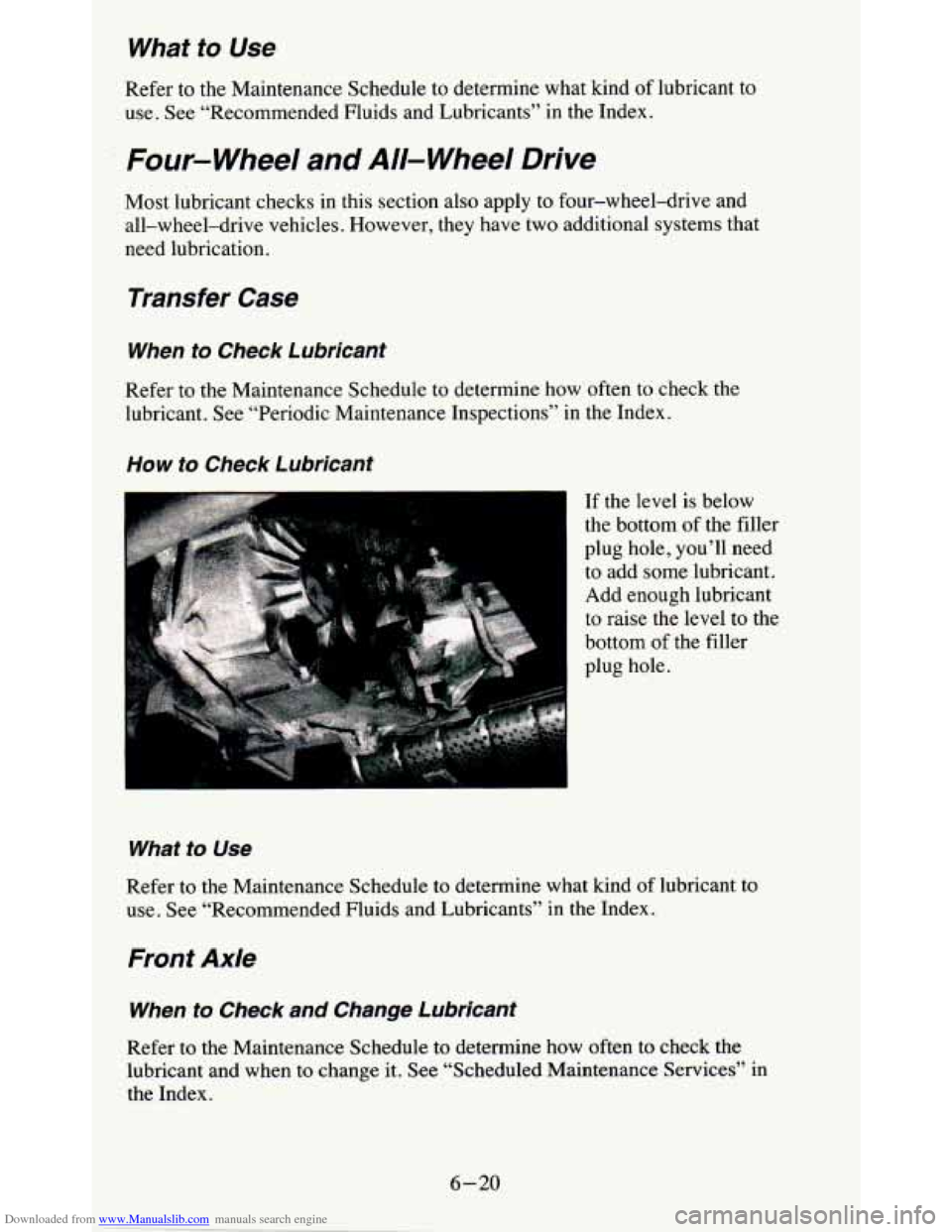
How to Check Lubricani
I If the level is below
the bottom
of the filler
plug hole, you’ll need to add some lubricant.
Add enough lubricant
to raise the level to the
bottom
of the filler
plug hole.
What to Use
Refer to the Maintenance Schedule to determine what kind of lubricant to
use. See “Recommended Fluids and Lubricants” in the Index.
Front Axle
When to Check and Change Lubricant
Refer to the Maintenance Schedule to determine how often to check the
lubricant and when to change it. See “Scheduled Maintenance Services” in
the Index.
6-20
Page 264 of 380
Downloaded from www.Manualslib.com manuals search engine Radiator Pressure Cap
NOTICE:
Your radiator cap is a 15 psi (105 kPa) pressure-type cap and
must be tightly installed to prevent coolant loss and possible \
engine damage from overheating. Be sure the arrows on the cap \
line up with the overflow tube on the radiator filler neck.
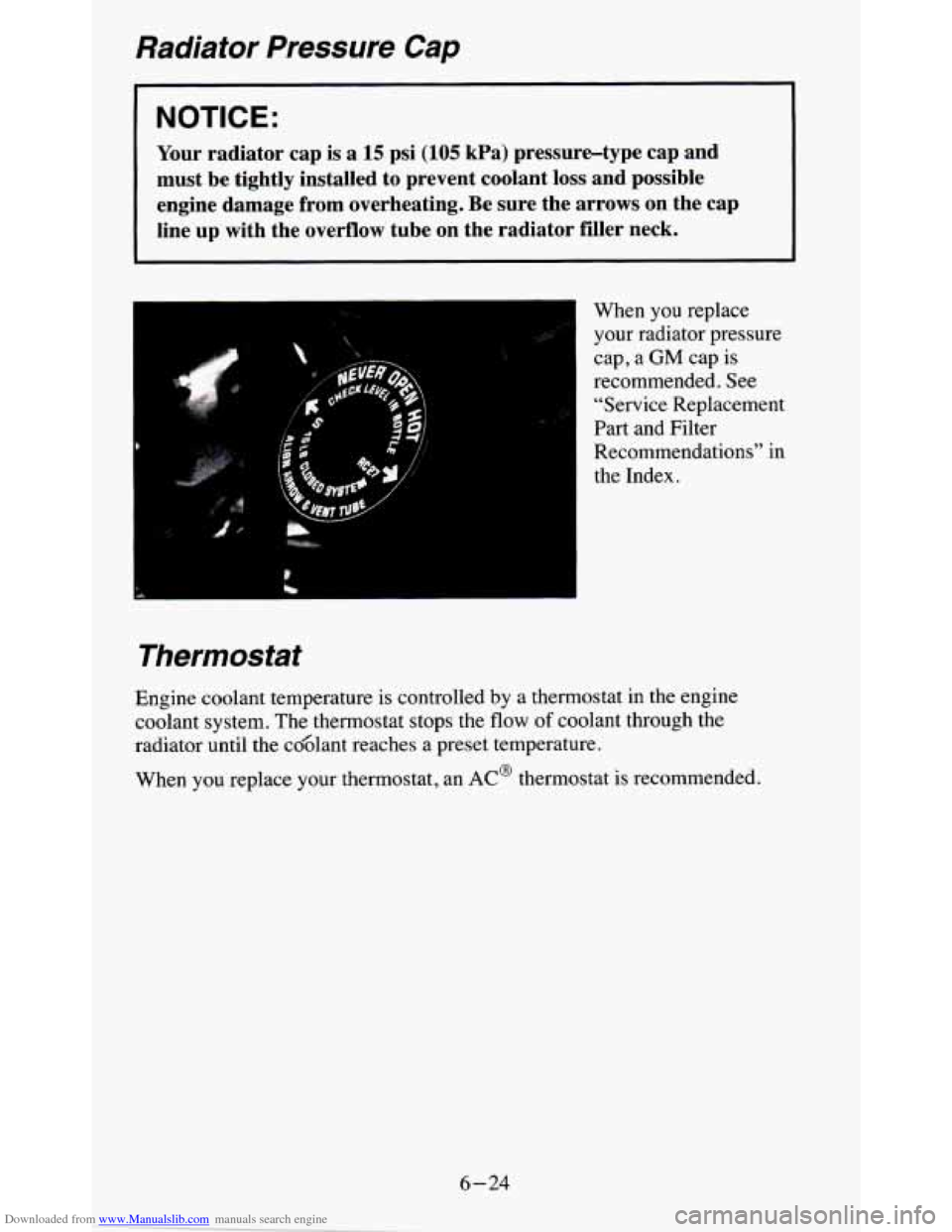
When you replace your radiator pressure
cap, a
GM cap is
recommended. See
“Service Replacement
Part and Filter
Recommendations” in
the Index.
Thermostat
Engine coolant temperature is controlled by a thermostat in the engine
coolant system. The thermostat stops the
flow of coolant through the
radiator until the co6lant reaches a preset temperature.
When you replace your thermostat, an
AC@ thermostat is recommended.
6-24
Page 280 of 380
Downloaded from www.Manualslib.com manuals search engine Air Conditioning
Every now and then have your dealership check your air conditioning
system to be sure it has not lost any cooling ability. If you think\
the system
is not working properly, have your dealership check it out as \
soon as
possible.
The air conditioning will not work when the temperature is below
40°F
(4°C).
Lock Cylinders
To be sure your locks operate properly, they must be lubricated.
Refer to the Maintenance Schedule to determine how often to lubricate them
and what type
of lubricant to use.
You should not
use penetrating oils because they could wash out me factory
installed lubricant and cause the lock to bind. De-icers which \
contain
alcohol could also wash away the lubricant,
so be sure to lubricate the lock
after using a de-icer of this type.
Exhaust System
To help prevent damage to your exhaust system, do not continue to drive
your vehicle
if you notice:
0 Engine misfiring
0 Loss of performance
0 Exhaust system components hanging lower than normal.
0 Loud exhaust system noises.
0 Other unusual operating conditions
Have your engine and exhaust system serviced regularly.
Three-way Catalytic Converter
Your vehicle’s three-way catalytic converter is designed to reduce \
the
pollutants in your vehicle’s exhaust. Use only unleaded fuel in your vehicle.
If you use leaded fuel, you could damage your three-way catalytic converter
and other engine components.
Engine Control Module System
This system has an oxygen (02) sensor that helps keep your engine’s
air-fuel mixture at a proper level. Use only unleaded fuel
in your vehicle. If
you use leaded fuel, you could damage your oxygen (02) sensor and affect
your vehicle’s emissions.
6-40
Page 281 of 380
Downloaded from www.Manualslib.com manuals search engine Ma/function Indicator Lamp (SERVICE ENGINE
SOON)
This light on your instrument panel lets you know when your emission
system needs service. See “Malfunction Indicator Lamp” in the Index.
Tires
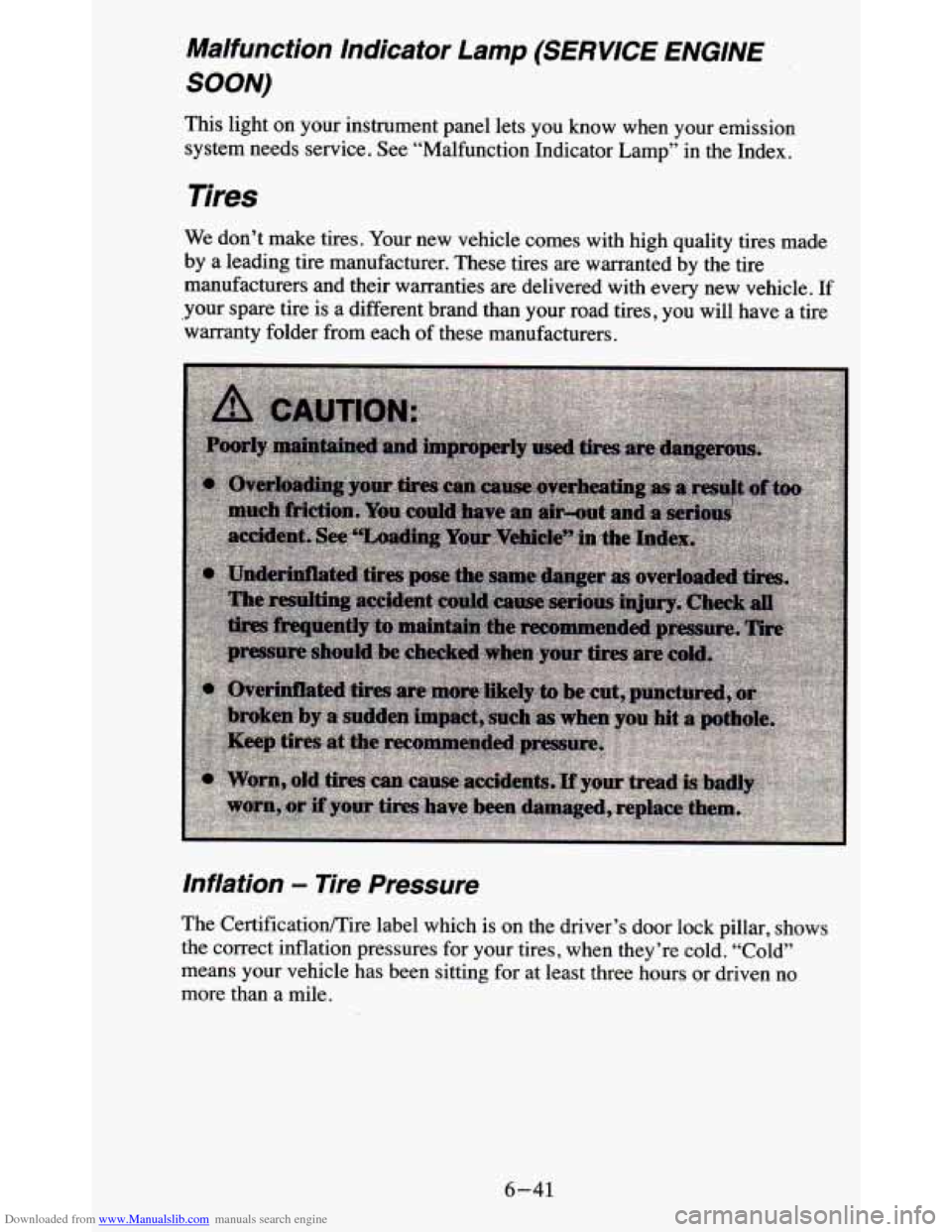
We don’t make tires. Your new vehicle comes with high quality tires made
by a leading tire manufacturer. These tires are warranted by the tire
manufacturers and their warranties
are delivered with every new vehicle. If
your spare tire is a different brand than your road tires, you will have a tire
warranty folder from each
of these manufacturers.
Inflation - lire Pressure
The Certificationire label which is on the driver’s door lock pillar, shows
the correct inflation pressures for your tires, when they’re cold. “Cold”
means your vehicle has been sitting for at least three hours or driven
no
more than a mile.
6-41
Page 283 of 380
Downloaded from www.Manualslib.com manuals search engine lire Inspection and Rotation
Tires should be inspected every 6,000 to 8,000 miles (10 000 to 13 000 km)
for any signs of unusual wear. If unusual wear is present, rotate your tires as
soon as possible and check wheel alignment. Also check for damaged tires
or wheels. See “When It’s Time for New Tires” and “Wheel Replacement”
later in this section for more information.
The purpose of regular rotation is to achieve more uniform wear for all tires
on the vehicle. The first rotation is the most important. See “Scheduled
Maintenance Services”
in the Index for scheduled rotation intervals.
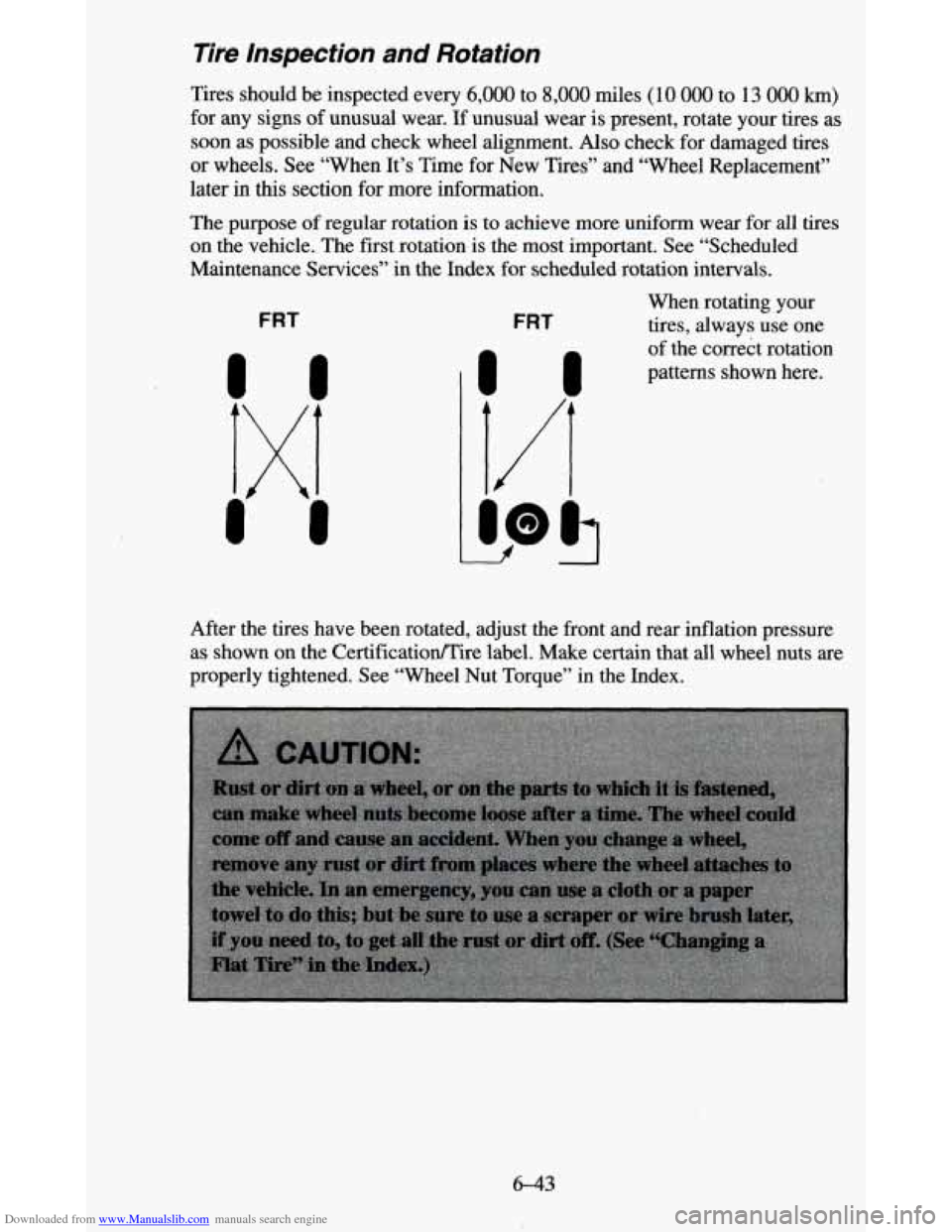
FRT
n
FRT When
rotating your
tires, always use one of the correct rotation
patterns shown here.
After the tires have been rotated, adjust the front and rear inflation pressure
as shown on the Certificatioflire label. Make certain that
all wheel nuts are
properly tightened. See “Wheel Nut Torque” in the Index.
6-43