1995 CHEVROLET BLAZER brake
[x] Cancel search: brakePage 172 of 380

Downloaded from www.Manualslib.com manuals search engine 0 As you are backing down the hill, put your left hand on the steering\
wheel at the
12 o’clock position. This way, you’ll be able to tell if your
wheels are straight and maneuver as you back down. It’s best that
you
back down the hill with your wheels straight rather than in the left or
right direction. Turning the wheel too far to the left or right will
increase the possibility of
a rollover.
Here are some things you
must not do if you stall, or are about to stall,
when going up a hill.
Never attempt to prevent a stall by shifting into NEUTRAL (N) (or
depressing the clutch, if you have a manual transmission) to “rev-up”
the engine and regain forward momentum. This won’t work. Your
vehicle will roll backwards very quickly and you could
go out of
control.
Instead, apply the regular brake to stop the vehicle. Then app\
ly the parking
brake. Shift into reverse, release the parking brake, and slowl\
y back straight down.
Never attempt to turn around if you are about to stall when going up a
hill.
If the hill is steep enough to stall your vehicle, it’s steep enou\
gh to
cause you to roll over
if you turn around. If you can’t make it up the
hill, you must back straight down the hill.
Q: Suppose, after stalling, I try to back down the hill and decide I just
can’t do it. What should
I do?
A: Set the parking brake, put your transmission in PARK (P) (or the
manual transmission in first gear), and
turn off the engine. Leave the
vehicle
and go get some help. Exit on the uphill side and stay clear of
the path the vehicle would take if it rolled downhill. Do not shift the
transfer case to NEUTRAL
(N) when you leave the vehicle. Leave it in
some gear.
4-18
Page 173 of 380
Downloaded from www.Manualslib.com manuals search engine Driving Downhill
When off-roading takes you downhill, you’ll want to consider a number of
things:
0 How steep is the downhill? Will I be able to maintain vehicle control?
What’s the surface like? Smooth? Rough? Slippery? Hard-packed dirt?
Gravel?
Are there hidden surface obstacles? Ruts? Logs? Boulders?
0 What’s at the bottom of the hill? Is there a hidden creek bank or even a
river bottom with large rocks?
If you decide you can go down a hill safely, then try to keep your vehicle
headed straight down, and use a low gear. This way, engine drag can help
your brakes and they won’t have to do all the work. Descend slowly,
keeping your vehicle under control at all times.
4-19
Page 174 of 380
Downloaded from www.Manualslib.com manuals search engine Q: Are there some things I should not do when driving down a hill?
A: Yes? These are important because if you ignore them you could lose
control and have a serious accident.
When driving downhill, avoid turns that take you across the incline of
the hill.
A hill that’s not too steep to drive down may be too steep to
drive across. You could roll over if
you don’t drive straight down.
Never go downhill with the transmission in NEUTRAL (N), or with the
clutch pedal depressed in a manual shift. This is called
“free-wheeling.” Your brakes will have to do all the work and could
overheat and fade.
Q: Am I likely to stall when going downhill?
A: It’s much more likely to happen going uphill. But if it happens going
downhill, here’s what to do.
0 Stop your vehicle by applying the regular brakes. Apply the parking
0 Shift to PARK (P) (or to Neutral with the manual transmission) and,
brake.
while still braking, restart the engine.
0 Shift back to a low gear, release the parking brake, and drive straight
down.
0 If the engine won’t start, get out and get help.
Driving Across an Incline
Sooner or later, an off-road trail will probably go across the incline of a hill.
If this happens,
you have to decide whether to try to drive across the incline.
Here are some things to consider:
0 A hill that can be driven straight up or down may be too steep to drive
across. When you
go straight up or down a hill, the length of the wheel
base (the distance from the front wheels to the rear wheels) reduces the
likelihood the vehicle will tumble end over end. But when
you drive
across an incline, the much more narrow track width (the distance
between the left and right wheels) may not prevent the vehicle from
tilting and rolling over. Also, driving across
an incline puts more
weight
on the downhill wheels. This could cause a downhill slide or a
rollover.
0 Surface conditions can be a problem when you drive across a hill.
Loose graveI, muddy
spots, or even wet grass can cause your tires to
slip sideways, downhill.
If the vehicle slips sideways, it can hit
something that will trip it (a rock,
a rut, etc.) and roll over.
4-20
Page 177 of 380

Downloaded from www.Manualslib.com manuals search engine Driving In .Water
Light rain causes no special off-road driving problems. But hea\
vy rain can
mean flash flooding, and flood waters demand extreme caution.
Find out how deep the water is before you drive through it. If it’s deep
enough to cover your wheel hubs, axles, or exhaust pipe, don’t
try it - you
probably won’t get through. Also, water that deep can damage your axle and
other vehicle parts.
If the water isn’t too deep, then drive through it slowly. At fast speeas, water
splashes on your ignition system and your vehicle can stall. Stalling can also
occur if you get your tailpipe under water. And, as long as your tailpipe is
under water, you’ll never be able to start your engine. When you
go through
water, remember that when your brakes get wet, it may take
you longer to
stop.
After Off-Road Driving
Remove any brush or debris that has collected on the underbody, chassis or
under the hood. These accumulations can be a fire hazard.
After operation in mud or sand, have the brake linings cleaned and checked.
These substances can cause glazing and uneven braking. Check th\
e body
structure, steering, suspension, wheels, tires, and exhaust system for
damage. Also, check the fuel lines and cooling system for any leakage.
Your vehicle will require more frequent service due to off-road use. Refer
to the Maintenance Schedule for additional information.
4-23
Page 180 of 380

Downloaded from www.Manualslib.com manuals search engine 1
Driving too fast through large water puddles or even going through some
car washes
can cause problems, too. The water may affect your brakes. Try
to avoid puddles. But if you can’t, try to slow down before you hit them.
Hydroplaning
Hydroplaning is dangerous. So much water can build up under your tires
that they can actually ride on the water. This can happen if the road is wet
enough and you’re going‘fast enough. When your vehicle is hydroplaning, it
has little or
no contact with the road.
Hydroplaning doesn’t happen often. But it can if your tires haven’t much
tread or if the pressure
in one or more is low. It can happen if a lot of water
is standing on the road, If you can see reflections from trees, telephone
poles, or other vehicles, and raindrops “dimple” the water’s surface, there
could be hydroplaning.
Hydroplaning usually happens at higher speeds. There just isn’t a hard and
fast rule about hydroplaning. The best advice is to slow down when it is
raining.
4-26
Page 184 of 380

Downloaded from www.Manualslib.com manuals search engine Then here tire some tips:
0 Make sure your vehicle is well ventilated, with a comfortably cool
interior.
0 Keep your eyes moving. Scan the‘road ahead and to the sides. Check
your mirrors and your instruments frequently.
If you get sleepy, pull off the road into a rest, service, or parking area
and take a nap, get some exercise, or both. For safety, treat drowsiness
on the highway as an emergency.
Hill and Mountain Roads
Driving on steep hills or mountains is different from driving in flat or
rolling terrain.
If you drive regularly in steep country, or if you’re plann\
ing to visit there,
here are some tips that can make your trips safer and more enjoyable. (See \
“Off-Road Driving” in the Index for information about driving off-road.)
Keep your vehicle in good shape. Check all fluid levels and also the
brakes, tires, cooling system and transmission. These parts can work
hard on mountain roads.
0 Know how to go down hills. The most important thing to know is this:
let your engine do some of the slowing down. Shift to a lower gear
when you go down a steep or long hill.
4-30
Page 187 of 380
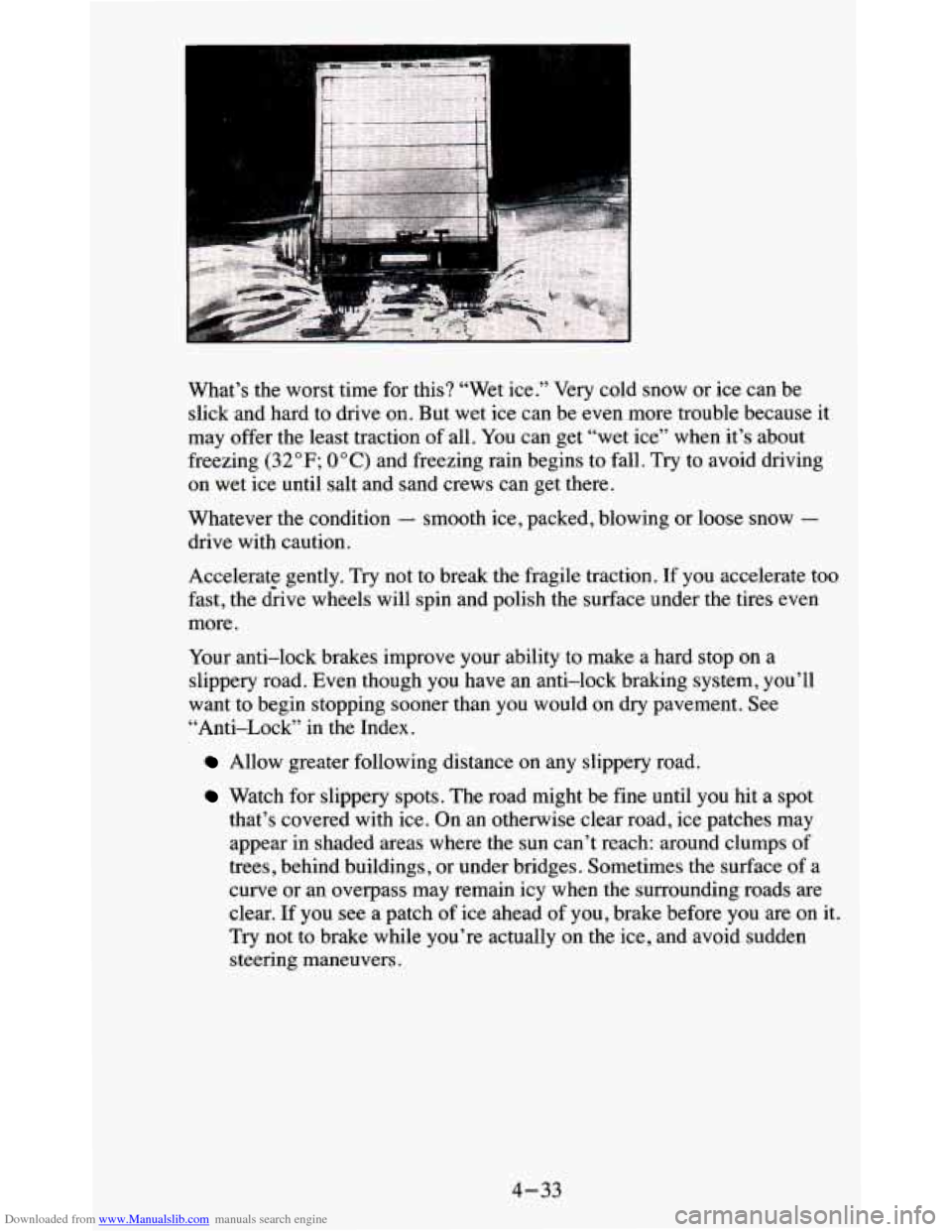
Downloaded from www.Manualslib.com manuals search engine What’s the worst time for this? “Wet ice.” Very cold snow or ice can be
slick and hard to drive on.
But wet ice can be even more trouble because it
may offer the least traction of all. You can get “wet ice” when it’s about
freezing
(32°F; 0°C) and freezing rain begins to fall. Try to avoid driving
on wet ice until salt and sand crews can get there.
Whatever the condition
- smooth ice, packed, blowing or loose snow -
drive with caution.
Accelerate gently. Try not to break the fragile traction. If you accelerate too
fast, the dkve wheels will spin and polish the surface under the tires even
more.
Your anti-lock brakes improve your ability
to make a hard stop on a
slippery road. Even though you have an anti-lock braking system, you’ll
want to begin stopping sooner than you would on dry pavement. \
See
“Anti-Lock” in the Index.
Allow greater following distance on any slippery road.
Watch for slippery spots. The road might be fine until you hit a spot
that’s covered with ice. On
an otherwise clear road, ice patches may
appear in shaded areas where the sun can’t reach: around cl\
umps of
trees, behind buildings,
or under bridges. Sometimes the surface of a
curve or an overpass may remain icy when the surrounding roads are
clear. If you see a patch of ice ahead of you, brake before you are on it.
Try not to brake while you’re actually on the ice, and avoid sudden
steering maneuvers.
4-33
Page 189 of 380
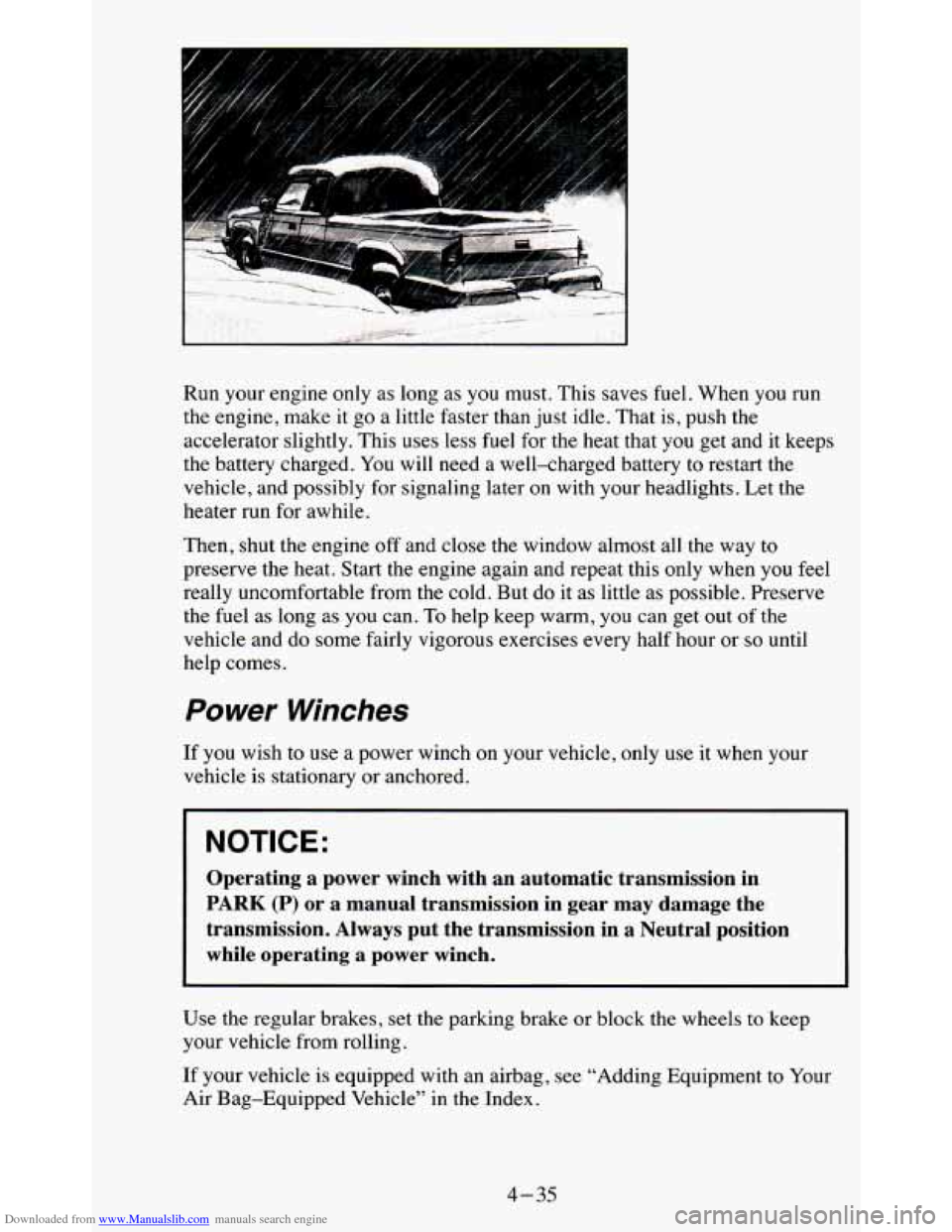
Downloaded from www.Manualslib.com manuals search engine Run your engine only as long as you must. This saves fuel. When you run
the engine, make it go a little faster than just idle. That is, push the
accelerator slightly. This uses less fuel for the heat that you get and it keeps
the battery charged. You will need a well-charged battery to restart the
vehicle, and possibly for signaling later on with your headlights. Let the
heater run for awhile.
Then, shut the engine
off and close the window almost all the way to
preserve the heat. Start the engine again and repeat this only when you feel
really uncomfortable from the cold. But do it as little as possible. Preserve
the
fuel as long as you can. To help keep warm, you can get out of the
vehicle and do some fairly vigorous exercises every half hour
or so until
help comes.
Power Winches
If you wish to use a power winch on your vehicle, only use it when your
vehicle is stationary or anchored.
NOTICE:
Operating a power winch with an automatic transmission in
PARK (P) or a manual transmission in gear may damage the
transmission. Always put the transmission in a Neutral position \
while operating a power winch.
I
Use the regular brakes, set the parking brake or block the wheels to keep
your vehicle from rolling.
If your vehicle is equipped with an airbag, see "Adding Equipment to Your
Air Bag-Equipped Vehicle" in the Index.
4-35