Page 98 of 380
Downloaded from www.Manualslib.com manuals search engine Using Cruise Control on Hills
How well your Cruise Control will work on hills depends upon your speed,
load, and the steepness of the hills. When going up steep hills, you may
want to step on the accelerator pedal to maintain your speed. When going
downhill, you may have to brake or shift to a lower gear to keep your speed
down. Of course, applying the brake takes you out of Cruise Control. Many
drivers find this to be too much trouble and don’t use Cruise Control on
steep hills.
To Get Out of Cruise Control
There are two ways to turn off the Cruise Control:
r
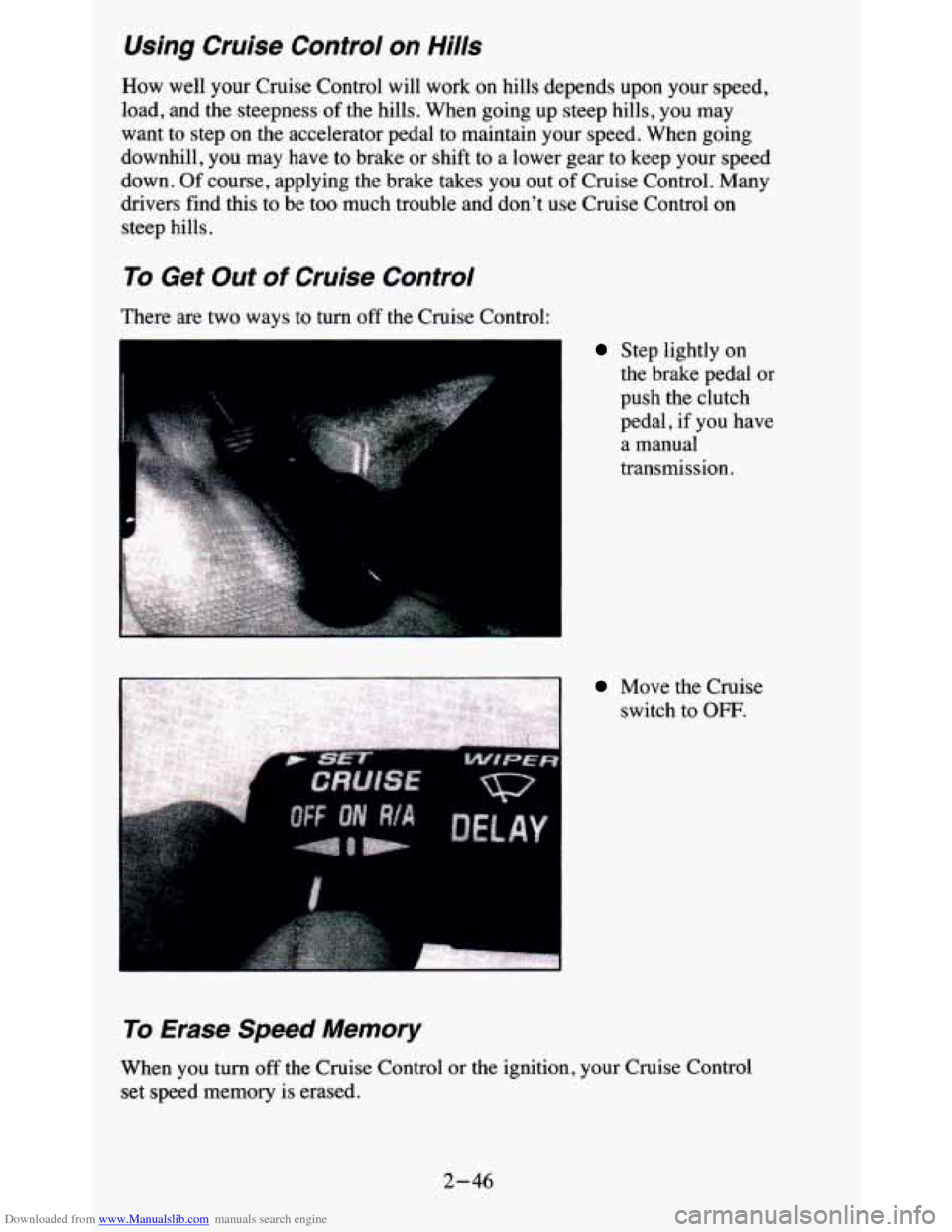
Step lightly on
the brake pedal
or
push the clutch
pedal,
if you have
a manual
transmission.
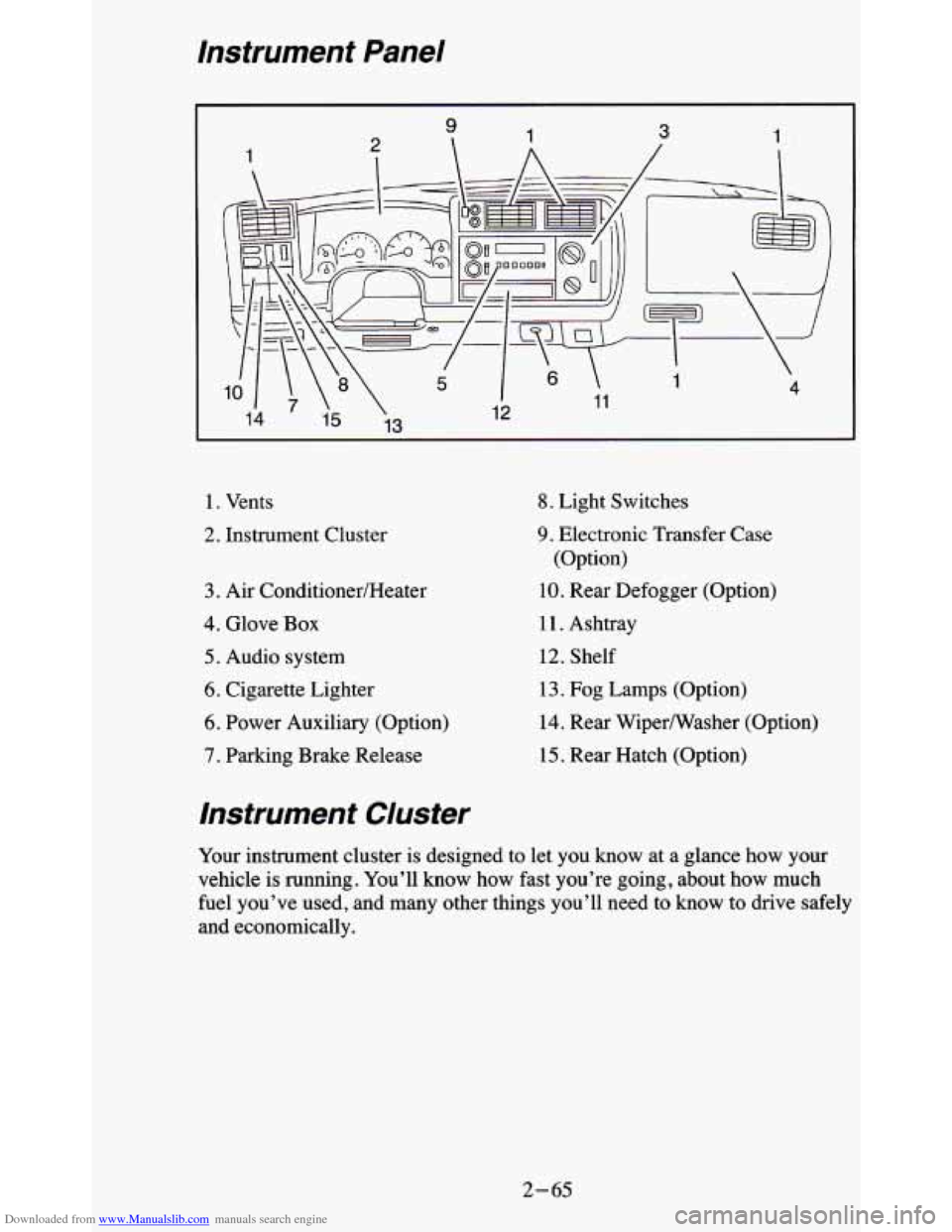
Move the Cruise
switch to
OFF.
To Erase Speed Memory
When you turn off the Cruise Control or the ignition, your Cruise Control
set speed memory
is erased.
2-46
Page 101 of 380
Downloaded from www.Manualslib.com manuals search engine Daytime Running Lamps (DRL) Indicator Light
You may have this
light on the instrument
panel. It goes on whenever the Daytime
Running Lamps are
on, the ignition is on,
the headlamp switch is
off, and the parking
brake is released.
Daytime Running Lamps
Vehicles sold in the United States may or may not have this feature. DRL is
required on new vehicles sold in Canada.
The high beam headlamps will come on at reduced brightness in daylight
when:
0 The ignition is on,
0 The headlamp switch is off, and
The parking brake is released.
When you turn on your headlamps, the DRL will switch
off and the exterior
lights will come
on. When you turn off the headlamps, the exterior lights
will go out and the high beams will change to the reduced brightness
of
DRL again.
The
DRL indicator light on the instrument panel will go on whenever the
DRL is
on. This light means that only the DRL is on. When you turn on
your exterior lights, this light will go out.
If the DRL indicator light is on at dawn or dusk, it is a reminder to turn on
your headlamps.
Of course, you may still turn on the headlamps any time you need to.
To idle your vehicle with the
DRL, off, set the parking brake. The DRL will
stay
off until you release the parking brake.
Headlamps-On Reminder
A reminder tone will sound when your headlamps or parking lamps are
turned on and your ignition is in OFF, LOCK or ACC. To turn the tone off,
press the OFF switch.
2-49
Page 117 of 380
Downloaded from www.Manualslib.com manuals search engine Instrument Panel
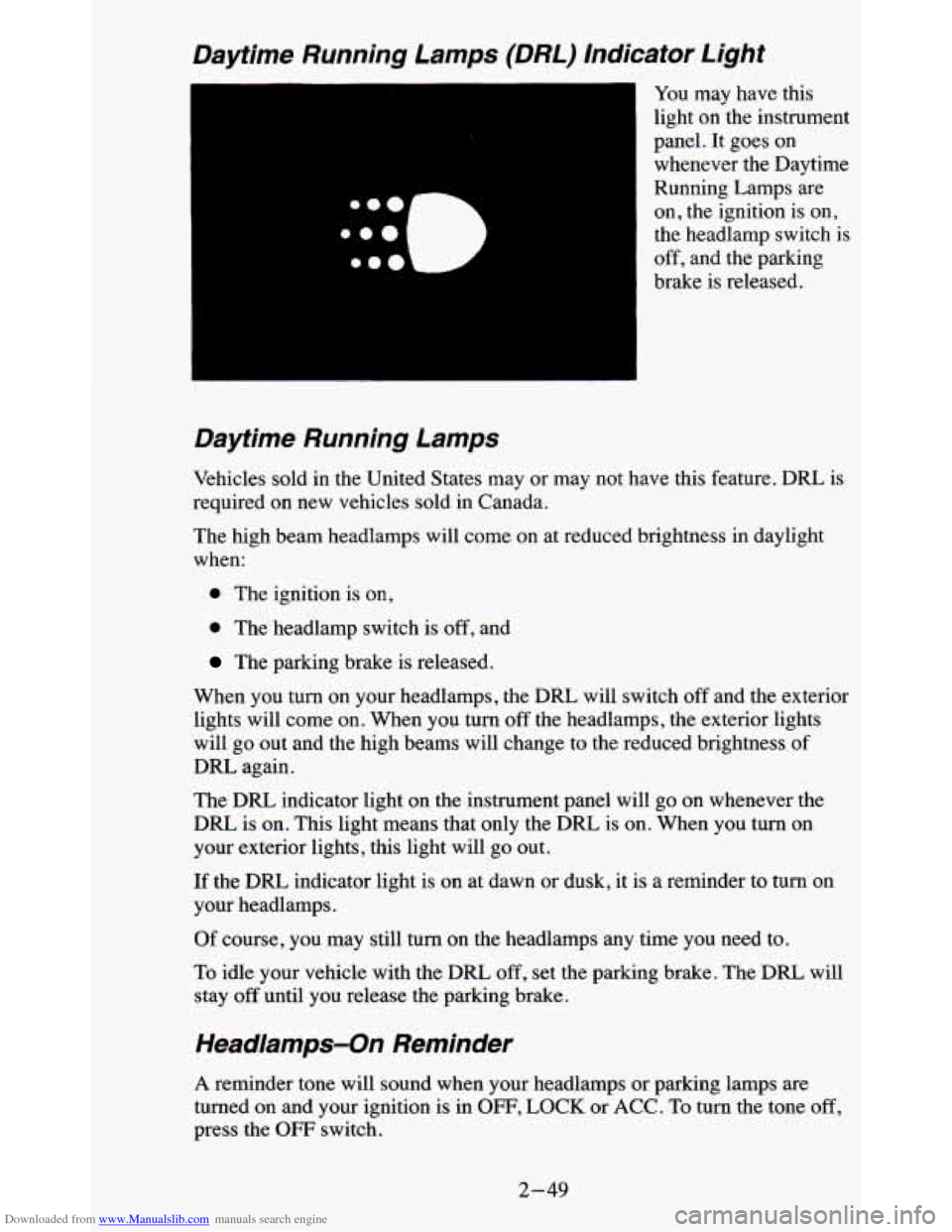
1. Vents
2. Instrument Cluster
3. Air ConditionedHeater
4. Glove Box
5. Audio system
6. Cigarette Lighter
6. Power Auxiliary (Option)
7. Parking Brake Release
8. Light Switches
9. Electronic Transfer Case
(Option)
10. Rear Defogger (Option)
11. Ashtray
12. Shelf
13. Fog Lamps (Option)
14. Rear Wipermasher (Option)
15. Rear Hatch (Option)
Instrument Cluster
Your instrument cluster is designed to let you know at a glance how your
vehicle
is running. You’ll know how fast you’re going, about how much
fuel you’ve used, and many other things you’ll need to know to drive safely
and economically.
2- 65
Page 122 of 380
Downloaded from www.Manualslib.com manuals search engine You will see this light flash for a few seconds when you turn your ignition
to
RUN or START. Then the light should go out. This means the system is
ready.
If the air bag readiness light doesn’t come on when you start your vehicle,
or stays on,
or comes on when you are driving, your air bag system may not
work properly. Have your vehicle serviced right away.
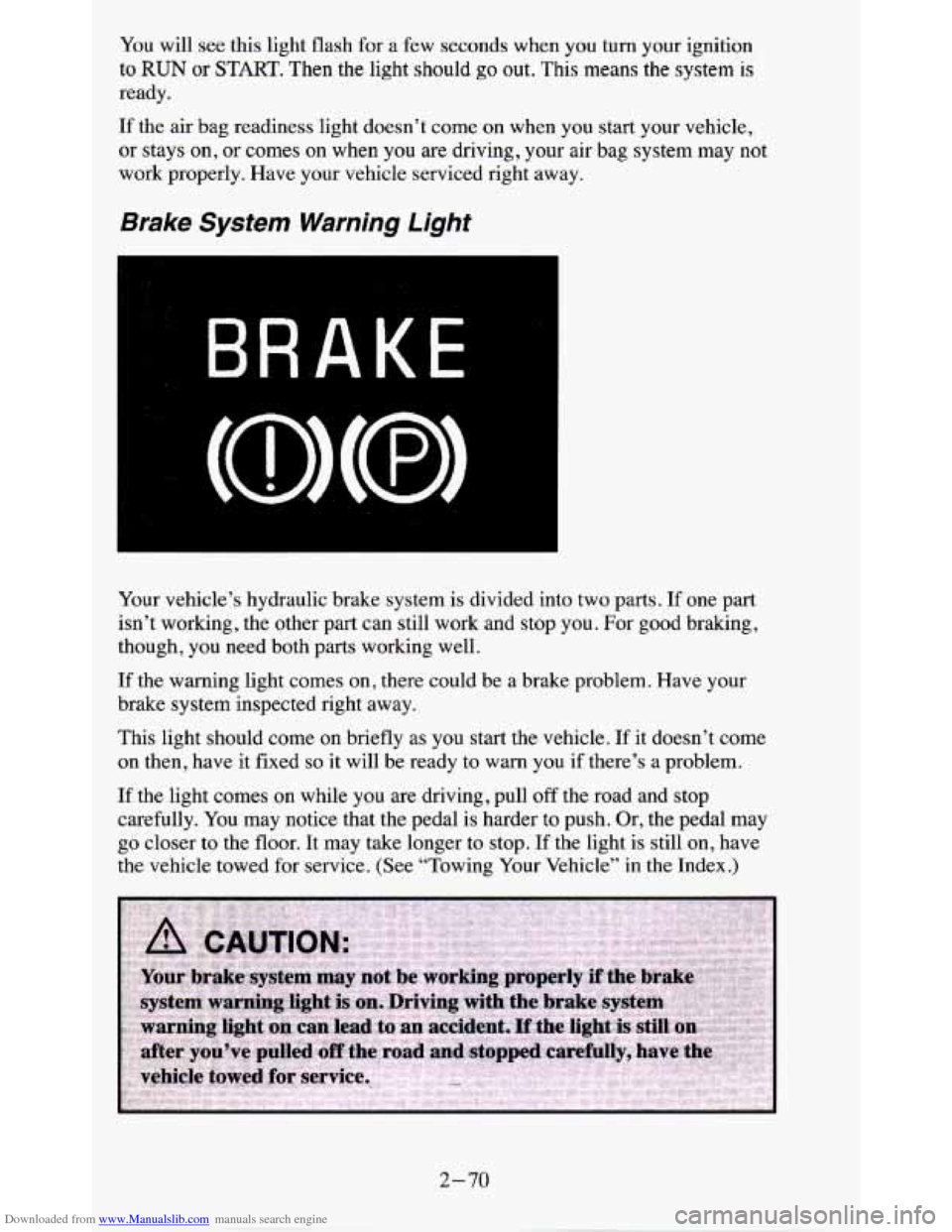
Brake System Warning Light
Your vehicle’s hydraulic brake system is divided into two parts. If one part
isn’t working, the other part can still work and stop
you. For good braking,
though, you need both parts working well.
If the warning light comes on, there could be a brake problem. Have your
brake system inspected right away.
This light should come on briefly
as you start the vehicle. If it doesn’t come
on then, have it fixed
so it will be ready to warn you if there’s a problem.
If the light comes on while you are driving, pull off the road and stop
carefully. You may notice that the pedal
is harder to push. Or, the pedal may
go closer to the floor. It may take longer to stop.
If the light is still on, have
the vehicle towed for service. (See “Towing Your Vehicle” in
the Index.)
2-70
Page 123 of 380
Downloaded from www.Manualslib.com manuals search engine The brake system warning light will also come on when you set your
parking brake, and it will stay on
if your parking brake doesn’t release fully.
If it stays
on after your parking brake is fully released, it means you have a
brake problem.
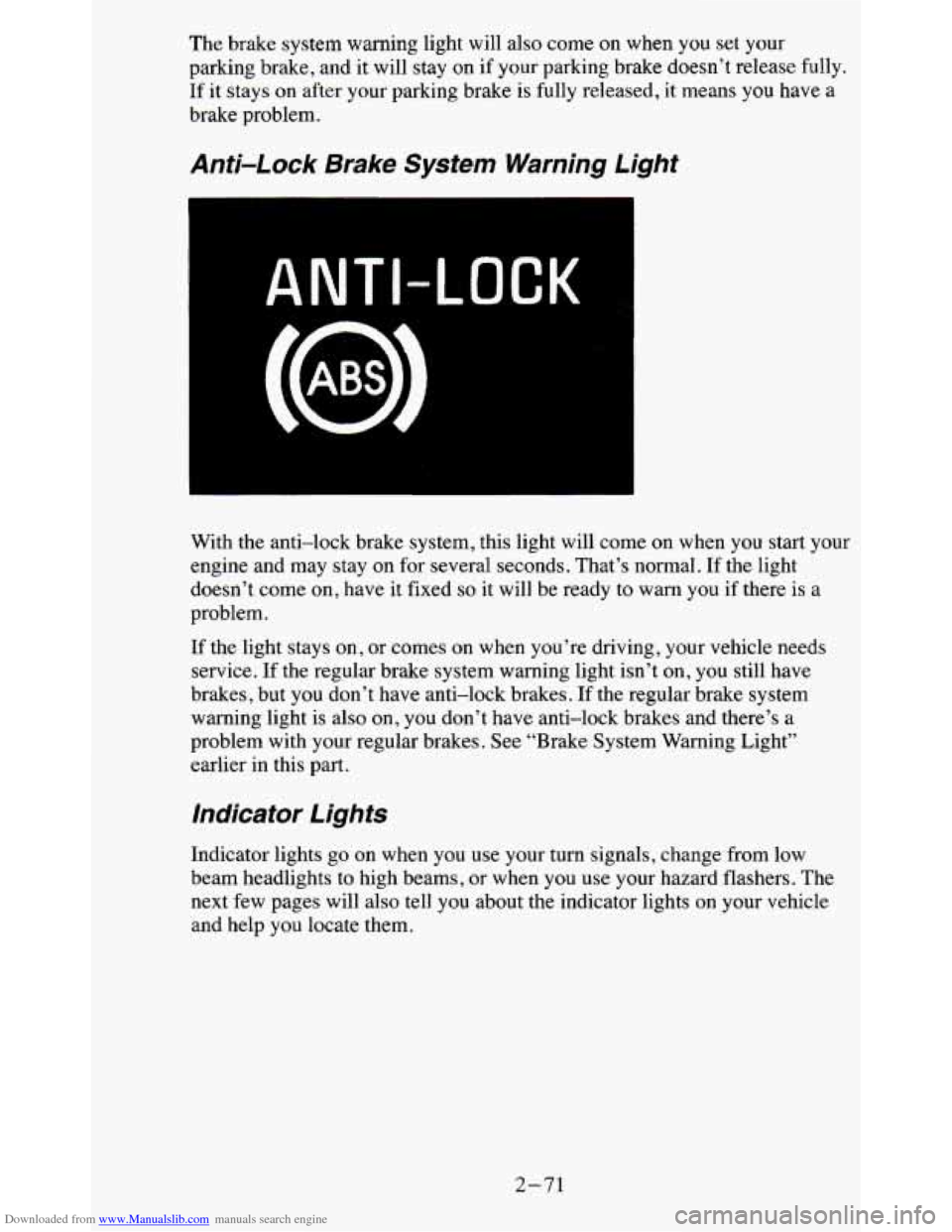
Anti-Lock Brake System Warning Light
ANTI-LOCK
With the anti-lock brake system, this light will come on when you start your
engine and may stay on for several seconds. That’s normal. If the light
doesn’t come on, have it fixed
so it will be ready to warn you if there is a
problem.
If the light stays on, or comes on when you’re driving, your vehicle needs
service. If the regular brake system warning light isn’t on, you still have
brakes, but you don’t have anti-lock brakes.
If the regular brake system
warning light is also on, you don’t have anti-lock brakes and there’s a
problem with your regular brakes. See “Brake System Warning Light”
earlier in this part.
Indicator Lights
Indicator lights go on when you use your turn signals, change from low
beam headlights to high beams,
or when you use your hazard flashers. The
next few pages will also tell you about the indicator lights \
on your vehicle
and help you locate them.
2-71
Page 127 of 380
Downloaded from www.Manualslib.com manuals search engine Daytime Running Lamps (DRL) Indicator Light
A
This green DRL
indicator light
is
above the fuel gage on
the instrument cluster.
The DRL indicator light is on whenever the ignition is
on and the headlight
switch and parking brake are
off. For more details about DRL, see “Day
Time Running Lamps” in
this section.
SHIFT Indicator Light
SHIFT
This amber SHIFT
indicator light
is at the
top of the instrument cluster
of vehicles
with manual
transmissions.
Shifting when the
indicator light is
on
will help you get the
best fuel economy.
See “SHIFT Light” in
this section.
2-75
Page 156 of 380
Downloaded from www.Manualslib.com manuals search engine Rear-end collisions are about the most preventable of accidents. Yet they
are common. Allow enough following distance. It’s the best defensive
driving maneuver, in both city and rural driving. You never know when the
vehicle in front of you is going to brake or
turn suddenly.
Drunken Driving
Death and injury associated with drinking and driving is a national tragedy.
It’s the number one contributor to the highway death toll, claiming
thousands
of victims every year.
Alcohol affects four things that anyone needs to drive a vehicle:
0 Judgment
Muscular Coordination
Vision
Attentiveness
Police records show that almost half of all motor vehicle-related deaths
involve alcohol. In most cases, these deaths are the result of someone who
was drinking and driving. In recent years, some
18,000 annual motor
vehicle-related deaths have been associated with the use
of alcohol, with
more than
300,000 people injured.
Many adults
- by some estimates, nearly half the adult population -
choose never to drink alcohol, so they never drive after drinking. For
persons under
21, it’s against the law in every U.S. state to drink alcohol.
There are good medical, psychological and developmental reasons for these
laws.
The obvious way to solve this highway safety problem is for people never to
drink alcohol and then
drive. But what if people do? How much is “too
much”
if the driver plans to drive? It’s a lot less than many might think.
Although it depends on each person and situation, here is some general
information on the problem.
The Blood Alcohol Concentration (BAC) of someone
who is drinking
depends upon four things:
0 How much alcohol consumed
The drinker’s body weight
0 The amount of food that is consumed before and during drinking
0 The length of time it’s taken the drinker to consume the alcohol
4-2
Page 158 of 380
Downloaded from www.Manualslib.com manuals search engine The body takes about an hour to rid itself of the alcohol in one drink. No
amount of coffee or number of cold showers will speed that up. “I’ll be
careful” isn’t
the right answer. What if there’s an emergency, a need to take
sudden action,
as when a child darts into the street? A person with even a
moderate
BAC might not be able to react quickly enough to avoid the
collision.
There’s something else about drinking and driving that many people don’t
know. Medical research
shows that alcohol in a person’s system can make
crash injuries worse, especially injuries to the brain, spinal cord or heart.
This means that when anyone who has been drinking
- driver or passenger
- is in a crash, that person’s chance of being killed or permanently disabled
is higher than
if the person had not been drinking.
Control of a Vehicle
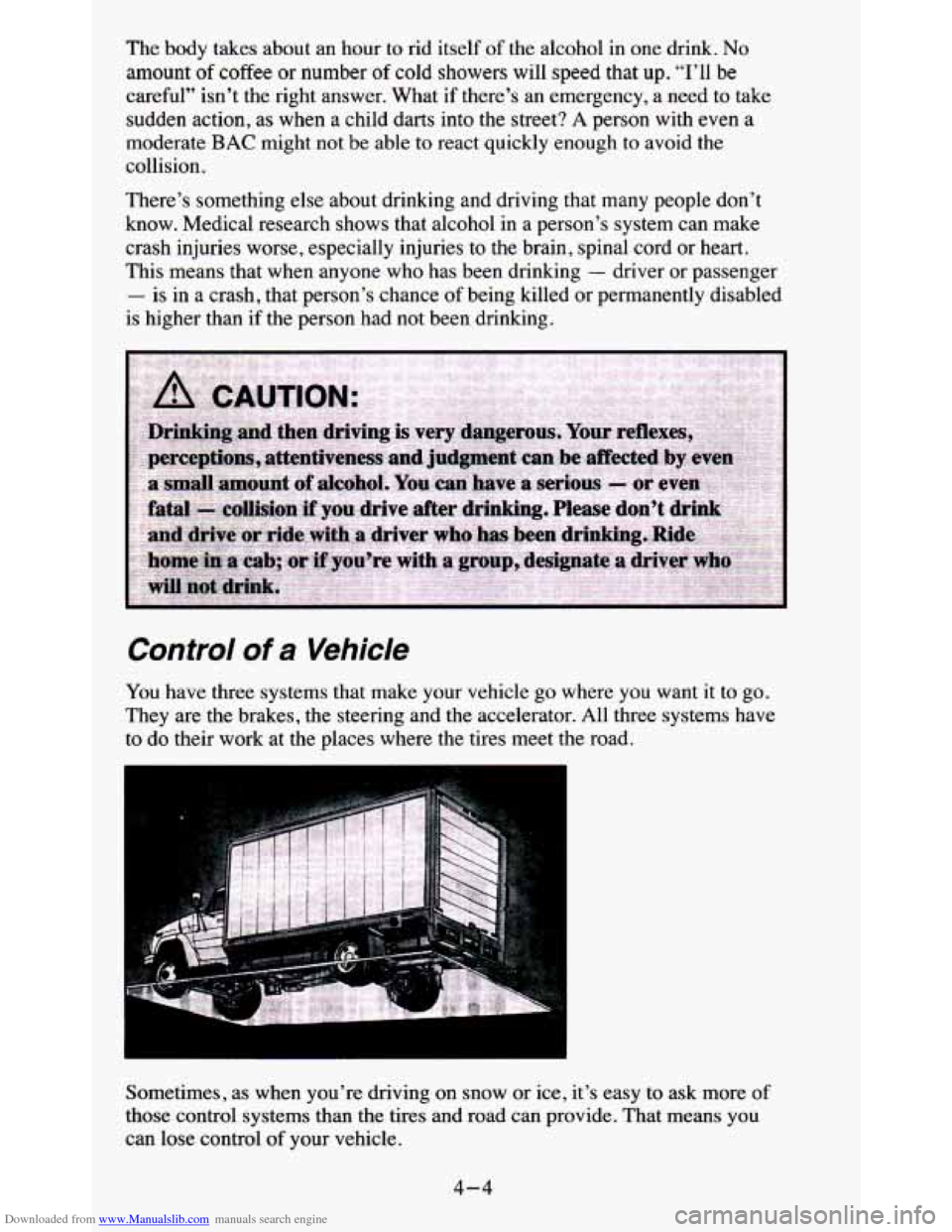
You have three systems that make your vehicle go where you want it to go.
They are the brakes, the steering and the accelerator. All three systems hav\
e
to do their work at the places where the tires meet the road.
Sometimes, as when you’re driving on snow or ice, it’s easy to
ask more of
those control systems than the tires and road can provide. That means you
can lose control
of your vehicle.
4-4