1995 CHEVROLET BLAZER steering
[x] Cancel search: steeringPage 170 of 380
Downloaded from www.Manualslib.com manuals search engine Approaching a Hill
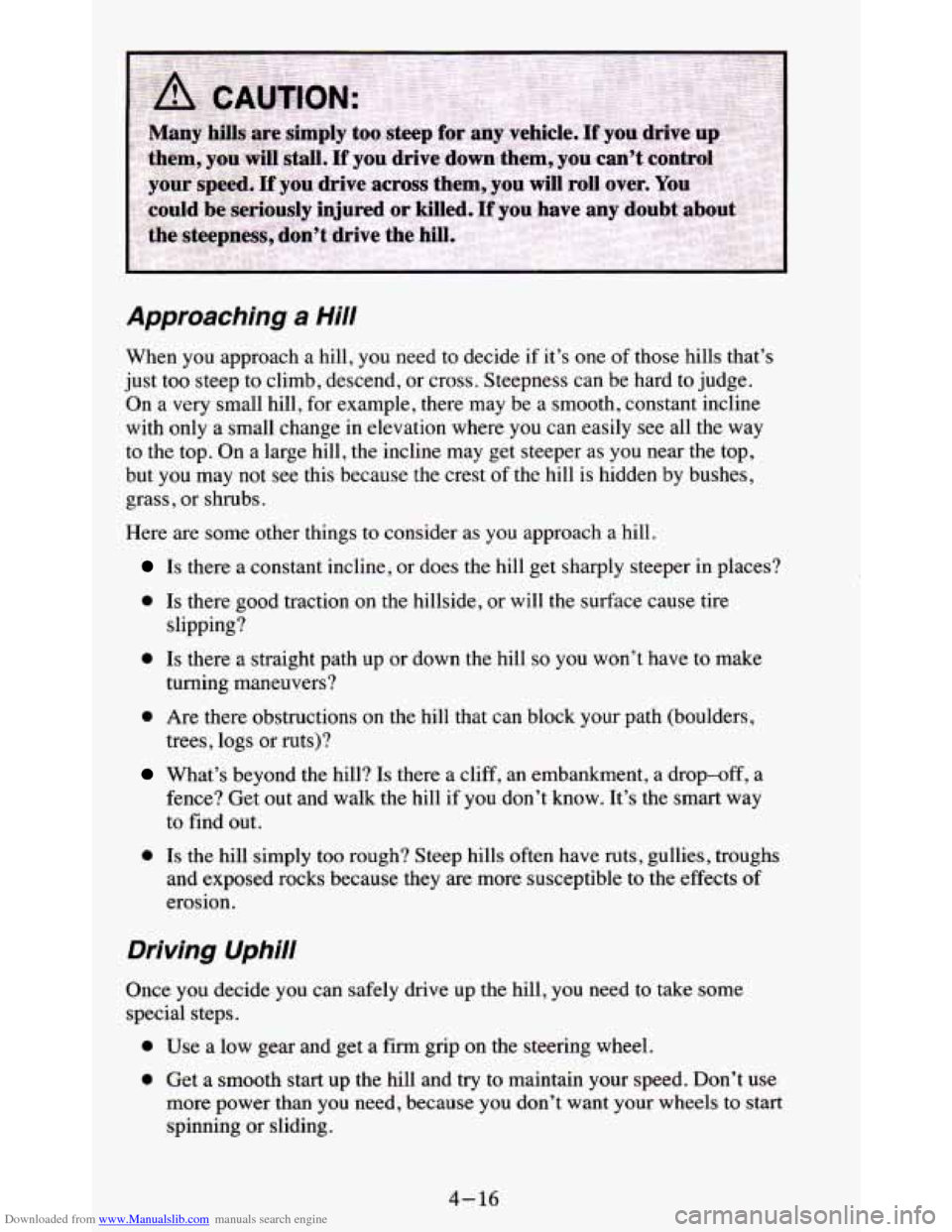
When you approach a hill, you need to decide if it’s one of those hills that’s
just too steep to climb, descend, or cross. Steepness can be hard to judge.
On a very small hill, for example, there may be a smooth, constant incline
with only
a small change in elevation where you can easily see all the way
to the top. On
a large hill, the incline may get steeper as you near the top,
but you may not see this because the crest of the hill is h\
idden by bushes,
grass, or shrubs.
Here are some other things to consider as you approach a hill.
Is there a constant incline, or does the hill get sharply steeper in places?
0 Is there good traction on the hillside, or will the surface cause tire
0 Is there a straight path up or down the hill so you won’t have to make
0 Are there obstructions on the hill that can block your path (boulders,
trees, logs or ruts)?
What’s beyond the hill? Is there a cliff, an embankment, a drop-off, a
fence? Get out and walk the hill if you don’t know. It’s the smart way
to find out.
slipping?
turning maneuvers?
0 Is the hill simply too rough? Steep hills often have ruts, gullies, troughs
and exposed rocks because they are more susceptible to the effects
of
erosion.
Driving Uphi//
Once you decide you can safely drive up the hill, you need to take some
special steps.
0 Use a low gear and get a firm grip on the steering wheel.
0 Get a smooth start up the hill and try to maintain your speed. Don’t use
more power than you need, because you don’t want your wheels
to start
spinning or sliding.
4- 16
Page 172 of 380

Downloaded from www.Manualslib.com manuals search engine 0 As you are backing down the hill, put your left hand on the steering\
wheel at the
12 o’clock position. This way, you’ll be able to tell if your
wheels are straight and maneuver as you back down. It’s best that
you
back down the hill with your wheels straight rather than in the left or
right direction. Turning the wheel too far to the left or right will
increase the possibility of
a rollover.
Here are some things you
must not do if you stall, or are about to stall,
when going up a hill.
Never attempt to prevent a stall by shifting into NEUTRAL (N) (or
depressing the clutch, if you have a manual transmission) to “rev-up”
the engine and regain forward momentum. This won’t work. Your
vehicle will roll backwards very quickly and you could
go out of
control.
Instead, apply the regular brake to stop the vehicle. Then app\
ly the parking
brake. Shift into reverse, release the parking brake, and slowl\
y back straight down.
Never attempt to turn around if you are about to stall when going up a
hill.
If the hill is steep enough to stall your vehicle, it’s steep enou\
gh to
cause you to roll over
if you turn around. If you can’t make it up the
hill, you must back straight down the hill.
Q: Suppose, after stalling, I try to back down the hill and decide I just
can’t do it. What should
I do?
A: Set the parking brake, put your transmission in PARK (P) (or the
manual transmission in first gear), and
turn off the engine. Leave the
vehicle
and go get some help. Exit on the uphill side and stay clear of
the path the vehicle would take if it rolled downhill. Do not shift the
transfer case to NEUTRAL
(N) when you leave the vehicle. Leave it in
some gear.
4-18
Page 176 of 380
Downloaded from www.Manualslib.com manuals search engine Driving In Mud, Sand, Snow, Or Ice
When you drive in mud, snow or sand, your wheels won’t get good traction.
You can’t accelerate as quickly, turning
is more difficult, and you’ll need
longer braking distances.
It’s best to use a low gear when you’re in mud
- the deeper the mud, the
lower the gear. In really deep mud, the idea is to keep your vehicle moving
so you don’t get stuck.
When you drive on sand, you’ll sense a change in wheel traction. But it will
depend upon how loosely packed the sand is. On loosely packed sand (as on
beaches or sand dunes) your tires will tend to sink into the sand. This has an
effect on steering, accelerating, and braking. You may want to reduce
the air
pressure in your tires slightly when driving on sand. This will improve
traction.
Hard packed snow and ice offer the worst tire traction. On th\
ese surfaces,
it’s very easy to lose control. On wet ice, for example, the traction is
so poor
that you will have difficulty accelerating. And if you do get moving, poor
steering and difficult braking can cause you
to slide out of control.
4-22
Page 177 of 380

Downloaded from www.Manualslib.com manuals search engine Driving In .Water
Light rain causes no special off-road driving problems. But hea\
vy rain can
mean flash flooding, and flood waters demand extreme caution.
Find out how deep the water is before you drive through it. If it’s deep
enough to cover your wheel hubs, axles, or exhaust pipe, don’t
try it - you
probably won’t get through. Also, water that deep can damage your axle and
other vehicle parts.
If the water isn’t too deep, then drive through it slowly. At fast speeas, water
splashes on your ignition system and your vehicle can stall. Stalling can also
occur if you get your tailpipe under water. And, as long as your tailpipe is
under water, you’ll never be able to start your engine. When you
go through
water, remember that when your brakes get wet, it may take
you longer to
stop.
After Off-Road Driving
Remove any brush or debris that has collected on the underbody, chassis or
under the hood. These accumulations can be a fire hazard.
After operation in mud or sand, have the brake linings cleaned and checked.
These substances can cause glazing and uneven braking. Check th\
e body
structure, steering, suspension, wheels, tires, and exhaust system for
damage. Also, check the fuel lines and cooling system for any leakage.
Your vehicle will require more frequent service due to off-road use. Refer
to the Maintenance Schedule for additional information.
4-23
Page 187 of 380
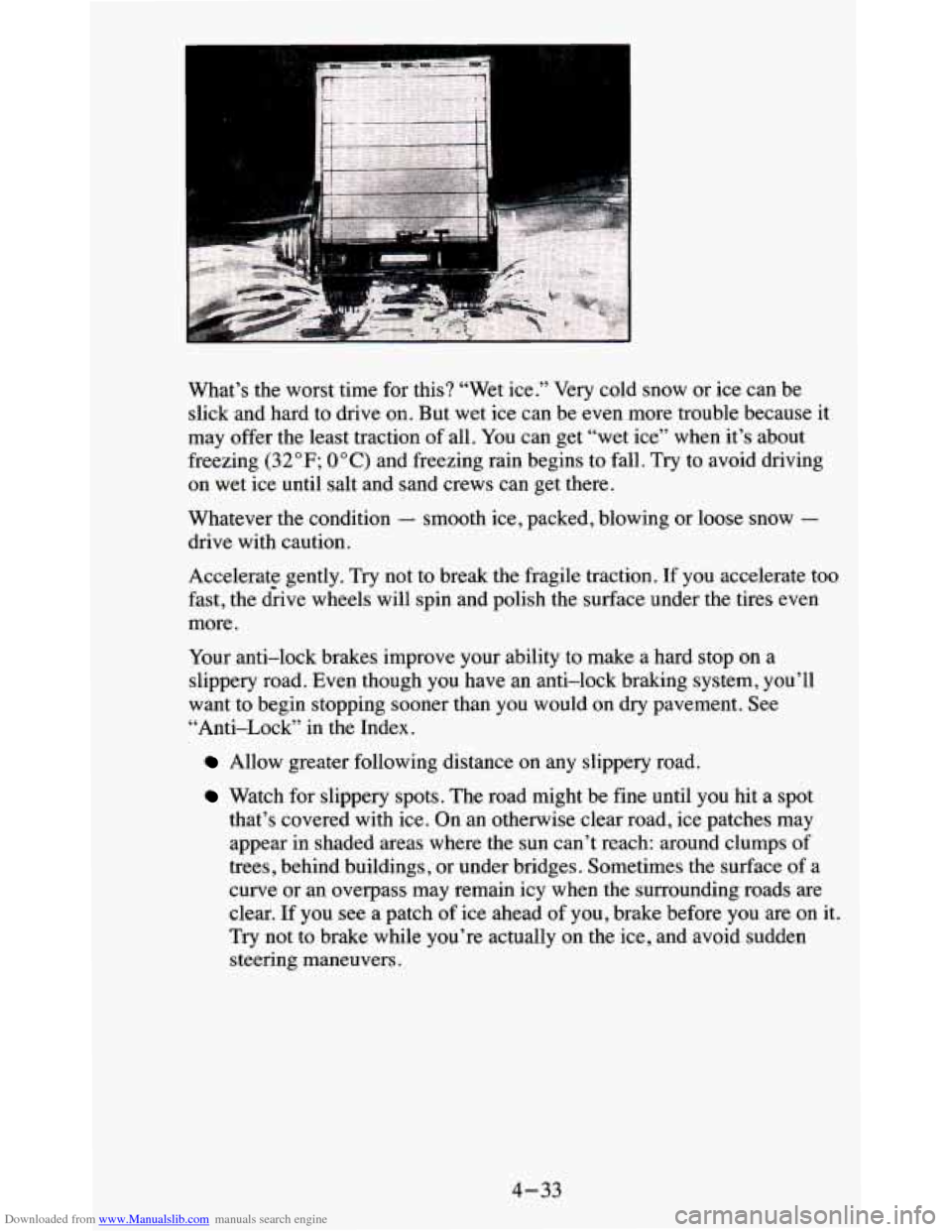
Downloaded from www.Manualslib.com manuals search engine What’s the worst time for this? “Wet ice.” Very cold snow or ice can be
slick and hard to drive on.
But wet ice can be even more trouble because it
may offer the least traction of all. You can get “wet ice” when it’s about
freezing
(32°F; 0°C) and freezing rain begins to fall. Try to avoid driving
on wet ice until salt and sand crews can get there.
Whatever the condition
- smooth ice, packed, blowing or loose snow -
drive with caution.
Accelerate gently. Try not to break the fragile traction. If you accelerate too
fast, the dkve wheels will spin and polish the surface under the tires even
more.
Your anti-lock brakes improve your ability
to make a hard stop on a
slippery road. Even though you have an anti-lock braking system, you’ll
want to begin stopping sooner than you would on dry pavement. \
See
“Anti-Lock” in the Index.
Allow greater following distance on any slippery road.
Watch for slippery spots. The road might be fine until you hit a spot
that’s covered with ice. On
an otherwise clear road, ice patches may
appear in shaded areas where the sun can’t reach: around cl\
umps of
trees, behind buildings,
or under bridges. Sometimes the surface of a
curve or an overpass may remain icy when the surrounding roads are
clear. If you see a patch of ice ahead of you, brake before you are on it.
Try not to brake while you’re actually on the ice, and avoid sudden
steering maneuvers.
4-33
Page 191 of 380
Downloaded from www.Manualslib.com manuals search engine 2. Insert the ignition key into the ignition switch and turn it one notch
forward of the
LOCK position. This places the key into the OFF
position, which unlocks the steering column while preventing battery
drain. Unlocking the steering column
will allow for proper movement
of the front wheeldtires during towing.
I NOTICE:
I You should exercise extra care whenever towing another vehicle. \
Loading Your Vehicle
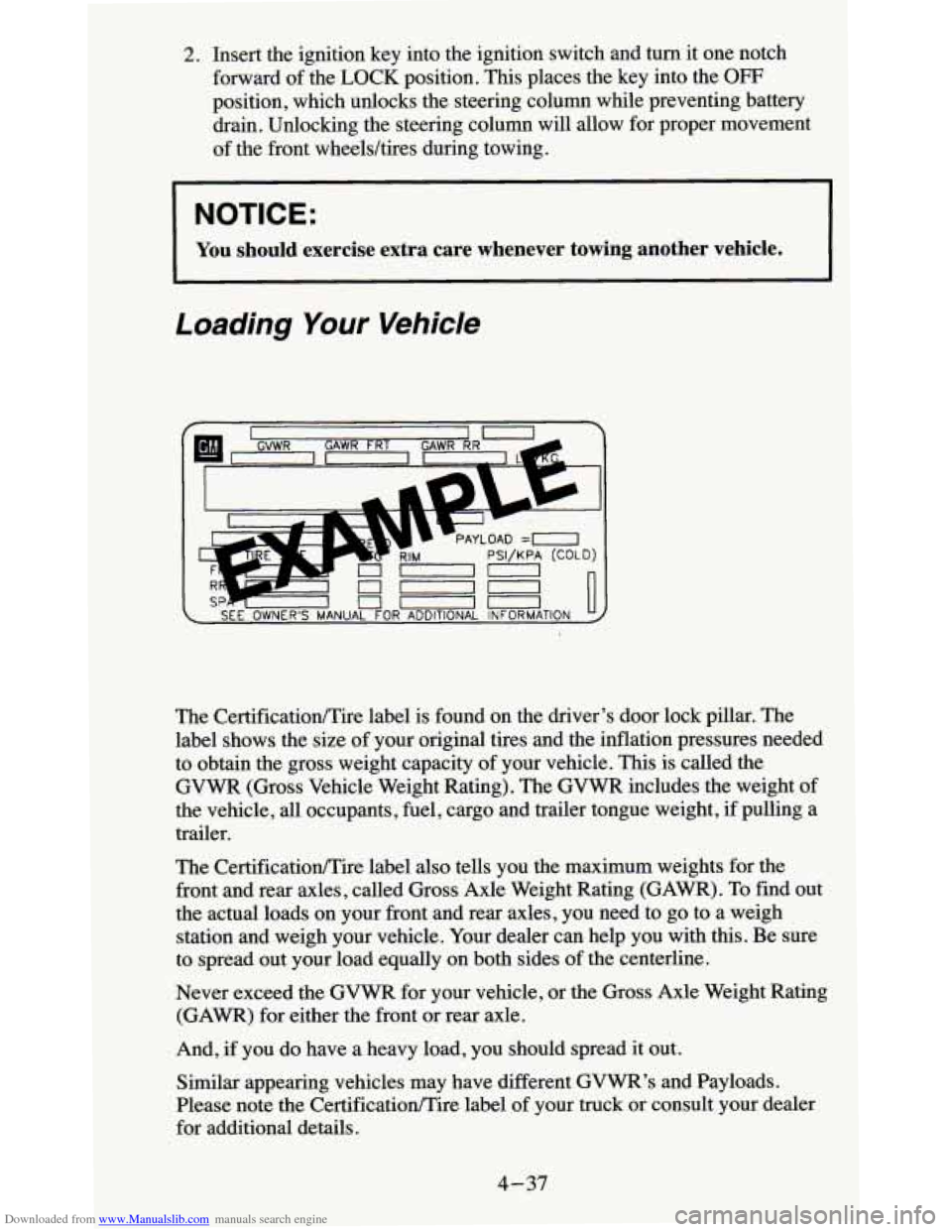
The CertificationEire label also tells you the maximum weights for the
front and rear axles, called Gross Axle Weight Rating (GAWR). To find out
the actual loads on your front and rear axles, you need to go to a weigh
station and weigh your vehicle. Your dealer can help
you with this. Be sure
to spread out your load equally on both sides
of the centerline.
Never exceed the
GVWR for your vehicle, or the Gross Axle Weight Rating
(GAWR) for either the front or rear axle.
And, if you do have
a heavy load, you should spread it out.
Similar appearing vehicles may have different
GVWR’s and Payloads.
Please note the CertificationEire label
of your truck or consult your dealer
for additional details.
4-37
Page 199 of 380
Downloaded from www.Manualslib.com manuals search engine Passing
You’ll need more passing distance up ahead when you’re towing a trailer.
And, because you’re a good deal longer, you’ll need to go much farther
beyond the passed vehicle before you can return to your lane.
Backing Up
Hold the bottom of the steering wheel with one hand. Then, to move the
trailer to the left, just move that hand to the left. To move the trailer to the
right, move your hand to the right. Always back up slowly and, if possible,
have someone guide you.
Making Turns
NOTICE:
Making very sharp turns while trailering could cause the traile\
r
to come in contact with the vehicle. Your vehicle could be
damaged. Avoid making very sharp turns while trailering.
When you’re turning with a trailer, make wider turns than normal. Do this
so your trailer won’t strike soft shoulders, curbs, road signs, trees, or other
objects. Avoid jerky or sudden maneuvers. Signal well in advance.
Turn Signals When Towing a Trailer
When you tow a trailer, your vehicle has to have extra wiring and a
heavy-duty
turn signal flasher (included in the optional trailering package).
The green arrows on your instrument panel will flash whenever you signal a
turn or lane change. Properly hooked up, the trailer lamps will also flash,
telling other drivers you’re about to turn, change lanes or stop.
When towing a trailer, the green arrows on your instrument panel will flash
for turns even if the bulbs on the trailer are burned out. Thus, you may think
drivers behind you are seeing your signal when they are not. It’s important
to check occasionally to be sure the trailer bulbs are still working.
Driving On Grades
Reduce speed and shift to a lower gear before you start down a long or steep
downgrade. If you don’t shift down, you might have to use your brakes
so
much that they would get hot and no longer work well.
On a long uphill grade, shift down and reduce your speed to around 45 mph
(70 Wh) to reduce the possibility of engine and transmission overheating.
4-45
Page 204 of 380
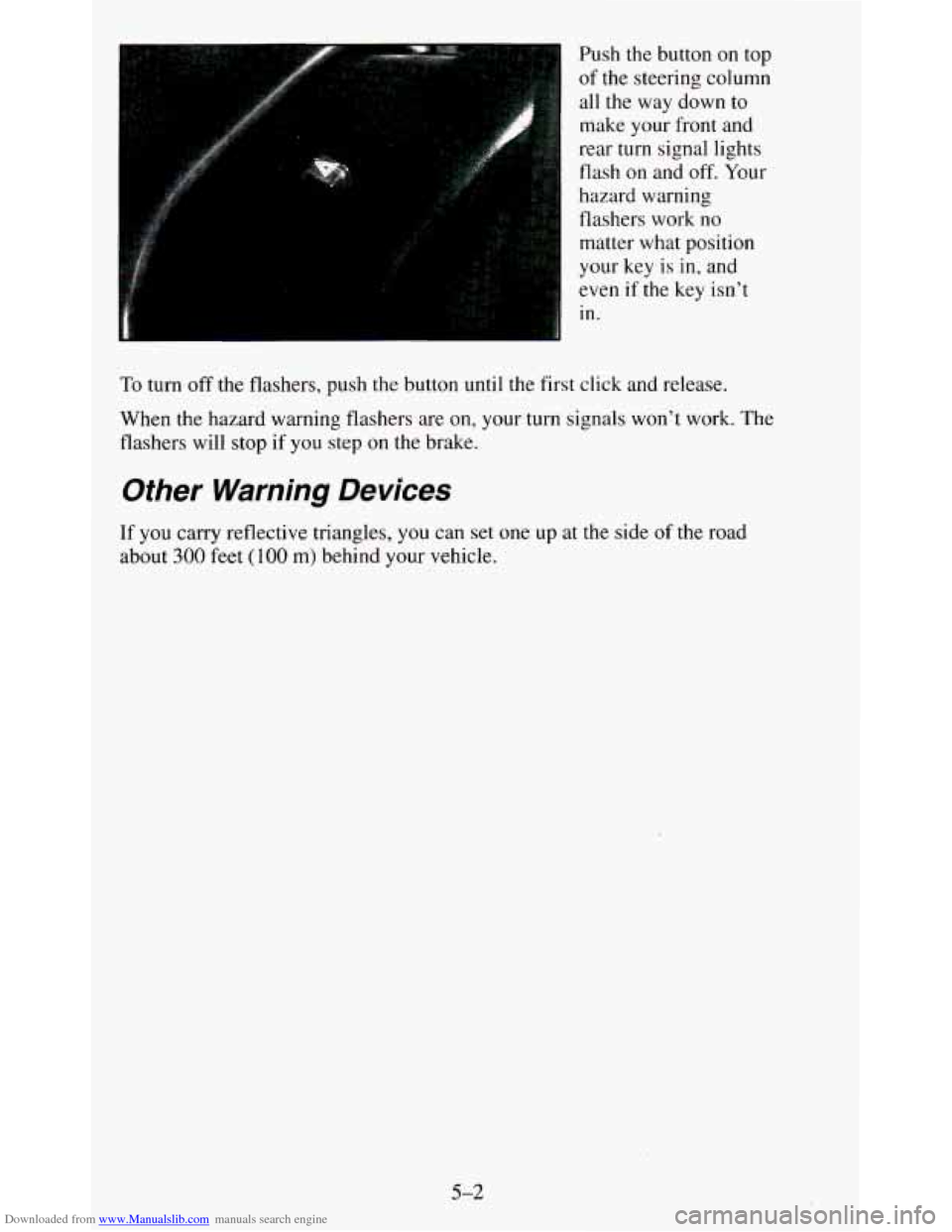
Downloaded from www.Manualslib.com manuals search engine , Push the button on top
i of the steering column
all
the way down to
make your front and
’ rear turn signal lights
flash on and off. Your
hazard warning
flashers work no matter what position
your key
is in, and
even if the key isn’t
in.
To turn off the flashers, push the button until the first click \
and release.
When the hazard warning flashers are on, your turn signals won\
’t work. The
flashers will stop if you step on the brake.
Other Warning Devices
If you carry reflective triangles, you can set one up at the side of the road
about
300 feet (100 m) behind your vehicle.
5-2