1995 CHEVROLET BLAZER fuel
[x] Cancel search: fuelPage 10 of 380
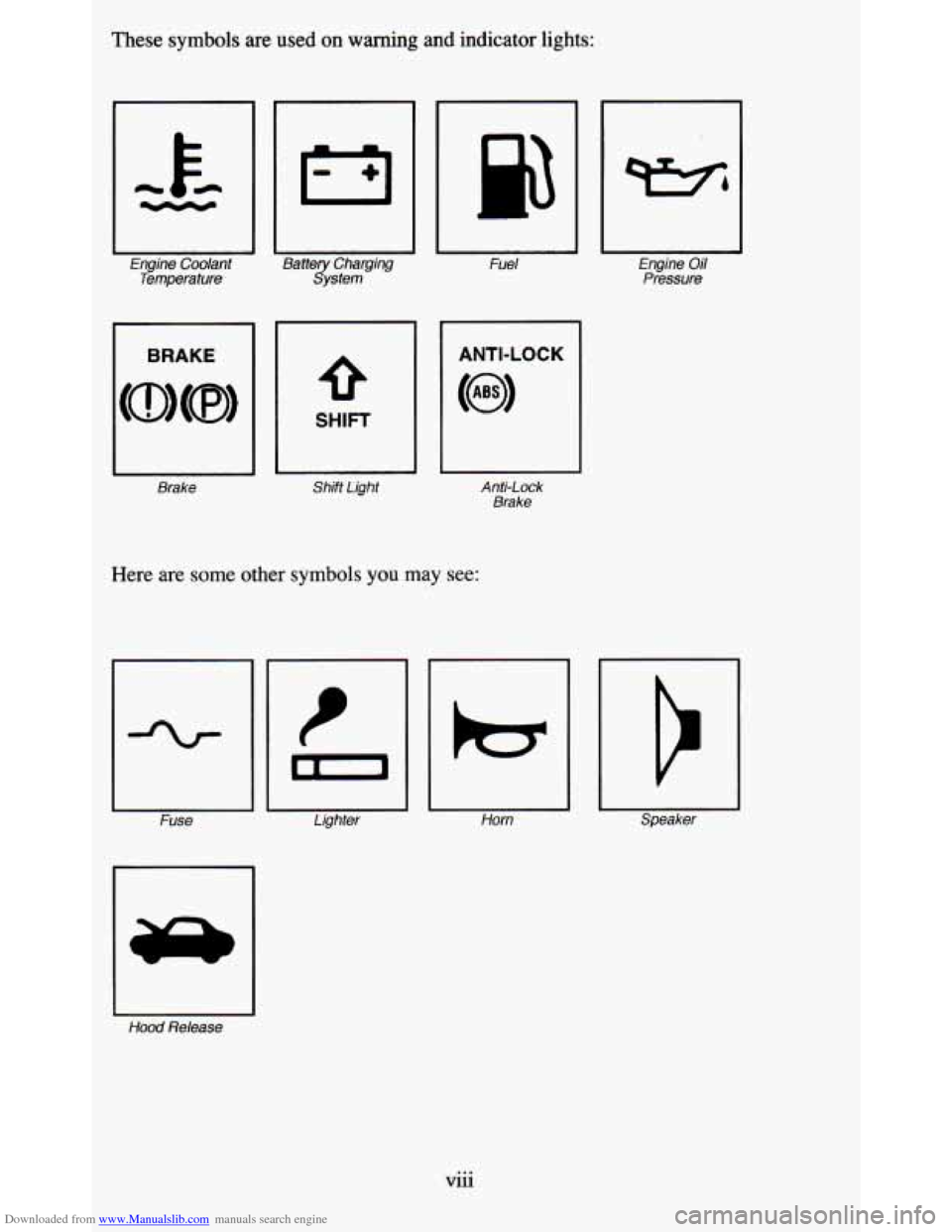
Downloaded from www.Manualslib.com manuals search engine These symbols are used on warning and indicator lights:
Engine Coolant
Temperature
I BRAKE
Brake
Battery Charging
System
1
Fuel
SHIFT
Shift Light
1 ANTI-LOCK
I
Anti-Lock Brake
Here are some other symbols you may see:
Fuse Lighter
I-
I-
Horn
L
Engine Oil Pressure
Hood
Release
Vlll ...
Page 69 of 380
Downloaded from www.Manualslib.com manuals search engine Manual transmission:
The gear selector should be in neutral. Hold the clutch pedal to the floor and
start the engine. Your vehicle won’t start if the clutch pedal
is not all the
way down
- that’s a safety feature.
To start your V6 engine:
1. Without pushing the accelerator pedal, turn your ignition key to
START. When the engine starts, let
go of the key. The idle speed will
go down as your engine gets warm.
NOTICE:
Holding your key in START for longer than 15 seconds at a time
will cause your battery to be drained much sooner. And the
excessive heat can damage your starter motor.
2. If it doesn’t start right away, hold your key in START. If it doesn’t start
in
10 seconds, push the accelerator pedal all the way down for 5
seconds, or until it starts.
3. If your engine still won’t start, wait 15 seconds to let the starter motor
cool down and do it all again.
When the engine starts, let go
of the key and the accelerator pedal.
NOTICE:
Your engine is designed to work with the electronics in your
vehicle.
If you add electrical parts or accessories, you could
change the
way the fuel injection system operates. Before adding
electrical equipment, check with your dealer.
If you don’t, your
~ engine might not perform properly.
If you ever have to have your vehicle towed, see the part of this
manual that tells how to do it without damaging your vehicle.
See “Towing Your Vehicle” in the Index.
2- 17
Page 70 of 380
Downloaded from www.Manualslib.com manuals search engine Driving Through Deep Standing Water
I NOTICE:
If you drive too quickly through deep puddles or standing water,
water can come in through your engine's air intake and badly
damage your engine. Never drive through water that is slightly
lower than the underbody
of your vehicle. If you can't avoid
deep puddles
or standing water, drive through them very slowly.
Engine Coolant Heater (Option)
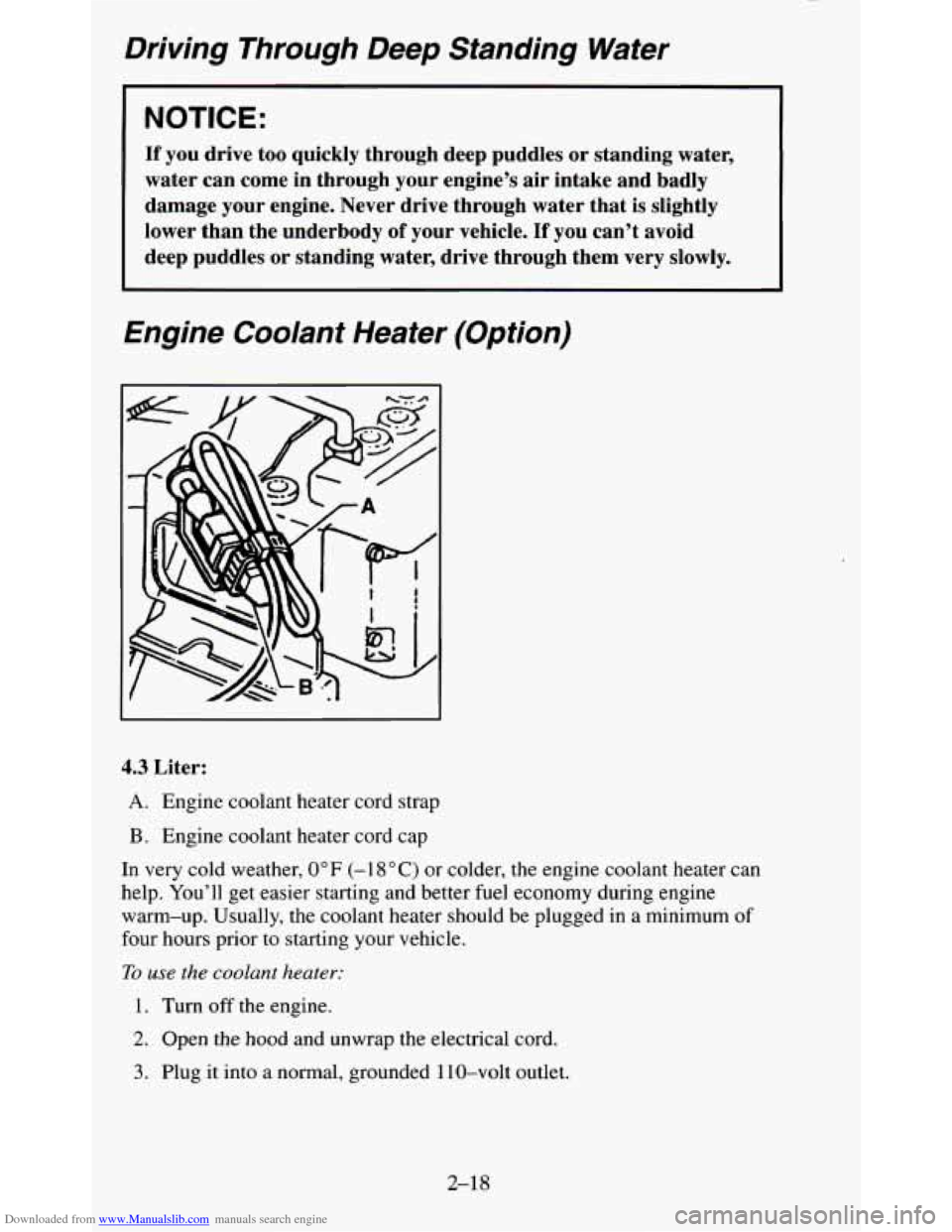
4.3 Liter:
A. Engine coolant heater cord strap
B. Engine coolant heater cord cap
In very cold weather, 0°F (-1 8 "C) or colder, the engine coolant heater can
help. You'll get easier starting and better fuel economy during engine
warm-up. Usually, the coolant heater should be plugged in a mi\
nimum
of
four hours prior to starting your vehicle.
To
use the coolant heater:
1. Turn off the engine.
2. Open the hood and unwrap the electrical cord.
3. Plug it into a normal, grounded 1 10-volt outlet.
2-18
Page 73 of 380
Downloaded from www.Manualslib.com manuals search engine NOTICE:
Damage to your transmission caused by shifting out of PARK
(P) or
NEUTRAL (N) with the engine racing isn’t covered by
your warranty.
OVERDRIVE (0) - This position is for normal driving. If you need
more power for passing, and you’re:
pedal about halfway down.
- Going less than about 35 mph (56 km/h), push your accelerator
- Going about 35 mph (56 kdh) or more, push the accelerator all
the way down.
You’ll shift down
to the next gear and have more power.
OVERDRIVE (a) should not be used when towing a trailer,
carrying
a heavy load, driving on steep hills, or for off-road
driving. Select
DRIVE (D) when operating the vehicle under any
of these conditions.
0 DRIVE (D) - This is like @, but you never go into Overdrive. You
should
use DRIVE (D) when towing a trailer, carrying a heavy load,
driving on steep
hills, or for off-road driving.
SECOND GEAR (2) - This position gives you more power but lower
fuel economy. You
can use SECOND GEAR (2) on hills. It can help
control your speed as you
go down steep mountain roads, but then you
would also want to use your brakes off and on.
If you manually select
SECOND GEAR (2), the transmission will drive
in second gear. You may use this feature for reducing torque to the rear
wheels when
you are trying to start your vehicle from a stop on
slippery road surfaces.
2-21
Page 74 of 380
Downloaded from www.Manualslib.com manuals search engine FIRST GEAR (1) - This position gives you even more power (but
lower fuel economy) than SECOND GEAR (2).
You can use it on very
steep hills,
or in deep snow or mud. If the selector lever is put in FIRST
GEAR
(1) while the vehicle is moving forward, the transmission won’t
shift into FIRST GEAR
(1) until the vehicle is going slowly enough.
NOTICE:
If your rear wheels can’t rotate, don’t try to drive. This might
happen
if you were stuck in very deep sand or mud or were up
against a solid object. You could damage your transmission.
Also,
if you stop when going uphill, don’t hold your vehicle there
with only the accelerator pedal. This could overheat and damage
the transmission. Use your brakes or shift into
PARK (P) to hold
your vehicle in position on a hill.
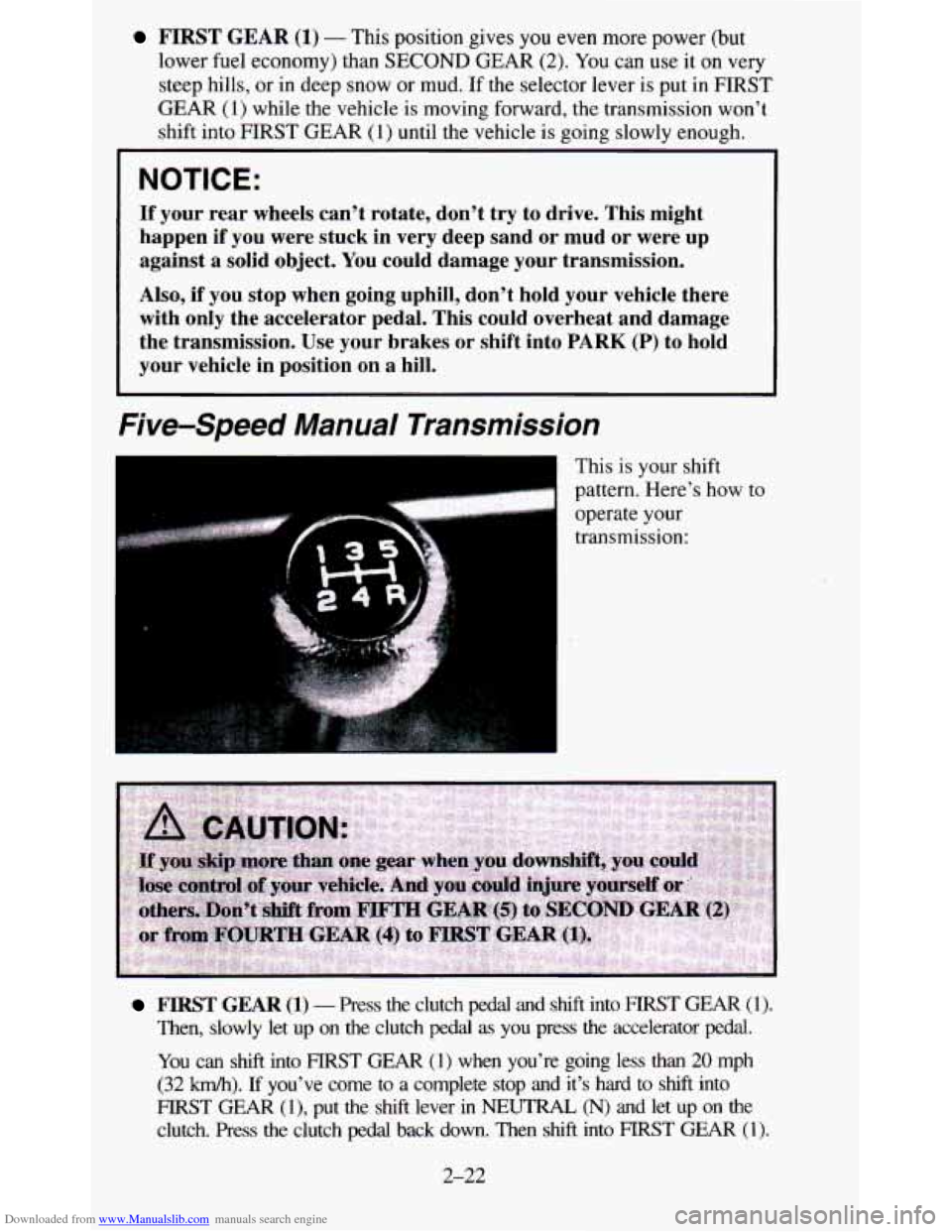
Five-Speed Manual Transmission
.- I
This is your shift
pattern. Here’s how
to
operate your
transmission:
FIRST GEAR (1) - Press the clutch pedal and shift into FlRST GEAR (1).
Then, slowly let up on the clutch pedal as you press the accelerator pedal.
You can shift into FIRST GEAR (1) when you’re going less than 20 mph
(32
km/h). If you’ve come to a complete stop and it’s hard to shift into
FIRST GEAR (1)’ put the shift lever in NEUTRAL, (N) and let up on the
clutch. Press the clutch pedal back down. Then shift into FIRST GEAR (1).
2-22
Page 75 of 380
Downloaded from www.Manualslib.com manuals search engine 0 SECOND GEAR (2) - Press the clutch pedal as you let up on the
accelerator pedal and shift into SECOND GEAR
(2). Then, slowly let
up on
the clutch pedal as you press the accelerator pedal.
0 THIRD, FOURTH AND FIFTH GEARS (3,4 and 5) - Shift into
THIRD GEAR
(3), FOURTH GEAR (4), and FIFTH GEAR (5) the
same way you do for SECOND GEAR
(2). Slowly let up on the clutch
pedal as
you press the accelerator pedal.
Just before the vehicle stops, press the clutch pedal
and the brake pedal,
and shift to
NEUTRAL (N).
To Stop - Let up on the accelerator pedal and press the brake pedal.
NEUTRAL (N) - Use this position when you start or idle your engine.
REVERSE (R) - To back up, press down the clutch pedal, wait about
6 seconds, then shift into REVERSE (R). Then let up on the clutch
pedal slowly while pressing
the accelerator pedal.
NOTICE:
Shift to REVERSE (R) only after your vehicle is stopped.
Shifting to REVERSE (R) while your vehicle is moving could
damage your transmission.
Also, use REVERSE (R), along with the parking brake, for parking
your vehicle.
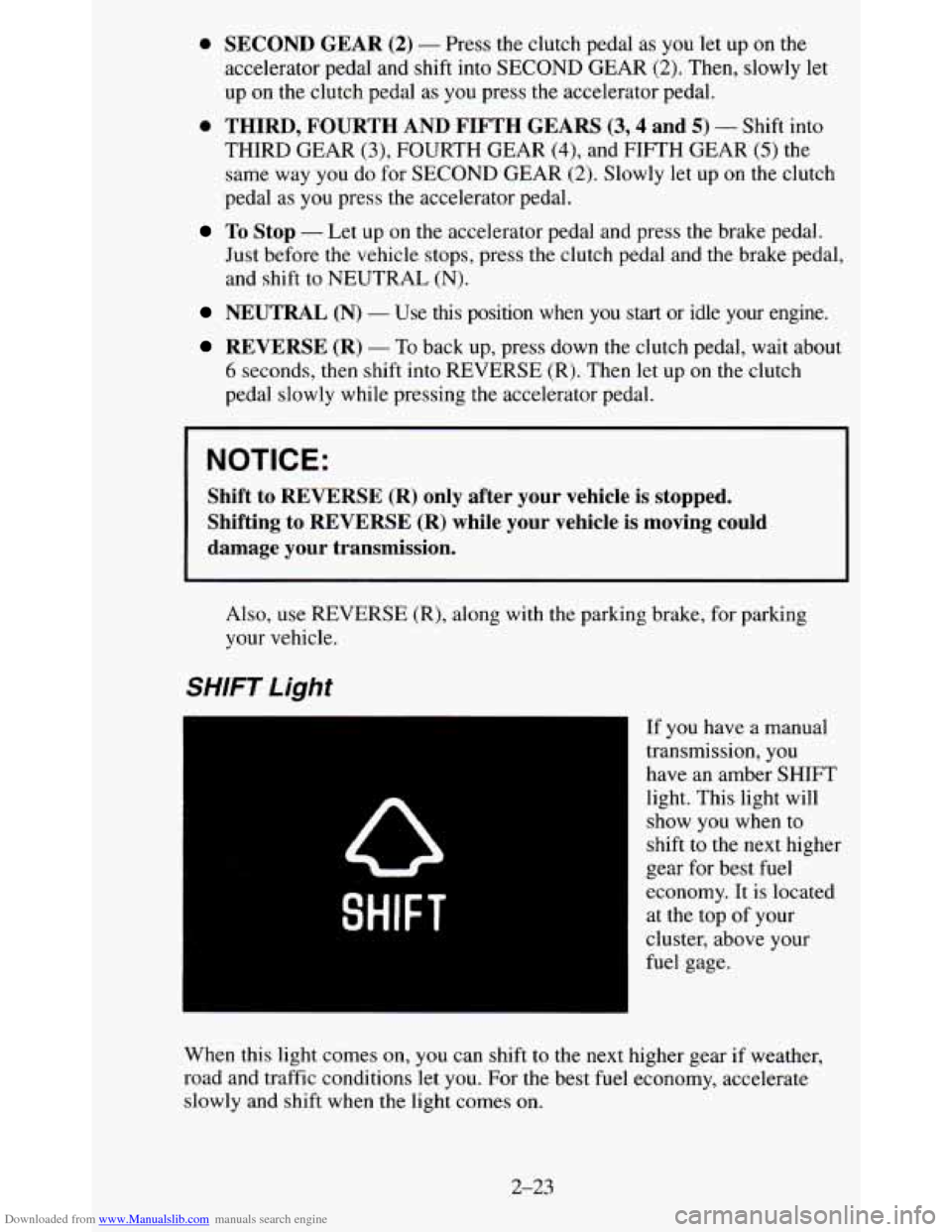
SHIFT Light
SHIFT
If you have a manual
transmission, you
have an amber SHIFT
light. This light will
show you when to
shift to the next higher
gear for best fuel
economy. It is located
at the top of your
cluster, above your
fuel gage.
When this light comes on,
you can shift to the next higher gear if weather,
road and traffic conditions let you. For the best fuel economy, accelerate
slowly and shift when the light comes
on.
2-23
Page 83 of 380
Downloaded from www.Manualslib.com manuals search engine dealer check your system. Turn the INT LIGHTS switch located to the righl
of your headlight switch to dim your transfer case indicator light when you1
headlights or parking lights are on. This will also cause your instrument
panel lights to dim.
2HI - This setting is for driving in most street and highway situations.
Your front axle is not engaged in two-wheel drive.
4HI - This setting engages your front axle to help drive your vehicle. Use
4HI when you need extra traction, such as on snowy or icy roads, or in mos
off-road situations.
N SET PARK BRAKE - Shift to this neutral setting only when your
vehicle needs to be towed.
4LO - This setting also engages your front axle to give you extra traction
and provides extra gear reduction. You may never need 4LO. It sends the
maximum power to all four wheels. You might choose 4LO if
you were
driving off-road in sand, mud, or deep snow and climbing or descending
steep hills.
You can shift from 2HI to 4HI or from 4HI to 2HI while the vehicle is
moving.
Do not press the transfer case shift lever button when shifting fron
2HI to 4HI or from 4HI to 2HI. Your front axle will engage faster
if you
take your foot off
of the accelerator for a few seconds after you shift.
To shift your transfer case into N SET PARK BRAKE:
1. Stop the vehicle and shift your transmission into NEUTRAL (N).
2. Set the parking brake. Your vehicle can roll unless the brakes are
3. Pull the transfer case shift lever into N SET PARK BRAKE.
applied.
To shift into or out
of 4LO:
1. The vehicle must be stopped or moving less than 3 mph (4.8 kdh)
with the transmission in NEUTRAL
(N) for an automatic transmission
or the clutch pedal depressed with a manual transmission.
2. Press the transfer case shift button and shift in one continuous motion.
Don’t pause in
N SET PARK BRAKE as you shift into or out of 4L0, or
your gears could clash.
Remember that driving in 4HI or 4LO may reduce fuel economy. Also,
driving in four-wheel
drive on dry pavement could cause your tires to wea
faster and make your transfer case harder to shift and reduce powertrain
longevity.
2-31
Page 117 of 380
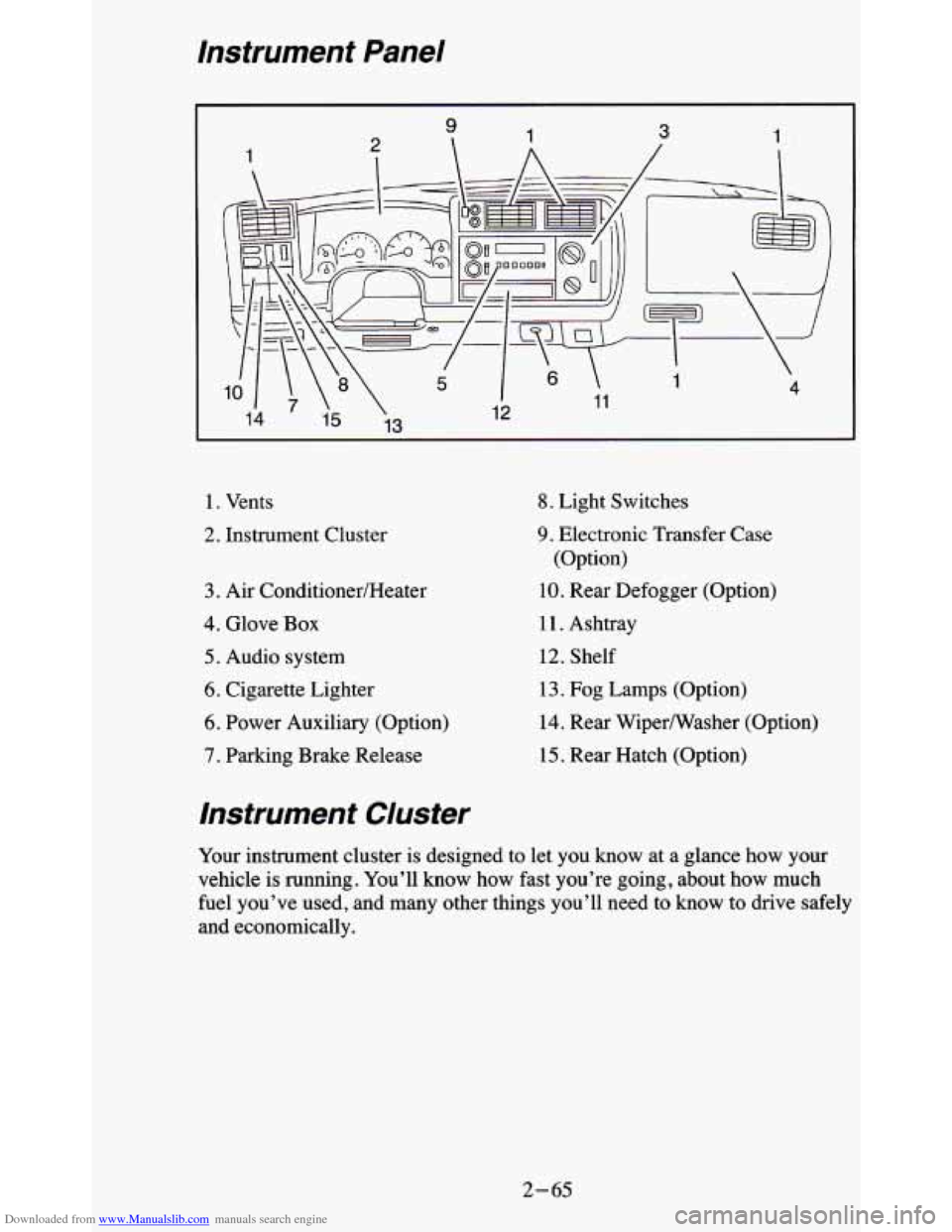
Downloaded from www.Manualslib.com manuals search engine Instrument Panel
1. Vents
2. Instrument Cluster
3. Air ConditionedHeater
4. Glove Box
5. Audio system
6. Cigarette Lighter
6. Power Auxiliary (Option)
7. Parking Brake Release
8. Light Switches
9. Electronic Transfer Case
(Option)
10. Rear Defogger (Option)
11. Ashtray
12. Shelf
13. Fog Lamps (Option)
14. Rear Wipermasher (Option)
15. Rear Hatch (Option)
Instrument Cluster
Your instrument cluster is designed to let you know at a glance how your
vehicle
is running. You’ll know how fast you’re going, about how much
fuel you’ve used, and many other things you’ll need to know to drive safely
and economically.
2- 65