1995 CHEVROLET BLAZER warning light
[x] Cancel search: warning lightPage 186 of 380
Downloaded from www.Manualslib.com manuals search engine Winter Driving
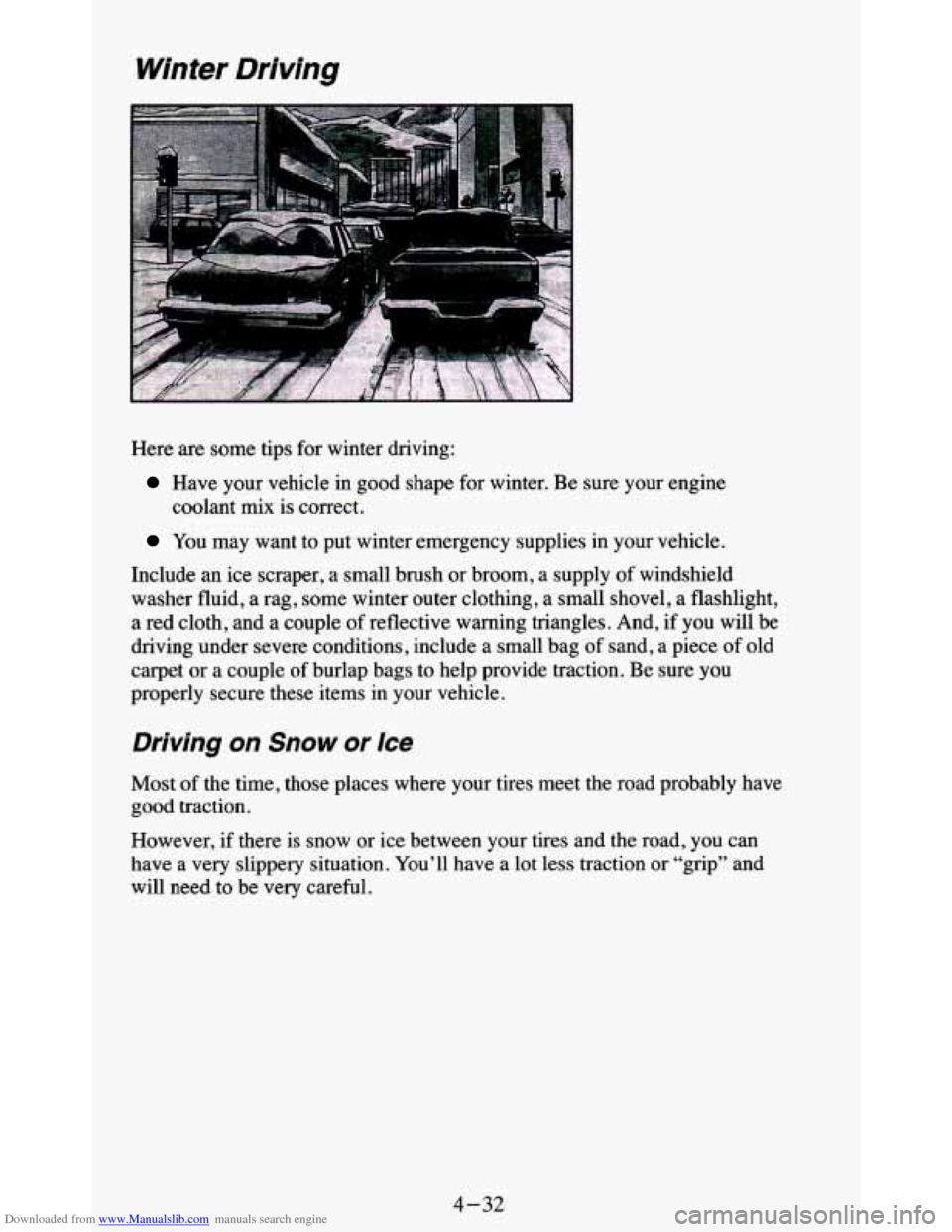
Here are some tips for winter driving:
Have your vehicle in good shape for winter. Be sure your engine
coolant mix is correct.
You may want to put winter emergency supplies in your vehicle.
Include an ice scraper, a small brush or broom, a supply of windshield
washer fluid, a rag, some winter outer clothing, a small shovel,
a flashlight,
a red cloth, and a couple of reflective warning triangles. And,
if you will be
driving under severe conditions, include a small bag
of sand, a piece of old
carpet or a couple
of burlap bags to help provide traction. Be sure you
properly secure these items in your vehicle.
Driving on Snow or Ice
Most of the time, those places where your tires meet the road probably have
good traction.
However, if there is snow or ice between your tires and the road,
you can
have a very slippery situation. You’ll have a lot less traction or “grip” and
will need to be very careful.
4-32
Page 203 of 380
Downloaded from www.Manualslib.com manuals search engine Problems on the Road
Section
Here you’ll find what to do about some problems that can occur on the road.
Hazard Warning Flashers
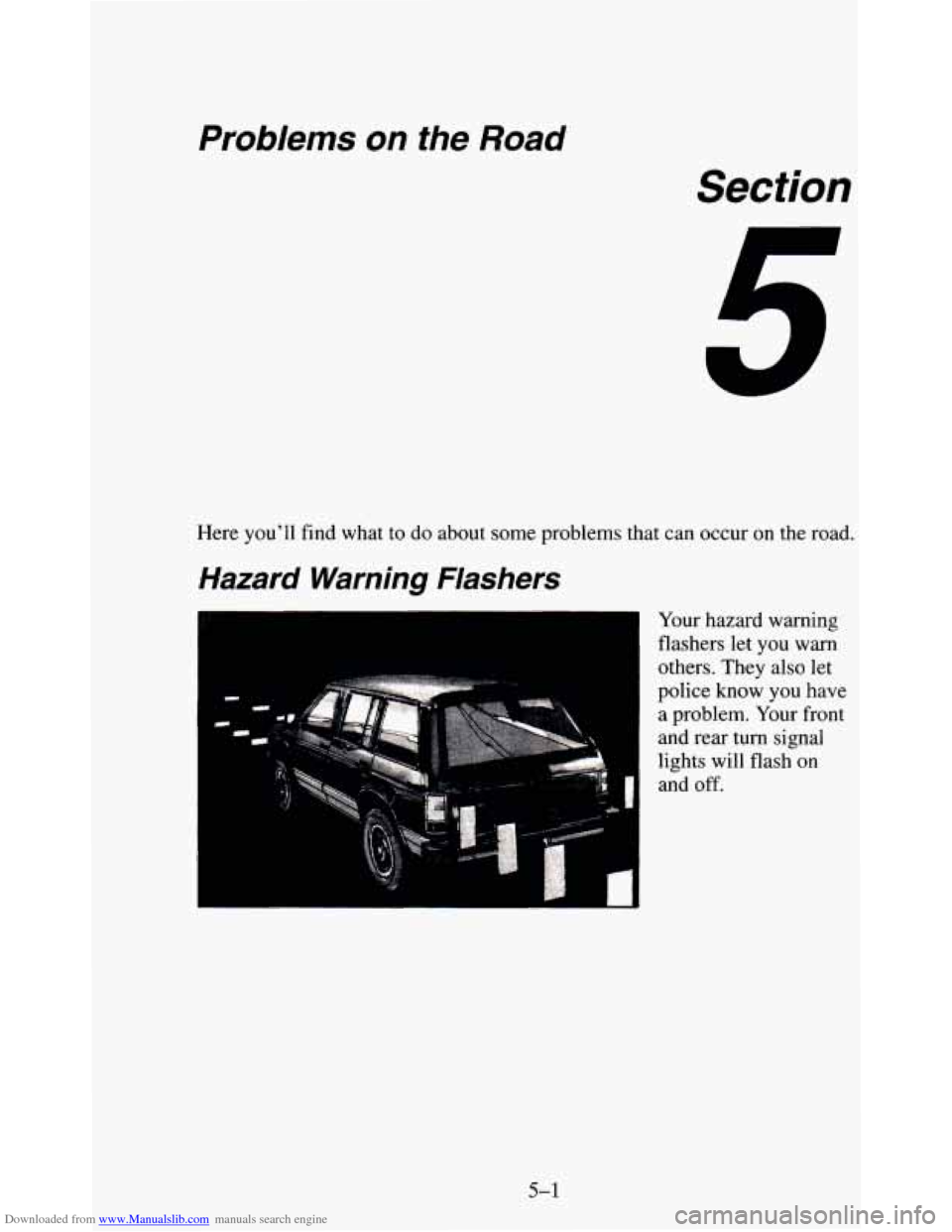
Your hazard warning
flashers let you warn
others. They also let
police know you have
a problem. Your front
and rear turn signal
lights will flash on
and
off.
5-1
Page 204 of 380
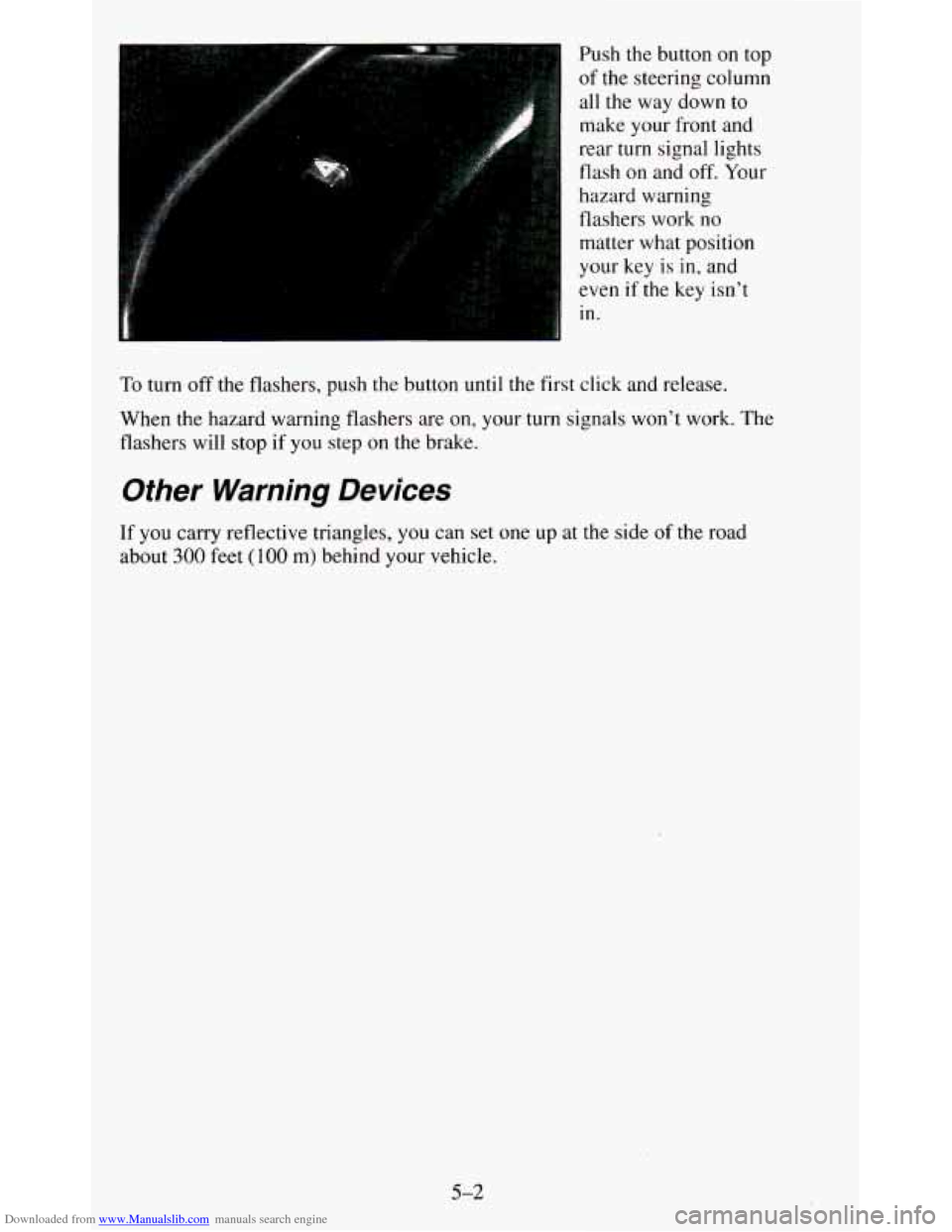
Downloaded from www.Manualslib.com manuals search engine , Push the button on top
i of the steering column
all
the way down to
make your front and
’ rear turn signal lights
flash on and off. Your
hazard warning
flashers work no matter what position
your key
is in, and
even if the key isn’t
in.
To turn off the flashers, push the button until the first click \
and release.
When the hazard warning flashers are on, your turn signals won\
’t work. The
flashers will stop if you step on the brake.
Other Warning Devices
If you carry reflective triangles, you can set one up at the side of the road
about
300 feet (100 m) behind your vehicle.
5-2
Page 261 of 380
Downloaded from www.Manualslib.com manuals search engine How to Check Lubricant
,:
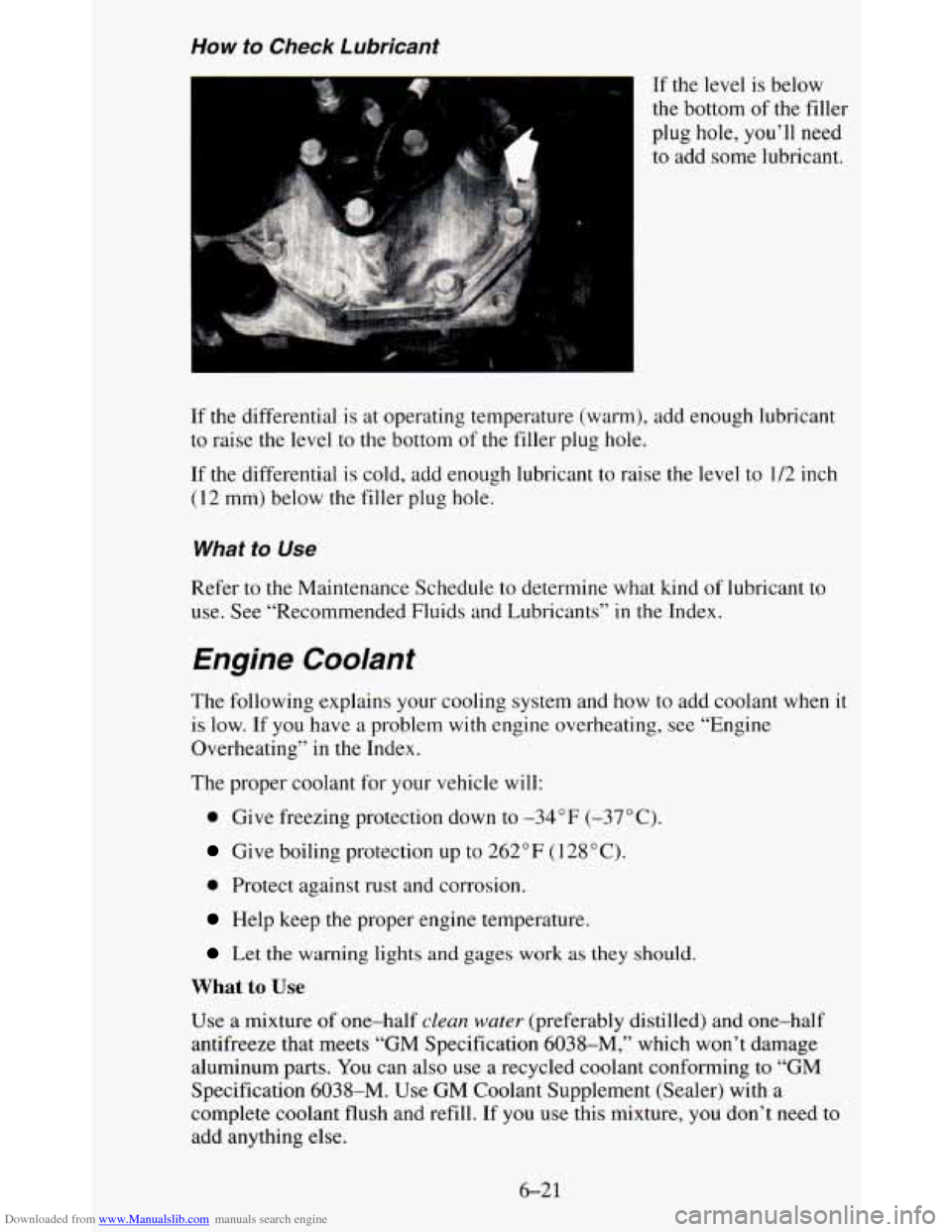
If the level is below
the bottom
of the filler
plug hole, you’ll need
to add some lubricant.
If the differential
is at operating temperature (warm), add enough lubricant
to raise the level to the bottom of the filler plug hole.
If the differential is cold, add enough lubricant to raise the le\
vel to 1/2 inch
(12 mm) below the filler plug hole.
What to Use
Refer to the Maintenance Schedule to determine what kind of lubricant to
use. See “Recommended Fluids and Lubricants”
in the Index.
Engine Coolant
The following explains your cooling system and how to add coolant \
when it
is low. If you have a problem with engine overheating, see “Engine
Overheating”
in the Index.
The proper coolant
for your vehicle will:
0 Give freezing protection down to -34°F (-37°C).
Give boiling protection up to 262°F (128°C).
0 Protect against rust and corrosion.
Help keep the proper engine temperature.
Let the warning lights and gages work as they should.
What to Use
Use a mixture of one-half clean water (preferably distilled) and one-half
antifreeze that meets “GM Specification 6038-M,” which won’t damage
aluminum parts.
You can also use a recycled coolant conforming to “GM
Specification 6038-M.
Use GM Coolant Supplement (Sealer) with a
complete coolant flush and refill. If
you use this mixture, you don’t need to
add anything else.
6-21
Page 269 of 380
Downloaded from www.Manualslib.com manuals search engine Brake Wear
Your vehicle has front disc brakes and rear drum brakes.
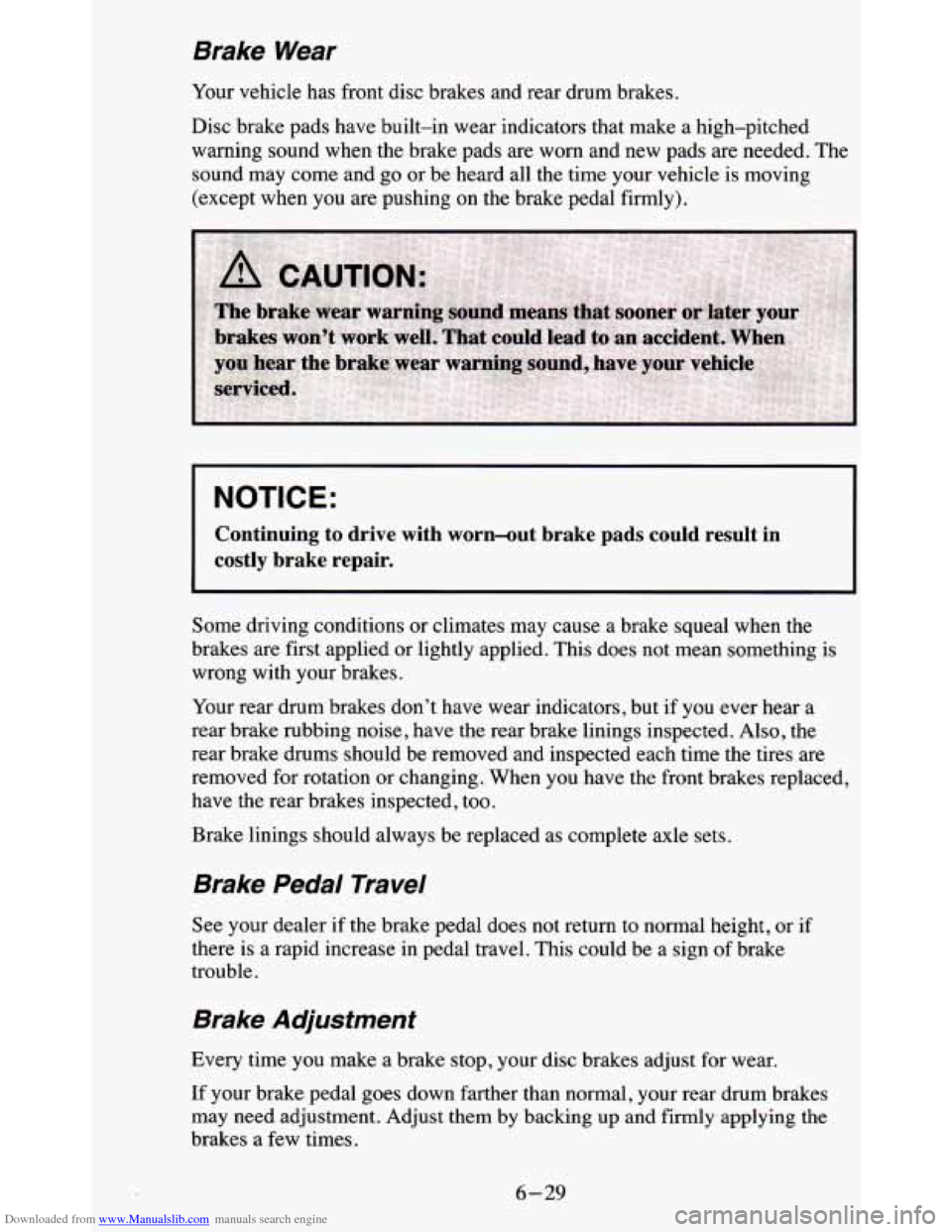
Disc brake pads have built-in wear indicators that make
a high-pitched
warning sound when the brake pads are worn and new pads are needed. The
sound may come and go or be heard all the time your vehicle is moving
(except when you are pushing on the brake pedal firmly).
NOTICE:
Continuing to drive with worn-out brake pads could result in
costly brake repair.
Some driving conditions or climates may cause a brake squeal when the
brakes
are first applied or lightly applied. This does not mean something is
wrong with your brakes.
Your rear drum brakes don’t have wear indicators, but if you
i?v& hear a
rear brake rubbing noise, have the rear brake linings inspected. Also, the
rear brake drums should be removed and inspected each time the tires are
removed for rotation or changing. When you have the front brakes replaced,
have the rear brakes inspected, too.
Brake linings should always be replaced as complete axle sets.
Brake Pedal Travel
See your dealer if the brake pedal does not return to normal height, or if
there is
a rapid increase in pedal travel. This could be a sign of brake
trouble.
Brake Adjustment
Every time you make a brake stop, your disc brakes adjust for wear.
If your brake pedal goes down farther than normal, your rear drum brakes
may need adjustment. Adjust them by backing up and firmly applying the
brakes a few times.
6-29
Page 369 of 380
Downloaded from www.Manualslib.com manuals search engine Index
A
Air Bag (See “Supplemental Inflatable Restraint System (SIR)”)
Readiness Light (See “Lights”)
Accessory Power Outlets
.......................................... 2-54
Aircleaner ..................................................... 6-13
Air Conditioning (See “Heater/Air Conditioning Controls”)
All-Wheel Drive (Option)
.................................... 2-29. 6-20
Antennacare ................................................... 3-19
Anti-Lock Brakes (See “Brakes”)
Appearancecare
................................................ 6-48
Materials Chart ............................................... 6-57
Arbitration Program (See “Better Business Bureau Mediation”)
Audiosystems
................................................... 3-5
AM-FM Stereo Audio Compact Disc (CD) System ................... 3-13
AM-FM Stereo Audio System .................................... 3-6
AM-FM Stereo Audio Cassette System ............................. 3-8
Care of Your Cassette Tape Player ................................ 3-18
Care of Your Compact Disc ..................................... 3-19
Delco LOC II@ Anti-Theft Feature ............................... 3-16
AM-FM Stereo Audio Cassette System with Equalizer ................ 3-10
Understanding Radio Reception .................................. 3-17
Automatic Transmission ( See “Transmission”)
Axle
Front
....................................................... 6-20
Locking ..................................................... 2-24
Rear ........................................................ 6-19
Battery ........................................................ 6-30
Belts (See “Safety Belts”)
Better Business Bureau Mediation
.................................... 8-3
Blizzard (See “Driving-If You’re Caught in a Blizzard”)
Brakes Adjustment
.................................................. 6-29
Anti-Lock .................................................... 4-6
Anti-Lock Warning Light (See “Lights”)
To Check Brake Fluid .......................................... 6-28
Master Cylinder .............................................. 6-27
Parking ..................................................... 2-24
PedalTravel ................................................. 6-29
Replacing Parts ............................................... 6-30
System Warning Light (See “Lights”)
Trailer (See “Trailer Brakes”)
Wear
....................................................... 6-29
Braking ......................................................... 4-5
InEmergencies ................................................ 4-7
Break-In. New Vehicle ............................................ 2-14
1
Page 373 of 380
Downloaded from www.Manualslib.com manuals search engine Hood Checking Under. Hood Release
................................... 6-6
Horn .......................................................... 2-36
Hydraulic Clutch ................................................ 6-18
Hydroplaning (See “Driving in the Rain”)
I
If You’re Stuck in Sand. Mud. Ice. or Snow ........................... 5-35
Ignitionswitch .................................................. 2-14
Inflation-Tire Pressure ( See “Tires”)
Instrument Cluster
............................................... 2-65
Instrument Panel ................................................ 2-65
J
Jacking Equipment Storage ........................................ 5-22
Jump Starting .......... ....................................... 5-3
K
Key Release Button .............................................. 2-16
Keyless Entry System ............................................. 2-6
Keys ........................................................... 2-1
L
Labels
Lamps CertificatiodTire
.............................................. 4-37
Bulb Replacement ............................................. 6-31
Domes ...................................................... 2-50
FogLamps .................................................. 2-48
Front
Parkingmum Signal ....................................... 6-34
Headlights (See “Headlamps”)
Lamp and Bulb Data
........................................... 6-64
Operation of Lighting System .................................... 2-38
Overhead Console Reading ...................................... 2-58
RearLamps .................................................. 6-35
Air Bag Readiness Light ........................................ 2-69
Anti-Lock Brake System Warning Light ........................... 2-71
BrakeSystemLight ............................................ 2-70
Charging System Light ......................................... 2-74
CheckGagesLight ............................................ 2-74
Daytime Running Lamps (DRL) Light ............................. 2-75
Headlamp High Beam Light ..................................... 2-76
Headlights (See “Headlamps”)
Malfunction Indicator
..................................... 2-72. 641
Safety Belt Reminder Light ..................................... 2-69
Service Engine Soon (See “Malfunction Indicator”)
ShiftLight
.............................................. 2-23. 2-75
Turn Signal and Lane Change Light ............................... 2-76
Lights
5
Page 375 of 380
Downloaded from www.Manualslib.com manuals search engine Radiator Pressure Cap ............................................ 6-24
Radio (See “Audio Systems”)
Rear Axle (See “Axle”)
Rear Safety Belt Comfort Guides (See “Safety Belts”)
Rear Window Defogger
............................................ 3-3
Recommended Fluids and Lubricants ................................ 740
Recovery Hooks
................................................. 5-36
Replacement Parts
............................................... 6-62
Reporting Safety Defects
To The United States Government ............... 8-4
Roadside Assistance ............................................... 8-6
RockingYourVehicle
............................................ 5-36
S
SafetyBelts ..................................................... 1-7
Center Front Passenger Position (&Door Model) .................... 1-23
Center Rear Passenger Position (4-Door Models)
.................... 1-29
Cleaning
.................................................... 6-52
Checking Restraint System
...................................... 140
Child Restraints
............................................... 1-32
Center Seat Position (&Door Models)
.......................... 1-35
Larger Children
............................................ 1-38
Right Front Seat Position
..................................... 1-36
Rear Outside Seat Position
................................... 1-33
TopStrap .................................................. 1-32
Where to Put the Restraint
.................................... 1-32
Children
.................................................... 1-30
DriverPosition ............................................... 1-11
Extender
..................................................... 1-40
Properwear ................................................. 1-11
Rear Safety Belt Comfort Guides
................................. 1-27
Reminder Light (See “Lights”)
Replacing Seat and Restraint Parts After a Crash
..................... 1-40
Right Front Passenger Position ................................... 1-22
LapBelt
..................................................... 1-23
Questions
& Answers .......................................... 1-10
RearSeatPassengers ........................................... 1-24
Use During Pregnancy
......................................... 1-22
Why Safety Belts Work
.......................................... 1-8
Safety Chains (See “Towing a Trailer”)
Safety Defects
Reporting Safety Defects to Canada
................................ 8-5
Reporting Safety Defects to General Motors ......................... 8-5
Reporting Safety Defects to the United States ........................ 8-4
Safety Warnings and Symbols
........................................ iv
Scheduled Maintenance Services Maintenance Record
........................................... 7-42
Maintenance Schedule
I ......................................... 7-6
MaintenanceSchedulen
........................................ 7-26
Periodic Maintenance
.......................................... 7-38
Recommended: Fluids and Lubricants
.............................. 7-40
Selecting the Right Schedule
..................................... 7-3
Using Your Maintenance Schedule
................................. 7-3
7