Page 101 of 380
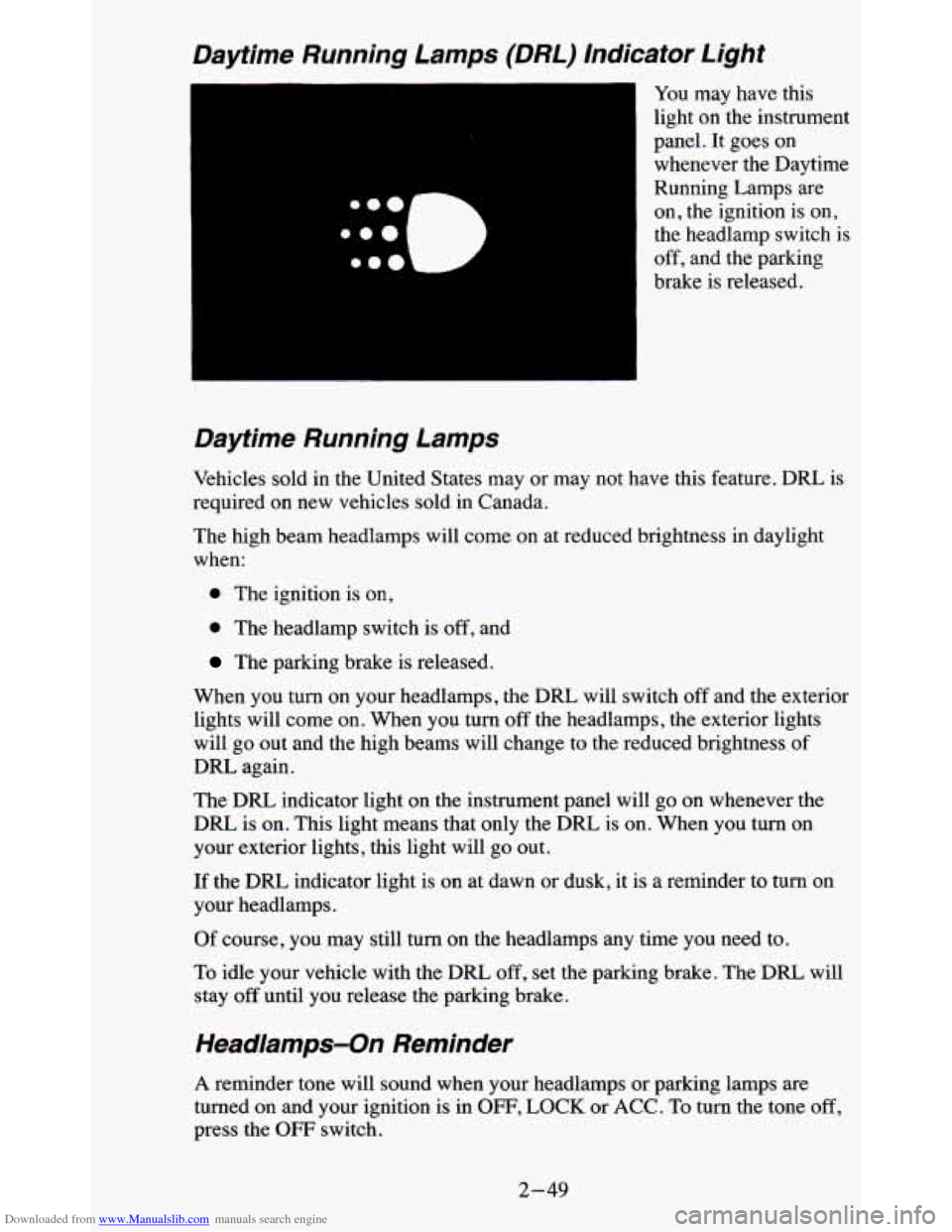
Downloaded from www.Manualslib.com manuals search engine Daytime Running Lamps (DRL) Indicator Light
You may have this
light on the instrument
panel. It goes on whenever the Daytime
Running Lamps are
on, the ignition is on,
the headlamp switch is
off, and the parking
brake is released.
Daytime Running Lamps
Vehicles sold in the United States may or may not have this feature. DRL is
required on new vehicles sold in Canada.
The high beam headlamps will come on at reduced brightness in daylight
when:
0 The ignition is on,
0 The headlamp switch is off, and
The parking brake is released.
When you turn on your headlamps, the DRL will switch
off and the exterior
lights will come
on. When you turn off the headlamps, the exterior lights
will go out and the high beams will change to the reduced brightness
of
DRL again.
The
DRL indicator light on the instrument panel will go on whenever the
DRL is
on. This light means that only the DRL is on. When you turn on
your exterior lights, this light will go out.
If the DRL indicator light is on at dawn or dusk, it is a reminder to turn on
your headlamps.
Of course, you may still turn on the headlamps any time you need to.
To idle your vehicle with the
DRL, off, set the parking brake. The DRL will
stay
off until you release the parking brake.
Headlamps-On Reminder
A reminder tone will sound when your headlamps or parking lamps are
turned on and your ignition is in OFF, LOCK or ACC. To turn the tone off,
press the OFF switch.
2-49
Page 102 of 380
Downloaded from www.Manualslib.com manuals search engine Dome Lamps
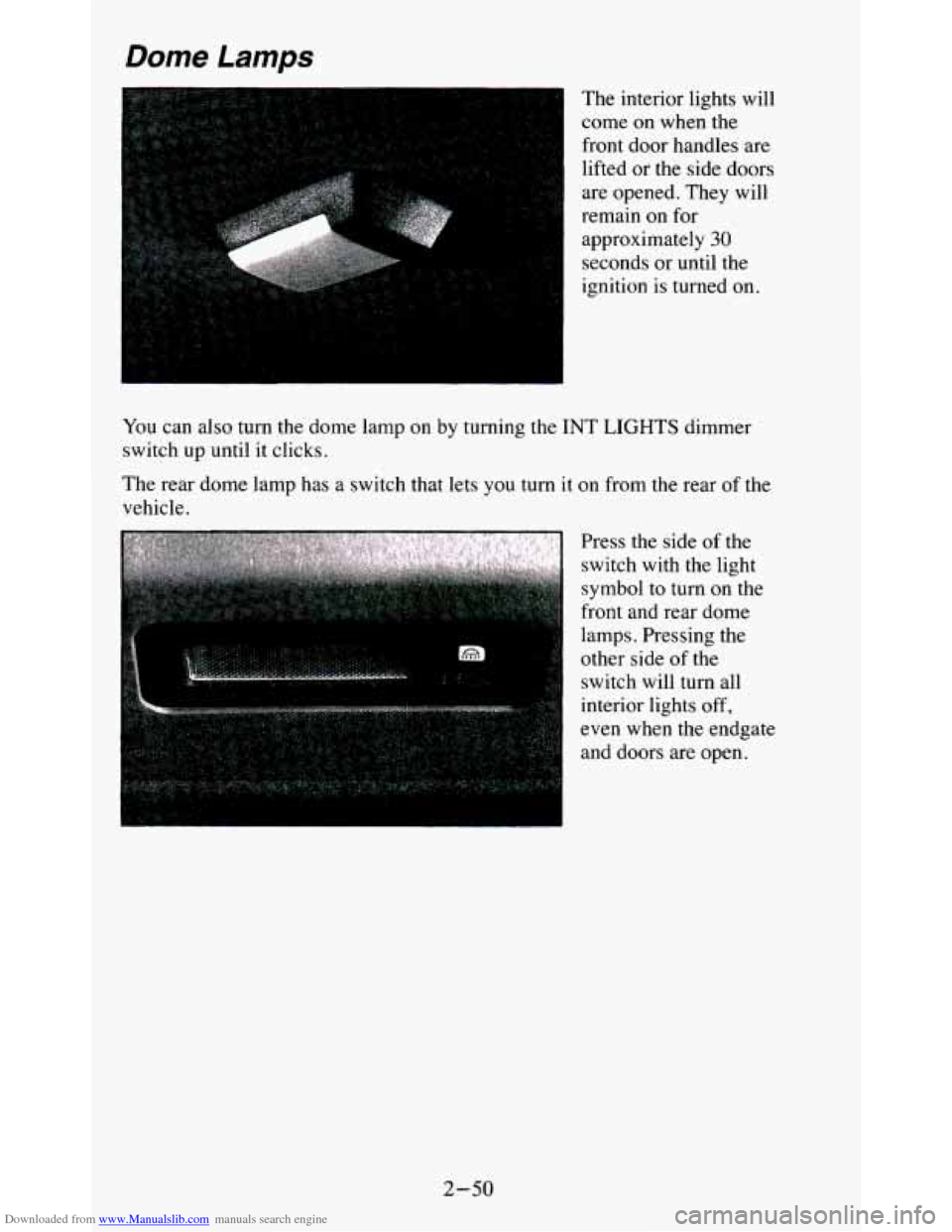
The interior lights will
come on when the
front door handles are
lifted or the side doors
are opened. They will
remain
on for
approximately
30
seconds or until the
ignition is turned
on.
You can also turn the dome lamp on by turning the INT LIGHTS dimmer
switch up until it clicks.
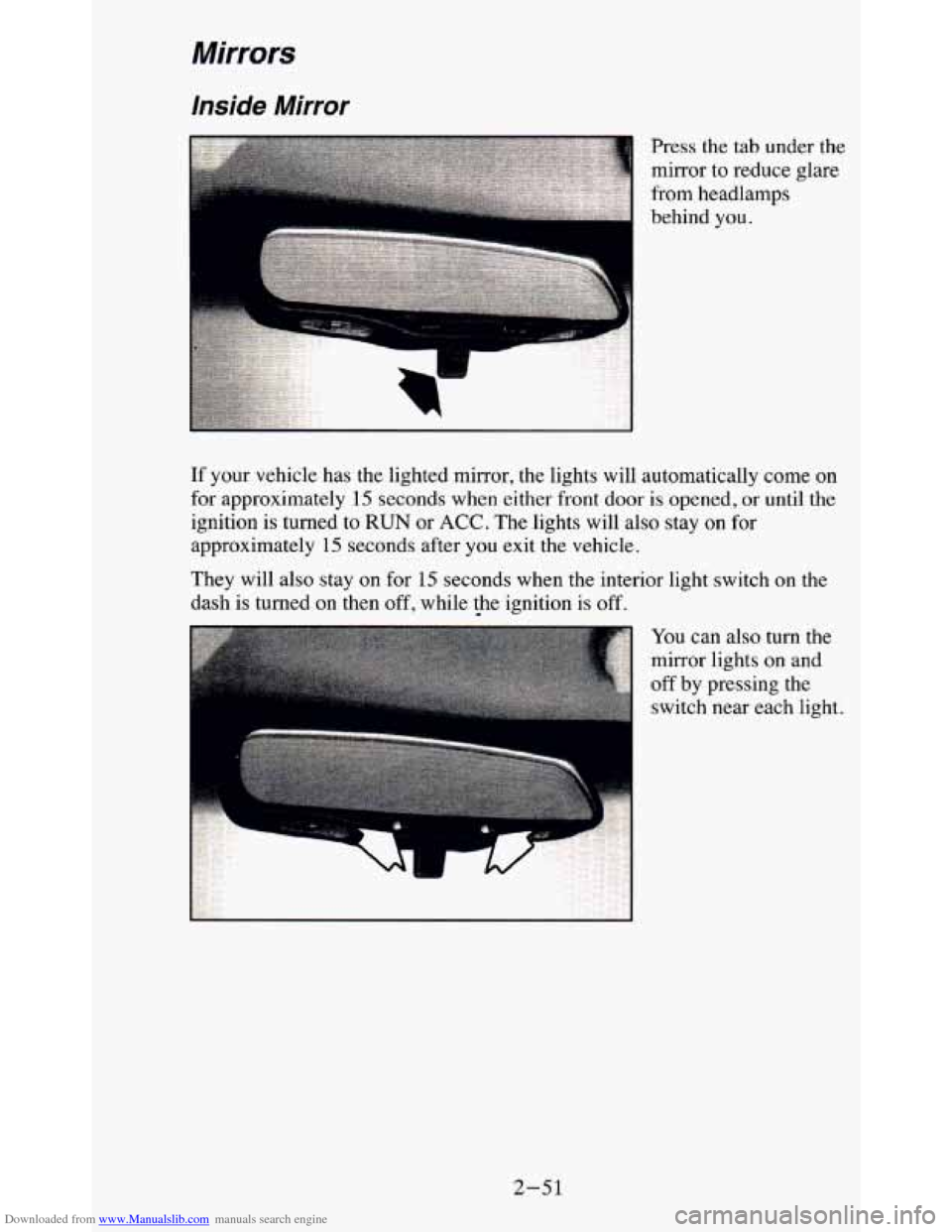
The rear dome lamp has a switch that lets
you turn it on from the rear of the
vehicle.
Press the side
of the
switch with the light
symbol to turn
on the
front and rear dome
lamps. Pressing the
other side
of the
switch will turn all
interior lights off,
even when the endgate
and doors are open.
2-50
Page 103 of 380
Downloaded from www.Manualslib.com manuals search engine Inside Mirror
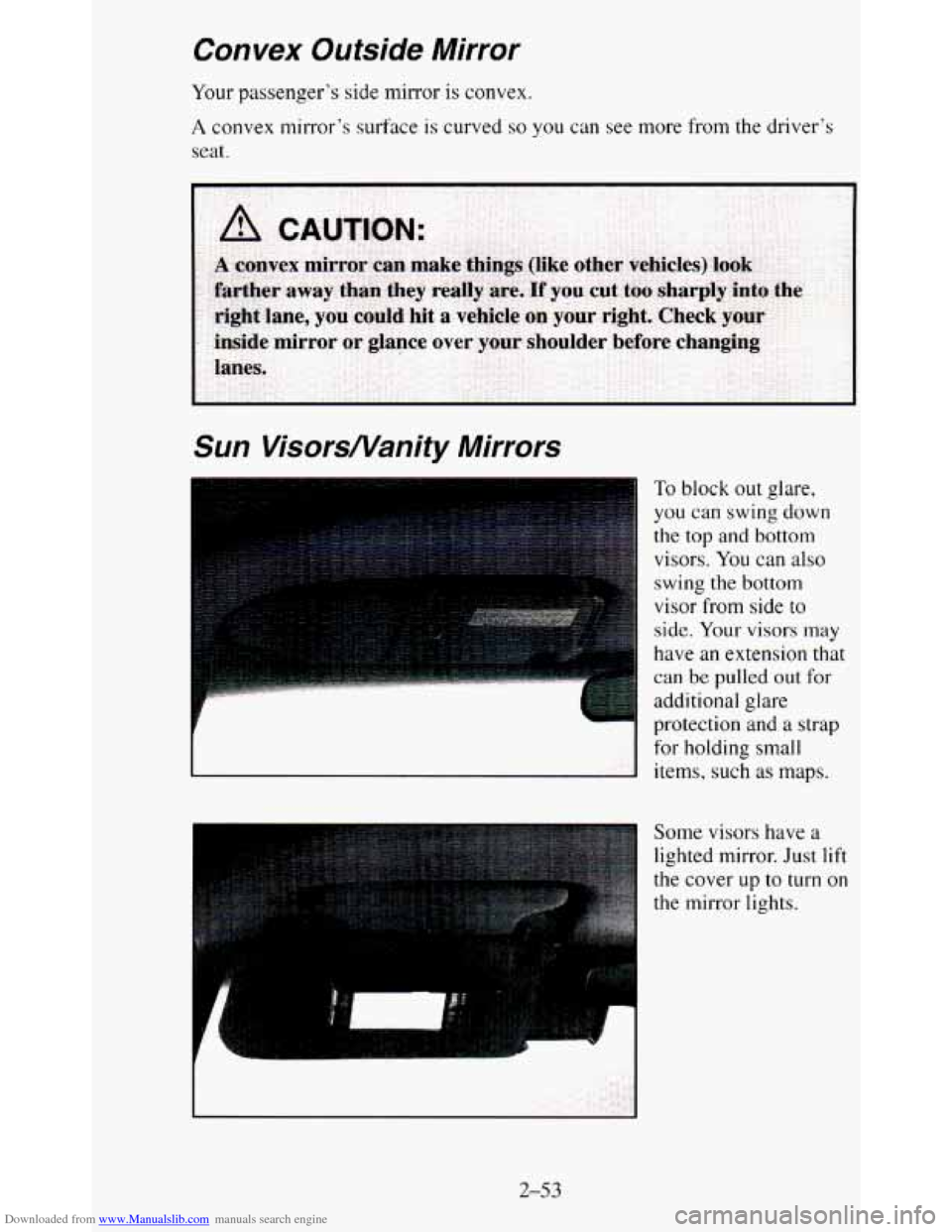
Press the tab under the
mirror to reduce glare
from headlamps
behind
you.
If your vehicle has the lighted mirror, the lights will automatically come on
for approximately
15 seconds when either front door is opened, or until the
ignition is turned to
RUN or ACC. The lights will also stay on for
approximately
15 seconds after you exit the vehicle.
They will also stay
on for 15 seconds when the interior light switch on the
dash is turned on then
off, while the ignition is off.
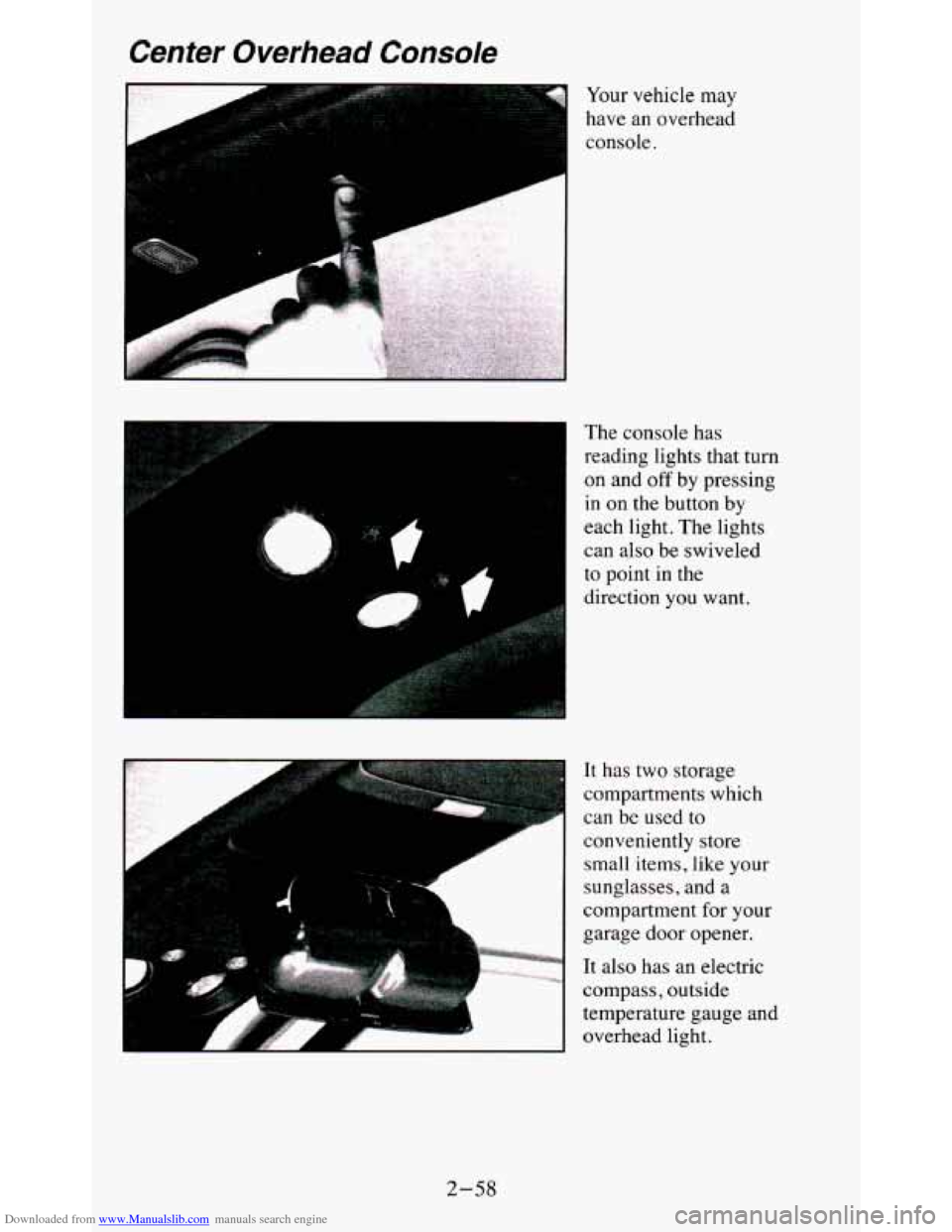
You can also turn me
mirror lights on and
off by pressing the
switch near each light.
2-51
Page 105 of 380
Downloaded from www.Manualslib.com manuals search engine Convex Outside Mirror
Your passenger’s side mirror is convex.
A convex mirror’s surface is curved so you can see more from the driver’s
seat.
Sun VisorsNanity Mirrors
- - -
L
To block out glare,
you can swing down
the top and bottom
visors.
You can also
swing the bottom
visor from side
to
side. Your visors may
have an extension that
can be pulled out for
additional glare
protection and a strap
for holding small
items, such
as maps.
Some visors have
a
lighted mirror. Just lift
the cover
up to turn on
the mirror lights.
2-53
Page 110 of 380
Downloaded from www.Manualslib.com manuals search engine Center Overhead Console
- I
P
Your vehicle may
have an overhead
console
+
The console has
reading lights that turn
on and off by pressing
in on the button by
each light. The lights
can also be swiveled
to point in the
direction
you want.
It has two storage
compartments which
can
be used to
conveniently store small
items, like your
sunglasses, and a
compartment for your
garage door opener.
It also has an electric
compass, outside
temperature gauge and
overhead light.
2-58
Page 120 of 380
Downloaded from www.Manualslib.com manuals search engine Normal operating range shows your engine speed during normal driving
conditions.
For example, when the needle points to 2, it means the engine is
running at 2,000 revolutions per minute (rpm). The tachometer needle will
vary all the time that the engine is running.
The red warning range tells you that your engine speed is reaching its upper
limits. Don’t drive very long with the tachometer in the red warning range.
If you have a manual transmission, shift to a higher gear as
soon as possible.
If you have an automatic transmission, lift your foot
off of the accelerator
pedal. If you drive for very long with the tachometer in the red danger
range, engine damage will result.
NOTICE:
Do not operate the engine with the tachometer in the red range,
or engine damage will occur.
The red danger range tells you that your engine speed is at its upper limits.
You should immediately shift to a higher gear, or lift your foot
off of the
accelerator pedal. If you drive for very long with the tachometer in the red
danger range, engine damage will result.
Warning Lights and Indicators
This part describes the warning lights and gages that may be on your
vehicle. The pictures will help you locate them.
Warning lights and gages can signal that something is wrong before it
becomes serious enough to cause an expensive repair or replacement.
Paying attention
to your warning lights and gages could also save you or
others from injury.
Warning lights come on when there may be or is a problem with one of your
vehicle’s functions.
As you will see in the details on the next few pages,
some warning lights come on briefly when you start the engine just to let
you know they’re working. If you are familiar with this section, you should
not be alarmed when this happens.
Gages caa indicate when there may be or is a problem with one of your
vehicle’s functions. Often gages and warning lights work together to let you
know when there’s a problem with your vehicle.
When one of the warning lights comes on and stays on when you are
driving, or when one of the gages shows there may be a problem, check the
section that tells you what
to do about it. Please follow this manual’s advice.
Waiting to
do repairs can be costly - and even dangerous. So please get to
know your warning lights and gages. They’re a big help.
2-68
Page 123 of 380
Downloaded from www.Manualslib.com manuals search engine The brake system warning light will also come on when you set your
parking brake, and it will stay on
if your parking brake doesn’t release fully.
If it stays
on after your parking brake is fully released, it means you have a
brake problem.
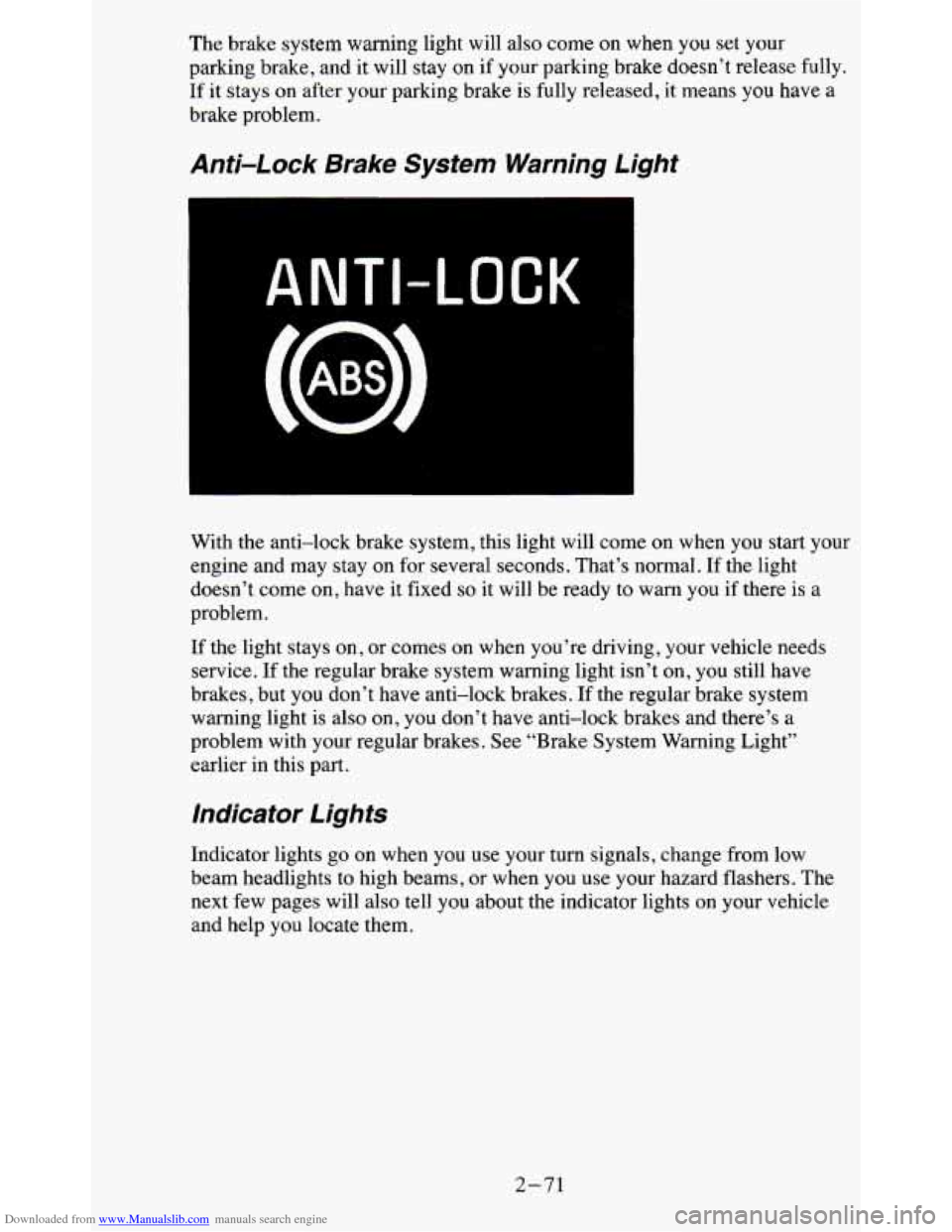
Anti-Lock Brake System Warning Light
ANTI-LOCK
With the anti-lock brake system, this light will come on when you start your
engine and may stay on for several seconds. That’s normal. If the light
doesn’t come on, have it fixed
so it will be ready to warn you if there is a
problem.
If the light stays on, or comes on when you’re driving, your vehicle needs
service. If the regular brake system warning light isn’t on, you still have
brakes, but you don’t have anti-lock brakes.
If the regular brake system
warning light is also on, you don’t have anti-lock brakes and there’s a
problem with your regular brakes. See “Brake System Warning Light”
earlier in this part.
Indicator Lights
Indicator lights go on when you use your turn signals, change from low
beam headlights to high beams,
or when you use your hazard flashers. The
next few pages will also tell you about the indicator lights \
on your vehicle
and help you locate them.
2-71
Page 169 of 380
Downloaded from www.Manualslib.com manuals search engine Surface Obstacles. Unseen or hidden obstacles can be hazardous. A rock,
log, hole, rut, or bump can startle you
if you’re not prepared for them. Often
these obstacles are hidden by grass, bushes,
snow or even the rise and fall of
the terrain itself. Here are some things to consider:
Is the path ahead clear?
Will the surface texture change abruptly up ahead?
@ Does the travel take you uphill or downhill? (There’s more discussion
of these subjects later.)
0 Will you have to stop suddenly or change direction quickly?
When you drive over obstacles or rough terrain, keep a firm grip
on the
steering wheel. Ruts, troughs, or other surface features can jerk
the wheel
out
of your hands if you’re not prepared.
When you drive over bumps, rocks, or other obstacles, your wheels can
leave the ground. If this happens, even with one or two wheels, you can’t
control the vehicle as well or
at all.
Because you will be on an unpaved surface, it’s especially important to
avoid sudden acceleration, sudden turns, or sudden braking.
In a way, off-road driving requires a different kind of alertness from driving
on paved roads and highways. There are no road signs, posted speed limits
or signal lights. You have to use your own good judgment about what is safe
and what isn’t.
Drinking and driving can be very dangerous on any road. And this
is
certainly true for off-road driving. At the very time you need special
alertness and driving skills, your reflexes, perceptions and judgment can be
affected by even a small amount of alcohol.
You could have a serious - or
even fatal - accident if you drink and drive or ride with a driver who has
been drinking. (See “Drunken Driving” in the Index.)
Driving On Off-Road Hills
Off-road driving often takes you up, down, or across a hill. Driving safely
on hills requires good judgment and an understanding of what your vehicle
can and can’t do. There are some hills that simply can’t be driven, no matter
how well built the vehicle.
4- 15