Page 261 of 380
Downloaded from www.Manualslib.com manuals search engine How to Check Lubricant
,:
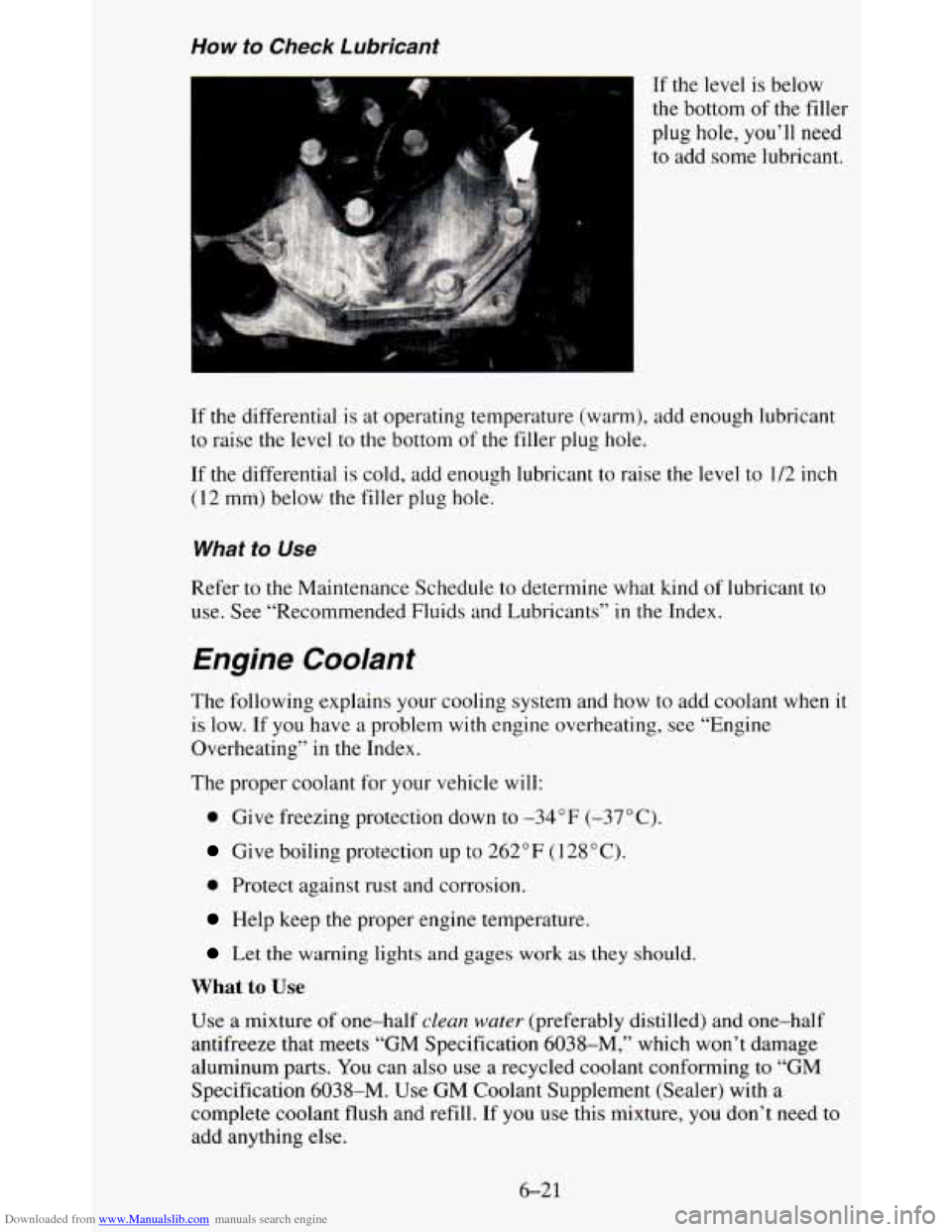
If the level is below
the bottom
of the filler
plug hole, you’ll need
to add some lubricant.
If the differential
is at operating temperature (warm), add enough lubricant
to raise the level to the bottom of the filler plug hole.
If the differential is cold, add enough lubricant to raise the le\
vel to 1/2 inch
(12 mm) below the filler plug hole.
What to Use
Refer to the Maintenance Schedule to determine what kind of lubricant to
use. See “Recommended Fluids and Lubricants”
in the Index.
Engine Coolant
The following explains your cooling system and how to add coolant \
when it
is low. If you have a problem with engine overheating, see “Engine
Overheating”
in the Index.
The proper coolant
for your vehicle will:
0 Give freezing protection down to -34°F (-37°C).
Give boiling protection up to 262°F (128°C).
0 Protect against rust and corrosion.
Help keep the proper engine temperature.
Let the warning lights and gages work as they should.
What to Use
Use a mixture of one-half clean water (preferably distilled) and one-half
antifreeze that meets “GM Specification 6038-M,” which won’t damage
aluminum parts.
You can also use a recycled coolant conforming to “GM
Specification 6038-M.
Use GM Coolant Supplement (Sealer) with a
complete coolant flush and refill. If
you use this mixture, you don’t need to
add anything else.
6-21
Page 262 of 380
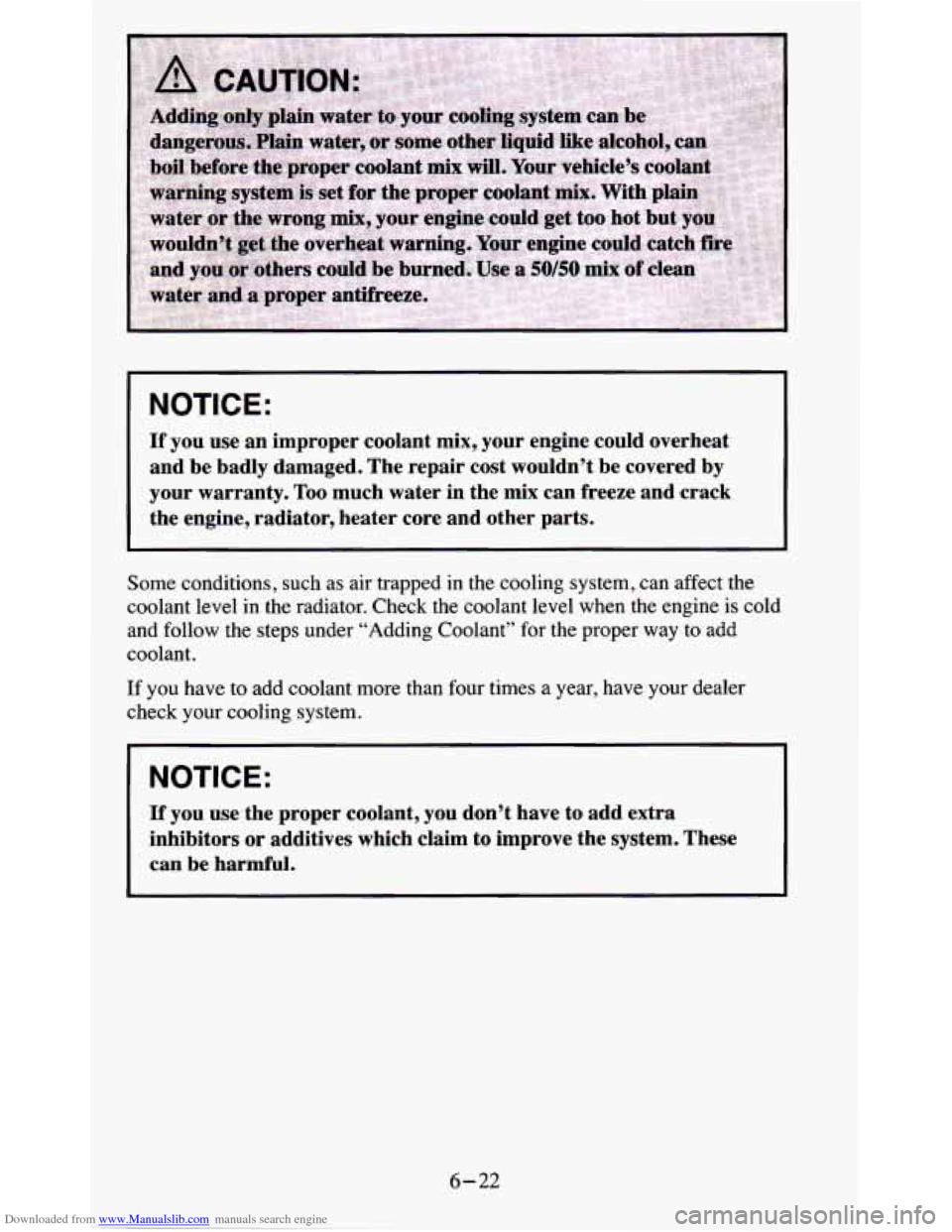
Downloaded from www.Manualslib.com manuals search engine NOTICE:
If you use an improper coolant mix, your engine could overheat
and be badly damaged. The repair cost wouldn’t be covered
by
your warranty. Too much water in the mix can freeze and crack
the engine, radiator, heater core and other parts.
Some conditions, such as air trapped in the cooling system, can affect the
coolant level in the radiator. Check the coolant level when the engine is cold
and follow the steps under “Adding Coolant” for the proper way to add
coolant.
If you have to add coolant more than four times a year, have your dealer
check your cooling system.
NOTICE:
If you use the proper coolant, you don’t have to add extra
inhibitors or additives which claim
to improve the system. These
can be harmful.
6-22
Page 280 of 380
Downloaded from www.Manualslib.com manuals search engine Air Conditioning
Every now and then have your dealership check your air conditioning
system to be sure it has not lost any cooling ability. If you think\
the system
is not working properly, have your dealership check it out as \
soon as
possible.
The air conditioning will not work when the temperature is below
40°F
(4°C).
Lock Cylinders
To be sure your locks operate properly, they must be lubricated.
Refer to the Maintenance Schedule to determine how often to lubricate them
and what type
of lubricant to use.
You should not
use penetrating oils because they could wash out me factory
installed lubricant and cause the lock to bind. De-icers which \
contain
alcohol could also wash away the lubricant,
so be sure to lubricate the lock
after using a de-icer of this type.
Exhaust System
To help prevent damage to your exhaust system, do not continue to drive
your vehicle
if you notice:
0 Engine misfiring
0 Loss of performance
0 Exhaust system components hanging lower than normal.
0 Loud exhaust system noises.
0 Other unusual operating conditions
Have your engine and exhaust system serviced regularly.
Three-way Catalytic Converter
Your vehicle’s three-way catalytic converter is designed to reduce \
the
pollutants in your vehicle’s exhaust. Use only unleaded fuel in your vehicle.
If you use leaded fuel, you could damage your three-way catalytic converter
and other engine components.
Engine Control Module System
This system has an oxygen (02) sensor that helps keep your engine’s
air-fuel mixture at a proper level. Use only unleaded fuel
in your vehicle. If
you use leaded fuel, you could damage your oxygen (02) sensor and affect
your vehicle’s emissions.
6-40
Page 287 of 380
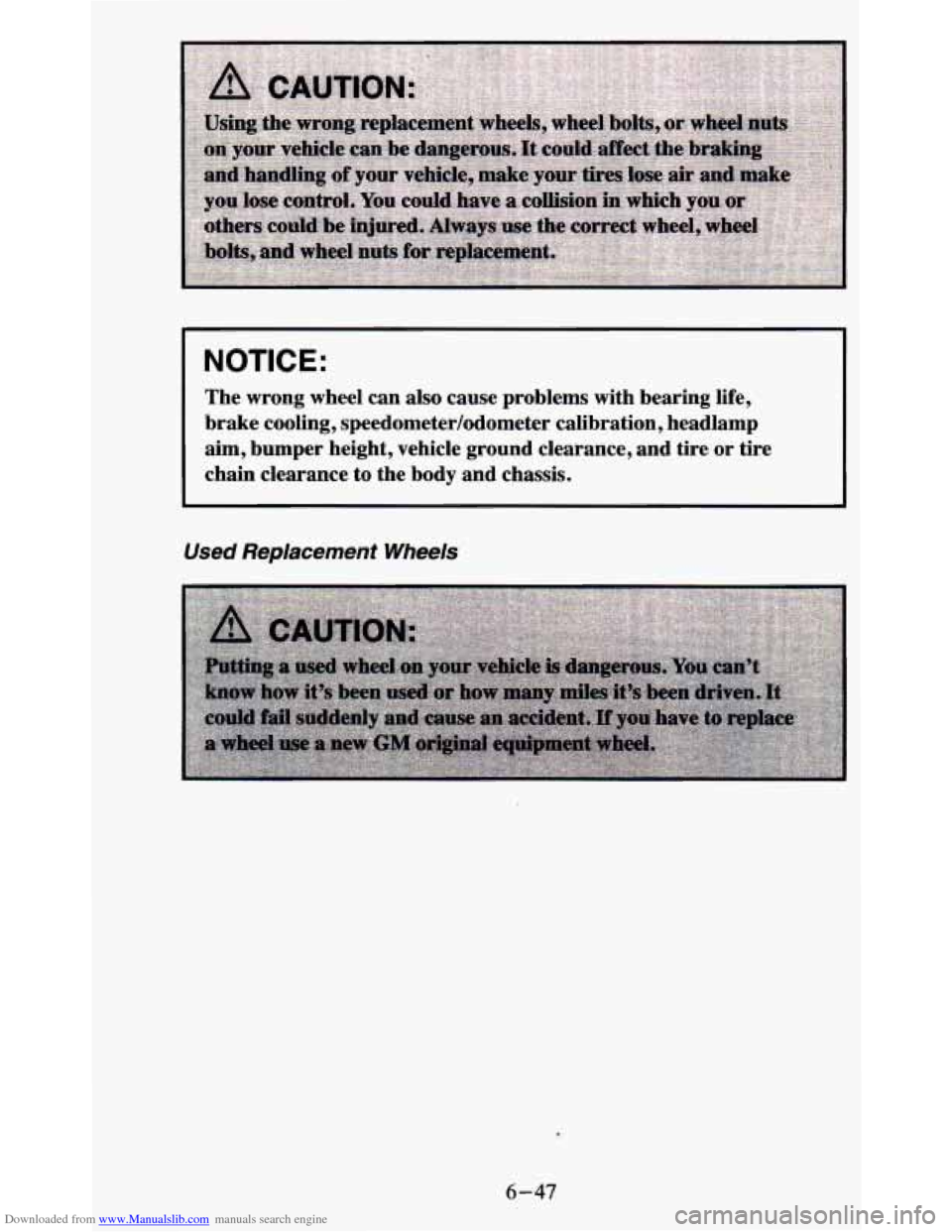
Downloaded from www.Manualslib.com manuals search engine I NOTICE:
The wrong wheel can also cause problems with bearing life,
brake cooling, speedometer/odometer calibration, headlamp
aim, bumper height, vehicle ground clearance, and
tire or tire
chain clearance
to the body and chassis.
Used Replacement Wheels
6-47
Page 303 of 380
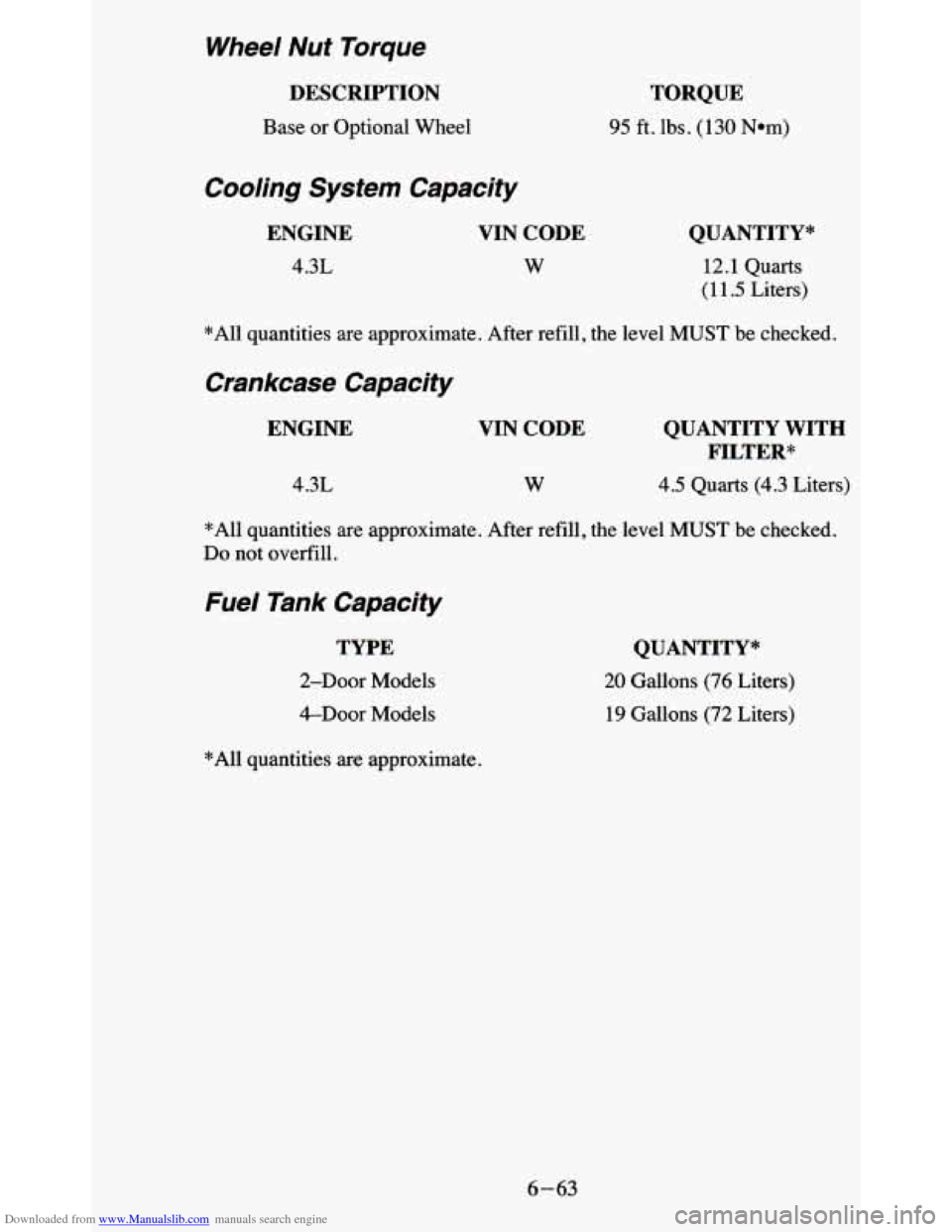
Downloaded from www.Manualslib.com manuals search engine Wheel Nut Torque
DESCRIPTION
Base or Optional Wheel
Cooling System Capacity
ENGINE VIN CODE
4.3L
W
TORQUE
95 ft.
lbs. ( 130 Nom)
QUANTITY*
12.1 Quarts
(1 1.5 Liters)
*All quantities are approximate. After refill, the level MUST be checked.
Crankcase Capacity
ENGINE
4.3L
VIN CODE
W
QUANTITY WITH
FILTER*
4.5 Quarts (4.3 Liters)
*All quantities are approximate. After refill, the level MUST be checked.
Do not overfill.
Fuel Tank Capacity
TYPE
2-Door Models
4-Door Models
QUANTITY*
20 Gallons (76 Liters)
19 Gallons (72 Liters)
*All quantities are approximate.
6-63
Page 316 of 380
Downloaded from www.Manualslib.com manuals search engine I Schedule I Definition I
Follow Maintenance Schedule I if any one of these is true for your vehicle:
Most trips are less than 5 to 10 miles (8 to 16 km). This is particularly
important when outside temperatures are below freezing.
Most trips include extensive idling (such as frequent driving \
in stop and
go traffic).
0 You operate your vehicle in dusty areas or off-road frequently.
0 You frequently two a trailer or use a carrier on top of your vehicle.
Schedule
I should also be followed if the vehicle is used for delivery
service, police, taxi, or other commercial application.
I Schedule / Intervals I
Every 3,000 Miles (5 000 km) or 3 Months
Engine Oil and Filter Change
Chassis Lubrication
Drive Axle Service
At 6,000 Miles (10 000 km) - Then Every 12,000 Miles (25 000
km)
Tire Rotation
Every 15,000 Miles (25 000 km)
Air Cleaner Filter Inspection, if driving in dusty conditions
Front Wheel Bearing Repack
(2WD Only)
Every 30,000 Miles (50 000 km)
Air Cleaner Filter Replacement
Spark Plug Replacement
Fuel Filter Replacement
Cooling System Service (or every
24 months)
Every 50,000 Miles (83 000 km)
Automatic Transmission Service (severe conditions)
7-4
Page 317 of 380
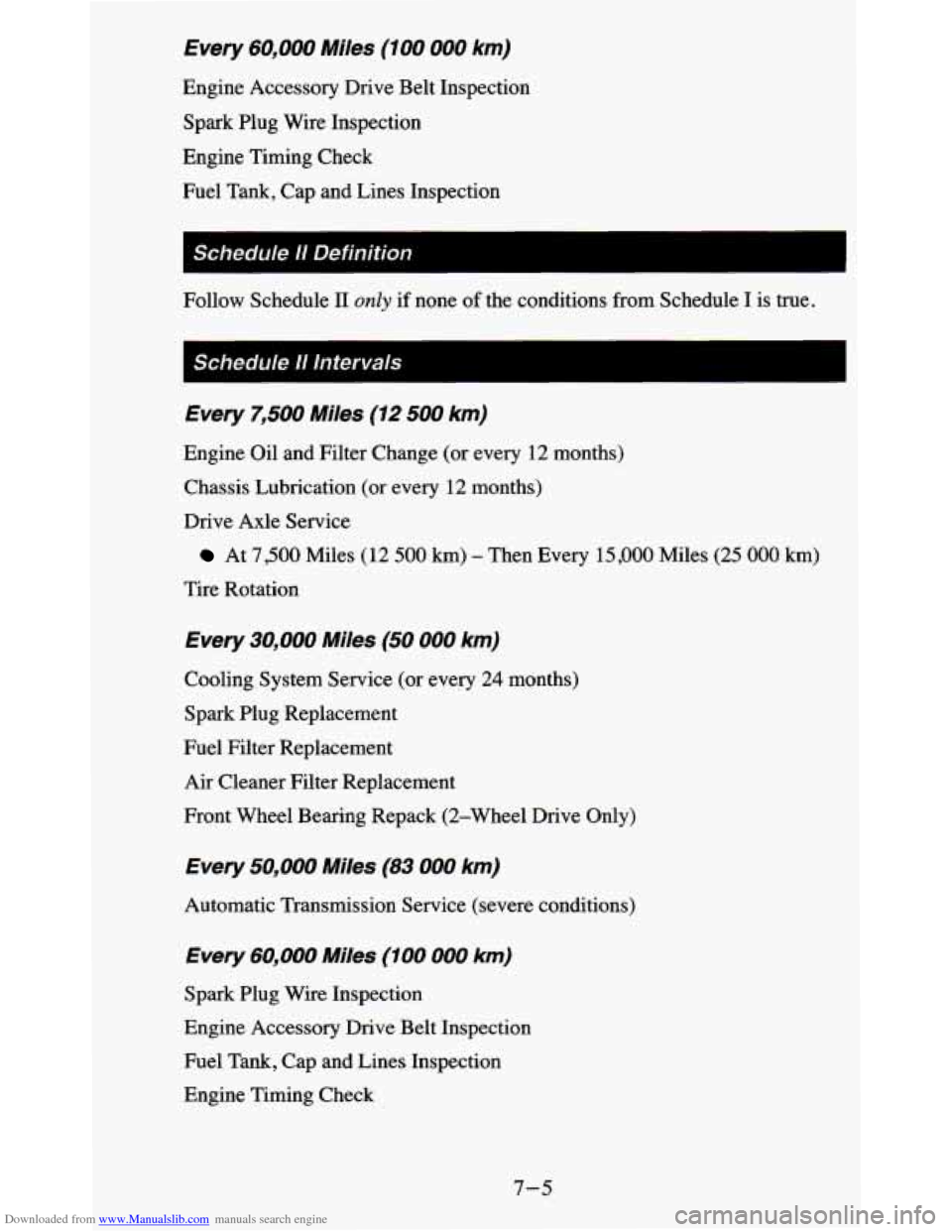
Downloaded from www.Manualslib.com manuals search engine Every 60,000 Miles (100 000 km)
Engine Accessory Drive Belt Inspection
Spark Plug Wire Inspection
Engine Timing Check
Fuel Tank, Cap and Lines Inspection
Follow Schedule I1
only if none of the conditions from Schedule I is true.
I Schedule // /nterva/s
Every 7,500 Miles (12 500 km)
Engine Oil and Filter Change (or every 12 months)
Chassis Lubrication (or every 12 months)
Drive Axle Service
At 7,500 Miles ( 12 500 km) - Then Every 15,000 Miles (25 000 km)
Tire Rotation
Every 30,000 Miles (50 000 km)
Cooling System Service (or every 24 months)
Spark Plug Replacement
Fuel Filter Replacement
Air Cleaner Filter Replacement
Front Wheel Bearing Repack (2-Wheel Drive Only)
Every 50,000 Miles (83 000 km)
Automatic Transmission Service (severe conditions)
Every 60,000 Miles (100 000 km)
Spark Plug Wire Inspection
Engine Accessory Drive Belt Inspection
Fuel Tank, Cap and Lines Inspection
Engine Timing Check
7-5
Page 323 of 380
Downloaded from www.Manualslib.com manuals search engine I Maintenance Schedule I
27,000 Miles (45 000)
0
0
0
Change engine oil and filter (or every 3 months, whichever occurs
first).
An Emission Control Service.
Lubricate the front suspension, ball joints (ball joints should not be
lubricated unless their temperature is 10°F (-12°C) or higher. When
the weather is cold, let them warm up before lubricating them or they
could be damaged.), steering linkage and transfer case shift linkage,
parking brake cable guides, propshaft splines, universal joints, brake
pedal springs, and clutch pedal springs at every oil change (or every
6
months, whichever occurs first).
Check readfront axle fluid level and add fluid as needed. Check
constant velocity joints and axle seals for leaking.**
DATE SERVICED BY ACTUAL MILEAGE
30,000 Miles (50 000 km)
0 Change engine oil and filter (or every 3 months, whichever occurs
0 Lubricate the front suspension, ball joints (ball joints should not be
first).
An
Emission Control Service.
lubricated unless their temperature is 10°F (-1 2°C) or higher. When
the weather is cold, let them
wm up before lubricating them or they
could be damaged.), steering linkage and transfer case shift linkage,
parking brake cable guides, propshaft splines, universal joints, brake
pedal springs, and clutch pedal springs at every oil change (or every
6
months, whichever occurs first).
0 Check readfront axle fluid level and add fluid as needed. Check
constant velocity joints and axle seals for leaking.**
occurs first).
An Emission Control Service
0 Inspect engine accessory drive belts (or every 24 months, whichever
0 Drain, flush and refill cooling system (or every 24 months, whichever
occurs first). Inspect hoses. Clean radiator, condenser, pressure cap and
neck. Pressure test the cooling system and pressure cap.
An Emission
Control Service.
(Continued)
7-11