1995 CHEVROLET ASTRO CARGO VAN Flush
[x] Cancel search: FlushPage 231 of 342
Downloaded from www.Manualslib.com manuals search engine What to Use
Refer to the Maintenance Schedule to determine what kind of lubricant to
use. See “Recommended Fluids and Lubricants”
in the Index.
Engine Coolant
The following explains your cooling system and how to add coolant when it
is low. If you have a problem with engine overheating, see “Engine
Overheating”
in the Index.
The proper coolant
for your vehicle will:
0 Give freezing protection down to -34°F (-37°C).
0 Give boiling protection up to 262 OF ( 1 28 O C).
0 Protect against rust and corrosion.
0 Help keep the proper engine temperature.
0 Let the warning lights and gages work as they should.
What to Use
Use a mixture of one-half clean wafer (preferably distilled) and one-half
antifreeze that meets
“GM Specification 6038-M,” which won’t damage
aluminum parts. You can also use a recycled coolant conforming to “GM
Specification 6038-M. Use
GM Coolant Supplement (Sealer) with a
complete coolant flush and refill.
If you use this mixture, you don’t need to
add anything else.
6-23
Page 261 of 342
Downloaded from www.Manualslib.com manuals search engine Cleaning the Outside of Your Vehicle
The paint finish on your vehicle provides beauty, depth of color, gloss
retention and durability.
Washing Your Vehicle
The best way to preserve your vehicle’s finish is to keep it clean by washing
it often with lukewarm or cold water.
Don’t wash your vehicle in the direct rays of
the sun. Don’t use strong soaps
or chemical detergents. Use liquid hand, dish or car washing (mild
detergent) soaps. Don’t use cleaning agents that are petroleum based, or that
contain acid or abrasives. All cleaning agents should be flushed promptly
and not allowed to dry on the surface,
or they could stain. Dry the finish
with a soft, clean chamois or a 100% cotton towel to avoid surface scratches
and water spotting.
High pressure vehicle washes may cause water
t0 eater your vehicle.
Finish Care
Occasional waxing or mild polishing of your vehicle by hand may be
necessary to remove residue from the paint finish.
You can get GM
approved cleaning products from your dealer. (See “Appearance Care and
Materials’’ in the Index.)
Your vehicle has a “basecoatjclearcoat” paint finish. The clearcoat gives
more depth and gloss to the colored basecoat. Always use waxes and
polishes that are non-abrasive and made for
a basecoat/clearcoat paint
finish.
NOTICE:
Machine compounding or aggressive polishing on a
basecoatklearcoat paint finish may dull the finish or leave swirl
marks.
Foreign materials such as calcium chloride and other salts, ice melting
agents, road oil and tar, tree sap, bird droppings, chemicals from industrial
chimneys, etc. can damage your vehicle’s finish if
they remain on painted
surfaces. Wash the vehicle as soon as possible. If necessary, use
non-abrasive cleaners that are marked safe for painted surfaces to remove
foreign matter.
Exterior painted surfaces are subject to aging, weather and chemical fallout
that can take their toll over a period
of years. You can help to keep the paint
finish looking new by keeping your vehicle garaged or covered whenever
possible.
6-53
Page 263 of 342
Downloaded from www.Manualslib.com manuals search engine Finish Damage
Any stone chips, fractures or deep scratches in the finish should be repaired
right away. Bare metal will corrode quickly and may develop
into a major
repair expense.
Minor chips and scratches can be repaired with touch-up materials available
from your dealer or other service outlets. Larger areas
of finish damage can
be corrected in your dealer’s body and paint shop.
Underbody Maintenance
Chemicals used for ice and snow removal and dust control can collect on
the underbody. If these are not removed, accelerated corrosion (rust) can
occur
on the underbody parts such as fuel lines, frame, floor pan, and
exhaust system even though they have corrosion protection.
At least every spring,
flush these materials from the underbody with plain
water. Clean any areas where mud and other debris
can collect. Dirt packed
in closed areas of the frame should be loosened before being flushed. Your
dealer or an underbody vehicle washing system can do this for
you.
Chemical Paint Spotting
Some weather and atmospheric conditions can create a chemical fallout.
Airborne pollutants can fall upon and attack painted surfaces
on your
vehicle. This damage can take two forms: blotchy, ringlet-shaped
discolorations, and small irregular dark
spots etched into the paint surface.
Although
no defect in the paint job causes this, GM will repair, at no charge
to the owner, the surfaces of new vehicles damaged by this fallout condition
within
12 months or 12,000 miles (20 000 km) of purchase, whichever
comes first.
6-55
Page 287 of 342
Downloaded from www.Manualslib.com manuals search engine Maintenance Schedule I
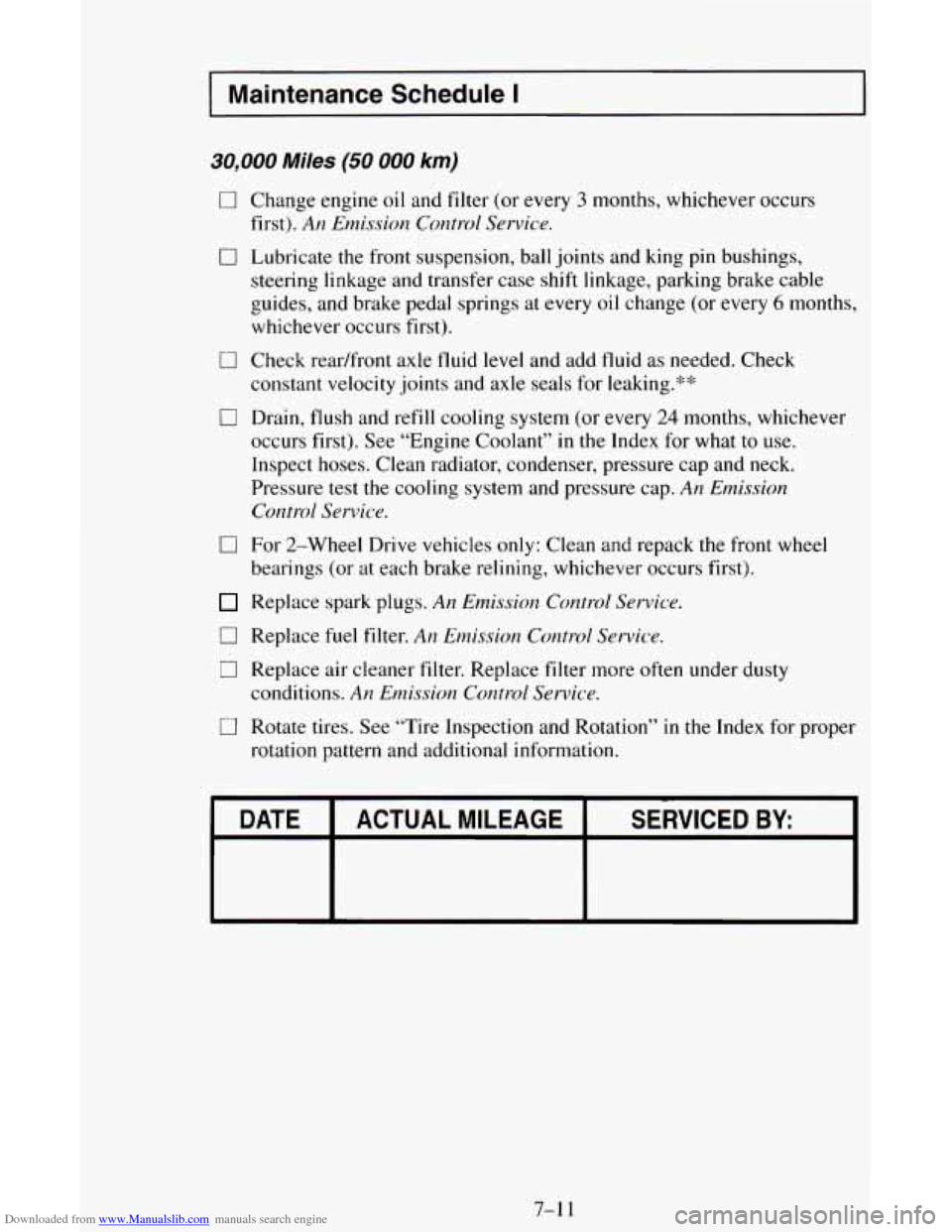
30,000 Miles (50 000 km)
0
0
0
0
0
0
Change engine oil and filter (or every 3 months, whichever occurs
first).
An Emission Control Service.
Lubricate the front suspension, ball joints and king pin bushings,
steering linkage and transfer case shift linkage, parking brake cable
guides, and brake pedal springs at every
oil change (or every 6 months,
whichever occurs first).
Check redfront axle fluid
level and add fluid as needed. Check
constant velocity joints and
axle seals for leaking.**
Drain, flush and refill cooling system
(or every 24 months, whichever
occurs first). See “Engine Coolant’’
in the Index for what to use.
Inspect hoses. Clean radiator, condenser, pressure cap and neck.
Pressure test
the cooling system and pressure cap. An Emission
Control Service.
For 2-Wheel Drive vehicles only: Clean and repack the front wheel
bearings (or at each brake relining, whichever occurs first).
Replace spark plugs.
An Emission Control Service.
Replace fuel filter. An Emission Control Service.
Replace air cleaner filter. Replace filter more often under dusty
conditions. An Emission Control Service.
Rotate tires. See “Tire Inspection and Rotation” in the Index for proper
rotation pattern and additional information.
I DATE I ACTUALMILEAGE I SERVICED BY: I
7-1 1
Page 293 of 342
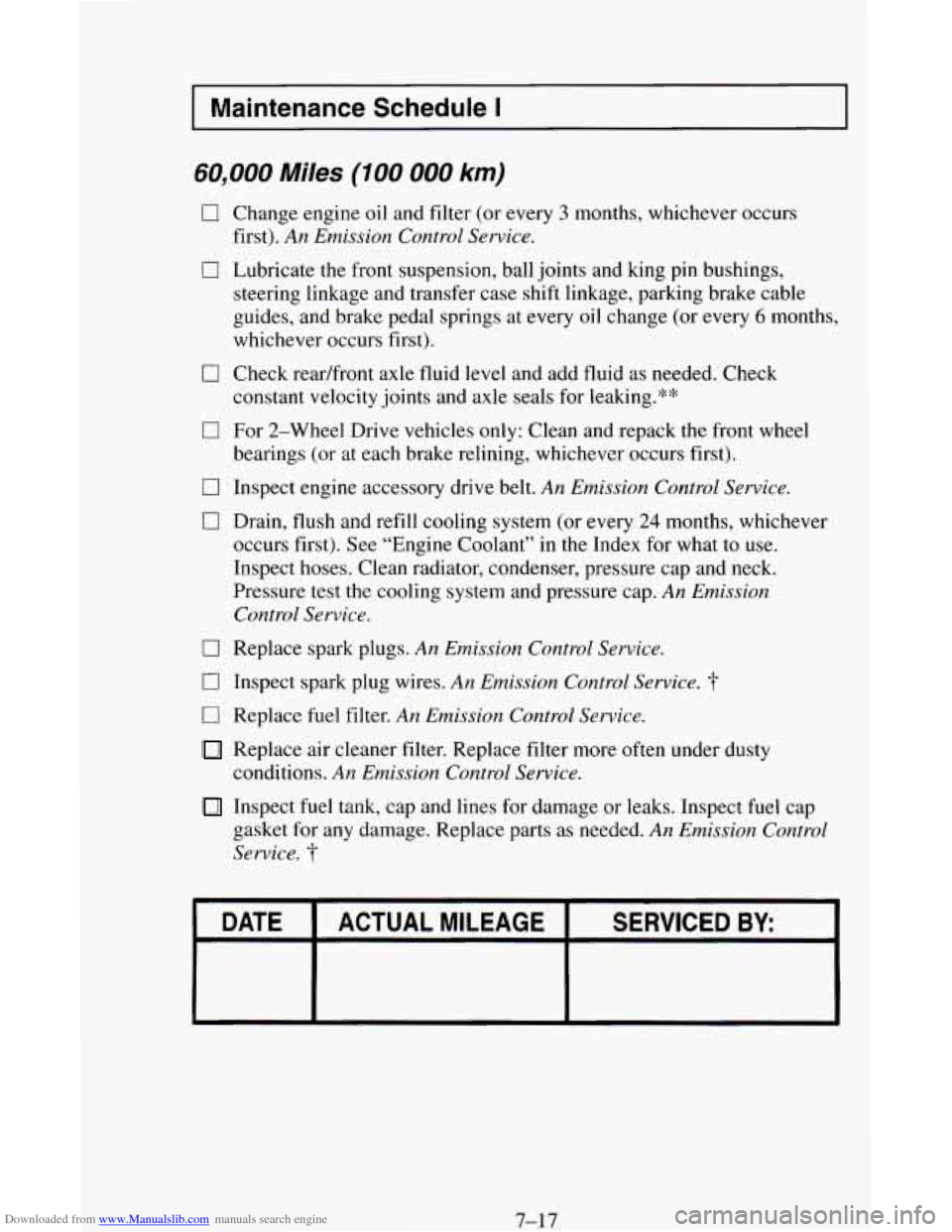
Downloaded from www.Manualslib.com manuals search engine 60,000 Miles (100 000 km)
0 Change engine oil and filter (or every 3 months, whichever occurs
first).
An Emission Control Service.
0 Lubricate the front suspension, ball joints and king pin bushings,
steering linkage and transfer case shift linkage, parking brake cable
guides, and brake pedal springs at every oil change (or every
6 months,
whichever occurs first).
0 Check readfront axle fluid level and add fluid as needed. Check
constant velocity joints and axle seals for leaking.**
bearings
(or at each brake relining, whichever occurs first),
0 For 2-Wheel Drive vehicles only: Clean and repack the front wheel
0 Inspect engine accessory drive belt. An Emission Control Service.
0 Drain, flush and refill cooling system (or every 24 months, whichever
occurs first). See “Engine Coolant” in the Index for what to use.
Inspect hoses. Clean radiator, condenser, pressure cap and neck.
Pressure test the cooling system and pressure cap.
An Emission
Control Service.
0 Replace spark plugs. An Emission Control Service.
0 Inspect spark plug wires. An Emission Control Service.
0 Replace fuel filter. An Emission Control Service.
Replace air cleaner filter. Replace filter more often under dusty
conditions.
An Emission Control Service.
Inspect fuel tank, cap and lines for damage or leaks. Inspect fuel cap
gasket for any damage. Replace parts
as needed. An Emission Control
Service.
DATE SERVICED BY ACTUAL MILEAGE
7-17
Page 298 of 342
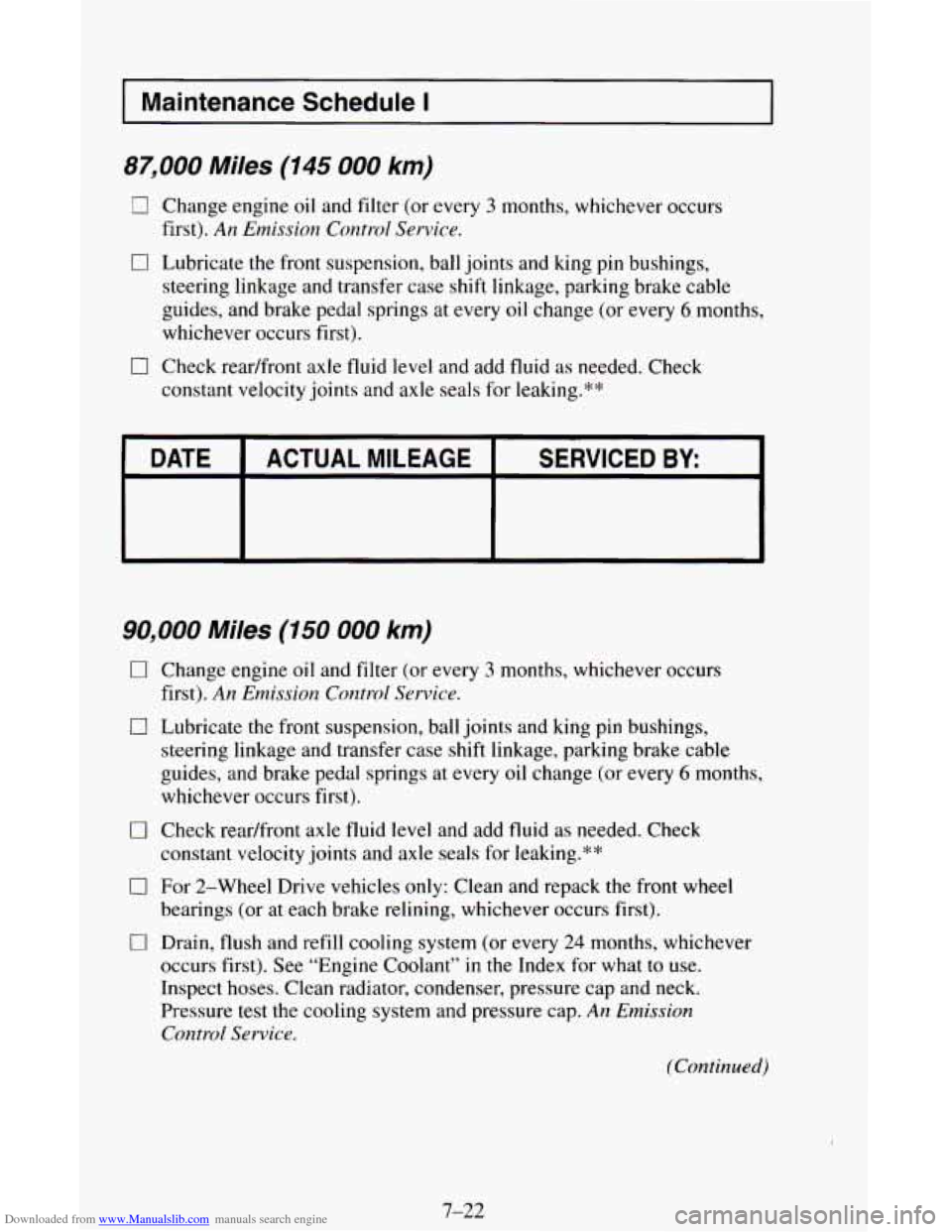
Downloaded from www.Manualslib.com manuals search engine I Maintenance Schedule I I ~~~ ~
87,000 Miles (145 000 km)
0
0
0
Change engine oil and filter (or every 3 months, whichever occurs
first).
An Emission Control Service.
Lubricate the front suspension, ball joints and king pin bushings,
steering linkage and transfer case shift linkage, parking brake cable
guides, and brake pedal springs
at every oil change (or every 6 months,
whichever occurs first).
Check readfront axle fluid level and add fluid as needed. Check
constant velocity joints and axle seals for leaking.**
DATE
SERVICED BY ACTUAL MILEAGE
90,000 Miles (150 000 km)
0 Change engine oil and filter (or every 3 months, whichever occurs
first).
An Emission Control Service.
0 Lubricate the front suspension, ball joints and king pin bushings,
steering linkage and transfer case shift linkage, parking brake cable
guides, and brake pedal springs at every oil change
(or every 6 months,
whichever occurs first).
0 Check readfront axle fluid level and add fluid as needed. Check
constant velocity joints and axle seals for leaking.**
bearings (or at each brake relining, whichever occurs first).
0 For 2-Wheel Drive vehicles only: Clean and repack the front wheel
0 Drain, flush and refill cooling system (or every 24 months, whichever
occurs first). See “Engine Coolant”
in the Index for what to use.
Inspect hoses. Clean radiator, condenser, pressure cap and neck.
Pressure test
the cooling system and pressure cap. An Emission
Control Service.
(Continued)
7-22
Page 304 of 342
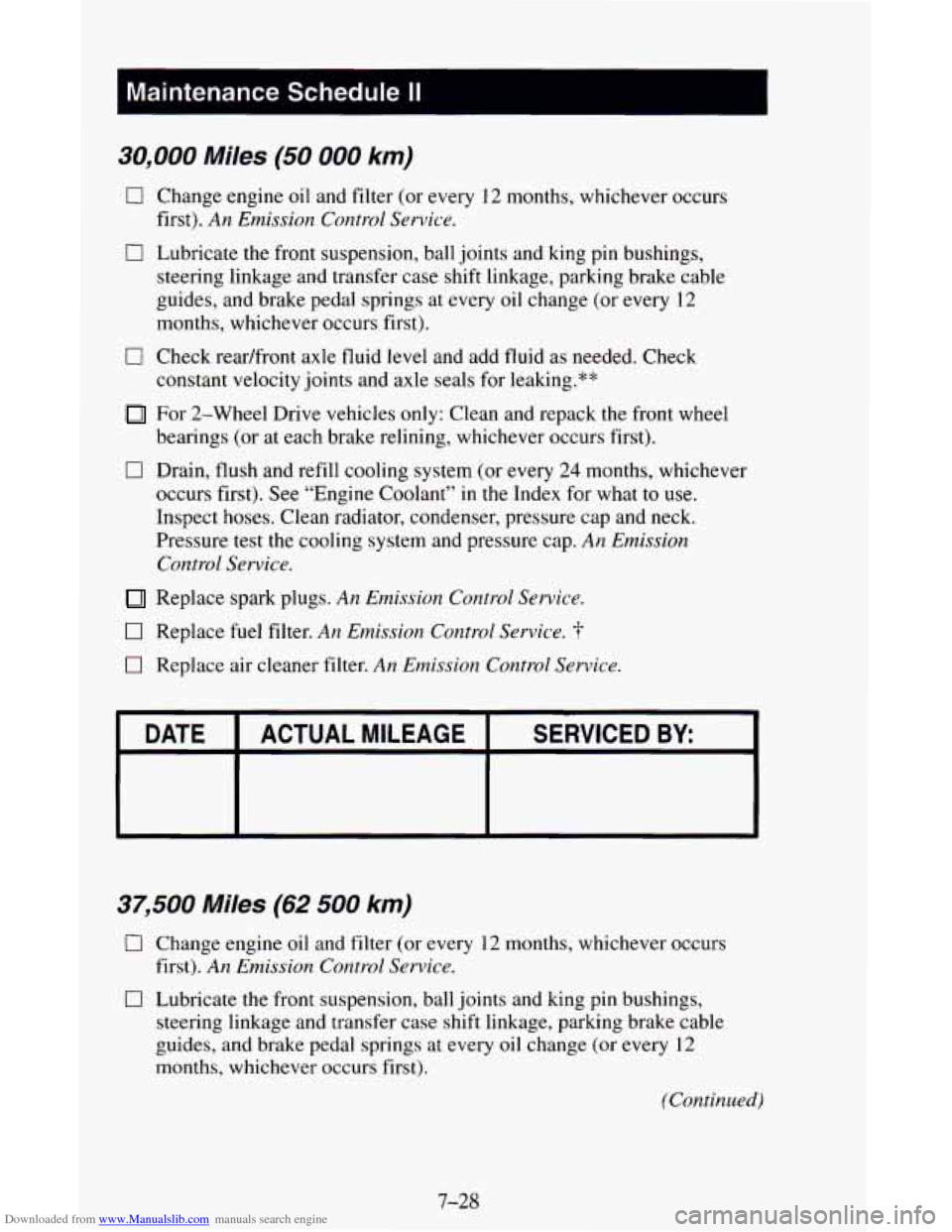
Downloaded from www.Manualslib.com manuals search engine I Maintenance Schedule II
30,000 Miles (50 000 km)
0 Change engine oil and filter (or every 12 months, whichever occurs
first).
An Emission Control Service.
0 Lubricate the front suspension, ball joints and king pin bushings,
steering linkage and transfer case shift linkage, parking brake cable
guides, and brake pedal springs at every oil change (or every
12
months, whichever occurs first).
0 Check readfront axle fluid level and add fluid as needed. Check
constant velocity joints and axle seals
for leaking.**
For 2-Wheel Drive vehicles only: Clean and repack the front wheel
0 Drain, flush and refill cooling system (or every 24 months, whichever
bearings (or
at each brake relining, whichever occurs first).
occurs first). See “Engine Coolant’’
in the Index for what to use.
Inspect hoses. Clean radiator, condenser, pressure cap and neck.
Pressure test the cooling system and pressure cap.
An Emission
Control Service.
Replace spark plugs. An Emission Control Service.
0 Replace fuel filter. An Emission Control Service. -f-
0 Replace air cleaner filter. An Emission Control Service.
37,500 Miles (62 500 km)
0 Change engine oil and filter (or every 12 months, whichever occurs
0 Lubricate the front suspension, ball joints and king pin bushings,
first).
An Emission Control
Service.
steering linkage and transfer case shift linkage, parking brake cable
guides, and brake pedal springs at every oil change (or every 12
months, whichever occurs first).
(Continued)
7-28
Page 307 of 342
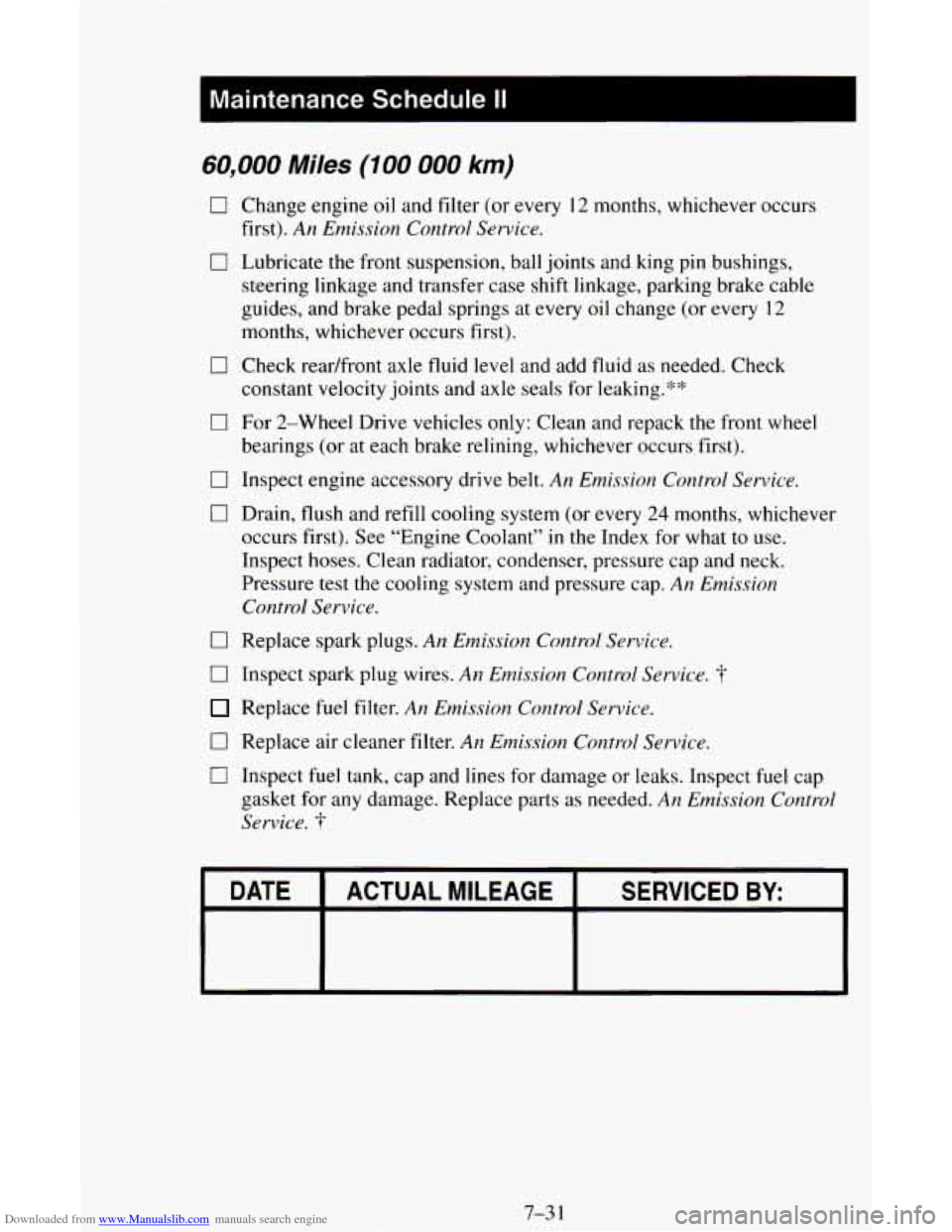
Downloaded from www.Manualslib.com manuals search engine I Maintenance Schedule II I
60,000 Miles (100 000 km)
cl
0
0
0
0
0
Change engine oil and filter (or every I2 months, whichever occurs
first).
An Emission Control Service.
Lubricate the front suspension, ball joints and king pin bushings,
steering linkage and transfer case shift linkage, parking brake cable
guides, and brake pedal springs at every
oil change (or every 12
months, whichever occurs first).
Check readfront axle fluid level and add fluid as needed. Check
constant velocity
joints and axle seals for leaking.“’”
For 2-Wheel Drive vehicles
only: Clean and repack the front wheel
bearings
(or at each brake relining, whichever occurs first).
Inspect engine accessory drive belt.
An Emission Conrrol Service.
Drain, flush and refill cooling system (or every 24 months, whichever
occurs first). See “Engine Coolant’’
in the Index for what to use.
Inspect hoses. Clean radiator, condenser, pressure cap and neck.
Pressure test
the cooling system and pressure cap. An E1nission
Corztrol Service.
Replace spark plugs. AI? Emission Cot~trol Service.
Inspect spark plug wires. An Emission Control Servica. -1
Replace fuel filter. An Emission Control Service.
Replace air cleaner filter. An Emission Control Service.
Inspect fuel tank, cap and lines for damage or leaks. Inspect fuel cap
gasket for any damage. Replace parts as needed.
An Emission Control
Service.
-i-
DATE SERVICED BY: ACTUAL MILEAGE r
7-3 1