1995 CHEVROLET ASTRO CARGO VAN steering
[x] Cancel search: steeringPage 159 of 342
Downloaded from www.Manualslib.com manuals search engine Your anti-lock brakes improve your ability to make a hard stop on a
slippery road. Even though you have an anti-lock braking system, you'll
want to begin stopping sooner than you would on dry pavement. See
"Anti-Lock" in the Index.
0 Allow greater following distance on any slippery road.
0 Watch for slippery spots. The road might be fine until you hit a spot
that's covered with ice. On an otherwise clear road, ice patches may
appear in shaded areas where the sun can't reach: around clumps of
trees, behind buildings, or under bridges. Sometimes the surface of a
curve or
an overpass may remain icy when the surrounding roads are
clear.
If you see a patch of ice ahead of you, brake before you are on it.
Try not to brake while you're actually on the ice, and avoid sudden
steering maneuvers.
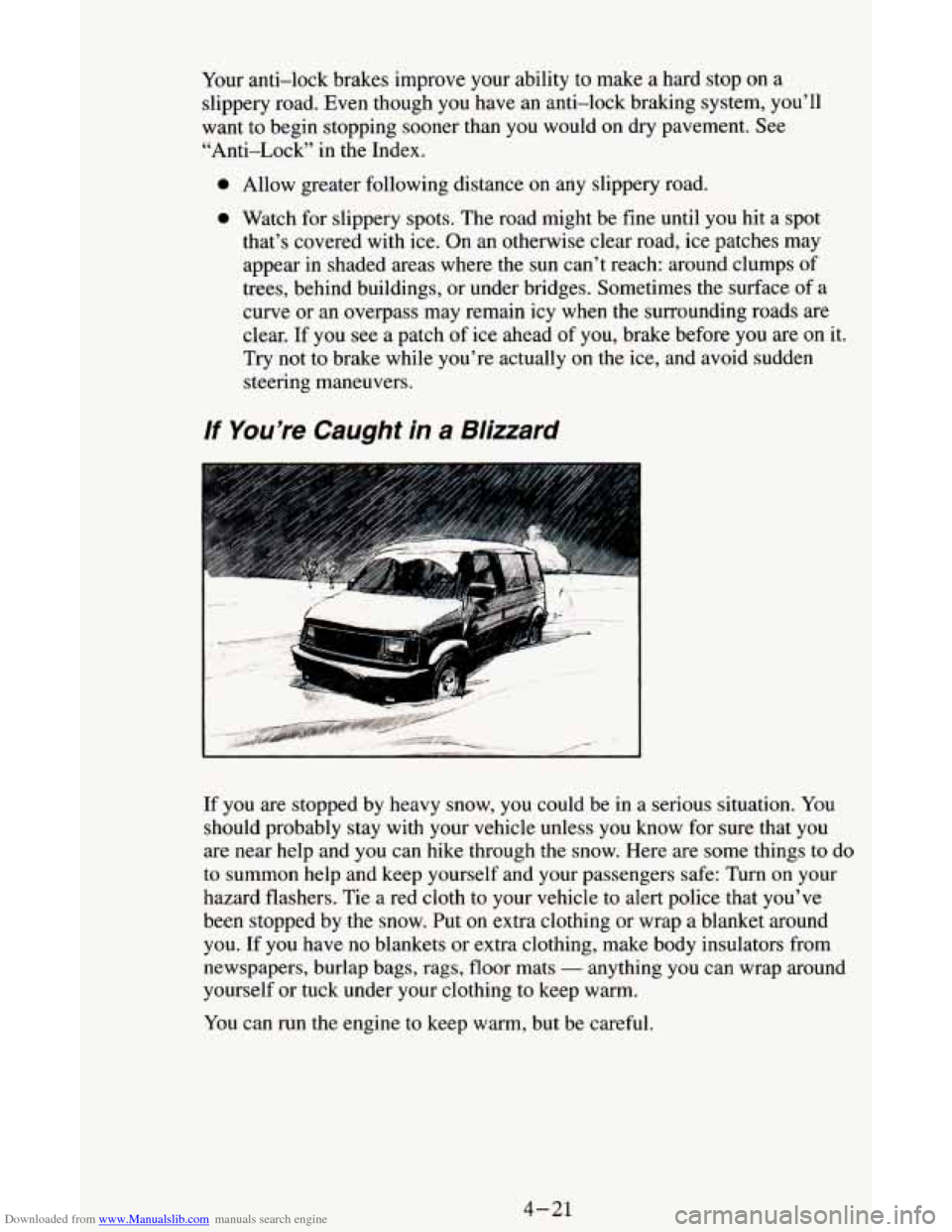
If You're Caught in a Blizzard
ha3 .. . - . .. .. ..
If you are stopped by heavy snow, you could be in a serious situation. You
should probably stay with your vehicle unless you know for sure that you
are near help and you can hike through the snow. Here are some things
to do
to summon help and keep yourself and your passengers safe: Turn on your
hazard flashers. Tie a red cloth to your vehicle to alert police that you've
been stopped by the snow. Put on extra clothing or wrap
a blanket around
you. If you have no blankets or extra clothing, make body insulators from
newspapers, burlap bags, rags, floor mats
- anything you can wrap around
yourself or tuck under your clothing to keep warm.
You can run the engine to keep warm, but be careful.
4-21
Page 169 of 342
Downloaded from www.Manualslib.com manuals search engine Passing
You’ll need more passing distance up ahead when you’re towing a trailer.
And, because you’re a good deal longer, you’ll need to go much farther
beyond the passed vehicle before
you can return to your lane.
Backing Up
Hold the bottom of the steering wheel with one hand. Then, to move the
trailer to the left,
just move that hand to the left. To move the trailer to the
right, move your hand to the right. Always back up slowly and, if possible,
have someone guide you.
Making Turns
NOTICE:
Making very sharp turns while trailering could cause the traile\
r
to come in contact with the vehicle. Your vehicle could be
damaged. Avoid making very sharp turns while trailering.
When you’re turning with a trailer, make wider turns than normal. Do this
so your trailer won’t strike soft shoulders, curbs, road signs, trees, or other
objects. Avoid jerky or sudden maneuvers. Signal well in advance.
Turn Signals When Towing a Trailer
When you tow a trailer, your vehicle has to have extra wiring and a
heavy-duty turn signal flasher (included in the optional trailering package).
The green arrows
on your instrument panel will flash whenever you signal a
turn or lane change. Properly hooked up, the trailer lamps will also flash,
telling other drivers you’re about
to turn, change lanes or stop.
When towing a trailer, the green arrows
on your instrument panel will flash
for turns even if the bulbs
on the trailer are burned out. Thus, you may think
drivers behind you are seeing your signal when they are not. It’s important
to check occasionally to be sure the trailer bulbs are still working.
4-31
Page 179 of 342
Downloaded from www.Manualslib.com manuals search engine Towing Your Vehicle
Try to have a GM dealer or a professional towing service tow your vehicle.
They can provide the right equipment and know how to tow
it without
damage.
If your vehicle has been changed
or modified since it was factory-new by
adding aftermarket items like fog lamps, aero skirting, or special tires and
wheels, these things can be damaged during towing.
Before
you do anything, turn on the hazard warning flashers.
When
you call, tell the towing service:
0 Whether your vehicle has rear-wheel drive or the all-wheel-drive
option. If your vehicle has fog lamps, it cannot be towed from the front
with sling-type equipment.
The make, model, and year of your vehicle.
0 Whether you can still move the shift lever.
0 If there was an accident, what was damaged.
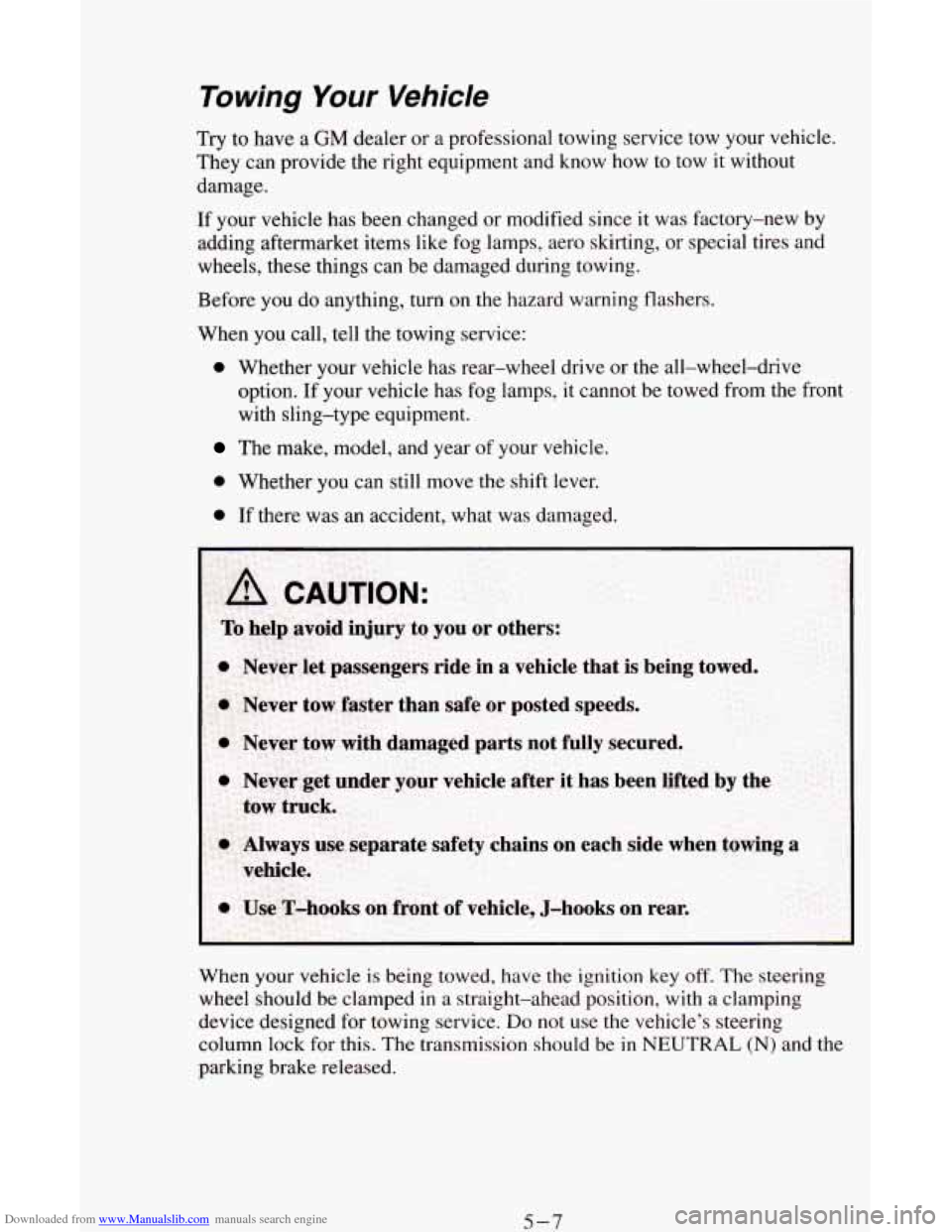
When your vehicle
is being towed, have the ignition key off. The steering
wheel should be clamped in a straight-ahead position, with
a clamping
device designed for towing service.
Do not use the vehicle’s steering
column lock for this.
The transmission should be in NEUTRAL (N) and the
parking brake released.
5-7
Page 192 of 342
Downloaded from www.Manualslib.com manuals search engine 7. By this time the coolant level inside the radiator filler neck may be
lower.
If the level is lower, add more of the proper mix through the
filler neck until the level reaches the base
of the filler neck.
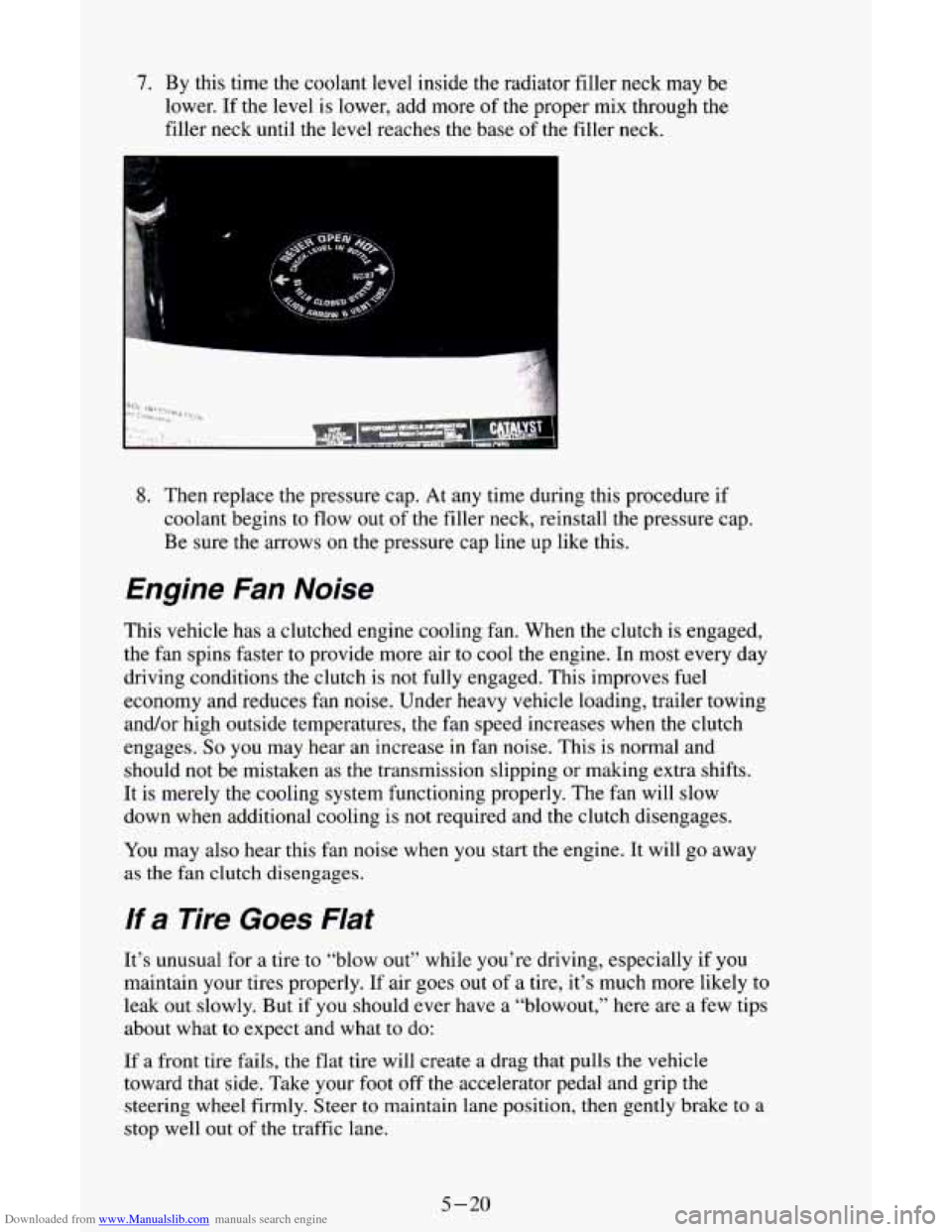
8. Then replace the pressure cap. At any time during this procedure if
coolant begins to flow out of the filler neck, reinstall the pressure cap.
Be sure the arrows on the pressure cap line
up like this.
Engine Fan Noise
This vehicle has a clutched engine cooling fan. When the clutch is engaged,
the fan spins faster to provide more air to cool the engine. In most every day
driving conditions the clutch is not fully engaged. This improves fuel
economy and reduces fan noise. Under heavy vehicle loading, trailer towing
and/or high outside temperatures, the fan speed increases when the clutch
engages.
So you may hear an increase in fan noise. This is normal and
should not be mistaken
as the transmission slipping or making extra sh
It is merely the cooling system functioning properly. The fan will slow
down when additional cooling is not required and the clutch disengage .ifts.
S.
You may
also hear this fan noise when you start the engine. It will go away
as the fan clutch disengages.
If a Tire Goes Flat
It’s unusual for a tire to “blow out” while you’re driving, especially if you
maintain your tires properly.
If air goes out of a tire, it’s much more likely to
leak out slowly. But if you should ever have a “blowout,” here are a few tips
about what
to expect and what to do:
If
a front tire fails, the flat tire will create a drag that pulls the vehicle
toward that side. Take your foot off the accelerator pedal and grip the
steering wheel firmly. Steer
to maintain lane position, then gently brake to a
stop well out of the traffic lane.
5-20
Page 193 of 342
Downloaded from www.Manualslib.com manuals search engine A rear blowout, particularly on a curve, acts much like a skid and may
require the same correction you’d use in
a skid. In any rear blowout, remove
your foot from the accelerator pedal. Get the vehicle under control by
steering the way you want the vehicle
to go. It may be very bumpy and
noisy, but
you can still steer. Gently brake to a stop, well off the road if
possible.
If a tire goes flat, the next part shows how to use your jacking equipment
to
change a flat tire safely.
Changing a Flat Tire
If a tire goes flat, avoid further tire and wheel damage by driving slowly to a
level place.
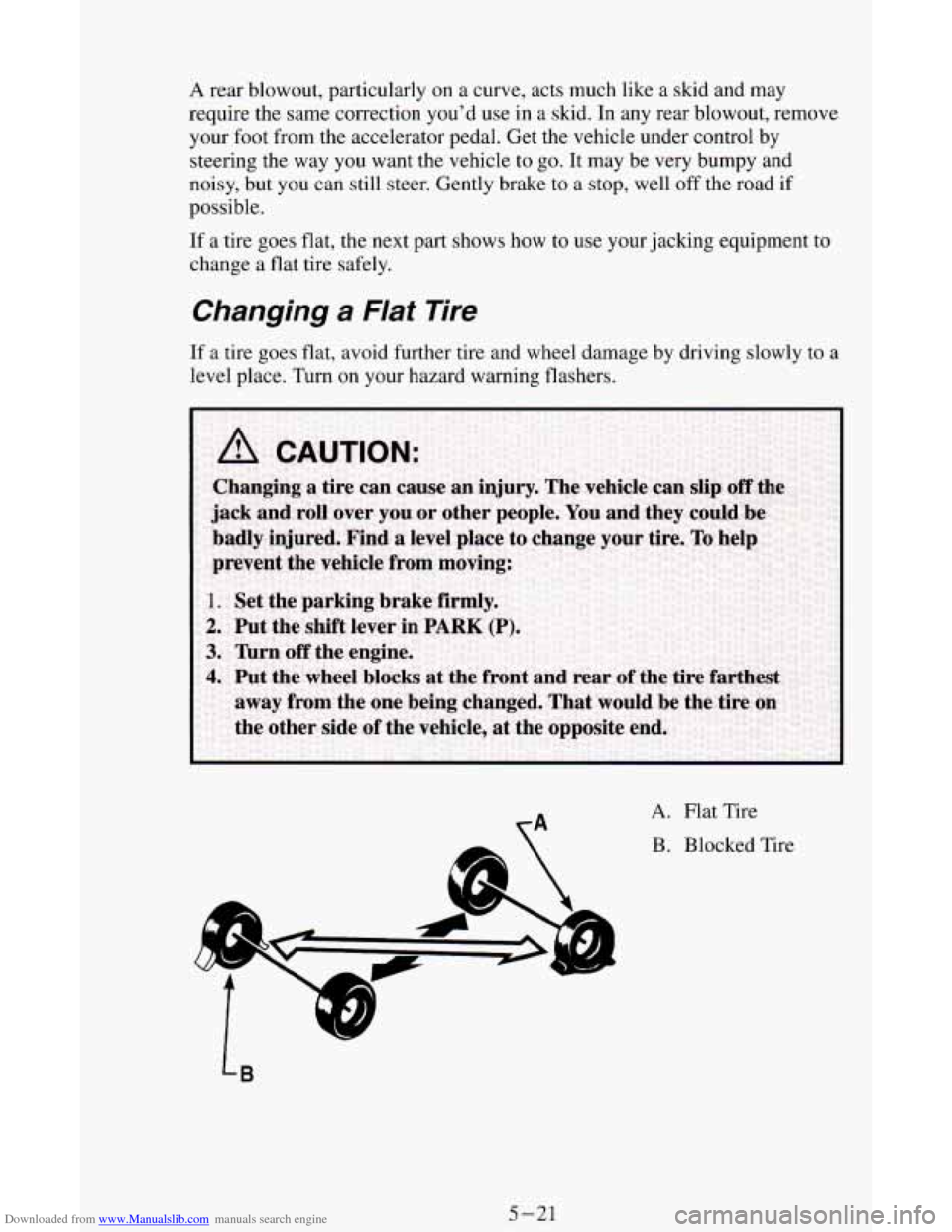
Turn on your hazard warning flashers.
A. Flat Tire
B. Blocked Tire
5-21
Page 207 of 342
Downloaded from www.Manualslib.com manuals search engine And don’t mix your compact spare or wheel with other wheels or tires. They
won’t fit. Keep your spare and its wheel together.
NOTICE:
Tire chains won’t fit your compact spare. Using them will
damage your vehicle and destroy the chains too. Don’t use tire
chains on your compact spare.
If You’re Stuck: In Sand, Mud, Ice or Snow
What you don’t want to do when your vehicle is stuck is to spin your wheels
too fast. The method known as “rocking” can help you get out when you’re
stuck, but
you must use caution.
I A CAUTION:
I NOTICE:
Spinning your wheels can destroy parts of your vehicle as well as
the tires. If you spin the wheels too fast while shifting your
transmission back and forth, you can destroy your transmission.
For information about using tire chains on your vehicle, see “Tire Chains”
in the Index.
Rocking your vehicle to get it out:
First, turn your steering wheel left and right. That will clear the area around
your front wheels. Then shift back and forth between REVERSE
(R) and a
forward gear, spinning the wheels as little as possible. Release
the
accelerator pedal while you shift, and press lightly on the accelerator pedal
when the transmission is in gear. If that doesn’t get
you out after a few tries,
you may need
to be towed out. If you do need to be towed out, see “Towing
Your Vehicle” in the Index.
5-35
Page 235 of 342
Downloaded from www.Manualslib.com manuals search engine Power Steering Fluid
How To Check Power Steering Fluid
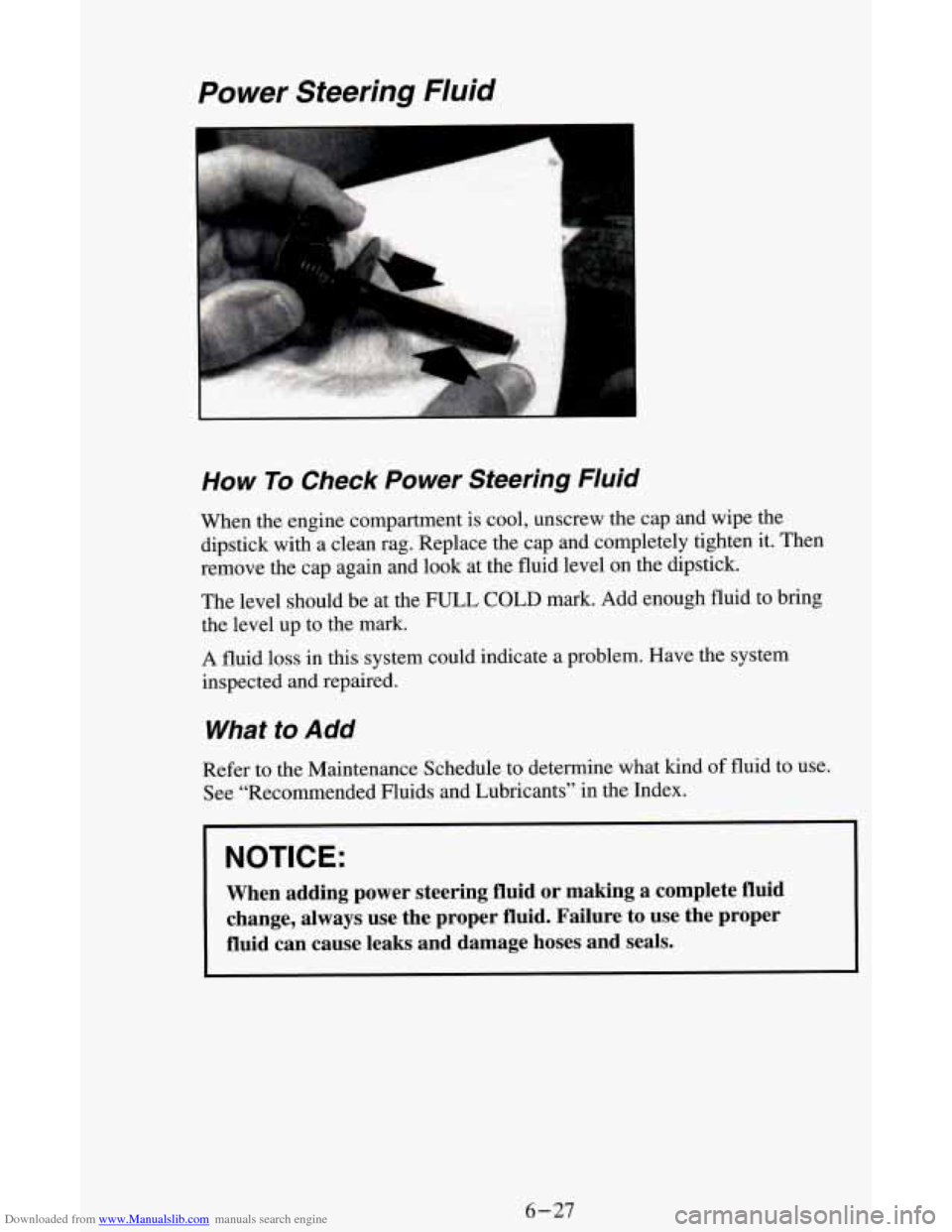
When the engine compartment is cool, unscrew the cap and wipe the
dipstick with a clean rag. Replace the cap and completely tighten it. Then
remove the cap again and look at the fluid level on the dipstick.
The level should be at the FULL
COLD mark. Add enough fluid to bring
the level up to the mark.
A fluid loss in this system could indicate a problem. Have the system
inspected and repaired.
What to Add
Refer to the Maintenance Schedule to determine what kind of fluid to use.
See “Recommended Fluids and Lubricants” in the Index.
NOTICE:
When adding power steering fluid or making a complete fluid
change, always use the proper fluid. Failure to use the proper\
fluid can cause leaks and damage hoses and seals.
6-27
Page 240 of 342
Downloaded from www.Manualslib.com manuals search engine Replacing Brake System Parts
The braking system on a modern vehicle is complex. Its many parts have to
be of top quality and work well together if the vehicle is to have really good
braking. Vehicles we design and test have topquality
GM brake parts in
them, as your vehicle does when it is new. When you replace parts of your
braking system
- for example, when your brake linings wear down and
you have to have
new ones put in - be sure you get new genuine GM
replacement parts. If you don’t, your brakes may no longer work properly.
For example, if someone puts in brake linings that are wrong for your
vehicle, the balance between your front and rear brakes can change
- for
the worse. The braking performance you’ve come to expect can change in
many other ways if someone puts in the wrong replacement brake parts.
Hydro-Boost Brake System
The power steering pump also powers the Hydro-Boost. Refer to “Power
Steering Fluid” in this section when checking the fluid level or adding fluid.
Battery
Every new vehicle has a Delco Freedom’ battery. You never have to add
water to one of these. When it’s time for a new battery, we recommend
a
Delco Freedom’ battery. Get one that has the replacement number shown
on the original battery’s label.
Vehicle Storage
If you’re not going to drive your vehicle for 25 days or more, take off the
black, negative (-) cable from the battery. This will help keep your battery
from running down.
Contact your dealer
to learn how to prepare your vehicle for longer storage
periods.
6-32