1995 CHEVROLET ASTRO CARGO VAN key
[x] Cancel search: keyPage 78 of 342
Downloaded from www.Manualslib.com manuals search engine Shifting Out of PARK (P)
Your vehicle has a brake-transmission shift interlock. You have to fully
apply your regular brake before you can shift from PARK (P) when the
ignition is in the RUN position.
See “Automatic Transmission” in the Index,
If you cannot shift out
of PARK (P), ease pressure on the shift lever - push
the shift lever all the way into PARK (P) as you maintain brake application.
Then move the shift lever into the gear you want.
If you ever hold the brake pedal down but still can’t shift out of PARK (P),
try this:
1. Turn the key to OFF.
2. Apply and hold the brake until the end of Step 4.
3. Shift to NEUTRAL (N).
4. Start the vehicle and then shift to the drive gear you want.
5. Have the vehicle fixed as soon as you can.
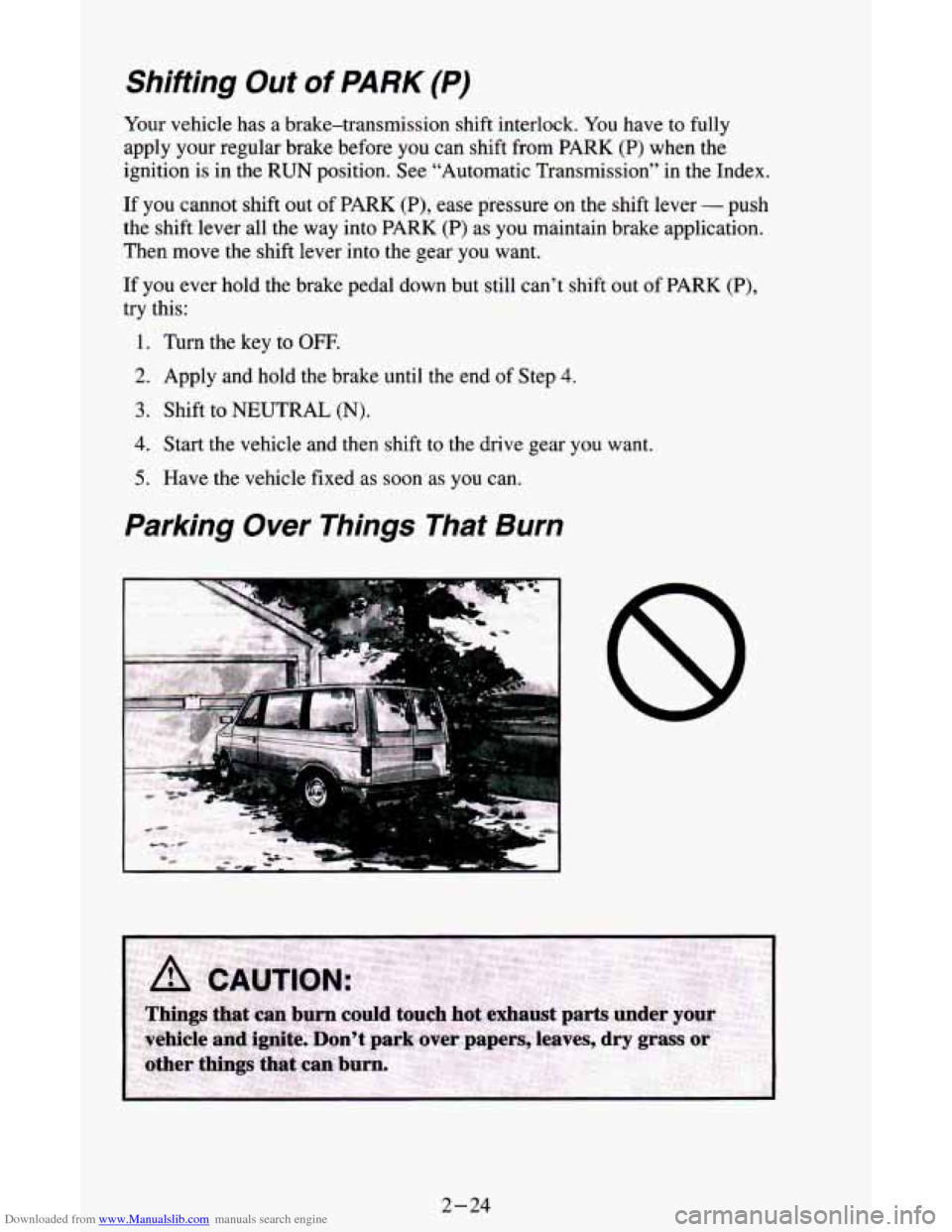
Parking Over Things That Burn
2-24
Page 97 of 342
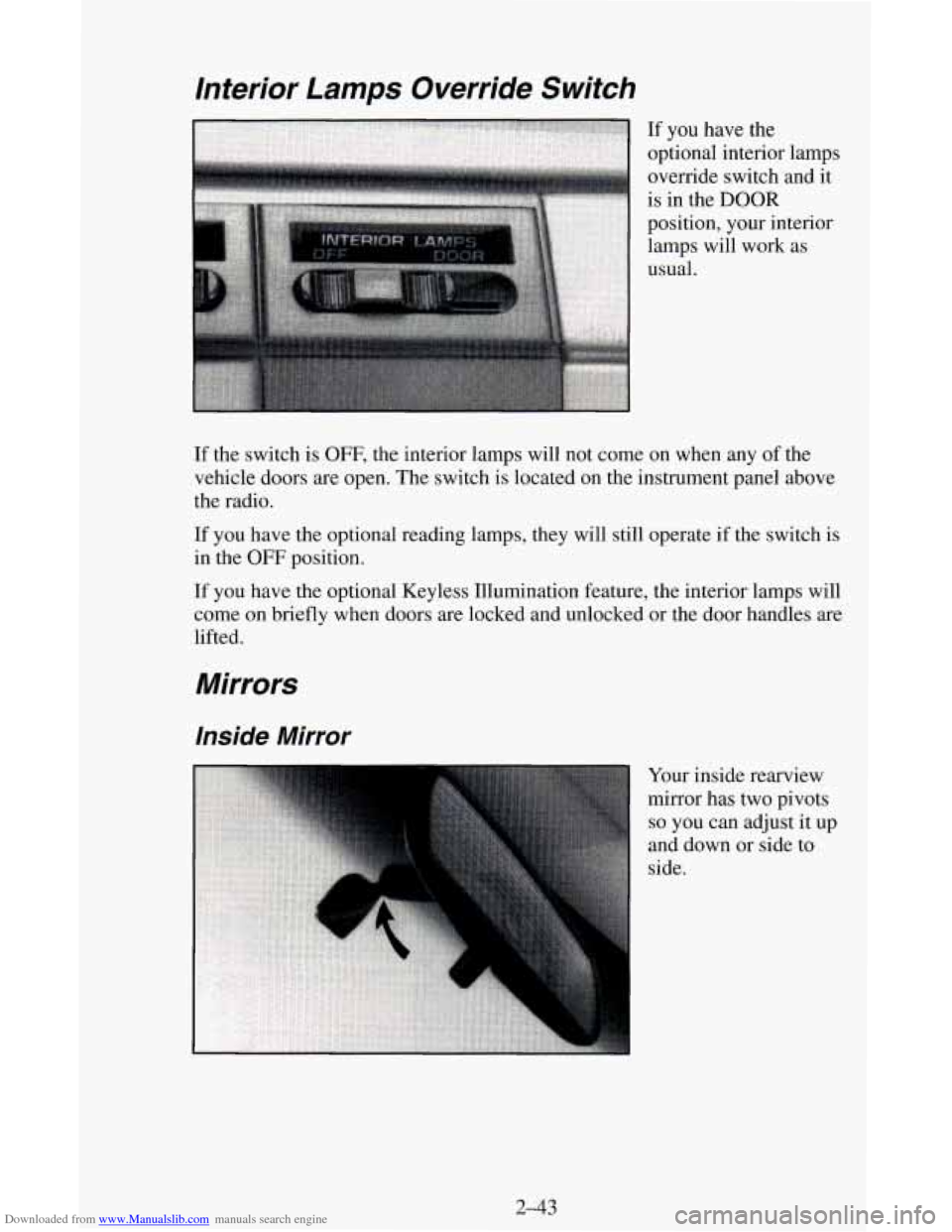
Downloaded from www.Manualslib.com manuals search engine If the switch is OFF, the interior lamps will not come on when any of the
vehicle doors are open. The switch is located on the instrument panel above
the radio.
If
you have the optional reading lamps, they will still operate if the switch is
in the OFF position.
If you have the optional Keyless Illumination feature, the interior lamps will
come on briefly when doors are locked and unlocked or the door handles are
lifted.
Mirrors
Inside Mirror
Your inside rearview
mirror has two pivots
so you can adjust it up
and down or side to
side.
2-43
Page 106 of 342
Downloaded from www.Manualslib.com manuals search engine you know they’re working. If you are familiar with this section, you should
not be alarmed when this happens.
Gages can indicate when there may be or
is a problem with one of your
vehicle’s functions. Often gages and warning lights work together
to let you
know when there’s a problem with your vehicle.
When one of the warning lights comes
on and stays on when you are
driving, or when
one of the gages shows there may be a problem, check the
section that tells you what to do about
it. Please follow this manual’s advice.
Waiting
to do repairs can be costly - and even dangerous. So please get to
know your warning lights and gages. They’re
a big help.
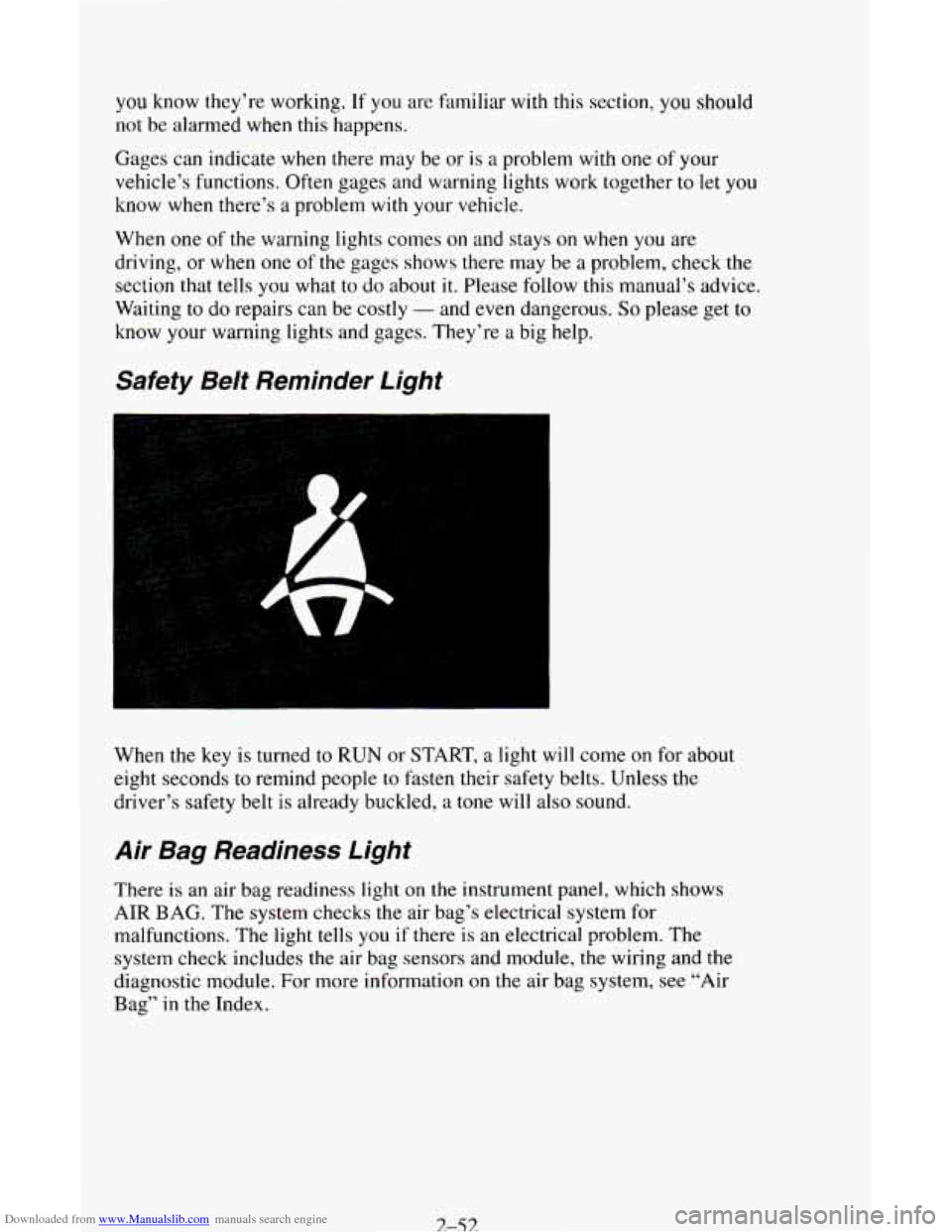
Safety Beit Reminder Light
When the key is turned to RUN or START, a light will come on for about
eight seconds to remind people
to fasten their safety belts. Unless the
driver’s safety belt is already buckled,
a tone will also sound.
Air Bag Readiness Light
There is an air bag readiness light on the instrument panel, which shows
AIR BAG. The system checks the air bag’s electrical system for
malfunctions. The light tells
you if there is an electrical problem. The
system check includes the air bag sensors and module, the wiring and the
diagnostic module. For more information on the air bag system,
see “Air
Bag”
in the Index.
3-53
Page 134 of 342
Downloaded from www.Manualslib.com manuals search engine If the disc player is very hot, or if you’re driving on a very rough road, a
disc may come out or just
not play. If you see the word HOT on the display,
the disc player is
too hot to play the disc. Press RCL to make the word HOT
go
off the display.
When things get back to normal, the disc should play again. If the disc
comes back out, check whether:
The disc is upside down.
It is dirty, scratched, or wet.
Too much moisture is in the air. (If there is, wait about one hour and try
again.)
RCL
- Press RCL to see what track is playing. Press it again within 5
seconds to see how long it has been playing. The track number also appears
when you change the volume or when a new track starts to play.
COMP
- Press the COMP button to make soft and loud passages more
nearly equal in volume. “COMP” will appear in the display while using this
control.
RDM
- The RDM button means random and when it is pressed, it causes
the CD mechanism to play the tracks in a random order rather than in the
sequential
1, 2’3 order. “RDM” will appear in the display while using this
control.
To return to normal sequence, press RDM again.
REV
- Press and hold the REV button to quickly return to a favorite
passage. Release it to display the passage. The counter reading will be
displayed while using this control.
FWD
- Press and hold the FWD button to advance quickly within a track.
Release it to resume playing. Watch the display
to stop at a specific passage.
SCAN
- Press SCAN to sample each track for approximately 10 seconds.
Scanning will continue until the RDM, SCAN
or any other motion button is
pressed again.
PREV
- Hold the PREV (4 SEEK) button, or press it more than once, and
the disc will return to previous tracks.
NEXT - Press NEXT (SEEK ,) to hear the next track now instead of
waiting until the present track is finished. If you hold this button or press it
more than once, the disc will advance further.
ST-PL
- Press ST-PL (Stop-Play) to make the disc stop and the radio
play. Press ST-PL again to restart the disc at the point where it stopped.
Press PWR or turn the ignition key
off to stop the disc player. The disc stays
in the player and will resume playing at the point where it stopped.
Press EJCT to eject the disc and make
the radio play. The disc will start at
track
1 when you reinsert it.
3-16
Page 140 of 342
Downloaded from www.Manualslib.com manuals search engine Rear-end collisions are about the most preventable of accidents. Yet they
are common. Allow enough following distance. It’s the best defensive
driving maneuver, in both city and rural driving. You never know when the
vehicle in front of you is going to brake or turn suddenly.
Drunken Driving
Death and injury associated with drinking and driving is a national tragedy.
It’s the number one contributor to the highway death toll, claiming
thousands
of victims every year.
Alcohol affects four things that anyone needs to drive a vehicle:
Judgment
Muscular Coordination
Vision
Attentiveness
Police records show that almost half of all motor vehicle-related deaths
involve alcohol. In most cases, these deaths are the result
of someone who
was drinking and driving. In recent years, some 18,000 annual motor
vehicle-related deaths have been associated with the use of alcohol, with
more than
300,000 people injured.
Many adults
- by some estimates, nearly half the adult population -
choose never to drink alcohol, so they never drive after drinking. For
persons under
21, it’s against the law in every U.S. state to drink alcohol.
There are good medical, psychological and developmental reasons for these
laws.
The obvious way to solve this highway safety problem is for people never to
drink alcohol and then drive. But what if people do? How much is “too
much” if the driver plans to drive? It’s a lot less than many might think.
Although it depends on each person and situation, here is some general
information
on the problem.
The Blood Alcohol Concentration (BAC) of someone who
is drinking
depends upon four things:
How much alcohol consumed
The drinker’s body weight
The amount of food that is consumed before and during drinking
The length of time it’s taken the drinker to consume the alcohol
According
to the American Medical Association, a 180-pound (82 kg)
person who drinks three 12-ounce
(355 ml) bottles of beer in an hour will
end up with a BAC of about
0.06 percent. The person would reach the same
BAC by drinking three 4-ounce
(1 20 ml) glasses of wine or three mixed
drinks if each had
1-1/2 ounces (45 ml) of a liquor like whiskey, gin or
vodka.
4-2
Page 174 of 342
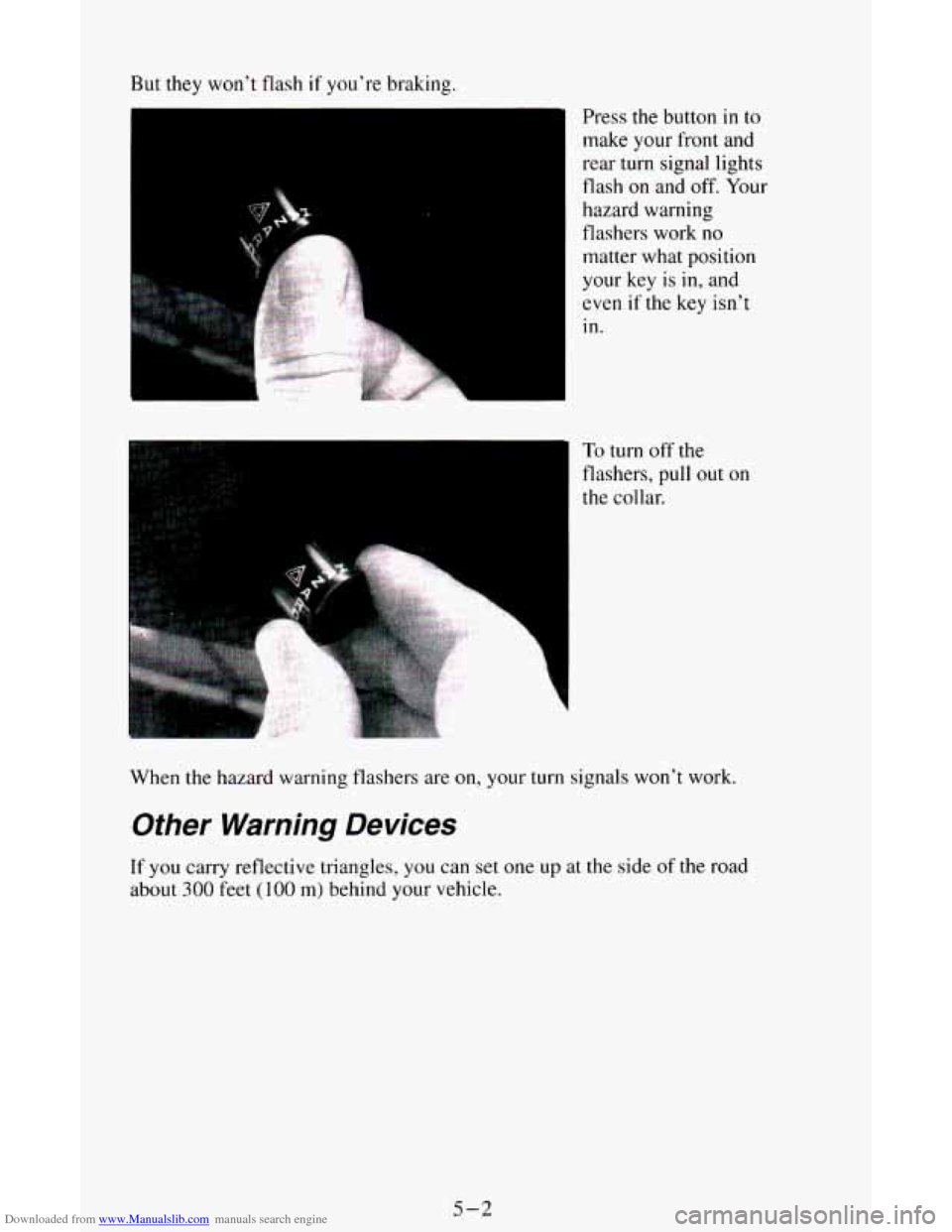
Downloaded from www.Manualslib.com manuals search engine But they won’t flash if you’re braking. Press the button
in to
make your front and
rear turn signal lights
flash
on and off. Your
hazard warning
flashers work no
matter what position
your key
is in, and
even
if the key isn’t
in.
To turn off the
flashers, pull out on
the collar.
When the hazard warning flashers are on, your turn signals
won’t work.
Other Warning Devices
If you carry reflective triangles, you can set one up at the side of the road
about
300 feet (100 m) behind your vehicle.
5-2
Page 179 of 342
Downloaded from www.Manualslib.com manuals search engine Towing Your Vehicle
Try to have a GM dealer or a professional towing service tow your vehicle.
They can provide the right equipment and know how to tow
it without
damage.
If your vehicle has been changed
or modified since it was factory-new by
adding aftermarket items like fog lamps, aero skirting, or special tires and
wheels, these things can be damaged during towing.
Before
you do anything, turn on the hazard warning flashers.
When
you call, tell the towing service:
0 Whether your vehicle has rear-wheel drive or the all-wheel-drive
option. If your vehicle has fog lamps, it cannot be towed from the front
with sling-type equipment.
The make, model, and year of your vehicle.
0 Whether you can still move the shift lever.
0 If there was an accident, what was damaged.
When your vehicle
is being towed, have the ignition key off. The steering
wheel should be clamped in a straight-ahead position, with
a clamping
device designed for towing service.
Do not use the vehicle’s steering
column lock for this.
The transmission should be in NEUTRAL (N) and the
parking brake released.
5-7
Page 312 of 342
Downloaded from www.Manualslib.com manuals search engine Engine Coolant Level
Check the engine coolant level and add the proper coolant mix if necessary.
See “Coolant” in the Index for further details.
Windshield Washer Fluid Level
Check the windshield washer fluid level in the windshield washer tank and
add the proper fluid if necessary. See “Windshield Washer Fluid” in the
Index for further details.
At Least Once a Month
Tire lnflation
Check tire inflation. Make sure tires are inflated to the pressures specified
on the CertificatiodTire label located on the rear edge of the driver’s door.
See “Tires” in the Index for further details.
Cassette Deck
Clean cassette deck. Cleaning should be done every 50 hours of tape play.
See “Audio Systems” in the Index for further details.
At Least Once a Year
Key Lock Cylinders
Lubricate the key lock cylinders with the lubricant specified in Part D.
Body Lubrication
Lubricate all body door hinges, the body hood, fuel door and rear
compartment hinges, latches and locks including interior glove box and
console doors, and any moving seat hardware. Lubricate the hood safety
lever pivot and prop rod pivot. Part
D tells you what to use. More frequent
lubrication may be required when exposed to a corrosive environment.
7-36