1995 CHEVROLET ASTRO CARGO VAN ECU
[x] Cancel search: ECUPage 49 of 342
Downloaded from www.Manualslib.com manuals search engine 6. To tighten the belt, pull its free end while you push down on the child
restraint.
7. Push and pull the child restraint in different directions to be sure it is
secure. If the child restraint isn’t secure, turn the latch plate over and
buckle it again. Then see if it
is secure. If it isn’t, secure the restraint in
a different place in the vehicle and contact the child restraint maker for
their advice about how to attach the child restraint properly.
To remove the child restraint, just unbuckle the vehicle’s safety belt. It will
be ready to work for an adult or larger child passenger.
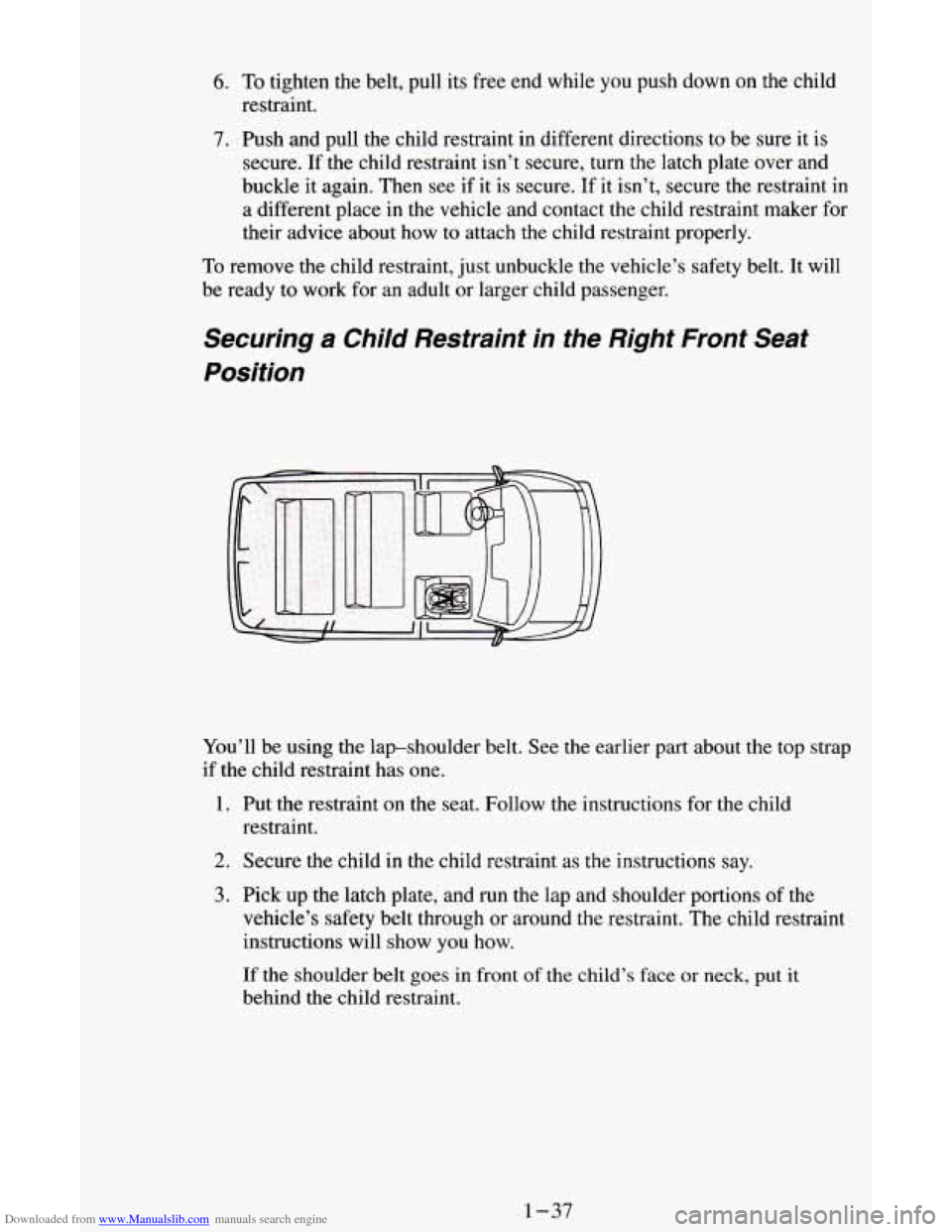
Securing a Child Restraint in the Right Front Seat
Position
You’ll be using the lap-shoulder belt. See the earlier part about the top strap
if the child restraint has one.
1. Put the restraint on the seat. Follow the instructions for the child
restraint.
2. Secure the child in the child restraint as the instructions say.
3. Pick up the latch plate, and run the lap and shoulder portions of the
vehicle’s safety belt through
or around the restraint. The child restraint
instructions will
show you how.
If the shoulder belt goes in front of the child’s face or neck, put it
behind the child restraint.
1-37
Page 51 of 342
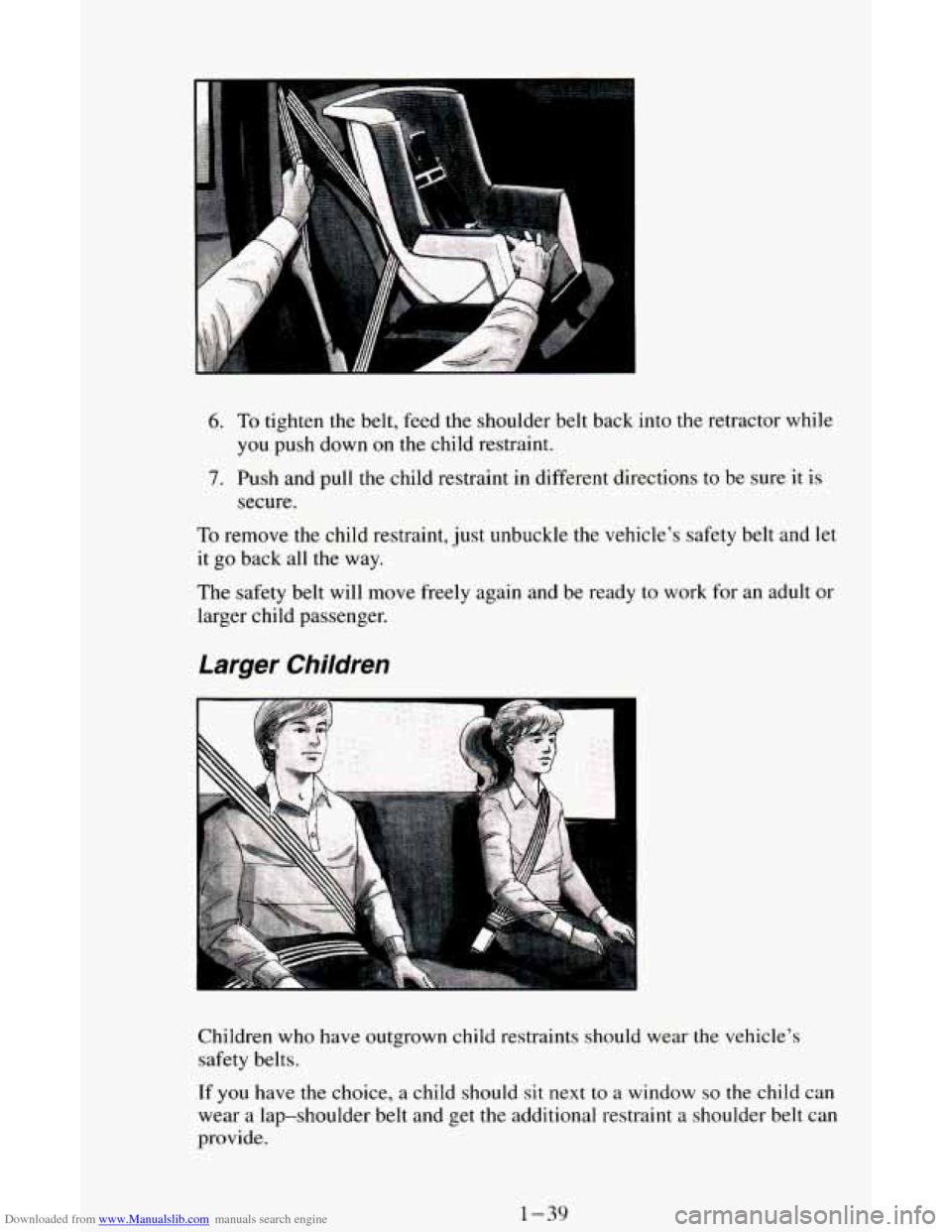
Downloaded from www.Manualslib.com manuals search engine 6. To tighten the belt, feed the shoulder belt back into the retractor while
you push down
on the child restraint.
7. Push and pull the child restraint in different directions to be sure it is
secure.
To remove the child restraint, just unbuckle the vehicle’s safety belt and let
it go back all the way.
The safety belt will move freely again and be ready to work for an adult or
larger child passenger.
Larger Children
Children who have outgrown child restraints should wear the vehicle’s
safety belts.
If you have the choice, a child should sit next to
a window so the child can
wear a lap-shoulder belt and get the additional restraint
a shoulder belt can
provide.
1-39
Page 102 of 342
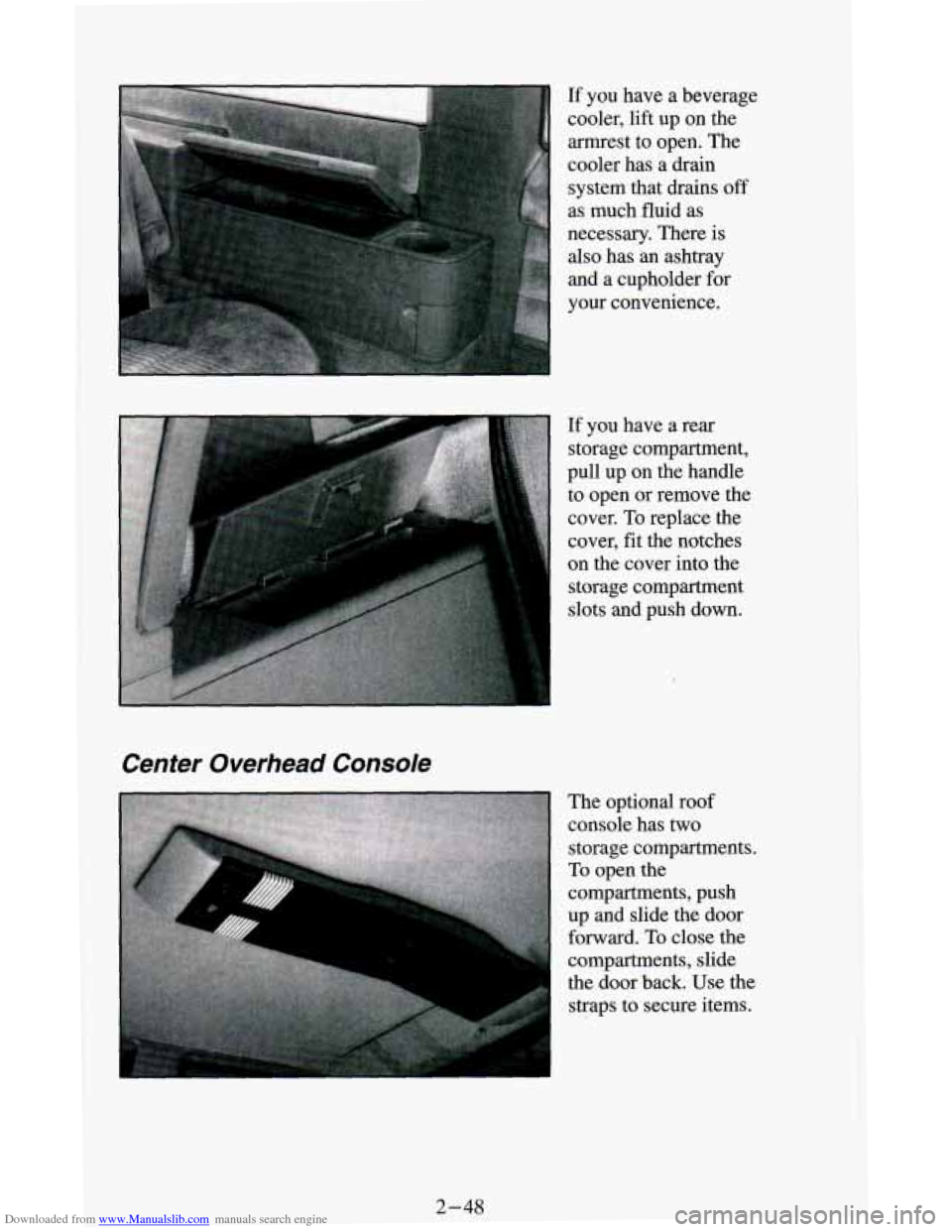
Downloaded from www.Manualslib.com manuals search engine If you have a beverage
cooler, lift up on the
armrest to open. The
cooler has a drain
system that drains
off
as much fluid as
necessary. There is
also has an ashtray
and a cupholder for
your convenience.
Center Overhead Console
If you have a rear
storage compartment,
pull up on the handle
to open or remove the
cover.
To replace the
cover, fit the notches
on the cover into the
storage compartment
I slots and push down.
The optional roof
console has two
storage compartments.
To open the
compartments, push
up and slide the door
forward.
To close the
compartments, slide
the door back. Use the
straps to secure items.
2-48
Page 116 of 342
Downloaded from www.Manualslib.com manuals search engine Luggage Carrier (Option)
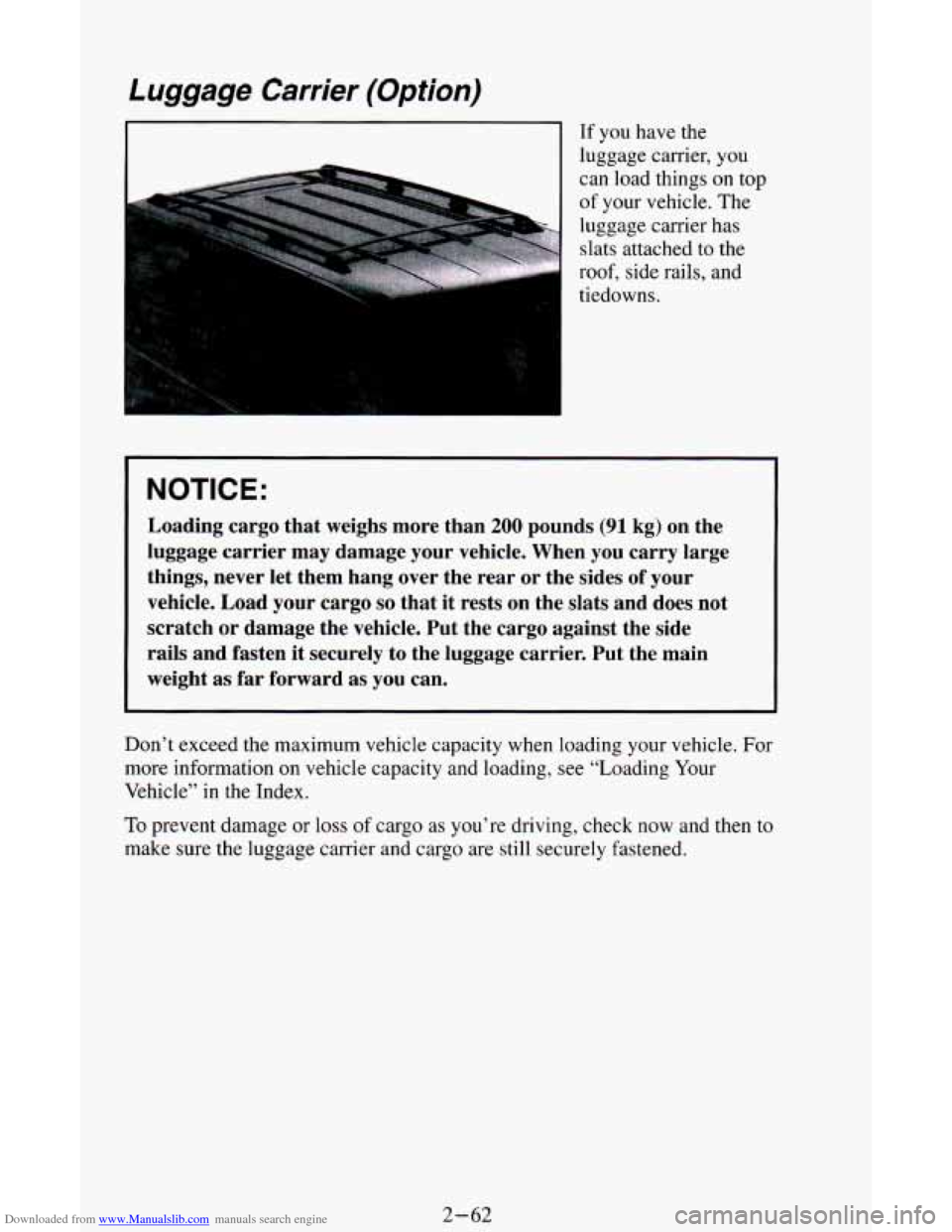
I If you have the
luggage carrier, you
can load things
on top
of your vehicle. The
luggage carrier has
slats attached to the
roof, side rails, and
tiedowns.
NOTICE:
Loading cargo that weighs more than 200 pounds (91 kg) on the
luggage carrier may damage your vehicle. When you carry large
things, never let them hang over the rear or the sides of your
vehicle. Load your cargo
so that it rests on the slats and does not
scratch or damage the vehicle. Put the cargo against the side
rails and fasten it securely to the luggage carrier. Put the main
weight as far forward as you can.
Don’t exceed the maximum vehicle capacity when loading your vehicle. For
more information
on vehicle capacity and loading, see “Loading Your
Vehicle” in the Index.
To prevent damage or loss of cargo as you’re driving, check now and then to
make sure the luggage carrier and cargo are still securely fastened.
2-62
Page 135 of 342
Downloaded from www.Manualslib.com manuals search engine Delco LOC /I Theft Deterent Feature
Delco LOC II@ is an anti-theft feature for the compact disc player. It can be
used or ignored. If ignored, the system plays normally. If it is used, your
player won’t be usable
if it is ever stolen, because it will go to LOC mode
any time the battery power is removed. After a
loss of battery power, the
player cannot be turned on unless an unlock code is entered.
The instructions below tell you how to enter
a secret code into the system. If
your vehicle loses battery power for any reason, you must unlock the system
with the secret code before the radio will turn on.
To Lock The System:
1. Write down any 6 digit number and keep it in a safe place.
2. Turn the ignition to the ACC (Accessory) or RUN position.
3. Press the PWR knob to turn the radio off.
4. Press the 1 and 4 buttons together. Hold them down until “- - -” shows
on the display.
You are now ready to enter your secret code. Don’t wait more than 15
seconds between steps.
5. Press SET and “000” will appear on the display.
6. Press the SEEK or 4 button to make the first number appear.
7. Press SCAN to make the next two numbers agree with your code.
8. Press BAND and “000” will appear again. Now you are ready to enter
9. Repeat steps 6 and 7 for the last three digits of your code.
the last three digits of your code.
10. Press BAND and “REP” will appear for 5 seconds and then “000” will
11. Repeat steps 6 through 10. This time “SEC” will appear - indicating
appear.
that the radio
is secure.
To Unlock The System After A Power Loss
When battery power is reapplied to a secured radio, the radio won’t turn on
and “LOC” will appear on the display.
Enter your secret code as follows. Pause no more than
15 seconds between
steps.
1. Turn the ignition on. (Radio off.)
2. Press the SET button. The display will show “000”.
3-17
Page 136 of 342
Downloaded from www.Manualslib.com manuals search engine 3. Enter the six digits of the code following steps 6-9 above. The display
will show the numbers
as entered.
4. Press the BAND knob and the time appears - indicating that the
disabling sequence was successful.
If the display indicates “SEC”, the
numbers did
not match and the unit is still secured.
Disabling The Theft System
1. Press presets 1 and 4 for 5 seconds with ignition on and radio off. The
display will show
“SEC”, indicating the unit is in the secure mode.
2. Press the SET button. The display will show “000”.
3. Enter the first three digits of the code following steps 6 and 7 of the
preceding paragraphs (“To Lock
the System”). The display will show
the numbers
as entered.
4. Press the BAND knob. The radio will display “000”.
5. Enter the second three digits of the code. The display will show the
numbers
as entered.
6. Press the BAND knob. If the display shows “- - - ”, the disabling
sequence was successful. The numbers matched the user-selected code
or the factory back-up code, and the
unit is in the UNSECURED
mode. If
the display shows “SEC”, the disabling sequence was
unsuccessful and
the numbers did not match either of the codes and the
unit will remain
in the SECURED mode.
Understanding Radio Reception
FM stereo will give you the best sound. But FM signals will reach only
about 10 to 40 miles (16 to 65 km). And, tall buildings or hills can interfere
with FM signals, causing the sound to come and
go.
The range for most AM stations is greater than for FM, especially at night.
The longer range, however, can cause stations
to interfere with each other.
AM can pick up noise from things like storms and power lines. Try reducing
the treble
to reduce this noise if you ever get it.
AM Stereo means the DelcoB system can receive C-QUAM@stereo
broadcasts. Many AM stations around
the countr use C-QUAM@ to
produce stereo, though some do not. (C-QUAM
4 is a registered trademark
of Motorola, Inc.) If your Delco@ system can get C-QUAM@, your
“STEREO” light
will come on when you’re receiving it.
Be aware that hearing damage from loud noise is almost undetectable
until
it is too late. Your hearing can adapt to higher volumes of sound. Sound that
seems normal can be loud and harmful to your hearing. Take precautions by
adjusting
the volume control on your radio to a safe sound level before your
hearing adapts
to it.
3-18
Page 158 of 342
Downloaded from www.Manualslib.com manuals search engine Include an ice scraper, a small brush or broom, a supply of windshield
washer fluid, a rag, some winter outer clothing, a small shovel, a flashlight,
a red cloth, and a couple of reflective warning triangles. And, if you will be
driving under severe conditions, include a small bag of sand, a piece of old
carpet or
a couple of burlap bags to help provide traction. Be sure you
properly secure these items in your vehicle.
Driving on Snow or Ice
Most of the time, those places where your tires meet the road probably have
good traction.
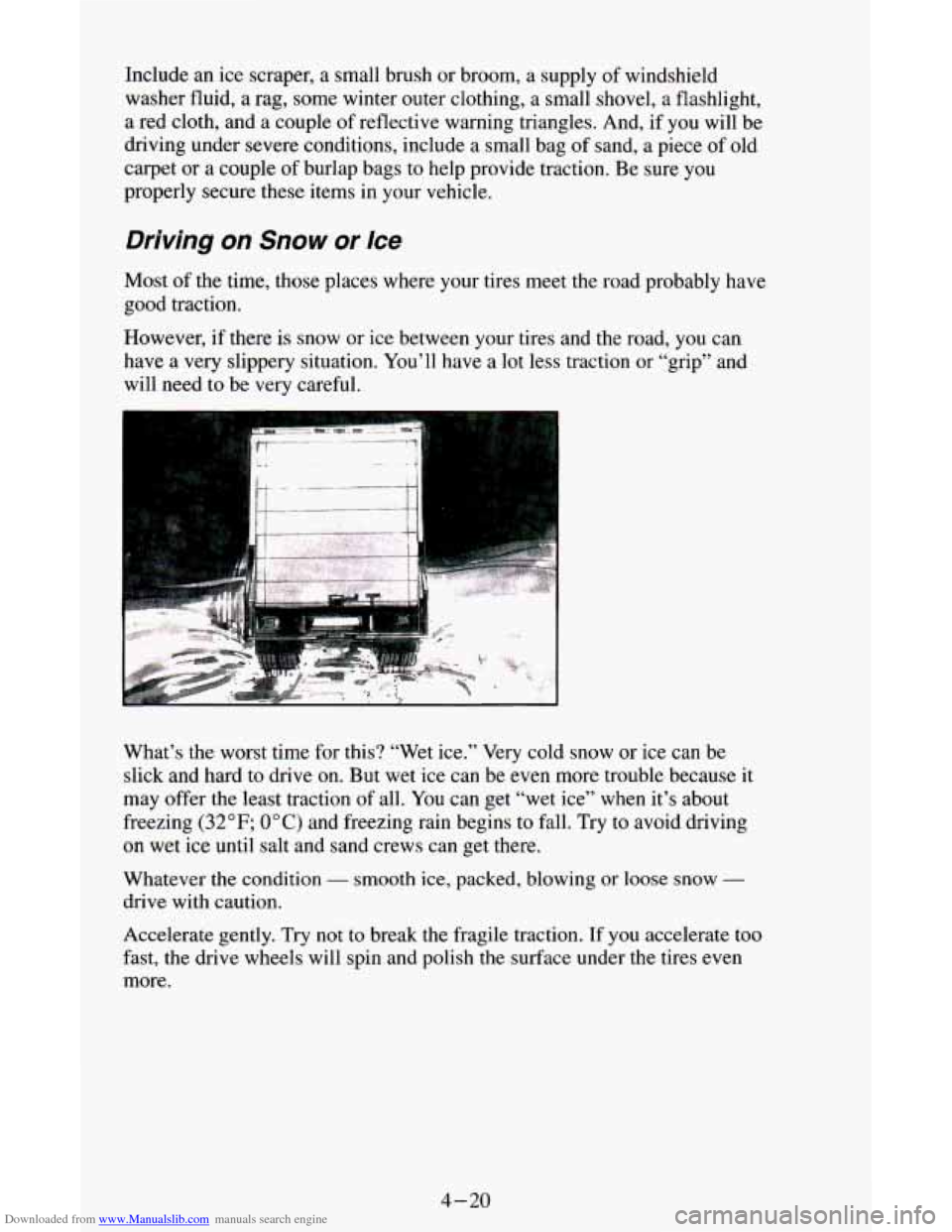
However, if there is snow or ice between your tires and the road, you can
have a very slippery situation. You’ll have a lot less traction or “grip” and
will need to be
very careful.
r tr“r“‘ ................... ..-......--.-
-- ..
I-.! .................. I
ii ,,-~ . .........._I........-.X i
What’s the worst time for this? “Wet ice.” Very cold snow or ice can be
slick and hard to drive
on. But wet ice can be even more trouble because it
may offer the least traction of all. You can get “wet ice” when it’s about
freezing
(32°F; 0°C) and freezing rain begins to fall. Try to avoid driving
on wet
ice until salt and sand crews can get there.
Whatever the condition
- smooth ice, packed, blowing or loose snow -
drive with caution.
Accelerate gently. Try not to break the fragile traction. If you accelerate too
fast, the drive wheels will spin and polish the surface under the tires even
more.
4-20
Page 168 of 342
Downloaded from www.Manualslib.com manuals search engine Driving with a Trailer
Towing a trailer requires a certain amount of experience. Before setting out
for the open road, you’ll want
to get to know your rig. Acquaint yourself
with the feel
of handling and braking with the added weight of the trailer.
And always keep in mind that the vehicle you are driving is now a good
deal longer and not nearly as responsive as your vehicle is by itself.
Before you start, check the trailer hitch and platform (and attachments),
safety chains, electrical connector, lights, tires and mirror adjustment.
If the
trailer has electric brakes, start
your vehicle and trailer moving and then
apply the trailer brake controller by hand to be sure the brakes are working.
This lets
you check your electrical connection at the same time.
During your trip, check occasionally
to be sure that the load is secure, and
that the lights and any trailer brakes are still working.
Following Distance
Stay at least twice as far behind the vehicle ahead as you would when
driving your vehicle without a trailer. This can help you avoid situations that
require heavy braking and sudden turns.
4-30