Page 90 of 395
Downloaded from www.Manualslib.com manuals search engine IGNITION KEY POSITIONS
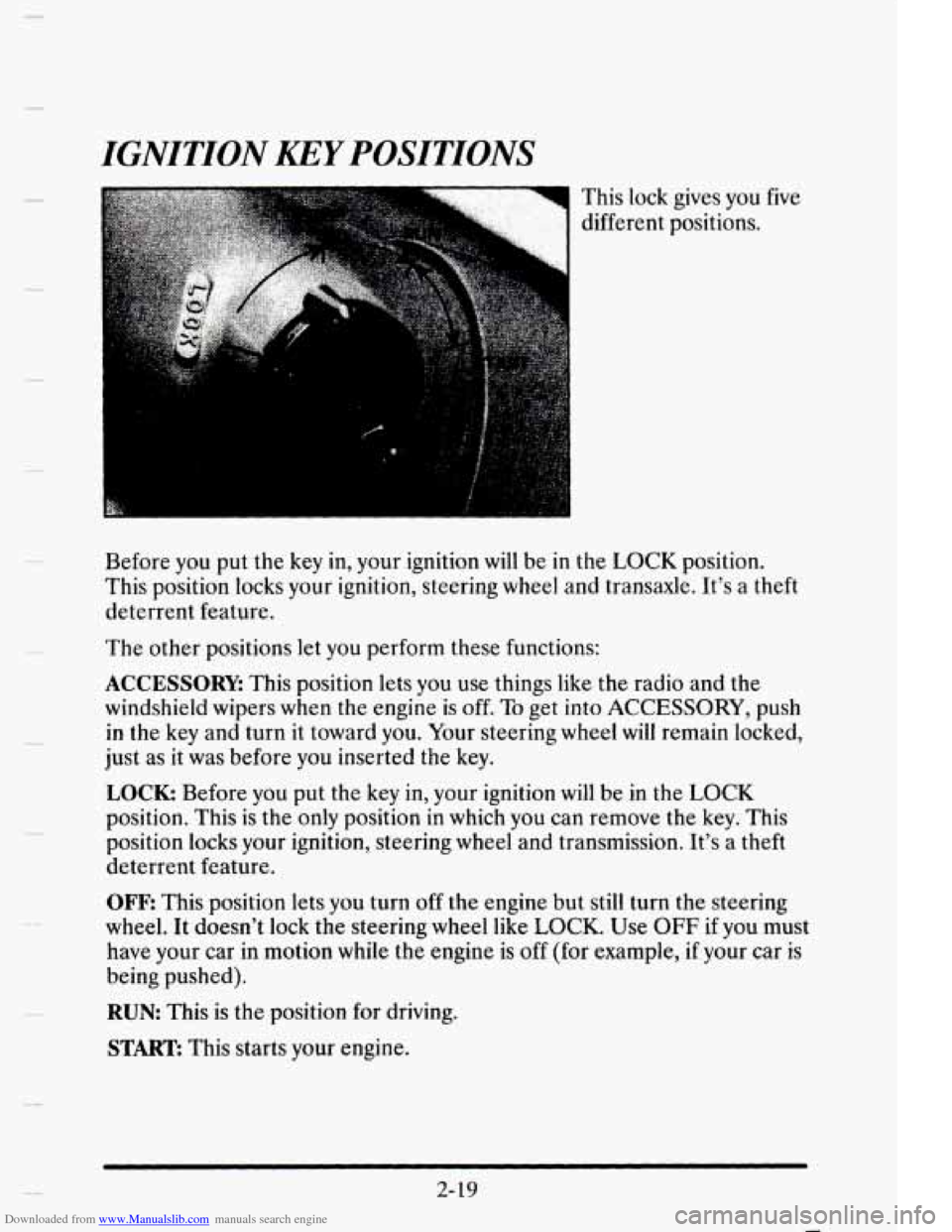
This lock gives you five
different positions.
Before you
put the key in, your ignition will be in the LOCK position.
This position locks your ignition, steering wheel and transaxle. It’s a theft
deterrent feature.
The other positions let you perform these functions:
ACCESSORY: This position lets you use things like the radio and the
windshield wipers when
the engine is off. To get into ACCESSORY, push
in the key and turn it toward you. Your steering wheel will remain locked,
just
as it was before you inserted the key.
LOCK: Before you put the key in, your ignition will be in the LOCK
position. This is the only position in which you can remove the key. This
position locks your ignition, steering wheel and transmission. It’s a theft
deterrent feature.
OFF
This position lets you turn off the engine but still turn the steering
wheel. It doesn’t lock the steering wheel like LOCK. Use OFF if you must
have your car in motion while the engine
is off (for example, if your car is
being pushed).
RUN: This is the position for driving.
START: This starts your engine.
2-19
Page 91 of 395

Downloaded from www.Manualslib.com manuals search engine I NOTICE:
If your key seems stuck in LOCK and you can’t turn it, be sure
it is all the way in. If it is, then turn the steering wheel left and
right while
you turn the key hard. But turn the key only with
your hand. Using a tool to force it could break the key
or the
ignition switch.
If none of this works, then your vehicle needs
service.
STARTING YOUR ENGINE
Move your shift lever to PARK (P) or NEUTRAL (N). Your engine won’t
start
in any other position -- that’s a safety feature. To restart when you’re
already moving, use
NEUTRAL (N) only.
~ ~~ ~
NOTICE:
Don’t try to shift to PARK (P) if your Cadillac is moving. If you
do, you could damage the transaxle. Shift to
PARK (P) only
when your vehicle is stopped.
To start your Northstar V8 engine:
1. Without pushing the accelerator pedal, turn your ignition key to
START When the engine starts, let go of the key. The idle speed will
go down as your engine gets warm.
NOTICE:
Holding your key in START for longer than 15 seconds at a time
will cause your battery to be drained much sooner.
And the
excessive heat can damage your starter motor.
2-21)
Page 94 of 395
Downloaded from www.Manualslib.com manuals search engine AUTOMATIC TMSXKLE
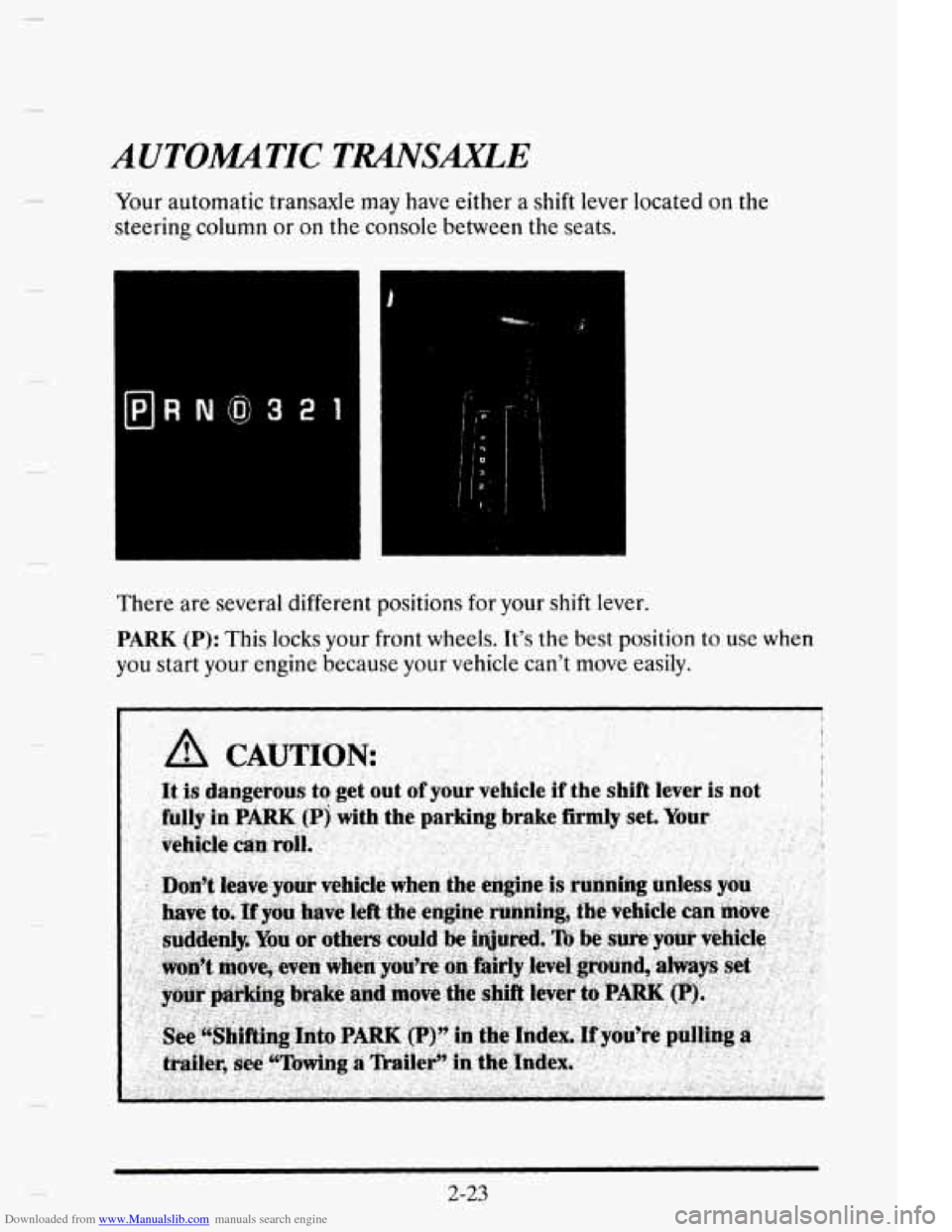
Your automatic transaxle may have either a shift lever located on the
steering column or
on the console between the seats.
BRN@3211
'I
i
There are several different positions for your shift lever.
PARK (P): This locks your front wheels. It's the best position to use when
you start your engine because your vehicle can't move easily.
2-23
Page 95 of 395

Downloaded from www.Manualslib.com manuals search engine Ensure the shift lever is fully in PARK (P) range before starting the
engine. Your Cadillac has
a brake-transaxle shift interlock. You have to
fully apply your regular brakes befure you can shift from PARK (P) when
when the ignition key is
in the RUN position. If you cannot shift out of
PARK (P), ease pressure on the shift lever -- push the shift lever all the
way into PARK (P) and release the shift lever button
on the floor shift
console models as you maintain brake application. Then move the shift
lever into the gear you wish. (Press the shift lever button before moving
the shift lever
on floor shift console models.) See “Shifting Out of
PARK (P)” in this section.
REVERSE (R): Use this gear to back up.
NOTICE:
Shifting to REVERSE (R) while your vehicle is moving forward
could damage
your transaxle. Shift to REVERSE (R) only after
your vehicle
has stopped.
Also use this gear to rock your vehicle back and forth to get out of snow,
ice or sand without damaging your transaxle. See “If You’re Stuck in
Sand,
Mud, Ice or Snow” in the Index for additional information.
NEUTRAL, (N): In this position, your engine doesn’t connect with the
wheels.
To restart when you’re already moving, use NEUTRAL (N) only.
Also, use NEUTRAL (N) when your vehicle is being towed.
2-24
1
1
a
Page 100 of 395
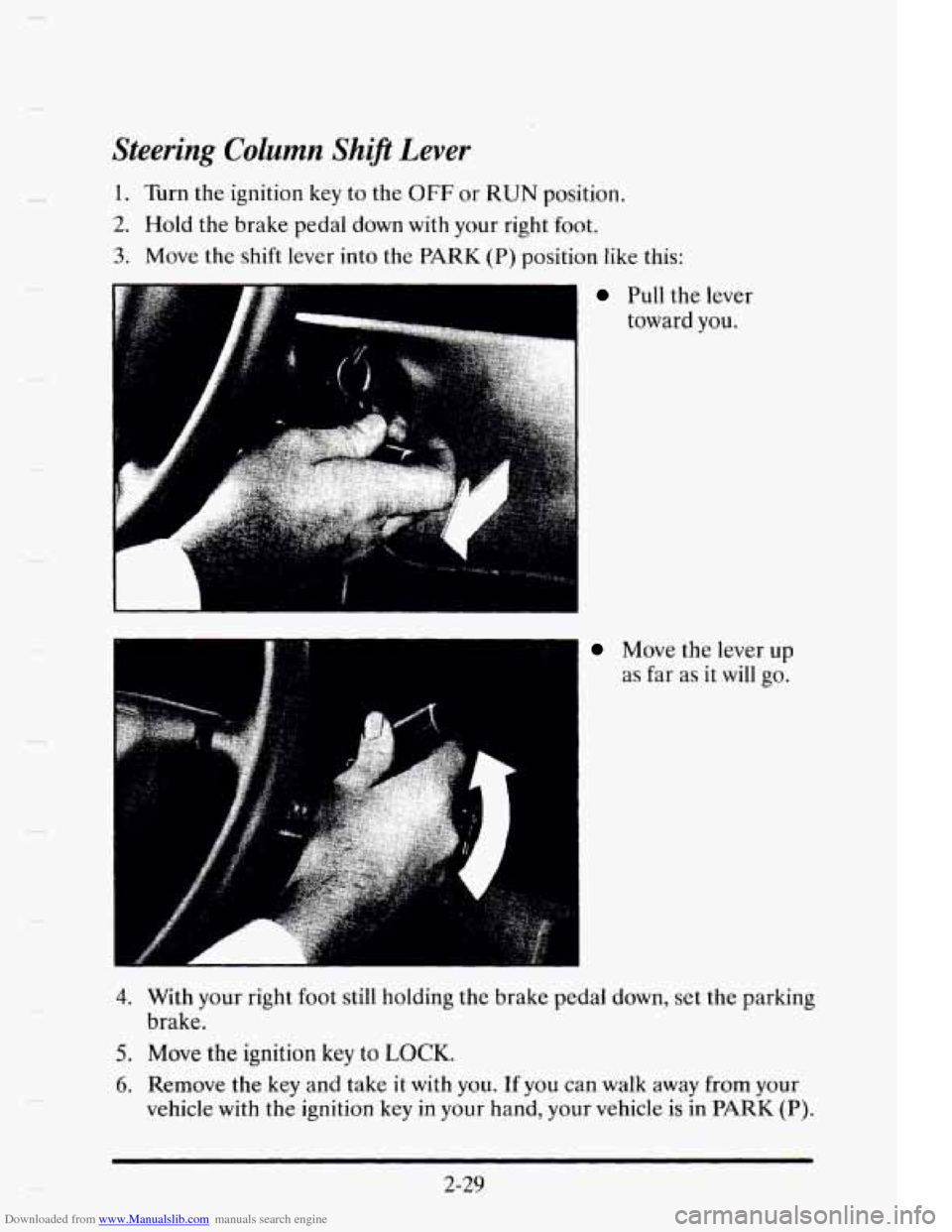
Downloaded from www.Manualslib.com manuals search engine Steering Column Ship Lever
1. Turn the ignition key to the OFF or RUN position.
2. Hold the brake pedal down with your right foot.
3. Move the shift lever into the PARK (P) position like this:
~ Pull the lever
toward you.
Move the lever up
as far as
it will go.
4. With your right foot still holding the brake pedal down, set the parking
5. Move the ignition key to LOCK.
6. Remove the key and take it with you. If you can walk away from your
brake.
vehicle with
the ignition key
in your hand, your vehicle is in PARK (P).
2-29
Page 101 of 395
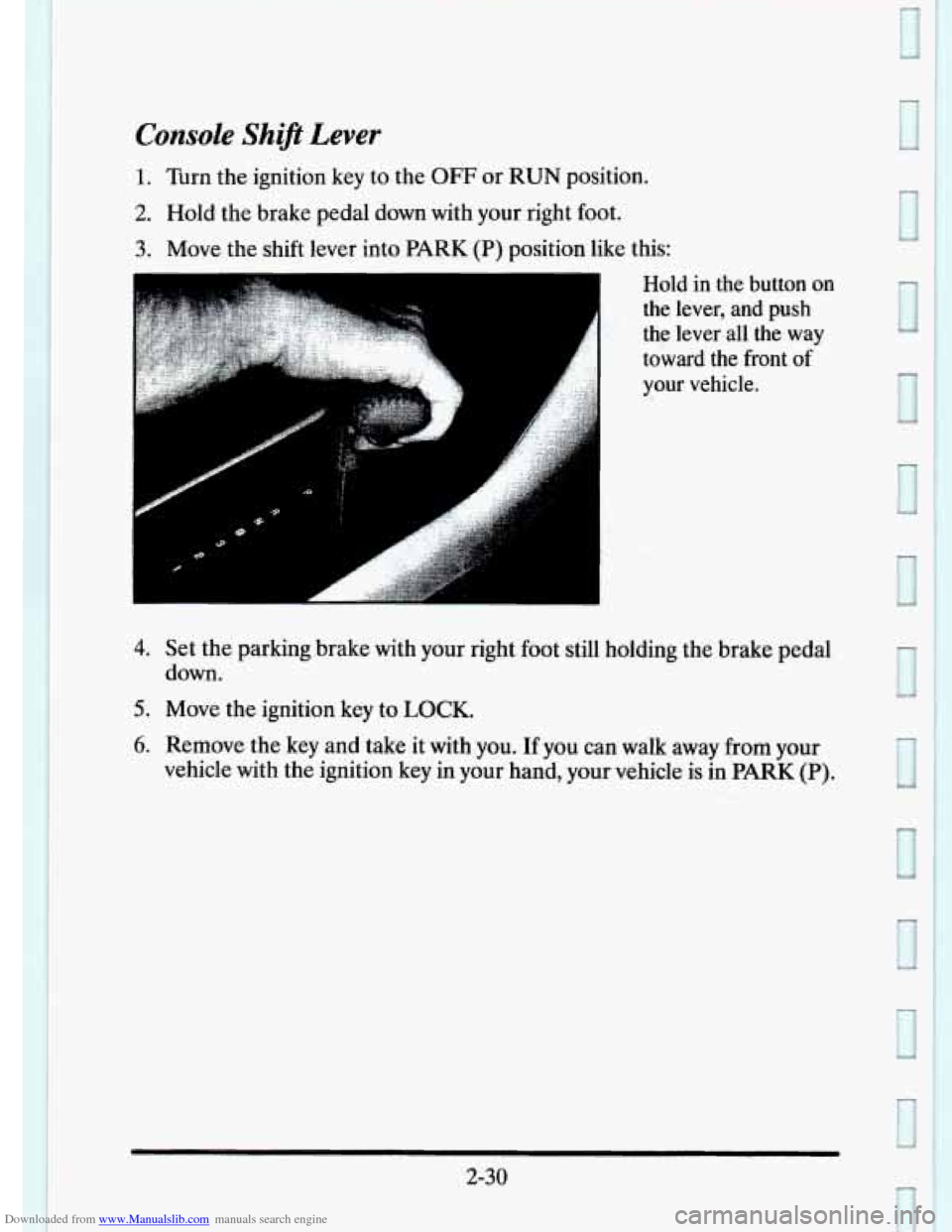
Downloaded from www.Manualslib.com manuals search engine Console Shift Lever
1. Turn the ignition key to the OFF or RUN position.
2. Hold the brake pedal down with your right foot.
3. Move the shift lever into PARK (P) position like this:
Hold in the button on
the lever, and push
the lever all the way
toward the front
of
your vehicle.
A
4. Set the parking brake with your right foot still holding the brake pedal
5. Move the ignition key to LOCK.
6. Remove the key and take it with you. If you can walk away from your
down.
vehicle with the ignition key in your hand, your vehicle is
in PARK (P).
2-30
Page 102 of 395
Downloaded from www.Manualslib.com manuals search engine Leaving Your khicle With the Engine Running
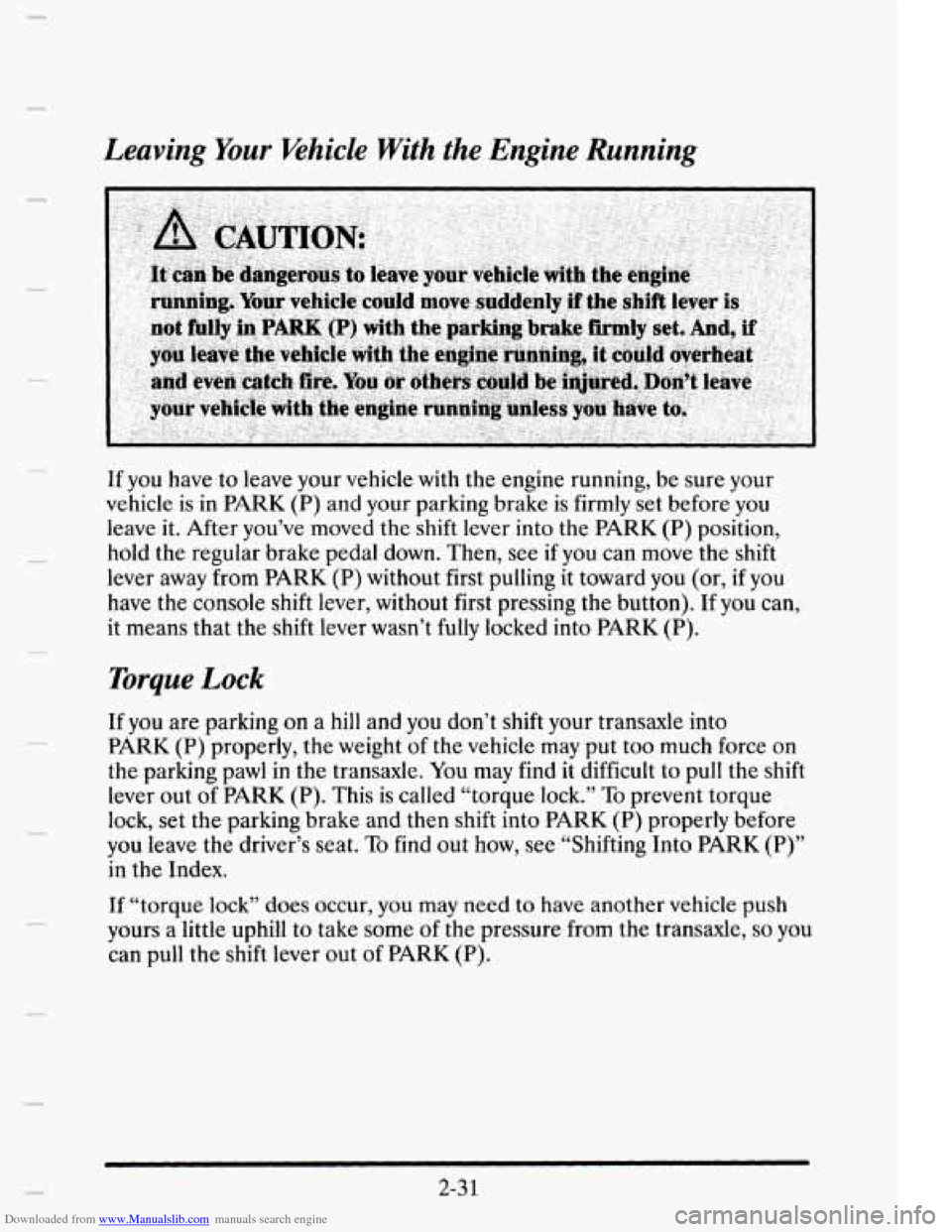
If you have to leave your vehicle with the engine running, be sure your
vehicle is in
PARK (P) and your parking brake is firmly set before you
leave it. After you’ve moved the shift lever into the PARK (P) position,
hold the regular brake pedal down. Then, see
if you can move the shift
lever away from
PARK (P) without first pulling it toward you (or, if you
have the console shift lever, without first pressing the button). If you can,
it means that the shift lever wasn’t fully locked into
PARK (P).
Torque Lock
If you are parking on a hill and you don’t shift your transaxle into
PARK (P) properly, the weight of the vehicle may put too much force on
the parking pawl in the transaxle. You may find it difficult to pull the shift
lever out
of PARK (P). This is called “torque lock.” To prevent torque
lock, set the parking brake and then shift into
PARK (P) properly before
you leave the driver’s seat.
To find out how, see “Shifting Into PARK (P)”
in the Index.
If “torque lock” does occur, you may need to have another vehicle push
yours a little uphill
to take some of the pressure from the transaxle, so you
can pull the shift lever out
of PARK (P).
2-3 1
Page 103 of 395
Downloaded from www.Manualslib.com manuals search engine SHIFTING OUT OF PRRK (P)
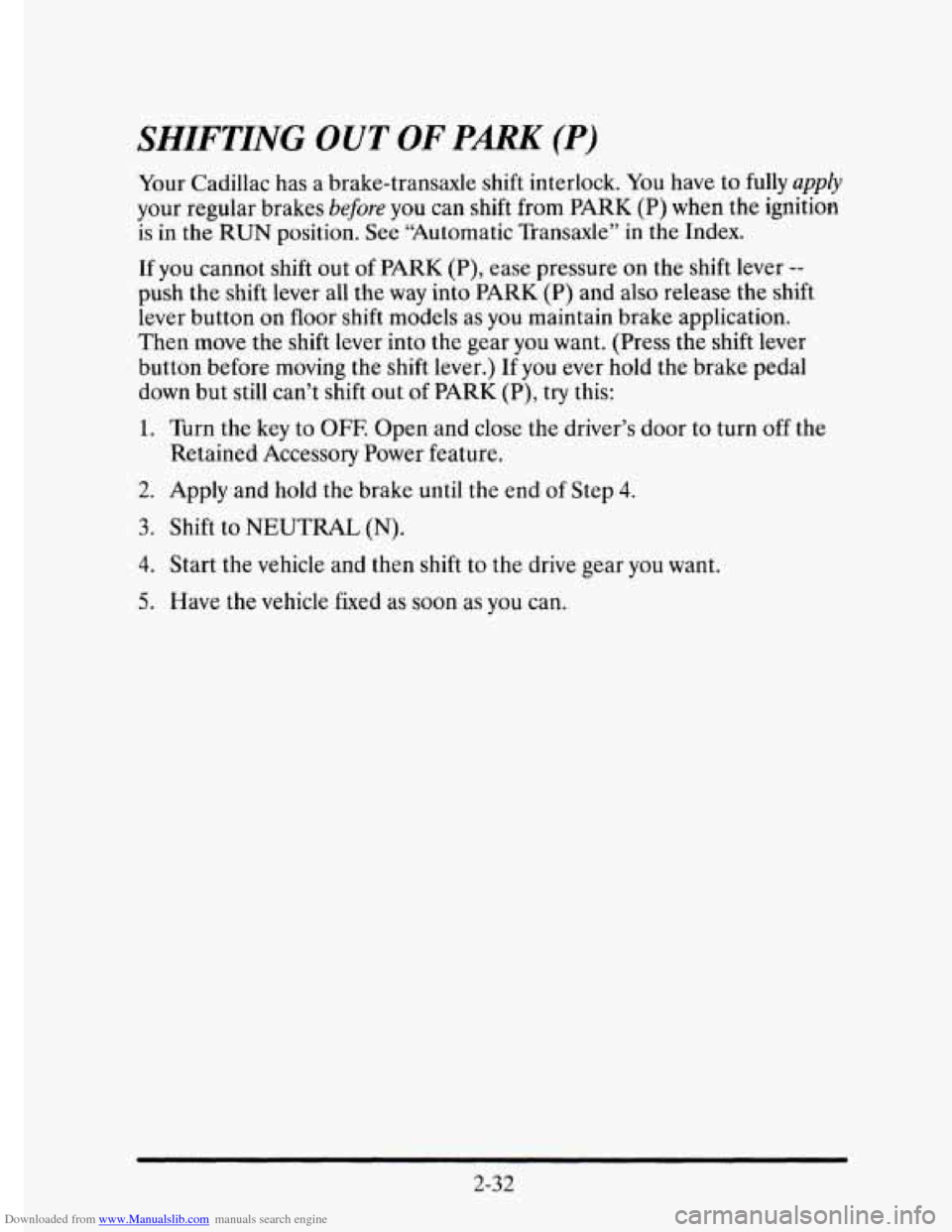
Your Cadillac has a brake-transaxle shift interlock. You have to fully apply
your regular brakes before you can shift from PARK (P) when the ignitioa
is
in the RUN position. See “Automatic Transaxle” in the Index.
If you cannot shift out of PARK (P), ease pressure on the shift lever --
push the shift lever all the way into PARK (P) and also release the shift
lever button on
floor shift models as you maintain brake application.
Then move the shift lever into the gear you want. (Press the shift lever
button before moving the shift lever.) If you ever hold the brake pedal
down but still can’t
shift out of PARK (P), try this:
1. Turn the key to OFE Open and close the driver’s door to turn off the
2. Apply and hold the brake until the end of Step 4.
3. Shift to NEUTRAL (N).
4. Start the vehicle and then shift to the drive gear you want.
5. Have the vehicle fixed as soon as you can.
Retained
Accessory Power feature.
2-32