Page 181 of 340
Towing Your Vehicle
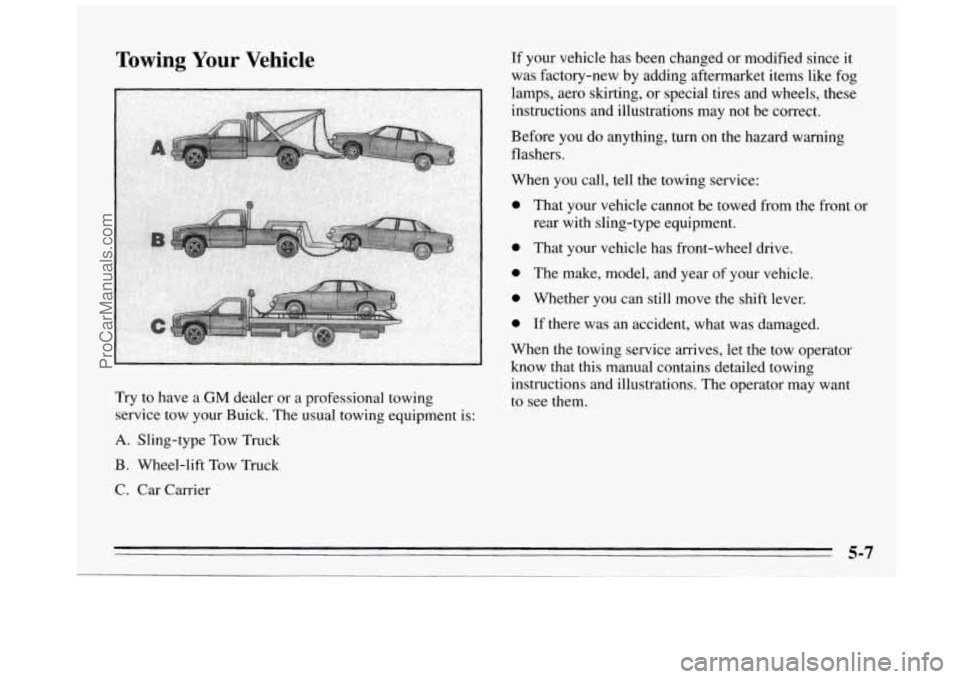
Try to have a GM dealer or a professional towing
service tow your Buick. The usual towing equipment is:
A. Sling-type Tow Truck
B. Wheel-lift Tow Truck
C. Car Carrier
If your vehicle has been changed or modified since it
was factory-new by adding aftermarket items like fog
lamps, aero skirting, or special tires and wheels, these
instructions and illustrations may not be correct.
Before you do anything, turn
on the hazard warning
flashers.
When you call, tell the towing service:
0
0
0
0
0
That your vehicle cannot be towed from the front or
rear with sling-type equipment.
That your vehicle has front-wheel drive.
The make, model, and year
of your vehicle.
Whether you can still move the shift lever.
If there was an accident, what was damaged.
When the towing service arrives, let the tow operator
know that this manual contains detailed towing instructions and illustrations. The operator may want
to see them.
5-7
ProCarManuals.com
Page 188 of 340
Engine Overheating
You will find a coolant temperature gage and a warning
light about
a hot engine on your instrument panel. See
“Engine Coolant Temperature Gage” and “Engine
Coolant Temperature Warning Light”
in the Index. You
also have a low coolant light on your instwrnent panel.
See “Low Coolant Light”
in the Ilrdex.
If Steam Is Coming From Your Engine
A CAUTION:
Steam from an overheated engine can burn you
badly, even if you just open the hood. Stay away
from the engine
if you see or hear steam corning
from it. Just turn
it off and get everyone away
from the vehicle until it cools down. Wait until
there is no sign of steam
or coolant before
opening the hood.
If you keep driving when your engine is
overheated, the liquids in it can catch fire. You or
others could be badly burned. Stop your engine
if
it overheats, and get out of the vehicle until the
engine is cool.
ProCarManuals.com
Page 189 of 340
NOTICE:
If your engine catches fire because you keep
driving with no coolant, your vehicle can be
badly damaged. The costly repairs would not be
covered
by your warranty.
If No Steam Is Coming From Your Engine
If you get the overheat warning but see or hear no
steam, the problem may not be too serious. Sometimes
the engine can get a little too
hot when you:
0 Climb a long hill on a hot day.
0 Stop after high speed driving.
Idle for long periods in traffic.
Tow a trailer.
If you get the overheat warning with no sign of steam,
try this for a minute or so:
1. Turn off your air conditioner
2. Turn on your heater to full hot at the highest fan
speed and open the window as necessary.
3.
If you’re in a traffic jam, shift to NEUTRAL (N);
otherwise, shift to the highest gear while
driving
-- DRIVE (D) or THIRD (3).
If you no longer have the overheat warning, you can
drive. Just to be safe, drive slower for about ten minutes.
If the warning doesn’t come back
on, you can drive
normally.
If the warning continues, pull over, stop, and park your
vehicle right away.
If there’s still
no sign of steam, you can idle the engine
for two
or three minutes while you’re parked, to see if
the warning stops. But then, if you still have the
warning,
rwrl ojftlw engine ~-rnd get owryotw out of’
the vehicle until it cools down.
You may decide not to lift the hood but
help right away. to
get service
5-15
ProCarManuals.com
Page 193 of 340
When the coolant in the coolant recovery tank is at the
COLD mark, start your vehicle.
If the overheat warning continues, there’s one more
thing you can try. You can add the proper coolant
mix
directly to the radiator, but be sure the cooling system is
cool before you
do it.
5-19
ProCarManuals.com
Page 221 of 340
Engine Coolant Heater
An engine coolant heater can be a big help if you have
to park outside in very cold weather,
0 OF (- 1 8 O C) or
colder. If your vehicle has this option, see “Engine
Coolant Heater” in
the Index.
What to Do with Used Oil
Did you know that used engine oil contains certain
elements that may be unhealthy for your skin and could
even cause cancer? Don’t
let used oil stay on your skin
for very long. Clean your skin and nails with soap and
water, or a good hand cleaner. Wash or properly throw
away clothing
or rags containing used engine oil. (See
the manufacturer’s warnings about the use and disposal
of oil products.)
Used oil can be a real threat
to the environment. If you
change your own oil, be sure to drain all free-flowing oil
from
the filter before disposal. Don’t ever dispose of oil
by putting it in the trash, pouring it on the ground, into
sewers, or into streams or bodies
of water. Instead,
recycle it by taking
it to a place that collects used oil. if
you have a problem properly disposing of your used oil,
ask your dealer, a service station or a local recycling
center for help.
Air Cleaner
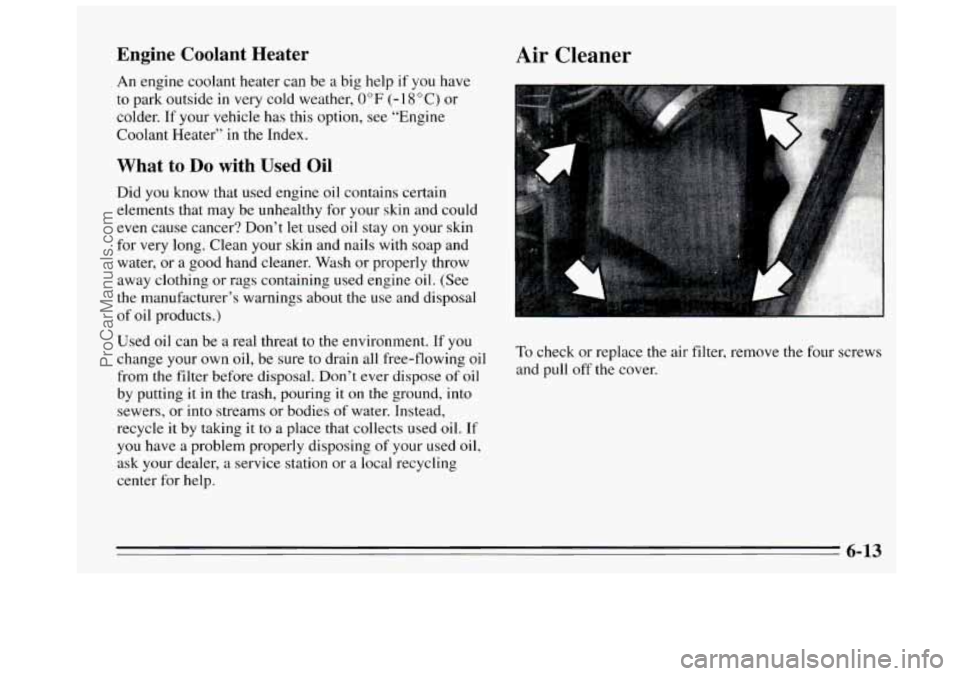
To check or replace the air filter, remove the four screws
and pull off the cover.
6-13
ProCarManuals.com
Page 225 of 340

How to Add Fluid
Refer to the Maintenance Schedule to determine what
kind of transaxle fluid to use. See “Recommended
Fluids and Lubricants”
in the Index.
If the fluid level is low, add only enough of the proper
fluid to bring the level into the cross-hatched area on the
dipstick.
1. Pull out the dipstick.
2. Using a long-neck funnel, add enough fluid at the
dipstick hole
to bring it to the proper level.
It doesn’t take much fluid, generally less than a pint
(OSL). Don ’t ouefill. We recommend you use only fluid
labeled DEXRON@-111, because fluid with that label is
made especially for your automatic transaxle. Damage
caused by fluid other than DEXRON@-I11 is not covered
by your new vehicle warranty.
After adding fluid, recheck the fluid level as
described under “How
to Check.”
When the correct fluid level is obtained, push the
dipstick back in all the way.
Engine Coolant
The following explains your cooling system and how to
add coolant when it is low. If you have a problem with
engine overheating or if
you need to add coolant to your
radiator, see “Engine Overheating” in the Index.
The proper coolant for your Buick will:
Give freezing protection down to -34°F (-37°C).
Give boiling protection up to 262 OF (1 28 O C).
Protect against rust and corrosion.
Help keep the proper engine temperature.
Let the warning lights work as they should.
What to Use
Use a mixture of one-half clean water (preferably
distilled) and one-half antifreeze that meets “GM
Specification
1825-M,” which won’t damage aluminum
parts. You can also use a recycled coolant conforming to
GM Specification 1825-M with a complete coolant flush
and refill. Use GM Engine Coolant Supplement (sealer)
with any complete coolant flush and refill.
If you use
this mixture, you don’t need to add anything else.
~
6-17
ProCarManuals.com
Page 232 of 340
should have your brake system fixed, since a leak means
that sooner or later your brakes won’t work well, or
won’t work at all.
So, it isn’t a good idea to “top off’
your brake fluid. Adding brake fluid won’t correct a
leak. If you add fluid when your linings are worn, then
you’ll have too much fluid when you get new brake
linings. You should add (or remove) brake fluid, as
necessary, only when work is done on the brake
hydraulic system.
When your brake fluid falls to a low level, your brake
warning light will come on. See “Brake System Warning
Light” in the Index. What to Add
When you do need brake fluid, use only DOT-3 brake
fluid -- such as Delco Supreme ll@ (GM Part No.
1052535). Use new brake fluid from a sealed container
only, and always clean the brake fluid reservoir cap
before removing it.
NOTICE:
0
0
Don’t let someone put in the wrong kind of
fluid. For example, just
a few drops of
mineral-based oil, such
as engine oil, in
your brake system can damage brake system parts
so badly that they’ll have to be
replaced.
Brake fluid can damage paint,
so be careful
not to spill brake fluid on your vehicle.
If
you do, wash it off immediately. See
“Appearance Care’’ in the Index.
6-24
ProCarManuals.com
Page 233 of 340
Brake Wear
Your Buick has four-wheel disc brakes.
Disc brake pads have built-in wear indicators that make
a high-pitched warning sound when the brake pads are
worn and new pads are needed. The sound may come
and go or be heard all the time your vehicle is moving
(except when you are pushing
on the brake pedal
firmly),
NOTICE:
Continuing to drive with worn-out brake pads
could result in costly brake repair.
Some driving conditions or climates may cause a brake
squeal when the brakes are first applied or lightly
applied.
This does not mean something is wrong with
your brakes.
Brake linings should always be replaced as complete
axle sets.
Brake Pedal Travel
See your dealer if the brake pedal does not return to
normal height, or
if there is a rapid increase in pedal
travel. This could be a sign of brake trouble.
Brake Adjustment
Every time you make a moderate brake stop, your disc
brakes adjust for wear.
If you rarely make a moderate
or heavier stop, then your brakes might not adjust
correctly.
If you drive in that way, then -- very
carefully
-- make a few moderate brake stops about
every
1,000 miles (1 600 km), so your brakes will adjust
properly.
6-25
ProCarManuals.com