1995 BUICK REGAL fuses
[x] Cancel search: fusesPage 66 of 340
Automatic Door Locks
Just close your doors and turn on the ignition. All of the
doors will lock when you move your shift lever out of
PARK
(P) or NEUTRAL (N). All doors will unlock
automatically when the ignition is turned off.
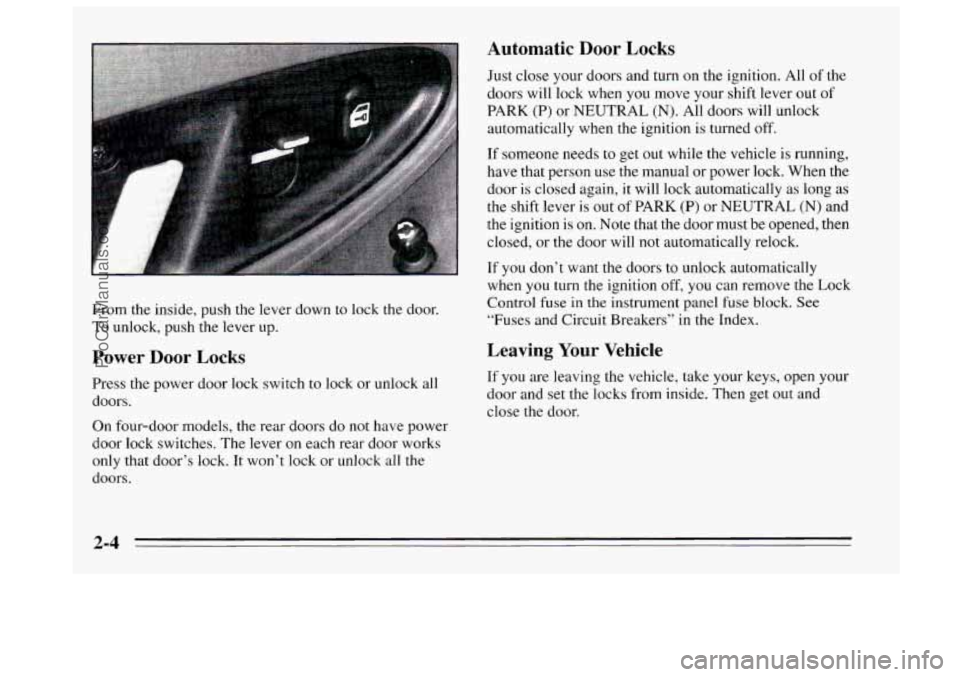
From the inside, push
the lever down to lock the door.
To unlock, push the lever up.
rower Door Locks
Press the power door lock switch to lock or unlock all
doors.
On four-door models,
the rear doors do not have power
door lock switches. The lever on each rear door works
only that door’s lock. It won’t lock or unlock all the
doors. If
someone needs to get out while the vehicle is running,
have that person use the manual or power lock. When the
door
is closed again, it will lock automatically as long as
the shift lever is out
of PARK (P) or NEUTRAL (N) and
the ignition is
on. Note that the door must be opened, then
closed, or the door will not automatically relock.
If you don’t want the doors to unlock automatically
when
you turn the ignition off, you can remove the Lock
Control
fuse in the instrument panel fuse block. See
“Fuses and Circuit Breakers” in the Index.
Leaving Your Vehicle
If you are leaving the vehicle, take your keys, open your
door and set the locks from inside. Then get out and
close
the door.
2-4
ProCarManuals.com
Page 71 of 340

PASS-Key@II
Your vehicle is equipped
with the PASS-Key%
(Personalized Automotive
Security System) theft
deterrent system.
PASS-Key% is a passive
theft deterrent system. This
means
you don’t have to do
anything different
to arm or
disarm the system.
It works when you insert or remove the key from
the
ignition. PASS-Key% uses a resistor pellet in the ignition
key that matches
a decoder in your vehicle.
When the PASS-Key% system senses that someone is
using the wrong key, it shuts down the vehicle’s starter and
fuel systems. For about three minutes, the starter won’t work and fuel won’t go to the engine. If someone tries to
start your vehicle again or uses another key during this
time, the vehicle will
not start. This discourages someone
from randomly trying different keys with different resistor
pellets in
an attempt to make a match.
The ignition key must be clean and dry before it’s
inserted in the ignition or the engine may not start. If the
engine does not
start and the SECURITY light is on, the
key may be dirty or wet. Turn the ignition off. Clean and dry the
key. Wait about three minutes and try
again. The security light may remain on during this
time. If the starter still won’t work, and the key appears
to be clean and dry, wait about three minutes and try
another ignition key. At this time, you may also want
to
check the fuse (see “Fuses and Circuit Breakers” in the
Index). If the starter won’t work with the other key, your
vehicle needs service. If your vehicle does start,
the first
ignition key may be faulty. See your Buick dealer or a
locksmith who can service
the PASS-Key@II.
If you accidentally use a key that has a damaged or
missing resistor pellet, the starter won’t work, and the
SECURITY light will flash. But
you don’t have to wait
three minutes before trying another ignition key.
See your Buick dealer or a locksmith who can service
the PASS-Key%
to have a new key made.
If you’re ever driving and the SECURITY light comes
on, you will be able to restart your engine if you turn it
off. Your PASS-Key% system, however, is not
working properly and must be serviced by
your Buick
dealer. Your vehicle is not protected by the
PASS-Key@II system.
If you lose or damage a PASS-Key% ignition
key,
see your Buick dealer or a locksmith who can service
PASS-Key@II
to have a new key made.
2-9
ProCarManuals.com
Page 88 of 340
Turn Signal and Lane Change Indicator
The turn signal has two upward (for right) and two
downward (for left) positions. These positions allow you
to signal a turn or a lane change.
To signal
a turn, move the lever all the way up or down.
When
the turn is finished, the lever will return
automatically.
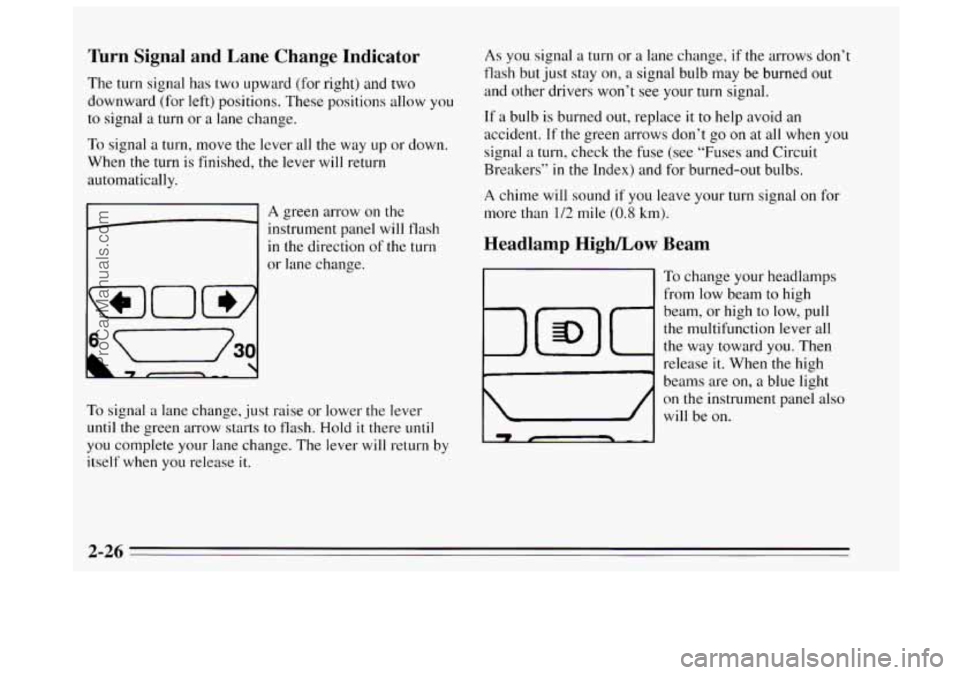
A green arrow on the
instrument panel will flash
in the direction of the turn
or lane change.
To signal a lane change, just raise or lower the lever
until the green arrow starts to flash. Hold it there until
you complete your lane change. The lever will return by
itself when you release it.
As you signal a turn or a lane change, if the arrows don’t
flash but just stay on, a signal bulb may be burned out
and other drivers won’t see
your turn signal.
If a bulb is burned out, replace
it to help avoid an
accident. If the green arrows don’t go on at all
when you
signal a turn, check the fuse (see
“Fuses and Circuit
Breakers”
in the Index) and for burned-out bulbs.
A chime will sound if you leave your turn signal on for
more than 1/2 mile
(0.8 km).
Headlamp High/Low Beam
bmd
To change your headlamps
from low beam to high
beam, or high to low, pull
the multifunction lever all
the way toward you. Then
release
it. When the high
beams are on,
a blue light
on the instrument panel
also
will be on.
2-26
ProCarManuals.com
Page 255 of 340
Add-on Electrical Equipment Fuses and Circuit Breakers
NOTICE:
Don’t add anything electrical to your Buick unless
you check with your dealer first. Some electrical
equipment can damage your vehicle and the
damage wouldn’t be covered by your warranty.
Some add-on electrical equipment can keep other
components from working as they should.
Your vehicle has an air bag system. Before attempting to
add anything electrical to your Buick, see “Servicing
Your Air Bag-Equipped Buick”
in the Index. The wiring
circuits
in your vehicle are protected from
short circuits by
a combination of fuses, circuit breakers,
and fusible thermal links in the wiring itself. This
greatly reduces the chance of fires caused
by electrical
problems.
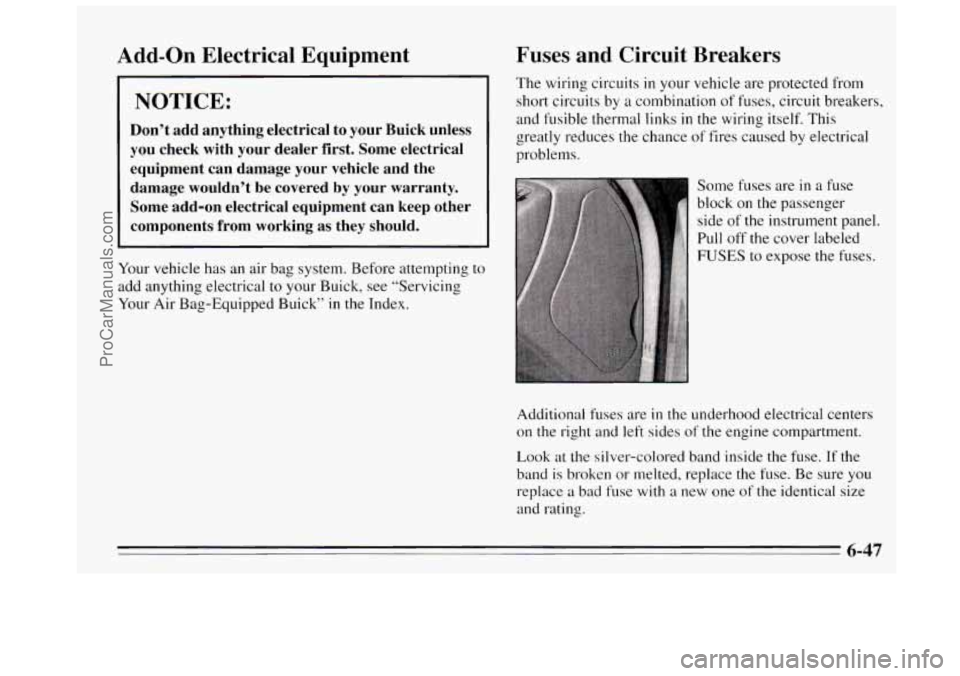
Some fuses are
in a fuse
block on the passenger
side of the instrument panel.
Pull off
the cover labeled
FUSES to expose the fuses.
Additional fuses are
in the underhood electrical centers
on the right and left sides of the engine compartment.
Look at the silver-colored band inside the fuse. If the
band is broken or melted, replace the fuse. Be sure
you
replace a bad fuse with a new one of the identical size
and rating.
6-47
ProCarManuals.com
Page 259 of 340
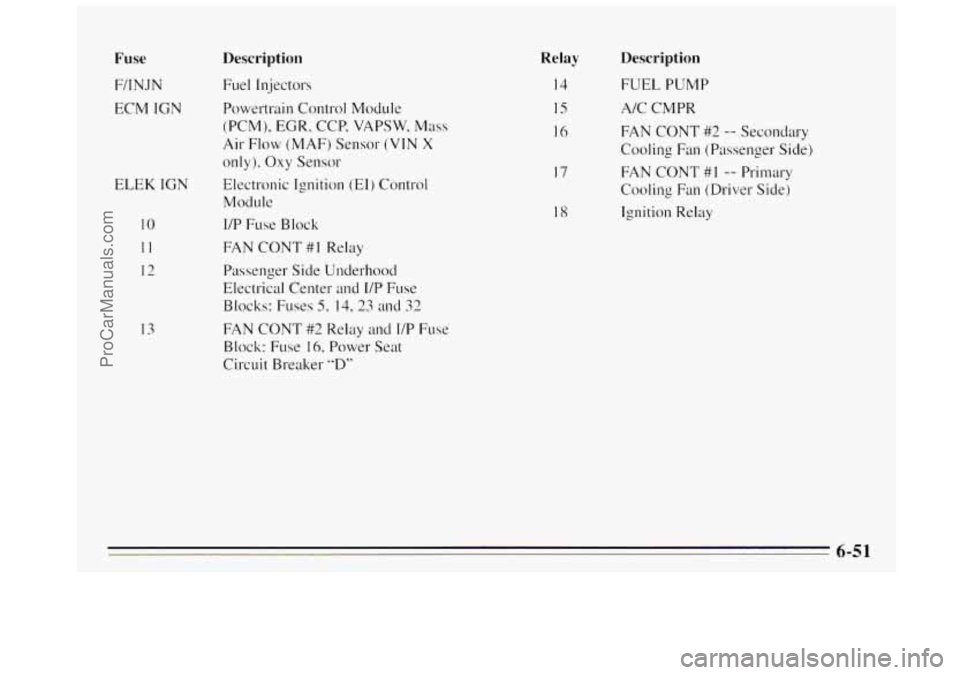
Fuse
F/INJN
ECM IGN
ELEK
IGN
10
I1
12
13
Description
Fuel Injectors
Powertrain Control Module
(PCM), EGR, CCP, VAPSW, Mass
Air Flow (MAF) Sensor (VIN X
only). Oxy Sensor
Electronic Ignition
(EI) Control
Module
I/P Fuse Block
FAN CONT
#I Relay
Passenger Side Underhood
Electrical Center and
I/P FLW
Blocks: Fuses 5, 14, 23 and 32
FAN CONT #2 Relay and I/P Fuse
Block: Fuse
16. Power Seat
Circuit Breaker
“D”
Relay
14
1s
16
17
18
Description
FUEL PUMP
A/C CMPR
FAN CONT
#2 -- Secondary
Cooling Fan (Passenger Side)
FAN CONT #1 -- Primary
Cooling Fan (Driver Side)
Ignition Relay
6-51
ProCarManuals.com
Page 260 of 340
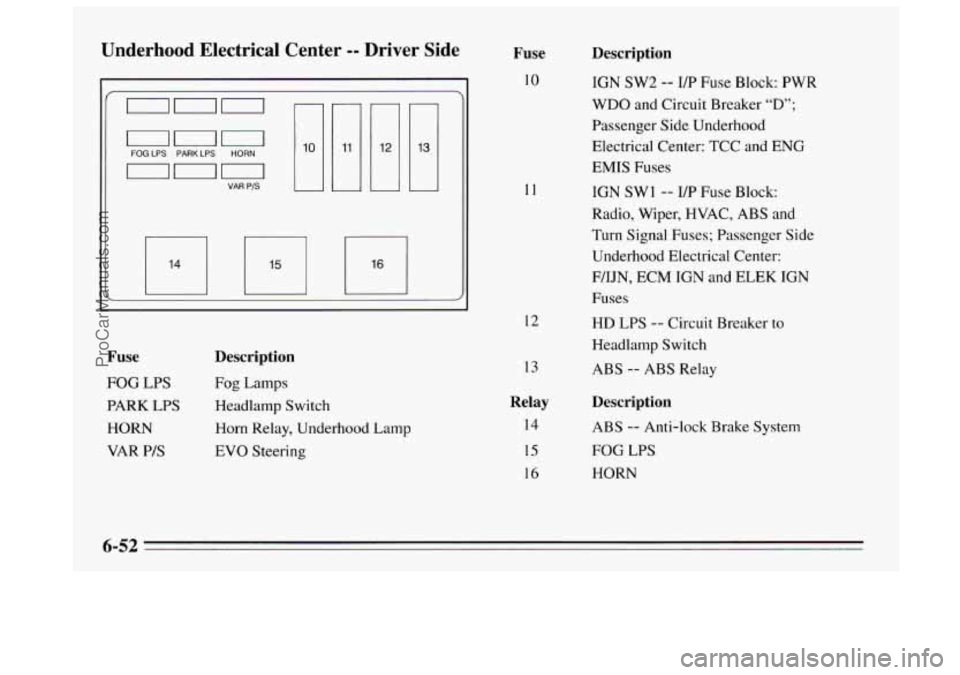
Underhood Electrical Center -- Driver Side
000 FOG LPS PARKLPS HORN
VAR PIS u
12
Fuse
FOG LPS
PARK LPS
HORN
VAR
P/S
uescription
Fog Lamps
Headlamp Switch
Horn Relay, Underhood Lamp
EVO Steering
Fuse
10
11
12
13
Relay
14
15
16
Description
IGN SW2 -- UP Fuse Block: PWR
WDO and Circuit Breaker “D”;
Passenger Side Underhood
Electrical Center:
TCC and ENG
EMIS Fuses
IGN
SW 1 -- UP Fuse Block:
Radio, Wiper, HVAC, ABS and
Turn Signal Fuses; Passenge.r Side
Underhood Electrical Center:
F/IJN,
ECM IGN and ELEK IGN
Fuses
HD LPS -- Circuit Breaker to
Headlamp Switch
ABS
-- ABS Relay
Description
ABS -- Anti-lock Brake System
FOG LPS
HORN
6-52
ProCarManuals.com
Page 331 of 340

Engine Coolant ................................. 6- 17
Adding
.................................... 6-18
Checking ................................... 6-18
Heater
................................ 2- 14. 6. I3
Temperature Gage
............................ 2-50
Temperature Light
........................... 2-49
Engineoil
..................................... 6-7
Additives
................................... 6-12
Checking
.................................... 6-8
What Kind to Use ............................ 6- IO
What to Do with Used Oil ..................... 6-13
When to Change
............................. 6- 12
Ethanol
(In Fuel) ................................ 6-3
Exhaust. Engine
................................ 2-23
Expectant Mothers. Use
of Safety Belts ............. 1-24
Extender. Safety Belt
............................ 1-50
Adding
..................................... 6-9
Fabric Cleaning
............................... 6-39
Fiberglass Springs
.............................. 6-44
Filling Your Tank ................................ 6-5
Filter
. Air Cleaner .............................. 6- 13
Finish Care .................................... 6-42
Finish Damage
................................. 6-43
First Gear. Automatic Transaxle
................... I 3-18
Fixed Mast Antenna ............................. 3- 19 Flashers
. Hazard Warning ......................... 5- I
Flat
Tire. Changing ............................. 5-24
Fluid Capacities
................................ 6-55
Fluid Levels. Maintenance
........................ 7-36
Fluids and Lubricants
............................ 7-40
Foreign Countries
. Fuel ........................... 6-4
Four-Way Manual Seat
........................... 1-2
Freeway Driving
............................... 4-18
French Language Manual
11
Fr011t Seatback Latches ........................... 1-5
Fuel .......................................... 6-3
Filling Your Tank
............................. 6-5
Gage
...................................... 2-44
In Foreign Countries
........................... 6-4
LowLight
.................................. 2-45
Fuse Block. Instrument Panel
..................... 6-48
Fuses and Circuit Breakers
....................... 6-47
.. ...........................
Gage . En. trine Coolant Temperature ............... 2-50
Gasoline
....................................... 6-3
Gasolines for Cleaner Air
......................... 6-4
GAWR
(Gross Axle Weight Rating) ................ 4-26
Gear Positions
................................. 2- IS
Glass. Cleaning ................................ 6-41
GloveBox ..................................... 2-8
GVWR (Gross Vehicle Weight Rating)
.............. 3-26
9-5
ProCarManuals.com