1995 BUICK REGAL overheating
[x] Cancel search: overheatingPage 3 of 340
The 1995 Buick Regal Owner's Manual
I
Seats and Restraint Systems .............................................................
This section tells you how to use your seats and safety belts properly. It also explains "SRS" system.
Featuresandcontrols ..................................................................
This section explains how to start and operate your Buick.
Comfort Controls and Audio Systems .....................................................
This section tells you how to adjust the ventilation and comfort controls and how to operate your
audio system.
YourDrivingandtheRoad ..............................................................
Here y6u'll find helpful info]-mation and tips about the road and how to drive under dif-ferent conditions.
ProblemsontheRoad ..................................................................
This section tells you what to do if you have a problem while driving. such as a flat tire or
engine overheating. etc.
ServiceandAppearanceCare ............................................................
Here the manual tells you how to kccp your Buick running properly and looking good.
Maintenanceschedule ..................................................................
This section tells you when to perform vehicle maintenance and what fluids and lubricants to use.
Customer Assistance Information ........................................................
This section tells you how to contact Buick for assistance and how to get service publications. It also
gives you infortnation on "Reporting Safety Defects.' on page 8-4.
Index ........................................................................\
........
Here's an alphabetical listing of almost every sub.ject in this n1anual. You can use it to quickly find
something you want
to read.
1-1
2- 1
3-1
4- 1
5- 1
6- 1
7- 1
8- 1
9- 1
1
ProCarManuals.com
Page 111 of 340

Anti-Lock Brake System Active Light
When your anti-lock system
is adjusting brake pressure
to help avoid a braking skid,
the
LOW TRAC light will
Engine Loolant Temperature Light
This light tells you that
your engine coolant has
overheated or your radiator
CYL hhh cooling fan is not working.
Slippery road conditions will exist
if this light comes on,
so adjust your driving accordingly. The light will stay on
for
a few seconds after the system stops adjusting brake
pressure.
The
LOW TRAC light also comes on briefly, as a bulb
check, when the engine is started. If the light doesn’t
come on then, have it fixed
so it will be there to tell you
when the system is active. If
you have been
operating your vehicle under normal
driving conditions, you should pull off the road, stop
your vehicle and turn off the engine as soon as possible.
Hot Coolant Can Burn You Badly!
In “Problems on the Road,” this manual shows what to
do. See “Engine Overheating” in the Index.
2-49
ProCarManuals.com
Page 112 of 340
Engine Coolant Temperature Gage
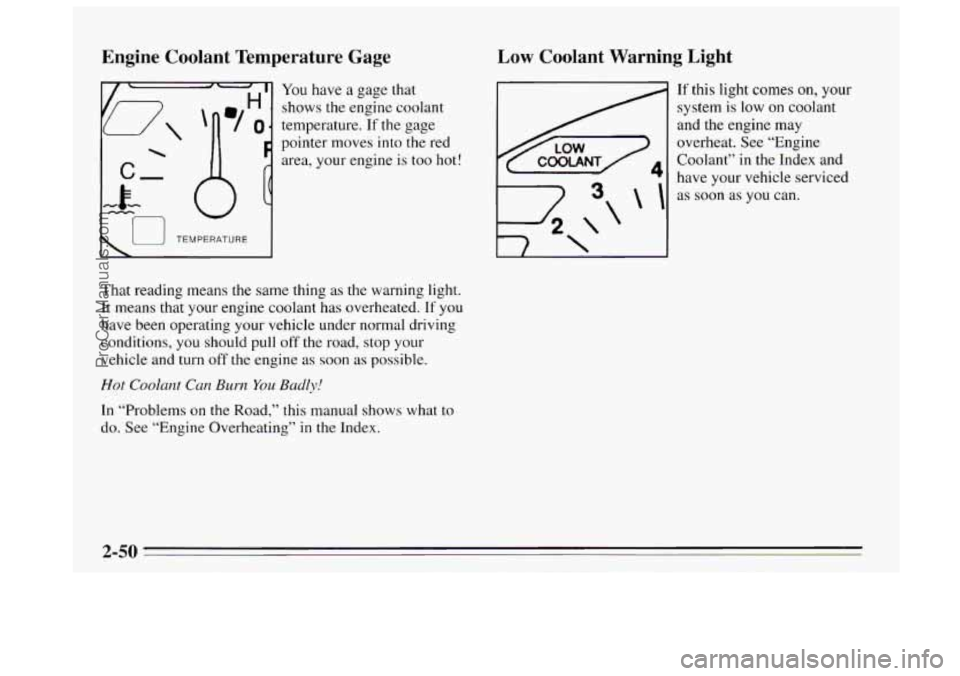
You have a gage that
shows the engine coolant
temperature.
If the gage
pointer moves into the red
area, your engine is too hot!
I u TEMPERATURE I
That reading means the same thing as the warning light.
It means that your engine coolant has overheated.
If you
have been operating your vehicle under normal driving
conditions, you should pull
off the road, stop your
vehicle
and turn off the engine as soon as possible.
Hot Coolant Can Burn You Badly!
In “Problems on the Road,” this manual shows what to
do. See “Engine Overheating” in the Index.
Low Coolant Warning Light
\I
4 \‘
If this light comes on, your
system
is low on coolant
and the engine may
overheat. See “Engine
Coolant” in the Index and
have your vehicle serviced
as soon as you can.
2-50
ProCarManuals.com
Page 171 of 340
Making Turns
NOTICE:
Making very sharp turns while trailering could
cause the trailer to come in contact with the
vehicle. Your vehicle could be damaged. Avoid
making very sharp turns while trailering.
When you’re turning with a trailer, make wider turns
than normal.
Do this so your trailer won’t strike soft
shoulders, curbs, road signs, trees, or other objects.
Avoid jerky or sudden maneuvers. Signal well
in
advance.
Turn Signals When Towing a Trailer
When you tow a trailer, your vehicle has to have a
different turn signal flasher and extra wiring. The green
arrows on your instrument panel will flash whenever
you signal
a turn or lane change. Properly hooked up,
the trailer lamps will also flash, telling other drivers
you’re about to turn, change lanes or stop. When
towing
a trailer, the green arrows on your
instrument panel will flash for turns even
if the bulbs on
the trailer are burned out. Thus, you may
think drivers
behind
you are seeing your signal when they are not. It’s
important to check occasionally
to be sure the trailer
bulbs are still working.
Driving On Grades
Reduce speed and shift to a lower gear Oefbve you start
down
a long or steep downgrade. If you don’t shift
down,
you might have to use your brakes so much that
they would get hot and no longer work well.
On
a long uphill grade, shift down and reduce your
speed to around
45 mph (70 km/h) to reduce the
possibility of engine and transaxle overheating.
If you are towing
a trailer that weighs more than
1,000 pounds (450 kg), you may prefer to drive in
THIRD (3) instead of DRIVE (D) (or, as you need to,
a lower gear).
4-33
ProCarManuals.com
Page 188 of 340
Engine Overheating
You will find a coolant temperature gage and a warning
light about
a hot engine on your instrument panel. See
“Engine Coolant Temperature Gage” and “Engine
Coolant Temperature Warning Light”
in the Index. You
also have a low coolant light on your instwrnent panel.
See “Low Coolant Light”
in the Ilrdex.
If Steam Is Coming From Your Engine
A CAUTION:
Steam from an overheated engine can burn you
badly, even if you just open the hood. Stay away
from the engine
if you see or hear steam corning
from it. Just turn
it off and get everyone away
from the vehicle until it cools down. Wait until
there is no sign of steam
or coolant before
opening the hood.
If you keep driving when your engine is
overheated, the liquids in it can catch fire. You or
others could be badly burned. Stop your engine
if
it overheats, and get out of the vehicle until the
engine is cool.
ProCarManuals.com
Page 191 of 340
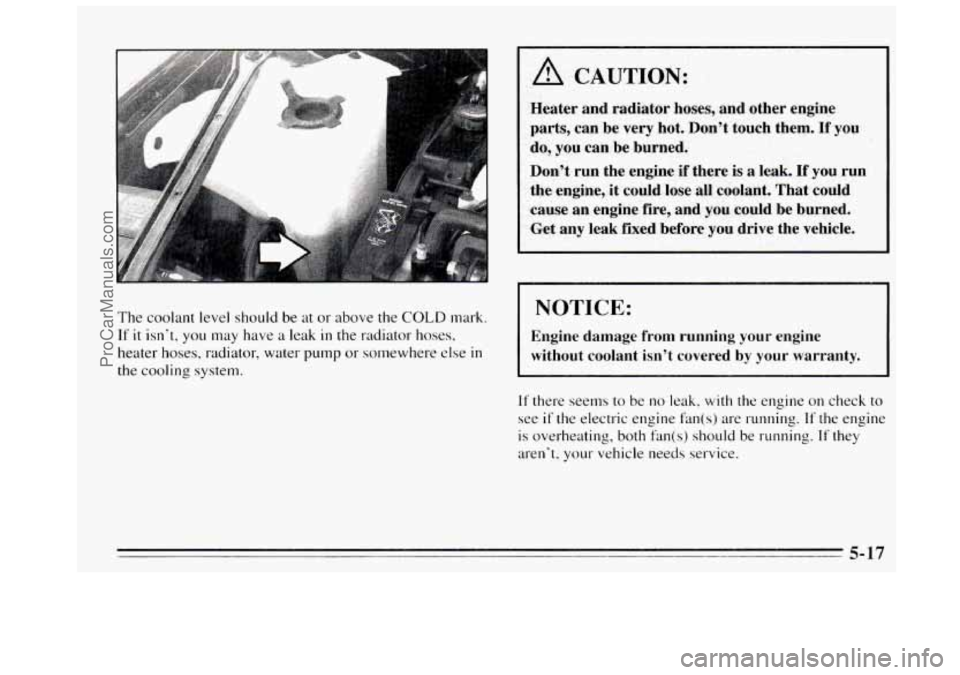
The coolant level should be at or above the COLD mark.
If it isn’t, you may have a leak in the radiator hoses,
heater hoses, radiator, water
pump or somewhere else in
the cooling system.
I A CAUTION:
Heater and radiator hoses, and other engine
parts, can be very hot. Don’t touch them.
If you
do,
you can be burned.
Don’t run the engine
i€ there is a leak. If you run
the engine, it could lose all coolant. That could
cause an engine fire, and you could be burned.
Get any leak fixed before you drive the vehicle.
NOTICE:
Engine damage from running your engine
without coolant isn’t covered
by your warranty.
If there seems to be no leak, with the engine on check to
see
if the electric engine fan(s) are running. If the engine
is overheating, both fan(s) should be running. If they
aren’t, your vehicle needs service.
ProCarManuals.com
Page 225 of 340

How to Add Fluid
Refer to the Maintenance Schedule to determine what
kind of transaxle fluid to use. See “Recommended
Fluids and Lubricants”
in the Index.
If the fluid level is low, add only enough of the proper
fluid to bring the level into the cross-hatched area on the
dipstick.
1. Pull out the dipstick.
2. Using a long-neck funnel, add enough fluid at the
dipstick hole
to bring it to the proper level.
It doesn’t take much fluid, generally less than a pint
(OSL). Don ’t ouefill. We recommend you use only fluid
labeled DEXRON@-111, because fluid with that label is
made especially for your automatic transaxle. Damage
caused by fluid other than DEXRON@-I11 is not covered
by your new vehicle warranty.
After adding fluid, recheck the fluid level as
described under “How
to Check.”
When the correct fluid level is obtained, push the
dipstick back in all the way.
Engine Coolant
The following explains your cooling system and how to
add coolant when it is low. If you have a problem with
engine overheating or if
you need to add coolant to your
radiator, see “Engine Overheating” in the Index.
The proper coolant for your Buick will:
Give freezing protection down to -34°F (-37°C).
Give boiling protection up to 262 OF (1 28 O C).
Protect against rust and corrosion.
Help keep the proper engine temperature.
Let the warning lights work as they should.
What to Use
Use a mixture of one-half clean water (preferably
distilled) and one-half antifreeze that meets “GM
Specification
1825-M,” which won’t damage aluminum
parts. You can also use a recycled coolant conforming to
GM Specification 1825-M with a complete coolant flush
and refill. Use GM Engine Coolant Supplement (sealer)
with any complete coolant flush and refill.
If you use
this mixture, you don’t need to add anything else.
~
6-17
ProCarManuals.com
Page 227 of 340
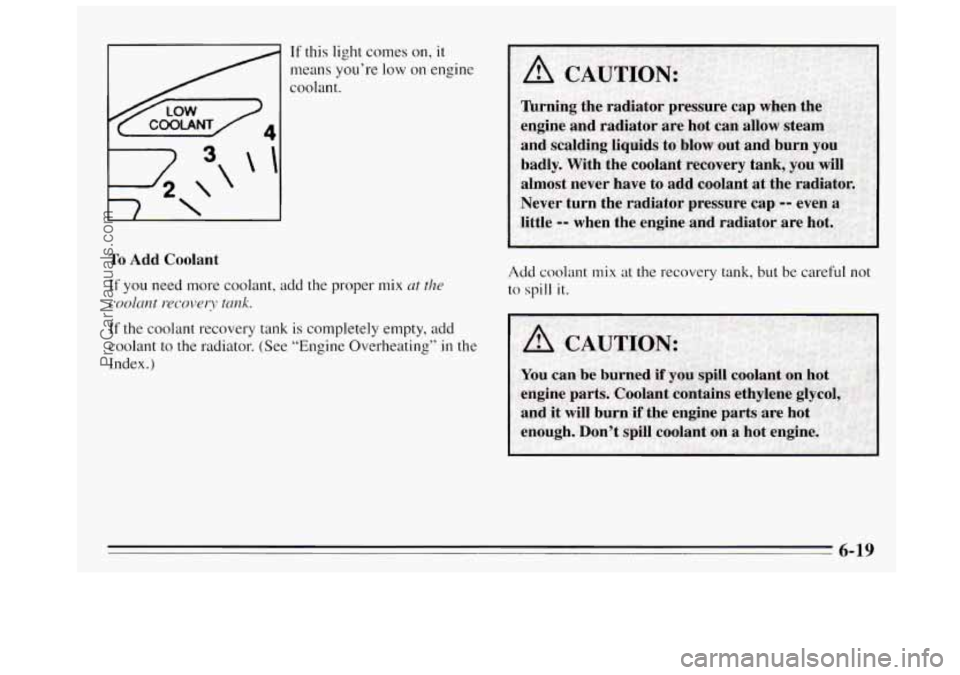
To Add Coolant
If this light comes on, it
means you’re low on engine
coolant.
If you need more coolant, add the proper mix at the
coolant recovery tank.
If the coolant recovery tank is completely empty, add
coolant to
the radiator. (See “Engine Overheating” in the
Index
.)
Add coolant mix at the recovery tank, but be careful not
to spill
it.
6-19
ProCarManuals.com