Page 228 of 340
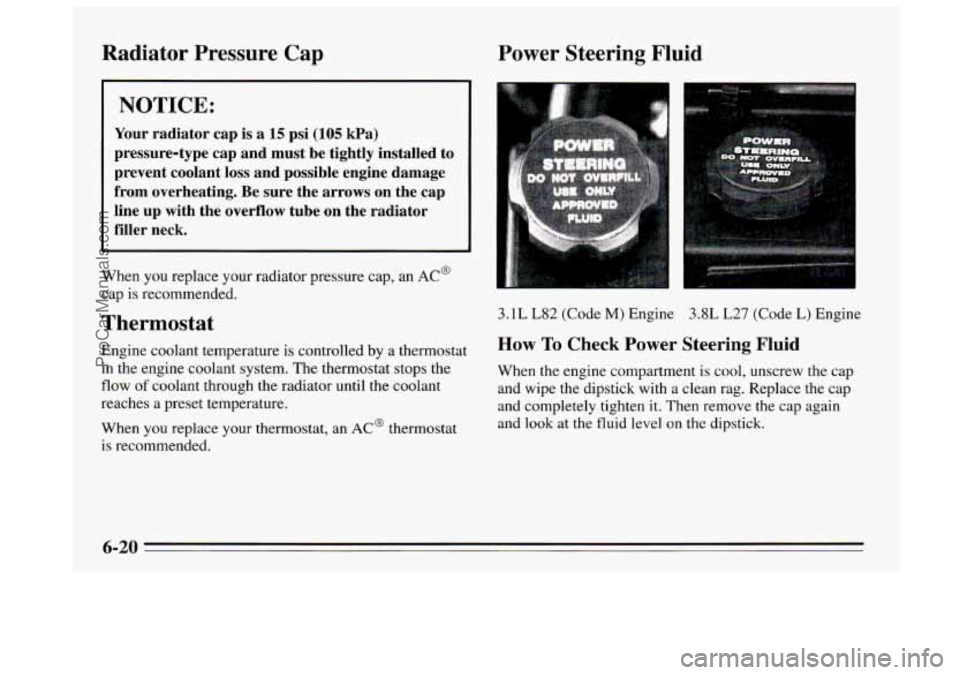
Radiator Pressure Cap Power Steering Fluid
NOTICE:
Your radiator cap is a 15 psi (105 kPa)
pressure-type cap and must be tightly installed to
prevent coolant loss and possible engine damage
from overheating. Be sure the arrows
on the cap
line up with the overflow tube on the radiator
filler neck.
When you replace your radiator pressure cap, an AC@
cap is recommended.
Thermostat
Engine coolant temperature is controlled by a thermostat
in the engine coolant system. The thermostat stops the
flow of coolant through the radiator until the coolant
reaches a preset temperature.
When you replace your thermostat, an
AC@ thermostat
is recommended. 3.1L
L82 (Code M) Engine
3.8L L27 (Code L) Engine
How To Check Power Steering Fluid
When the engine compartment is cool, unscrew the cap
and wipe the dipstick with a clean rag. Replace the cap
and completely tighten
it. Then remove the cap again
and look at the fluid level
on the dipstick.
6-20
ProCarManuals.com
Page 239 of 340
Inflation - Tire Pressure
The Tire-Loading Information label which is inside the
trunk lid shows the correct inflation pressures for your tires,
when they’re cold. “Cold” means your vehicle has been
sitting for at least three hours or driven no more than a mile.
NOTICE:
Don’t let anyone tell you that underinflation or
overinflation is all right. It’s not.
If your tires
don’t have enough
air (underinflation) you can
get:
Too much flexing
Too much heat
Tire overloading
Bad wear
Bad handling
Bad fuel economy.
If your tires have too much air (overinflation),
you can get:
Unusual wear
Bad handling
Rough ride
Needless damage from road hazards. When to Check
Check
your tires once a month or more.
Don’t forget your compact spare tire. It should be at
60 psi (420 kPa).
How
to Check
Use a good quality pocket-type gage to check tire
pressure. Simply looking at the tires will
not tell you the
pressure, especially
if you have radial tires -- which
may look properly inflated even if they’re underinflated.
If your tires have valve caps, be sure
to put them back
on. They help prevent leaks by keeping out dirt and
moisture.
6-31
ProCarManuals.com
Page 240 of 340
Tire Inspection and Rotation
Tires should be inspected every 6,000 to 8,000 miles
(I 0 000 to 13 000 km) for any signs of unusual wear.
If unusual wear is present, rotate your tires as soon as
possible and check wheel alignment. Also check for
damaged tires or wheels. See “When
it’s Time ,for New
Tires” and “Wheel Replacement” later
in this section for
more information.
The purpose of regular rotation is to achieve more
uniform wear for all tires on the vehicle. The first
rotation is the most important. See “Scheduled
Maintenance Services”
in the Index for scheduled
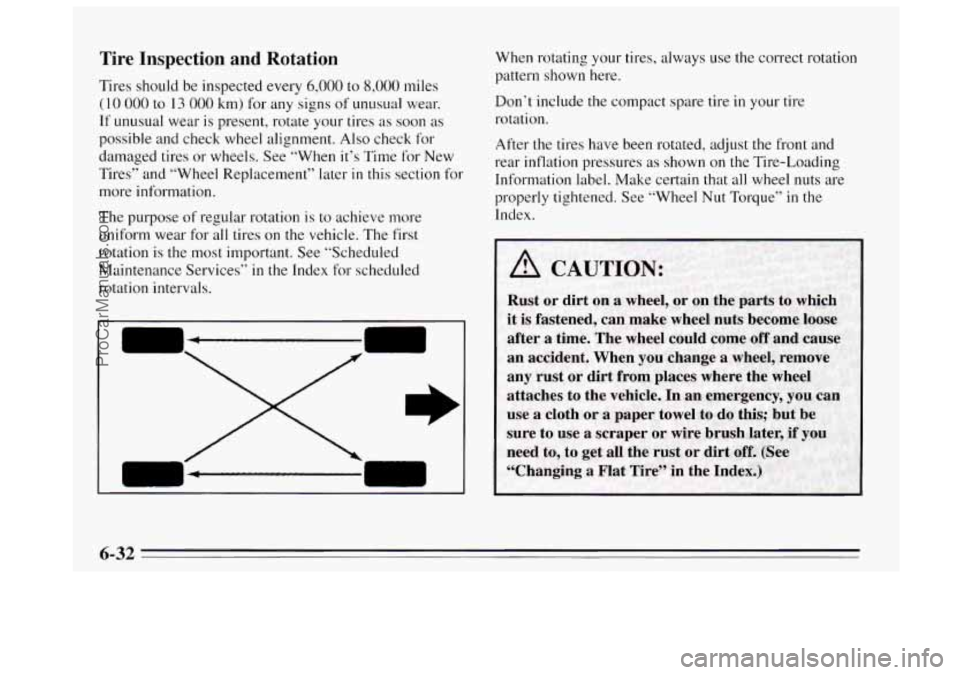
rotation intervals. When
rotating your tires, always use the correct rotation
pattern shown here.
Don’t include the compact spare tire
in your tire
rotation.
After the tires have been rotated, adjust the front and
rear inflation pressures
as shown on the Tire-Loading
Information label. Make certain that all wheel nuts are
properly tightened. See “Wheel
Nut Torque” in the
Index.
6-32
ProCarManuals.com
Page 247 of 340
Using Foam-Type Cleaner on Fabric
0 Vacuum and brush the area to remove any loose dirt.
0 Always clean a whole trim panel or section. Mask
surrounding trim along stitch or welt lines.
0 Mix Multi-Purpose Powdered Cleaner following the
Use suds only and apply with a clean sponge.
Don’t saturate the material.
Don’t rub it roughly.
As soon as you’ve cleaned the section, use a sponge
Rinse the section with a clean, wet sponge.
Wipe off what’s left with a slightly damp paper towel
0 Then dry it immediately with a blow dryer or a heat lamp.
directions
on the
container label.
to remove the
suds.
or cloth.
NOTICE:
Be careful. A blow dryer or a heat lamp may
scorch the fabric.
Wipe with a clean cloth.
Using Solvent-Type Cleaner on Fabric
First, see if you have to use solvent-type cleaner at all.
Some spots and stains will clean off better with just
water and mild soap.
If you need
to use a solvent:
Gently scrape excess soil from the trim material
with
a clean, dull knife or scraper. Use very little
cleaner, light pressure and clean cloths (preferably
cheesecloth). Cleaning should start at the outside of
the stain, “feathering” toward the center. Keep
changing to a clean section
of the cloth.
When you clean a stain from fabric, immediately dry
the area with
a blow dryer to help prevent a cleaning
ring. (See the previous NOTICE.)
Special Cleaning Problems
Greasy or Oily Stains
Stains caused by grease, oil, butter, margarine, shoe
polish, coffee with cream, chewing gum, cosmetic
creams, vegetable oils, wax crayon, tar and asphalt can
be removed
as follows:
Carefully scrape off excess stain.
Follow the solvent-type instructions aescribed earlier.
6-39
ProCarManuals.com
Page 250 of 340
Weatherstrips
Silicone grease on weatherstrips will make them last
longer, seal better, and not stick or squeak. Apply
silicone grease with
a clean cloth at least every six
months. During very cold, damp weather more frequent
application may be required. (See “Recommended
Fluids and Lubricants”
in the Index.)
Cleaning the Outside of Your Buick
The paint finish on your vehicle provides beauty, depth
of color, gloss retention and durability.
Washing Your Vehicle
The best way to preserve your vehicle’s finish is to keep it
clean by washing it often with lukewarm or cold water.
Don’t wash your vehicle in the direct rays
of the sun.
Don’t use strong soaps or chemical detergents. Use
liquid hand, dish or car washing (mild detergent) soaps.
Don’t use cleaning agents that are petroleum based,
or
that contain acid or abrasives. All cleaning agents
should be flushed promptly and not allowed to dry on
the surface, or they could stain. Dry
the finish with a
soft, clean chamois or a 100% cotton towel to avoid
surface scratches and water spotting.
High pressure car washes may cause water to enter your
vehicle.
Finish Care
Occasional waxing or mild polishing of your Buick by
hand may be necessary to remove residue from the paint
finish. You can get GM approved cleaning products
from your dealer. (See “Appearance Care and Materials”
in the Index.)
Your Buick has
a “basecoat/clearcoat” paint finish. The
clearcoat gives more depth and gloss to the colored
basecoat. Always use waxes and polishes that are
non-abrasive and made for
a basecoatklearcoat paint
finish.
I NOTICE:
Machine compounding or aggressive polishing on
a basecoatklearcoat paint finish may dull the
finish or leave swirl marks.
Foreign materials such as calcium chloride and other
salts, ice melting agents, road oil and tar, tree sap, bird
droppings, chemicals from industrial chimneys, etc. can
damage your vehicle’s finish
if they remain on painted
surfaces. Wash the vehicle
as soon as possible. If
necessary, use non-abrasive cleaners that are marked
safe for painted surfaces to remove foreign matter.
6-42
ProCarManuals.com
Page 258 of 340
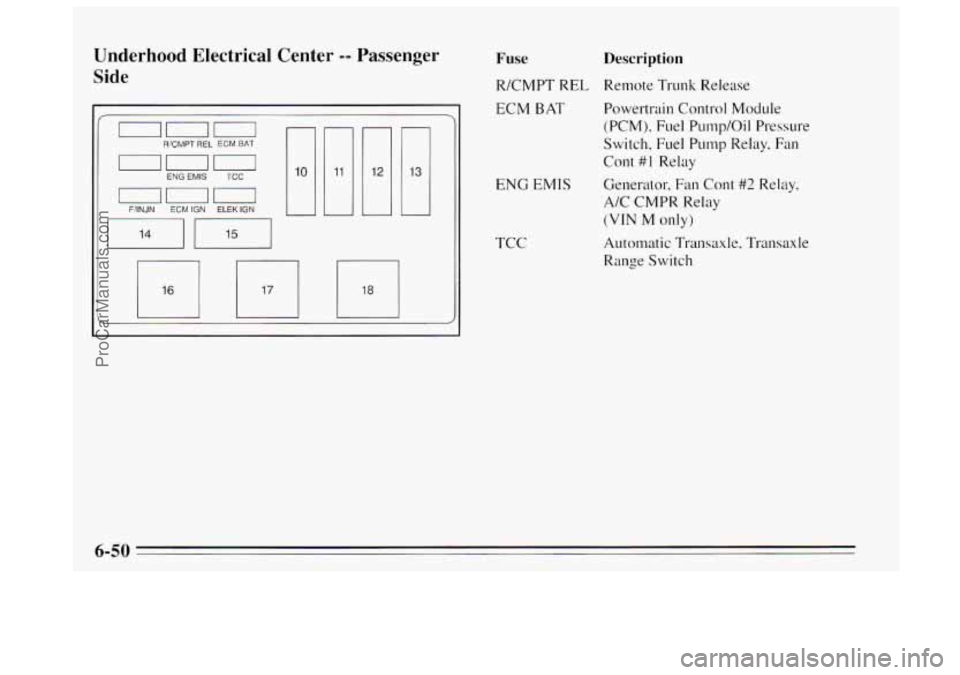
Underhood Electrical Center -- Passenger
Side
r
RCMPT REL EGM BAT
000 ENG EMIS TCC
FilNJN ECM IGN ELEK IGN
--
Fuse Description
R/CMPT REL Remote Trunk Release
ECM
BAT
ENG EMIS
TCC Powertrain Control Module
(PCM), Fuel Pump/Oil Pressure
Switch, Fuel Pump Relay,
Fan
Cont #I Relay
Generator, Fan Cont
#2 Relay,
A/C CMPR Relay
(VIN M only)
Automatic Transaxle, Transaxle
Range Switch
6-50
ProCarManuals.com
Page 279 of 340

Maintenance Schedule I
30,000 Miles (50 000 km)
0 Change engine oil and filter (or every
3 months, whichever occurs first).
An Emission Control Service.
0 Lubricate the shift linkage, parking brake
cable guides, underbody contact points and
linkage (or every
6 months, whichever
occurs first).
0 Inspect engine accessory drive belt (or
every 24 months, whichever occurs first).
An Emission Control Service
0 Drain, flush and refill cooling system (or
every 24 months, whichever occurs first).
See “Engine Coolant” in the Index for what
to use. Inspect hoses. Clean radiator,
condenser, pressure cap and neck. Pressure
test the cooling system and pressure cap.
An Emission Control Service.
0 Replace spark plugs. An Emission Control
Service.
0 Inspect spark plug wires. An Emission Control
0 Replace air cleaner filter. Replace filter
Service. T
more often under dusty conditions.
An Emission Control Service.
0 Inspect fuel tank, cap and lines for damage
or leaks. Inspect fuel cap gasket for any
damage. Replace parts as needed.
An Emission Control Service.
0 Rotate tires. See “Tire Inspection and
Rotation” in the Index for proper rotation
pattern and additional information.
I
~~
I DATE I ACTUAL MILEAGE SERVICED BY:
7-11
ProCarManuals.com
Page 285 of 340
Maintenance Schedule I
60,000 Miles (IO0 000 km)
0 Change engine oil and filter (or every
3 months, whichever occurs first).
An Emission Control Service.
0 Lubricate the shift linkage, parking brake
cable guides, underbody contact points and
linkage (or every
6 months, whichever
occurs first).
0 Inspect engine accessory drive belt (or
every 24 months, whichever occurs first).
0 Drain, flush and refill cooling system (or
every 24 months, whichever occurs first).
See “Engine Coolant’’
in the Index for what
to use. Inspect hoses. Clean radiator,
condenser, pressure cap and neck. Pressure
test the cooling system and pressure cap.
An Emission Control Service.
An Emission Control Service.
0 Replace spark plugs. An Ernission Control
Inspect spark plug wires. An Emission Control
0 Replace air cleaner filter. Replace filter
more often under dusty conditions.
Ail
Service.
Service.
-1
Emission Control Service.
0 Inspect fuel tank, cap and lines for damage
or leaks. Inspect fuel cap gasket for any
damage. Replace parts as needed.
An Emission Control Service.?
I I I I
DATE SERVICED BY: ACTUAL MILEAGE
7-17
ProCarManuals.com