Page 157 of 340
Once you are moving on the freeway, make certain you
allow a reasonable following distance. Expect to move
slightly slower at night.
When you want to leave the freeway, move to the proper
lane
well in advance. If you miss your exit do not, under
any circumstances, stop and back up. Drive
on to the
next exit.
The exit ramp can be curved, sometimes quite sharply.
The exit speed is usually posted.
Reduce your speed according to your speedometer, not
to
your sense of motion. After driving for any distance
at higher speeds,
you may tend to think you are going
slower than
you actually are.
Before Leaving on a Long Trip
Make sure you’re ready. Try to be well rested. If you
must start when you’re not fresh -- such as after a day’s
work
-- don’t plan to make too many miles that first part
of the journey. Wear comfortable clothing and shoes you
can easily drive in.
Is your vehicle ready for a long trip? If you keep it
serviced and maintained. it’s ready to go. If it needs
service, have
it done before starting out. Of course,
you’ll find experienced and able service experts
in
Buick dealers all across North America. They’ll be
ready and willing to help if you need
it.
Here are some things you can check before a trip:
0
0
0
0
0
0
Windshield Wc~slwr Fluid: Is the reservoir full‘? Are
all windows clean inside and outside?
Wiper Blades: Are they in good shape?
Fuel, Eqirze Oil, Other Fluids: Have you checked
all levels‘?
Lamps: Are they all working? Are the lenses clean?
Tires: They are vitally important to a safe,
trouble-free trip.
Is the tread good enough for
long-distance driving? Are the tires all inflated
to the recommended pressure‘?
Weather Fowcvzsrs: What’s the weather outlook
along your route? Should you delay your trip
a short
time to avoid a major storm system‘?
A4up.s: Do you have up-to-date maps?
4-19
ProCarManuals.com
Page 164 of 340
Loading Your Vehicle
OCCUPANTS VEHICLE CAP. WT.
TIRE-LOADING INFORMATION
I FRT. CTR. RR.
TOTAL LBS. KG
MAX.
LOADING & GVWR SAME AS VEHICLE
CAPACITY WEIGHT XXX COLD TIRE
TIRE
SIZE SPEED PRESSURE
RTG
PSIiKPa
FRT.
RR.
SPA.
IF TIRES ARE HOT, ADD 4PSIj28KPa
SEE OWNER’S MANUAL FOR ADDITIONAL
INFORMATION
- ~-__I__-__ -d
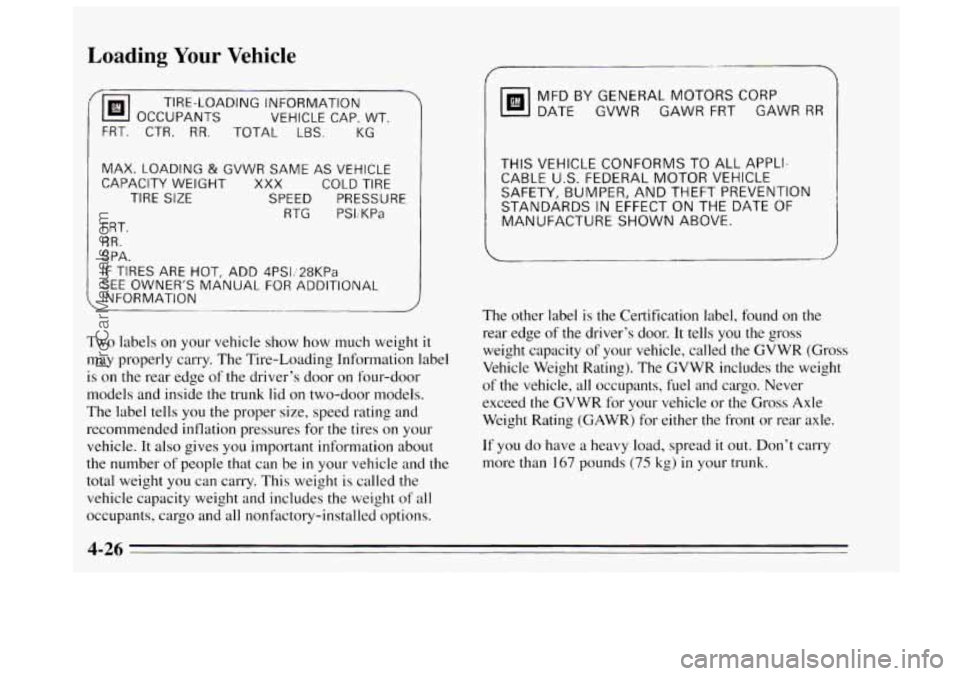
Two labels on your vehicle show how much weight it
may properly carry. The Tire-Loading Information label
is on the rear edge of the driver’s door on four-door
models and inside the trunk lid on two-door models.
The label tells you the proper size, speed rating and
recommended inflation pressures for the tires on your
vehicle. It
also gives you important information about
the number of people that can be
in your vehicle and the
total weight you can carry. This weight is called the
vehicle capacity weight and includes the weight of
all
occupants, cargo and all nonfactory-installed options.
/ -- -7
MFD BY GENERAL MOTORS CORP
DATE GVWR GAWR FRT GAWR RR
I
THIS VEHICLE CONFORMS TO ALL APPLI-
CABLE
U.S. FEDERAL MOTOR VEHICLE
SAFETY,
BUMPER, AND THEFT PREVENTION
STANDARDS
IN EFFECT ON THE DATE OF
MANUFACTURE SHOWN ABOVE.
1
The other label is the Certification label, found on the
rear edge of the driver’s door. It tells you the gross
weight capacity of your vehicle, called the GVWR
(Gross
Vehicle Weight Rating). The GVWR includes the weight
of the vehicle, all occupants, fuel and cargo. Never
exceed the GVWR for your vehicle or the Gross Axle
Weight Rating (GAWR) for either the front or rear axle.
If you do have a heavy load, spread
it out. Don’t carry
more than
167 pounds (75 kg) in your trunk.
4-26
ProCarManuals.com
Page 168 of 340
Weight of the Trailer Tongue
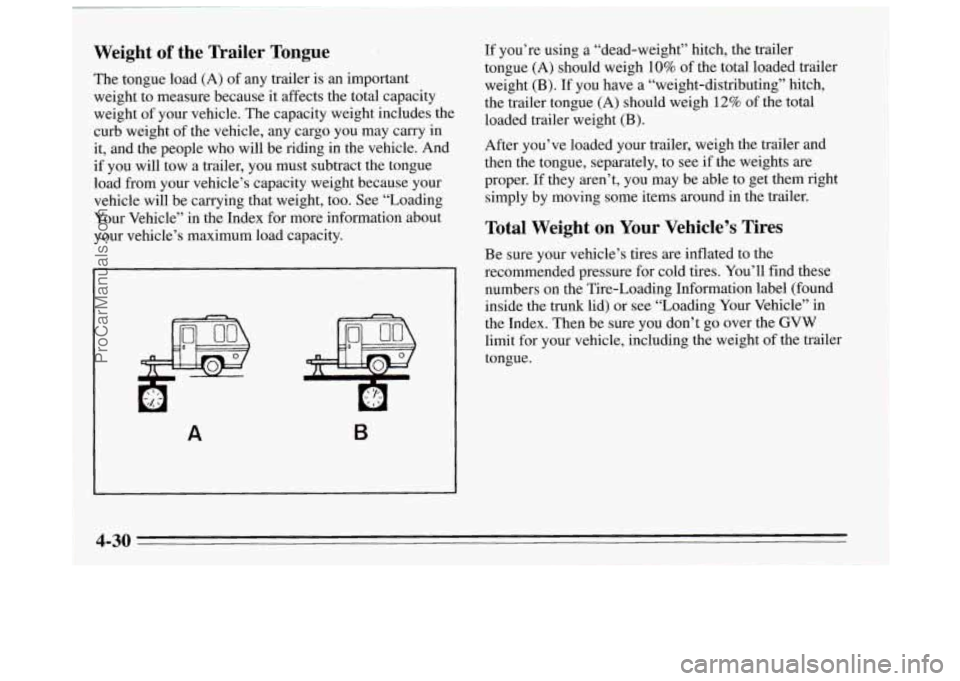
The tongue load (A) of any trailer is an important
weight to measure because it affects the total capacity
weight of your vehicle. The capacity weight includes the
curb weight of the vehicle, any cargo you may carry in
it, and the people who will be riding in the vehicle. And
if you will tow a trailer, you must subtract the tongue
load from your vehicle’s capacity weight because your
vehicle will be carrying that weight, too. See “Loading
Your Vehicle” in the Index for more information about
your vehicle’s maximum load capacity.
A B
If you’re using a “dead-weight” hitch, the trailer
tongue (A) should weigh
10% of the total loaded trailer
weight
(B). If you have a “weight-distributing” hitch,
the trailer tongue
(A) should weigh 12% of the total
loaded trailer weight (B).
After you’ve loaded your trailer, weigh the trailer and
then the tongue, separately, to see if the weights
are
proper. If they aren’t, you may be able to get them right
simply by moving some items around in the trailer.
Total Weight on Your Vehicle’s Tires
Be sure your vehicle’s tires are inflated to the
recommended pressure for cold tires. You’ll find these
numbers on the Tire-Loading Information label (found
inside the trunk lid) or see “Loading Your Vehicle” in
the Index. Then be sure you don’t go over the
GVW
limit for your vehicle, including the weight of the trailer
tongue.
4-30
ProCarManuals.com
Page 190 of 340
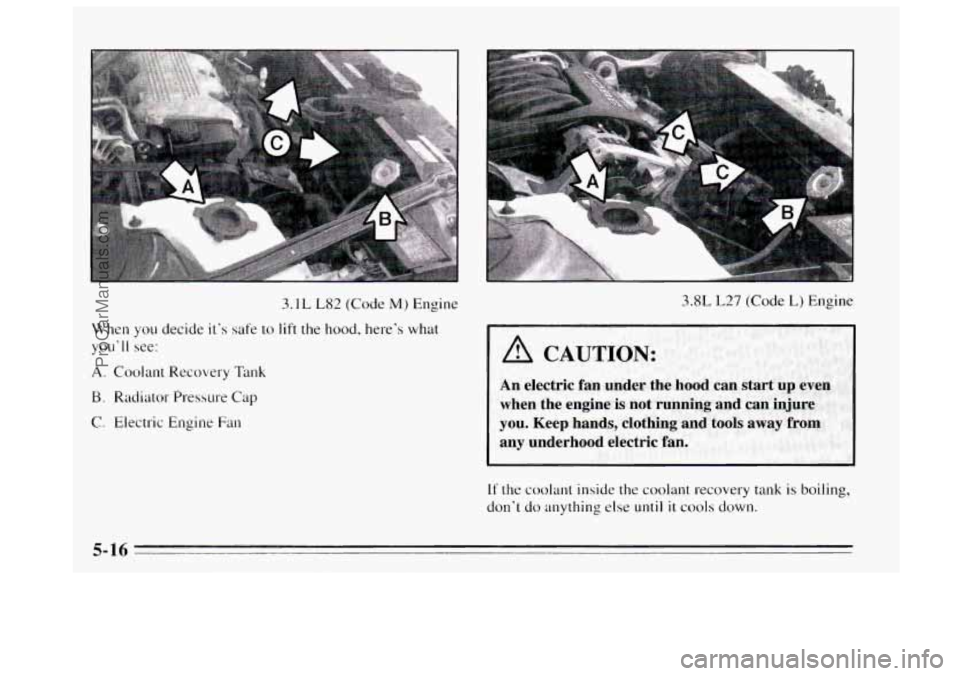
3.1 L L82 (Code M) Engine
When
you decide it’s safe to lift the hood, here’s what
you’
I1 see:
A. Coolant Recovery Tank
B. Radiator Pressure Cap
C. Electric Engine Fan
3.8L L27 (Code L) Engine
An electric fan under the hood can start up even
when the engine
is not running and can injure
you.
Keep hands, clothing and tools away from
any underhood electric fan.
If the coolant inside the coolant recovery tank is boiling,
don’t
do anything else until it cools down.
5-16
ProCarManuals.com
Page 194 of 340
How to Add Coolant to the Radiator
NOTICE:
Your engine has a specific radiator fill procedure.
Failure to
follow this procedure could cause your
engine to overheat and be severely damaged.
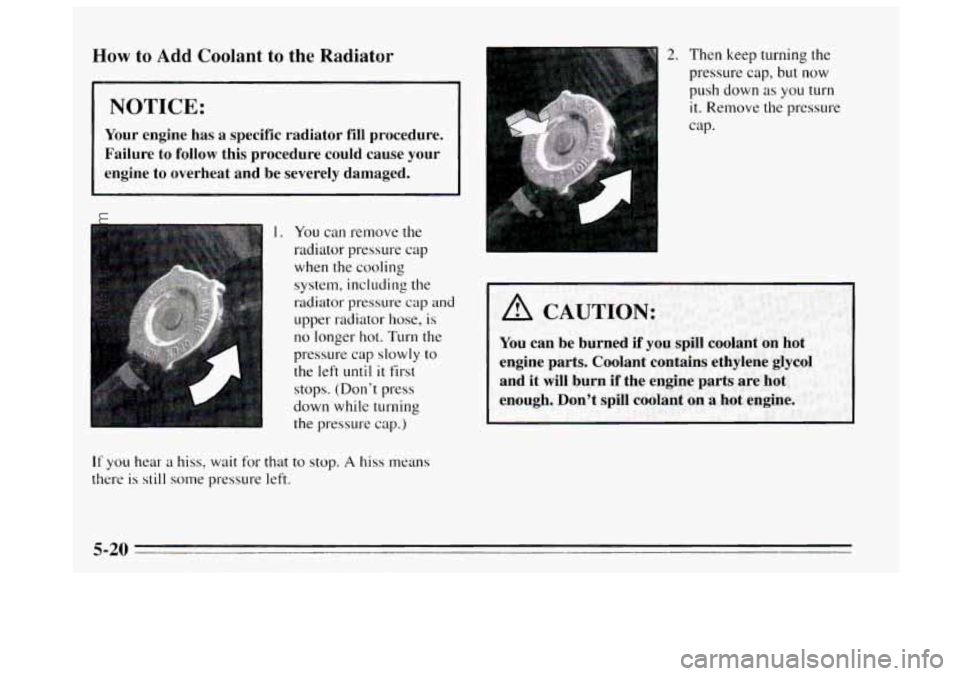
1. You can remove the
radiator pressure cap
when the cooling
system, including the
radiator pressure
cap and
upper radiator hose,
is
no longer hot. Turn the
pressure
cap slowly to
the left until it first
stops. (Don’t press
down while turning
the pressure cap.)
IC you hear a hiss, wait for that to stop. A hiss means
there
is still some pressure left.
2. Then keep turning the
pressure cap, but now
push down
as you turn
it. Remove the pressure
cap.
5-20
ProCarManuals.com
Page 196 of 340
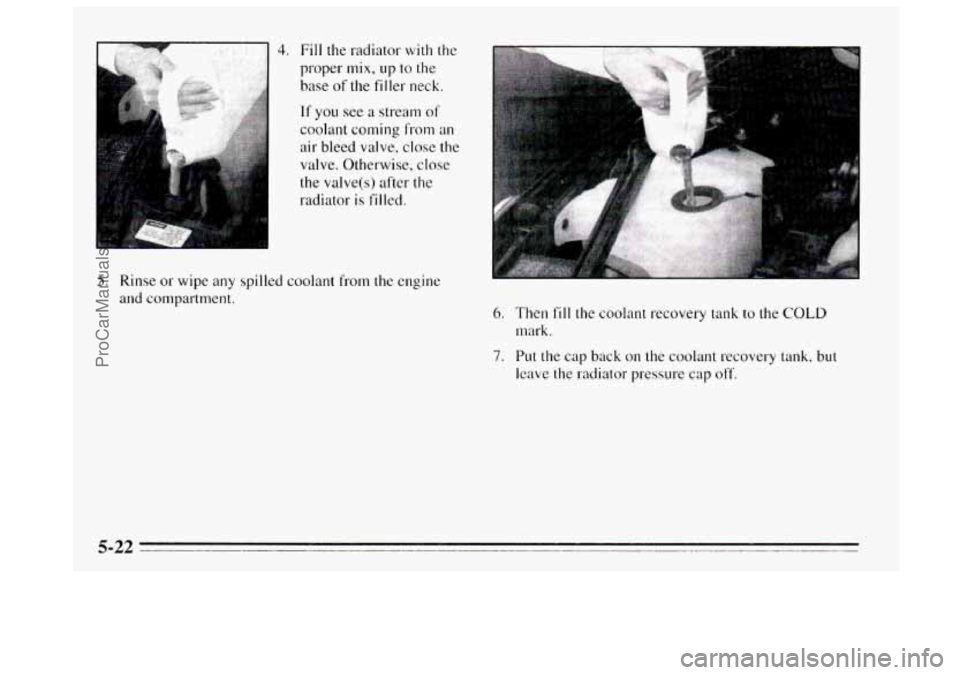
Fill the radiator with the
proper
mix, up to the
base of the filler neck.
If
you see a stream of
coolant coming horn an
air bleed valve, close the
valve. Otherwise, close
the valve(s) after the
radiator is filled.
5. Rinse or wipe any spilled coolant from the engine
and compartment.
6. Then fill the coolant recovery tank to the COLD
mark.
7. Put the cap back on the coolant recovery tank, but
leave the radiator pressure cap off.
ProCarManuals.com
Page 197 of 340
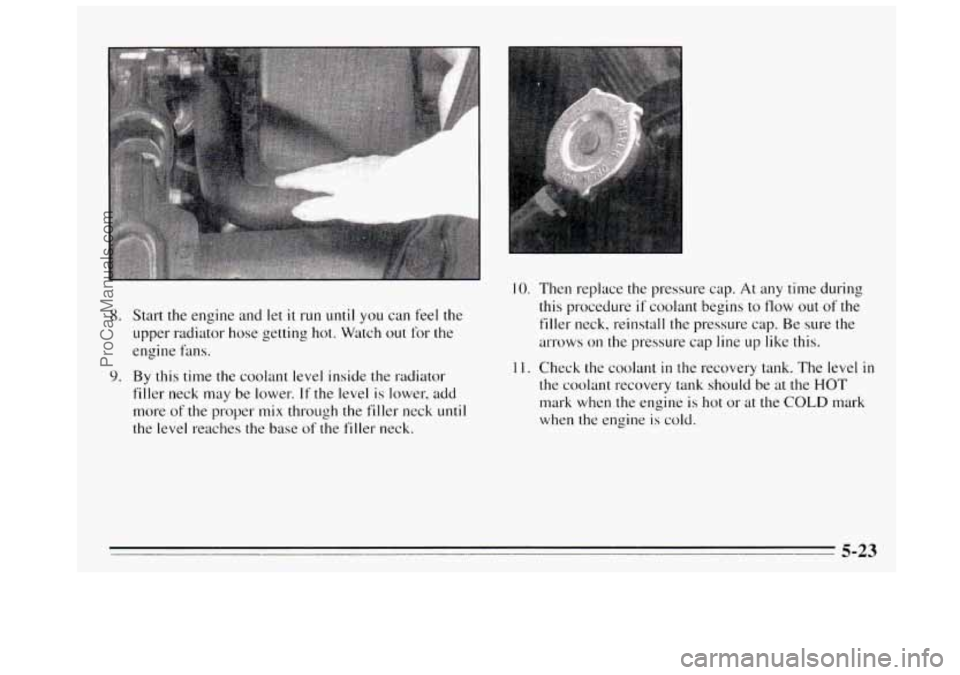
8. Start the engine and let it run until you can feel the
upper radiator hose getting hot. Watch
out for the
engine hns.
9. By this time the coolant level inside the radiator
filler neck may be lower.
If the level is lower, add
more
of the proper mix through the filler neck until
the level reaches the base of the filler neck.
10. Then replace the pressure cap. At any time during
this procedure
if coolant begins to flow out of the
filler neck, reinstall the pressure
cap. Be sure the
BI-~OWS on the pressure cap line up like this.
1 1 - Check the coolant in the recovery tank. The level in
the coolant recovery tank should be at the HOT
mark when the engine is hot or at the COLD mark
when the engine
is cold.
5-23
ProCarManuals.com
Page 206 of 340
Compact Spare Tire
Although the compact spare was fully inflated when
your vehicle was
new, it can lose air after a time. Check
the inflation pressure regularly. It should be 60 psi
(420 kPa). After installing the compact spare on your
vehicle, you should stop
as soon as possible and make
sure your spare tire
is correctly inflated. The compact
spare is made
to perform well at posted speed limits for
distances
up to 3,000 miles (5 000 km), so you can
finish your trip and have your full-size tire repaired or
replaced where you want.
Of course, it’s best to replace
your spare with
a full-size tire as soon as you can. Your
spare will last longer and be in good shape
in case you
need it again.
1 NOTICE:
Don’t take your compact spare through an
automatic
car wash with guide rails. The
compact spare can get caught on the rails. That
can damage the tire and wheel, and maybe other
parts
of your vehicle.
Don’t use your compact spare on some other vehicle.
And don’t mix your compact spare or wheel
with other
wheels or tires. They won’t
fit. Keep your spare and its
wheel together.
NOTICE:
Tire chains won’t fit your compact spare. Using
them will damage your vehicle and destroy the
chains too. Don’t use tire chains on your compact
spare.
5-32
ProCarManuals.com