1994 PONTIAC GRAND-AM brake
[x] Cancel search: brakePage 90 of 274

The Instrument
Panel-Your Information System
Your instrument panel is designed to let
you know at a glance how
your vehicle is
running. You’ll know how fast you’re
going, how much fuel you’re using, and
many other things you’ll need to drive
safely and economically.
The main components of your instrument
panel are:
1. Fog Light Switch
2. Instrument Panel Intensity Control,’
Interior Lights Switch
3. Side Vent
4. Turn Signal/Multifunction Lever
5. Hazard Warning Flashers Switch
6. Instrument Cluster
7. Windshield Wipersmasher Stalk
8. Center Vent
9. Audio System
10. Side Vent
11. Side Window Defogger Vent
12. Glove Box
13. Climate Control System
14. Ashtraybighter
15. Gear Shift Lever
16. Rear Window Defogger (Option)
17. Ignition Switch
18. SRS - Supplemental Restraint
System (Air Bag)
19. Horns
20. Tilt Steering Wheel Lever (Option)
21. Parking Brake Release Lever
22. Hood Release Handle
23. Fuse Panel
ProCarManuals.com
Page 99 of 274

Features & Controls
BRAKE
Brake System Warning
light
four Pontiac’s hydraulic brake system is
!ivided into two parts. If one part isn’t
qorking, the other part can still work and
top you. For good braking, though, you
leed both parts working well.
f the warning light comes on, there coulc
le a brake problem. Have your brake
ystem inspected right away.
ihis light should come on as you start tht
lehicle. If it doesn’t come
on then, have i
ixed so it will be ready to warn you if
here’s a problem.
[f the light comes on while you are
hiving, pull
off the road and stop
zarefully. You may notice that the pedal is
harder to push. Or, the pedal may go
;loser to the floor. It may take longer to
stop. If the light is still on, or if the
anti-lock brake system warning light is
flashing, have the vehicle towed for
service. (See “Anti-Lock Brake System
Warning Light” and “Towing Your Car”
in the Index.)
The brake system warning light will also
come on when you set your parking
brake, and it will stay on if your parking
brake doesn’t release fully. If it stays on
after your parking brake is fully released,
it means you have a brake problem.
... 98
ProCarManuals.com
Page 100 of 274

anti-Lock Brake System
Naming Light
Vith anti-lock, this light will come on
{hen you start your engine and it will
tay on for three seconds. That’s normal.
F the light doesn’t come on, have it fixed
D it will be ready to warn you if there is 2
roblem.
1 the light flashes when you’re driving,
ou don’t have anti-lock brakes and
lere’s a problem with your regular
rakes. Pull off the road and stop arefully. You may notice that the pedal
is
arder to push. Or, the pedal may go
loser to the floor. It may take longer to
:op. Have the vehicle towed for service.
See “Towing Your Car”
in the Index.)
If the anti-lock brake system warning
light stays on longer than normal after
you’ve started your engine, turn the
ignition
off. Or, if the light comes on and
stays on when you’re driving, stop as
soon as possible and turn the ignition off.
Then start the engine again to reset the
system.
If the light still stays on, or comes
3n again while you’re driving, your
Pontiac needs service.
If the light is on
but not flashing and the regular brake
system warning light isn’t on, you still
nave brakes, but you don’t have anti-lock
xakes.
Shift Light
(MANUAL TRA NSAXL E)
This light comes on when you need to
shift to the next higher gear. See “Manual
Transaxle”
in the Index.
99. ..
ProCarManuals.com
Page 121 of 274
Your Driving and the Road
Defensive Driving
The best advice anyone can give about
driving is: Drive defensively.
Please start with a very important safety
device
in your Pontiac: Buckle up. (See
“Safety Belts”
in the Index.)
Defensive driving really means “be ready
for anything.” On city streets, rural roads,
or freeways,
it means “always expect the
unexpected.”
Assume that pedestrians or other drivers
are going to be careless and make
mistakes. Anticipate what they might do.
Be ready for their mistakes.
Rear-end collisions are about the most
preventable of accidents. Yet they are
common. Allow enough following
distance. It’s the best defensive driving
maneuver,
in both city and rural driving.
You never know when the vehicle in front
of you is going to brake or
turn suddenly.
Drunken Driving
Death and injury associated with drinking
and driving is a national tragedy. It’s the
number one contributor to the highway
death toll, claiming thousands of victims
every year. Alcohol takes away three
things that anyone needs to drive a
vehicle:
Judgment
0 Muscular Coordination
0 Vision
Police records show that almost half of all
motor vehicle-related deaths involve
alcohol
- a driver, a passenger or
someone else, such as a pedestrian, had
been drinking. In’most cases, these deaths
are the result
of someone who was
drinking and driving. About
20,000 motor
vehicle-related deaths occur each year
because of alcohol, and thousands of
people are injured.
Just how much alcohol is too much if a
person plans to drive? Ideally, no one
should drink alcohol and then drive. But
if one does, then what’s “too much”? It
;an be a lot less than many
might think.
Although it depends on each person and
situation, here is some general
information on the problem.
The Blood Alcohol Content (BAC) of
someone who is drinking depends upon
four things:
0 How much alcohol is in the drink.
0 The drinker’s body weight.
The amount of food that is consumed
before and during drinking.
The length of time it has taken the
drinker to consume the alcohol.
. . . I20
ProCarManuals.com
Page 123 of 274
Your Driving and the Road
Drunken Driving (CONTI
people are impaired at a BAC
approaching
0.05 percent, and that the
effects are worse at night. All drivers are
impaired at BAC levels above
0.05
percent. Statistics show that the chance of
being in an accident increases sharply for
drivers who have a BAC of
0.05 percent
or above. A driver with a BAC level of
0.06 percent (three beers in one hour for a
180-pound or
82 kg person) has doubled
his or her chance of having an accident.
At a BAC level of
0.10 percent, the
chance of that driver having an accident is
six times greater; at a level of 0.15
percent, the chances are twenty-five times
greater! And, the body takes about an
hour to rid itself of the alcohol in on@
drink.
No amount of coffee or number of
cold showers will speed that up.
“I’ll be careful” isn’t the right answer.
What if there’s an emergency, a need to
take sudden action, as when a child darts
into the street? A person with a higher
BAC might not be able to react quickly
enough to avoid the collision.
There’s something else about drinking
and driving that many people don’t know.
Medical research shows that alcohol in a
person’s system can make crash injuries
worse. That’s especially true for brain,
spinal cord and heart injuries. That means
that if anyone who has been drinking
--
driver or passenger -- is in a crash, the
chance of being killed or permanently
disabled
is higher than if that person had
not. been drinking. And we’ve already
seen that the chance of a crash itself is
higher for drinking drivers.
Control of a Vehicle
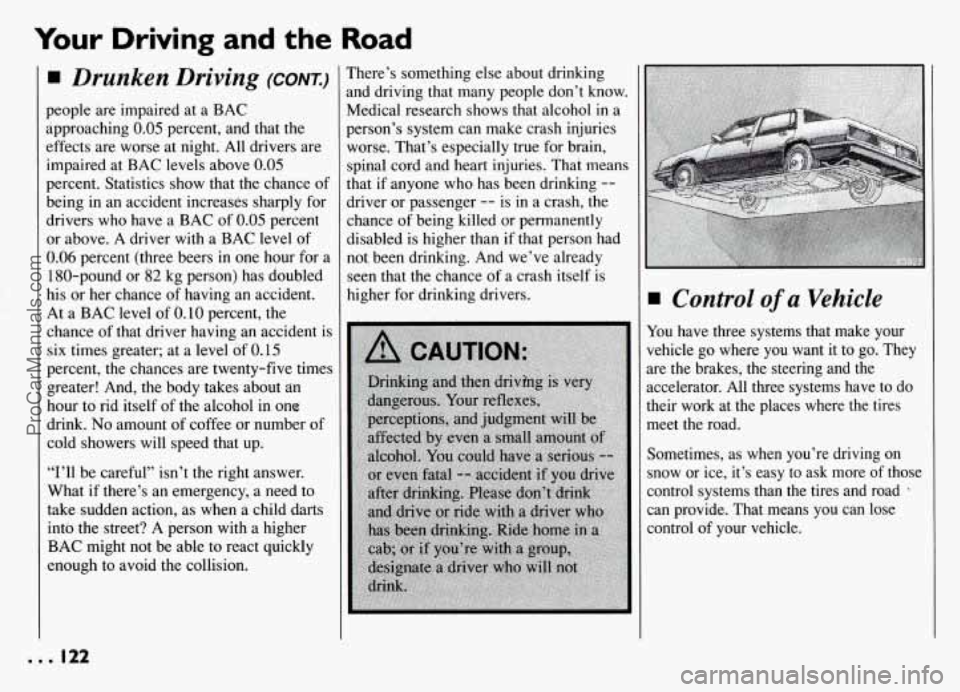
You have three systems that make your
vehicle
go where you want it to go. They
are the brakes, the steering and the
accelerator. All three systems have to do
their work at the places where the tires meet the road.
Sometimes, as when you’re driving on
snow or ice, it’s easy
to ask more of those
control systems than the tires and road
a
can provide. That means you can lose
control of your vehicle.
ProCarManuals.com
Page 125 of 274
Your Driving and the Road
anti-Lock Brakes (ABS)
‘CONT.)
’his light on the instrument panel will go
In when you start your vehicle.
Nhen you start your vehicle, or when yo^
begin to drive away, you may hear a
nomentary motor or clicking noise. And
‘ou may even notice that your brake
edal moves a little while this
is going on
rhis is the ABS system testing itself.
If
here’s a problem with the anti-lock brakc
ystem, the anti-lock brake system
Yarning light will stay on or flash.
iee “Anti-lock Brake System Warning
ight” in the Index.
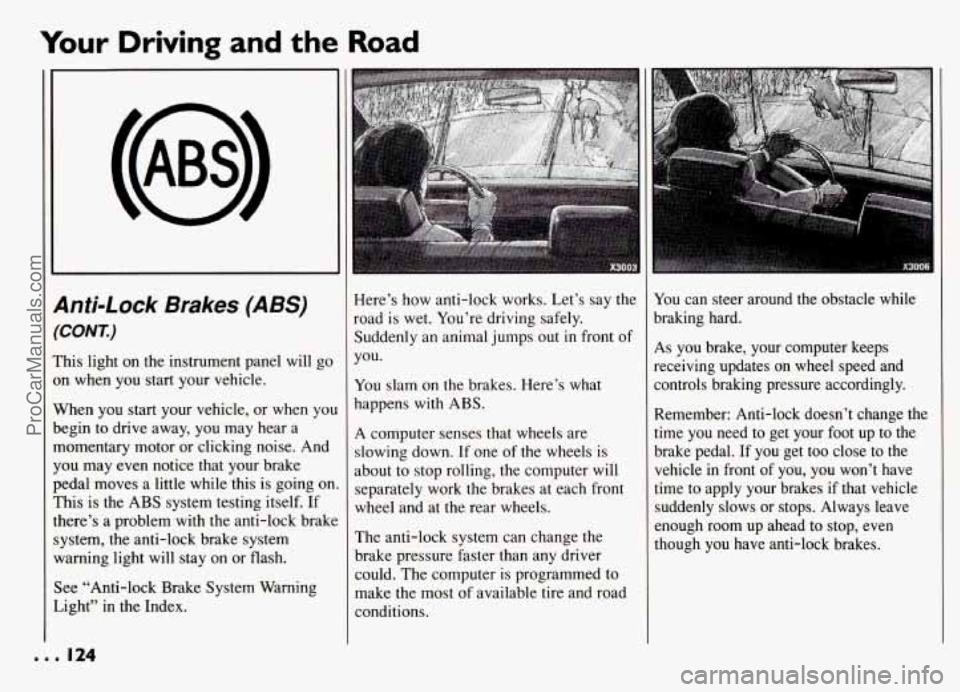
Here’s how anti-lock works. Let’s say the
road is wet. You’re driving safely.
Suddenly an animal jumps out in front of
you.
You slam on the brakes. Here’s what
happens with ABS.
A computer senses that wheels are
slowing down. If one of the wheels is
about to stop rolling, the computer will
separately work the brakes at each front
wheel and at the rear wheels.
The anti-lock system can change the
brake pressure faster than any driver
could. The computer is programmed to
make the most of available tire and road
conditions.
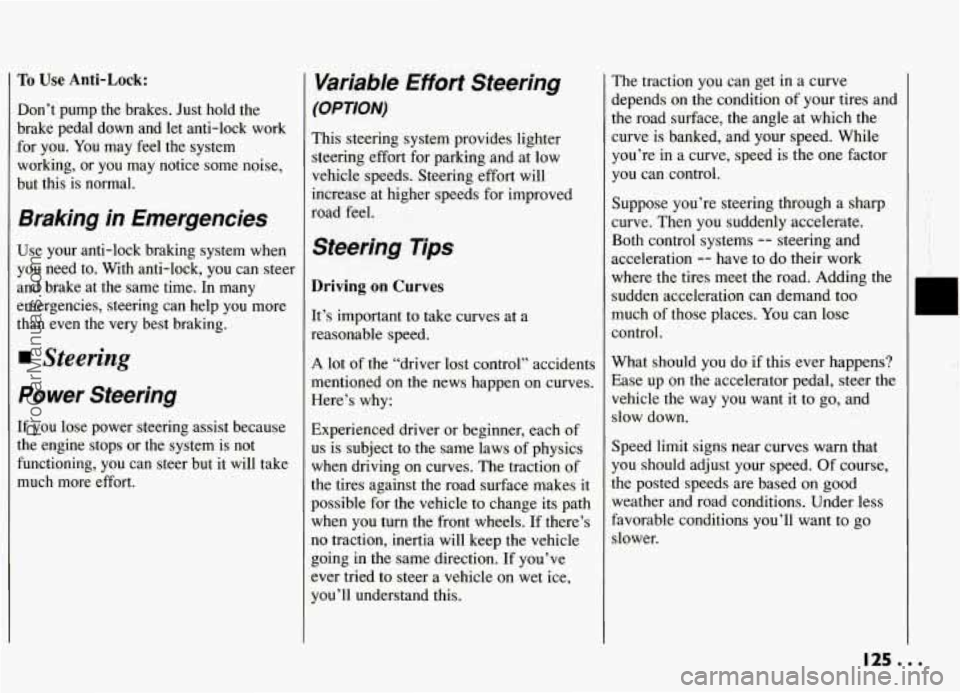
You can steer around the obstacle while
braking hard.
As you brake, your computer keeps
receiving updates
on wheel speed and
controls braking pressure accordingly.
Remember: Anti-lock doesn’t change the
time you need to get your foot up to the
brake pedal.
If you get too close to the
vehicle in front of you, you won’t have
time to apply your brakes
if that vehicle
suddenly slows
or stops. Always leave
enough room
up ahead to stop, even
though you have anti-lock brakes.
... 124
ProCarManuals.com
Page 126 of 274
To Use Anti-Lock:
Don’t pump the brakes. Just hold the
brake pedal down and let anti-lock work
.for you. You may feel the system
working, or you may notice some noise,
but this is normal.
Braking in Emergencies
Use your anti-lock braking system when
you need to. With anti-lock, you can steer
and brake at the same time. In many
emergencies, steering can help you more
than even the very best braking.
Steering
Power Steering
If you lose power steering assist because
the engine stops or the system is not
functioning, you can steer but it will take
much more effort.
Variable Effort Steering
(OPTION)
This steering system provides lighter
steering effort for parking and at low
vehicle speeds. Steering effort will
increase at higher speeds for improved
road feel.
Steering Tips
Driving on Curves
It’s important to take curves at a
reasonable speed.
A lot of the “driver lost control” accidents
mentioned on the news happen on curves.
Here’s why:
Experienced driver or beginner, each of
us is subject to the same laws of physics
when driving on curves. The traction of
the tires against the road surface makes it
possible
for the vehicle to change its path
when you
turn the front wheels. If there’s
no traction, inertia will keep the vehicle
going in the same direction. If you’ve
ever tried to steer a vehicle on wet ice,
you’ll understand this.
The traction you can get in a curve
depends on the condition of your tires and
the road ,surface, the angle at which the
curve is banked, and your speed. While
you’re in a curve, speed isthe one factor
you can control.
Suppose you’re steering through a sharp
curve. Then you suddenly accelerate.
Both control systems
-- steering and
acceleration
-- have to do their work
where the tires meet the road. Adding the
sudden acceleration can demand too
much of those places. You can lose
control.
What should you do if this ever happens?
Ease up on the accelerator pedal, steer the
vehicle the way you want it to go, and
slow down.
Speed limit signs near curves warn that
you should adjust your speed. Of course,
the posted speeds are based on good
weather and road conditions. Under less
favorable conditions you’ll want
to go
slower.
I
125...
ProCarManuals.com
Page 127 of 274
Your Driving and the Road
Steering Tips (CONT.)
If you need to reduce your speed as you
approach a curve, do it before you enter
the curve, while your front wheels are
straight ahead.
Try to adjust your speed so you can
“drive” through the curve. Maintain a
reasonable, steady speed. Wait to
accelerate until you are out of the curve,
and then accelerate gently into the
straightaway.
I .. ..
I
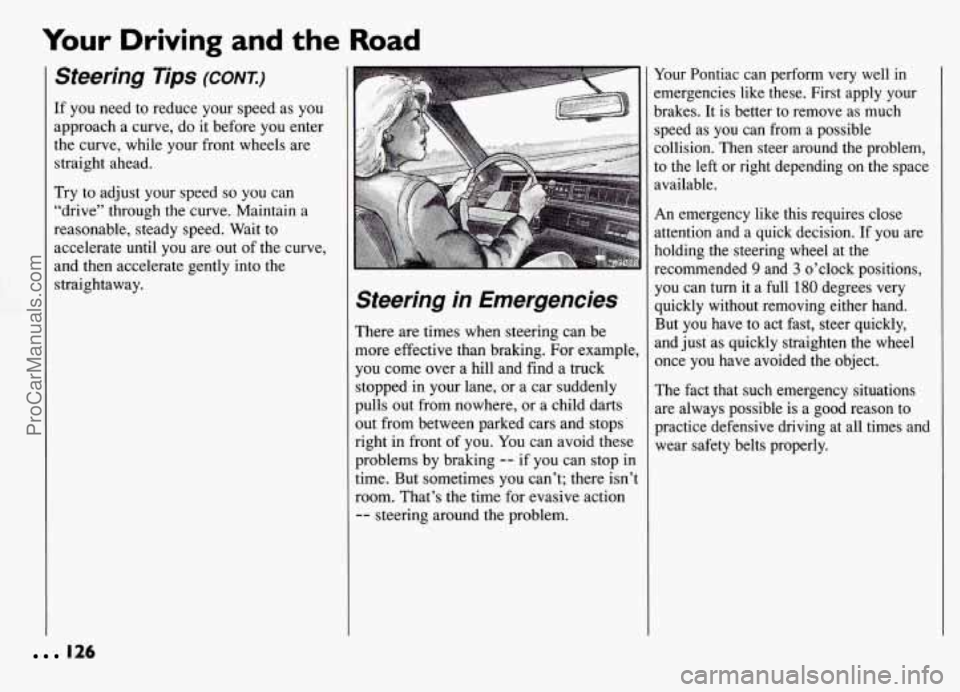
Steering in Emergencies
There are times when steering can be
more effective than braking. For example,
you come over a
hill and find a truck
stopped in your lane, or a car suddenly
pulls out from nowhere, or a child darts
out from between parked cars and stops
right in front of you. You can avoid these
problems by braking
-- if you can stop in
time. But sometimes you can’t; there isn’t
room. That’s the time for evasive action
-- steering around the problem.
Your Pontiac can perform very well in
=mergencies like these. First apply your
brakes. It is better to remove as much
speed as you can from a possible
Zollision. Then steer around the problem,
to the left or right depending on the space
mailable.
An emergency like this requires close
attention and a quick decision. If you are
holding the steering wheel at the
recommended
9 and 3 o’clock positions,
you can turn it a full
180 degrees very
quickly without removing either hand.
But you have to act fast, steer quickly,
and just as quickly straighten the wheel
once you have avoided the object.
The fact that such emergency situations
are always possible is a
good reason to
practice defensive driving at all times and
wear safety belts properly.
126
ProCarManuals.com