1994 PONTIAC BONNEVILLE service
[x] Cancel search: servicePage 101 of 290
Features & Controls
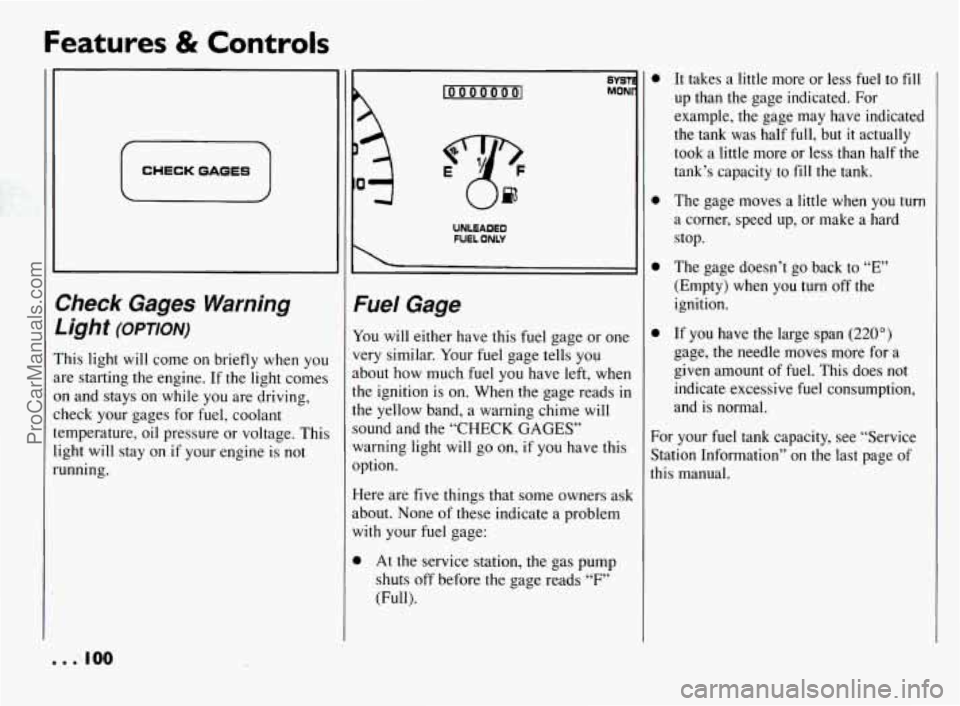
CHECK GAGES
>heck Gages Warning
Jght
(OPTION)
‘his light will come on briefly when you
re starting the engine. If the light comes
n and stays on while you are driving,
heck your gages for fuel, coolant
:mperature, oil pressure or voltage. This
ght will stay on
if your engine is not
Inning.
loooooool
8YST MONl
UNLEADED
FUEL ONLY
Fuel Gage
You will either have this fuel gage or one
very similar.
Your fuel gage tells you
about how much fuel you have left, when
the ignition is on. When the gage reads in
the yellow band, a warning chime will
sound and the
“CHECK GAGES”
warning light will
go on, if you have this
option.
Here are five things that some owners ask
about. None
of these indicate a problem
with your fuel gage:
0 At the service station, the gas pump
shuts off before the gage reads
“F”
(Full).
It takes a little more or less fuel to fill
up than the gage indicated. For
example, the gage may have indicated
the tank was half full, but
it actually
took a little more or less than half the
tank’s capacity to
fill the tank.
The gage moves a little when you
turn
a corner, speed up, or make a hard
stop.
The gage doesn’t go back to
“E”
(Empty) when you turn off the
ignition.
If you have the large span
(220”)
gage, the needle moves more for a
given amount of fuel. This does not
indicate excessive fuel consumption,
and is normal.
For your fuel tank capacity, see “Service
Station Information” on the last page of
this manual.
.e 100
ProCarManuals.com
Page 103 of 290
Features & Controls
Oi/ Pressure Gage (OPTION)
(CONK)
Driving your vehicle with low oil
pressure can cause extensive engine
damage.
Ih
I I NOTICE:
I
Damage to your engine from
neglected oil problems can be costly
and is not covered by your warranty.
. . . 102
lo
il
s:
a
ir
SI
H230!
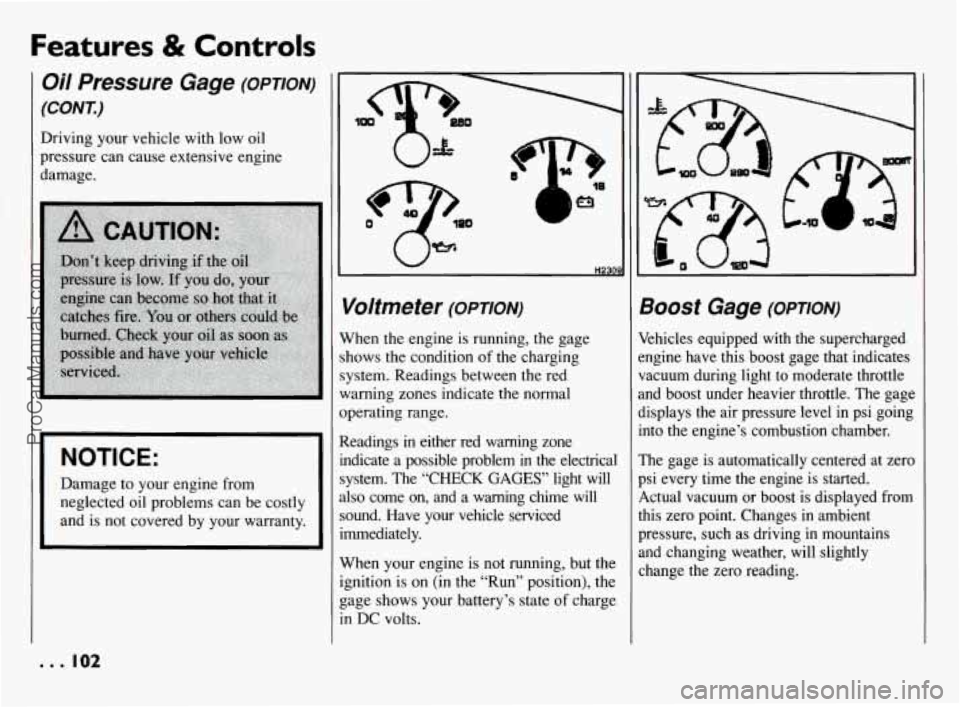
Voltmeter (omoN)
Vhen the engine is running, the gage
hows the condition of the charging
ystem. Readings between the red
Iarning zones indicate the normal
perating range.
Leadings
in either red warning zone
ldicate
a possible problem in the electrical
ystem. The “CHECK
GAGES’ light will
lso come on, and a warning chime will
ound. Have your vehcle serviced
mediately.
Vhen your engine is not running, but the
pition is on (in the “Run” position), the
age shows your battery’s state
of charge
I DC volts.
300St Gage (OPTION)
khicles equipped with the supercharged
ngine have this boost gage that indicates
acuum during light to moderate throttle
nd boost under heavier throttle. The gage
isplays the air pressure level in psi going
]to the engine’s combustion chamber.
‘he gage is automatically centered at zero
si every time the engine is started.
,ctual vacuum or boost is displayed from
lis zero point. Changes in ambient
ressure, such as driving in mountains
nd changing weather, will slightly
hange the zero reading.
ProCarManuals.com
Page 135 of 290
Comfort Controls & Audio Systems
Cassettes are subject to wear and the
sound quality may degrade over time.
Always verify that the cassette tape is
in
good condition before obtaining service
on your tape player.
Please note that cassette tape adapter kits
for portable
CD players will not work in
your cassette player. These adapter
cassettes will be ejected by
the radio.
Care of Your Compact
Discs
Handle discs carefully. Store them in their
original cases or other protective cases
and away from direct sunlight and dust. If
the surface of a disc is soiled, dampen a
clean, soft cloth
in a mild, neutral
detergent solution and clean
it, wiping
from
the center to the edge.
Be sure never to touch the signal surface
when handling discs. Pick up discs by
grasping
the outer edges or the edge of
the hole and the outer edge.
Fixed Mast Antenna
The fixed mast antenna can withstand
most car washes without being damaged.
If the mast should ever become slightly
bent, you can straighten
it out by hand. If
the mast is badly bent, as
it might be by
vandals, you should replace it.
Check every once
in a while to be sure
the mast
is still tightened to the fender.
ProCarManuals.com
Page 153 of 290
Your Driving and the Road
H Freeway Driving (CONK)
along the entrance ramp, you should
begin to check traffic. Try to determine
where you expect to blend with the flow.
Try
to merge into the gap at close to the
prevailing speed. Switch on your turn
signal, check your mirrors and glance
over your shoulder as often as necessary.
Try to blend smoothly with the traffic
flow.
Once you are
on the freeway, adjust your
speed to the.posted limit or to the
prevailing rate if it’s slower. Stay in the
right lane unless
you want to pass.
Before changing lanes, check your
mirrors. Then use your turn signal.
Just before you leave the lane, glance
quickly over your shoulder to make sure
there isn’t another vehicle in your “blind”
spot.
Once you are moving
on the freeway,
make certain you allow a reasonable
following distance. Expect to move
slightly slower at night.
When you want to leave the freeway,
move to the proper lane well
in advance.
If you miss your exit do not, under any
,.. 152
circumstances, stop and back up. Drive on
to the next exit.
The exit ramp can be curved, sometimes
quite sharply.
The exit speed
is usually posted.
Reduce your speed according to your
speedometer, not to your sense of motion.
After driving for any distance at higher
speeds, you may tend to think
you are
going slower than you actually are.
Before Leaving on a
Long Trip
Make sure you’re ready. Try to be well
rested.
If you must start when you’re not
fresh
-- such as after a day’s work --
don’t plan to make too many miles that
first part
of the journey. Wear comfortable
clothing and shoes you can easily drive
in.
Is your vehicle ready for a long trip? If
you keep it serviced and maintained, it’s
ready to go. If it needs service, have it
done before starting out. Of course, you’ll
find experienced and able service experts
in Pontiac dealerships all across North America. They’ll
be ready and willing to
help if you need it.
Here are some things
you can check
before a trip:
0 Windshield Washer Fluid: Is the
reservoir full? Are all windows clean
inside and outside?
0 Wiper Blades: Are they in good
shape?
0 Fuel. Engine Oil. Other Fluids: Have
you checked all levels?
0 Lights: Are they all working? Are the
lenses clean?
Tires: They are vitally important to a
safe, trouble-free trip.
Is the tread
good enough for long-distance
driving? Are the tires all inflated to
the recommended pressure?
0 Weather Forecasts: What’s the weather outlook along your route?
Should you delay your trip a short
time to avoid a major storm system?
Maps: Do you have up-to-date maps?
ProCarManuals.com
Page 164 of 290

Parking on Hills
You really should not park your vehicle,
with a trailer attached, on a hill.
If
something goes wrong, your rig could
start to move. People can be injured, and
both your vehicle and the trailer can be
damaged.
But if you ever have to park your rig on a
hill, here’s how to do it:
1.
2.
3.
4.
5.
Apply your regular brakes, but don’t
shift into
“P” (Park) yet.
Have someone place chocks under the
trailer wheels.
When the wheel chocks are in place,
release the regular brakes until the chocks absorb the load.
Reapply the regular brakes. Then
apply your parking brake, and then shift to
“F”’ (Park).
Release the regular brakes.
When You Are Ready to Leave After
Parking
on a Hill
1.
2.
3.
4.
Apply your regular brakes and hold
the pedal down while you:
0 Start your engine;
Shift into a gear; and
0 Release the parking brake.
Let up on the brake pedal.
Drive slowly until the trailer is clear
of the chocks.
Stop and have someone pick up and
store the chocks.
Maintenance When Trailer Towing
Your vehicle will need service more often
when you’re pulling a trailer.
See the
Maintenance Schedule for more
on this.
Things that are especially important in
trailer operation are automatic transaxle
fluid (don’t overfill), engine oil, belt(s),
cooling system, and brake adjustment,
Each
of these is covered in this manual,
and the Index will help you find them
quickly. If you’re trailering, it’s a good
idea to review these sections before. you
start your trip.
Check periodically to
see that all hitch
nuts and bolts are tight.
,j.;
i .a
1. i
,
.?.
163...
ProCarManuals.com
Page 171 of 290

Problems on the Road
To Jump Start Your
Pontiac: (CONT.)
9. Attach the cable at least 18 inches
(45 cm) away from the dead battery,
but not near engine parts that move.
The electrical connection is just as
good there, but the chance of sparks
getting back to the battery is much
less.
16. Now start the vehicle with the good
battery and
run the engine for a while.
11. Try to start the vehicle with the dead
battery.
If it won't start after a few tries, it
probably needs service.
I 0 170
12. Re'move the cables in reverse order to
prevent electrical shorting. Take care
that they don't touch each other or
any other metal. Towing Your Pontiac
Try to have a GM dealer or a professional
towing service tow your Pontiac. The
usual towing equipment is:
(A) Sling-type tow truck
(B) Wheel-lift
(C) Car carrier
If your vehicle has been changed or
modified since it was factory-new by
adding aftermarket items like fog lamps,
aero skirting, or special tires and wheels,
these instructions and illustrations may
not be correct.
ProCarManuals.com
Page 172 of 290

Before you do anything, turn on the
hazard warning flashers.
When you call, tell the towing service:
0 That, if you have the SSE or SSEi
model, your vehicle cannot be towed
from the front with sling-type
equipment.
0 That your vehicle has front-wheel
drive.
The make, model, and year of your
vehicle.
Whether you can still move the shift
lever.
0 If there was an accident, what was
damaged.
When the towing service arrives, let the
tow operator know that this manual
, contains detailed towing instructions and
illustrations. The operator may want to
see them. When
your vehicle is being towed, have
the ignition key
off. The steering wheel
should be clamped in a straight-ahead
position, with a clamping device designed
for towing service. Do not use the
vehicle’s steering column lock for this.
The transaxle should be in Neutral and the
parking brake released.
Don’t have your vehicle towed on the front
wheels, unless you must.
If the vehicle
must be towed on the front wheels, don’t
go more than 35 mph (56 km/h) or farther
than
50 miles (80 km) or your transaxle
will
be damaged. If these limits must be
exceeded, then the front wheels have
to be
supported on a dolly.
171 ...
c
ProCarManuals.com
Page 178 of 290

If No Steam Is Coming
From Your Engine
If you get the overheat warning but see or
hear no steam, the problem may not be
too serious. Sometimes the engine can get
a little too hot when you:
0 Climb a long hill on a hot day.
0 Stop after high speed driving.
0 Idle for long periods in traffic.
Tow a trailer.
If you get the overheat warning with
no
sign of steam, try this for a minute or so:
1. Turn off your air conditioner.
2. Turn on your heater to full hot at the
highest fan speed and open the
window as necessary.
3. If you’re in a traffic jam, shift to “N”
(Neutral).
If you no longer have the overheat
warning, you can drive. Just to be safe,
drive slower for about ten minutes. If the
warning doesn’t come back on, you can
drive normally.
If the warning continues, pull over, stop,
and park your vehicle right away.
If there’s still no sign of steam, you can
idle the engine for two or three minutes
while you’re parked, to see
if the warning
stops.
But then,
if you still have the warning,
TURN
OFF THE ENGINE AND GET
EVERYONE OUT
OF THE VEHICLE
until it cools down.
You may decide not to lift the hood but to
get service help right away.
11
Cooling System
When you decide it’s safe to lift the hood,
here’s what you’ll see:
(A) Coolant recovery tank
(B) Radiator pressure cap
(C) Electric engine fan
. 177..
c
ProCarManuals.com