1994 OLDSMOBILE SILHOUETTE service
[x] Cancel search: servicePage 197 of 276
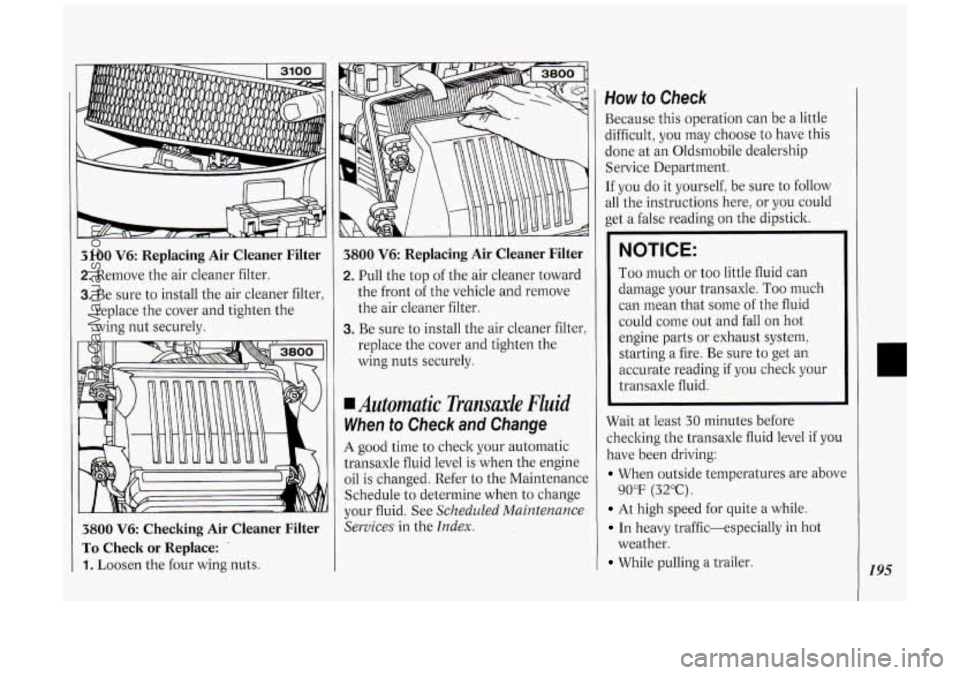
3100 V6: Replacing Air Cleaner Filter
2. Remove the air cleaner filter.
3. Be sure to install the air cleaner filter,
replace the cover and tighten the
wing nut securely.
3800 V6 Checking Air Cleaner Filter
To Check or Replace: .
1. Loosen the four wing nuts.
3800 V6: Replacing Air Cleaner Filter
2. Pull the top of the air cleaner toward
the front of the vehicle and remove
the air cleaner filter.
3. Be sure to install the air cleaner filter,
replace the cover and tighten the
wing nuts securely.
Automatic Transaxle Fluid
When to Check and Change
A good time to check your automatic
transaxle fluid level is when the engine
oil is changed. Refer
to the Maintenance
Schedule to determine when to change
your fluid. See
Scheduled Maintenance
Services
in the Index.
How to Check
Because this operation can be a little
difficult, you may choose to have this
done at an Oldsmobile dealership
Service Department.
If you do it yourself, be sure to follow
all the instructions here, or you could
get a false reading on the dipstick.
NOTICE:
Too much or too little fluid can
damage your transaxle.
Too much
can mean that some of the fluid
could come out and fall on hot
engine parts or exhaust system,
starting a fire. Be sure to get an
accurate reading if you check your
transaxle fluid.
Wait at least
30 minutes before
checking the transaxle fluid level
if you
have been driving:
When outside temperatures are above
At high speed for quite a while.
In heavy traffic-especially in hot
While pulling a trailer.
90°F (32°C).
weather.
195
ProCarManuals.com
Page 198 of 276
Service &Appearance Care
196
To get the right reading, the fluid
should be at normal operating
temperature, which is
180°F to 200°F
(82°C to 93°C).
Get the vehicle warmed up by driving
about
15 miles (24 ltm) when outside
temperatures are above
50°F (10°C). If
it's colder than 50°F ( 10°C), you may
have to drive longer.
To Check the Fluid Level
Park your vehicle on a level place.
With the parking brake applied, place
With your foot on the brake pedal,
the
shift lever in
P (Park).
move the shift lever through each gear
range, pausing for about three
seconds in each range. Then, position
the shift lever in
P (Park).
Let the engine run at idle for three to
five minutes.
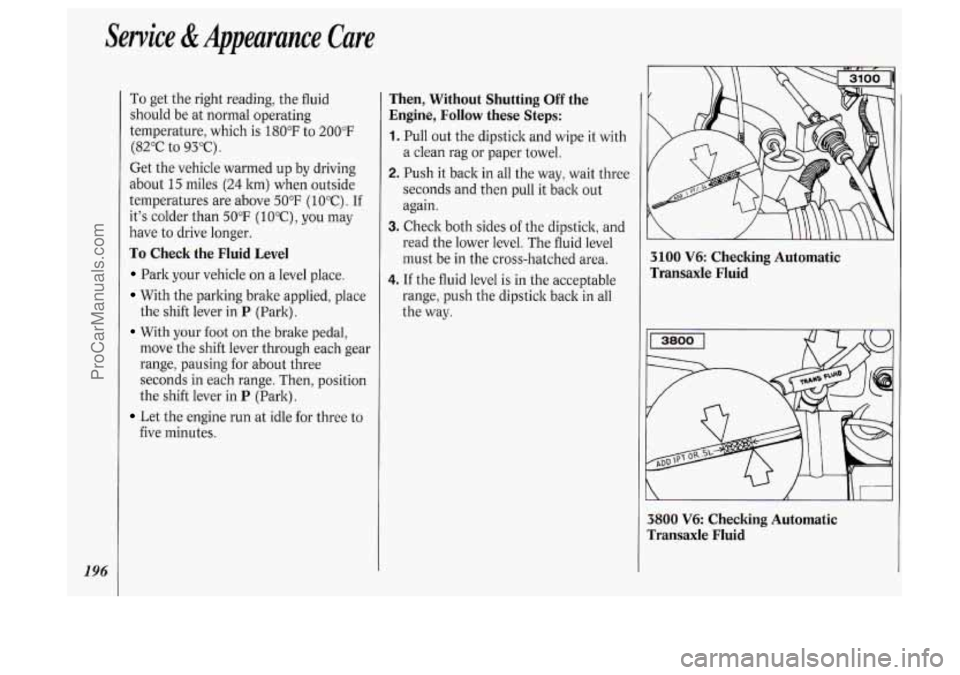
Then, Without Shutting Off the
Engine, Follow these Steps:
1. Pull out the dipstick and wipe it with
a clean rag or paper towel.
2. Push it back in all the way, wait three
seconds and then pull it back out
again.
3. Check both sides of the dipstick, and
read the lower level. The fluid level
must be in the cross-hatched area.
4. If the fluid level is in the acceptable
range, push the dipstick back in all
the way.
3100 V6: Checking Automatic
rransaxle Fluid
3800 V6: Checking Automatic
rransaxle Fluid
ProCarManuals.com
Page 200 of 276
Service &Appearance Cure
NOTICE:
198
If you use an improper coolant mix,
your engine could overheat and be
badly damaged. The repair
cost
wouldn’t be covered by your
warranty. Too much water in the
mix can freeze and crack the
engine, radiator, heater core and
other parts.
Adding Coolant
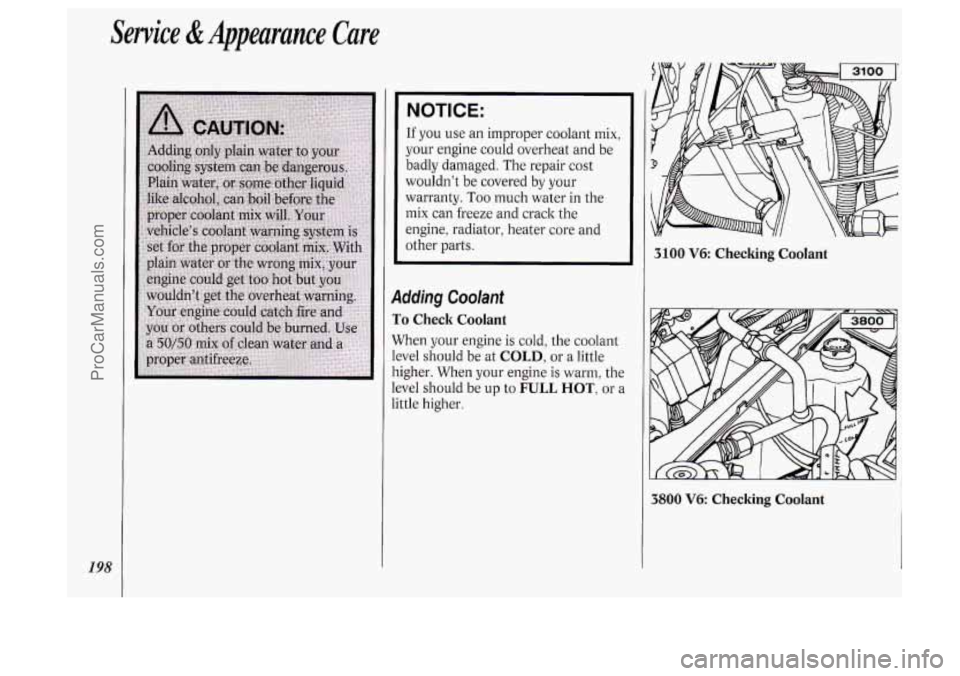
To Check Coolant
When your engine is cold, the coolant
level should be at
COLD, or a little
higher. When your engine is warm, the
level should be up to
FULL HOT, or a
little higher.
3100 V6: Checking Coolant
3800 V6: Checking Coolant
ProCarManuals.com
Page 202 of 276
Service &Appearance Care
What to Add
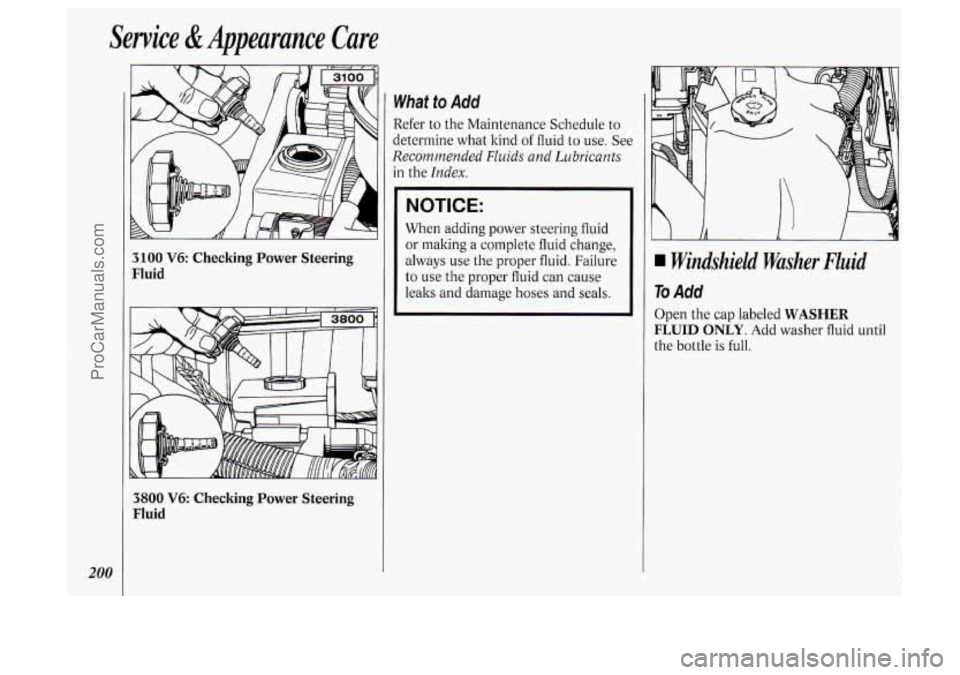
Refer to the Maintenance Schedule to
determine what kind of fluid to use. See
Recommended Fluids and Lubricants
in the Index.
200
3100 V6: Checking Power Steering
Fluid
NOTICE:
When adding power steering fluid
or malting a complete fluid change,
always use the proper fluid. Failure
to use the proper fluid can cause
leaks and damage hoses and seals.
Windshield Washer Fluid
To Add
Open the cap labeled WASHER
FLUID ONLY. Add washer fluid until
the bottle
is full.
3800 V6: Checking Power Steering
Fluid
ProCarManuals.com
Page 204 of 276
Service & Appearance Care
202
container only, and always clean the
brake fluid reservoir cap before
removing it.
NOTICE:
DOT-5 silicone brake fluid can
Don’t let someone put in the
damage
your vehicle. Don’t use it.
wrong kind of fluid. For example,
just a few drops of mineral-based
oil, such
as engine oil, in your
brake system can damage brake
system parts
so badly that they’ll
have to be replaced.
Brake fluid can damage paint, so
be careful not to spill brake fluid
on your vehicle. If you do, wash it
off immediately. See
Appearance
Care
in the Index.
Brake Wear
Your Oldsmobile has front disc brakes
and rear drum brakes.
Disc brake pads have built-in wear
indicators that make
a high-pitched
warning sound when the brake pads are worn
and new pads are needed. The
sound may come and go or be heard all
the time your vehicle is moving (except
when you are pushing on the brake
pedal firmly).
NOTICE:
Continuing to drive with worn-out
brake pads could result in costly
brake repair.
Some driving conditions or climates
may cause
a brake squeal when the
brakes are first applied or lightly
applied. This does not mean something
is wrong with your brakes. Your
rear drum brakes don’t have wear
indicators, but if you ever hear a rear
brake rubbing noise, have the rear brake
linings inspected. Also, the rear brake
drums should be removed and
inspected each time the tires are
removed for rotation or changing. When
you have the front brakes replaced,
have the rear brakes inspected, too.
Brake linings should always be replaced
as complete axle sets.
Brake Pedal Travel
See your dealer if the brake pedal does
not return to normal height, or if there
is a rapid increase in pedal travel. This
could be a sign of brake trouble.
Brake Adjustment
Every time you apply the brakes
moderately, with or without the vehicle
moving, your brakes adjust for wear.
ProCarManuals.com
Page 206 of 276
Service &Appearance Care
204
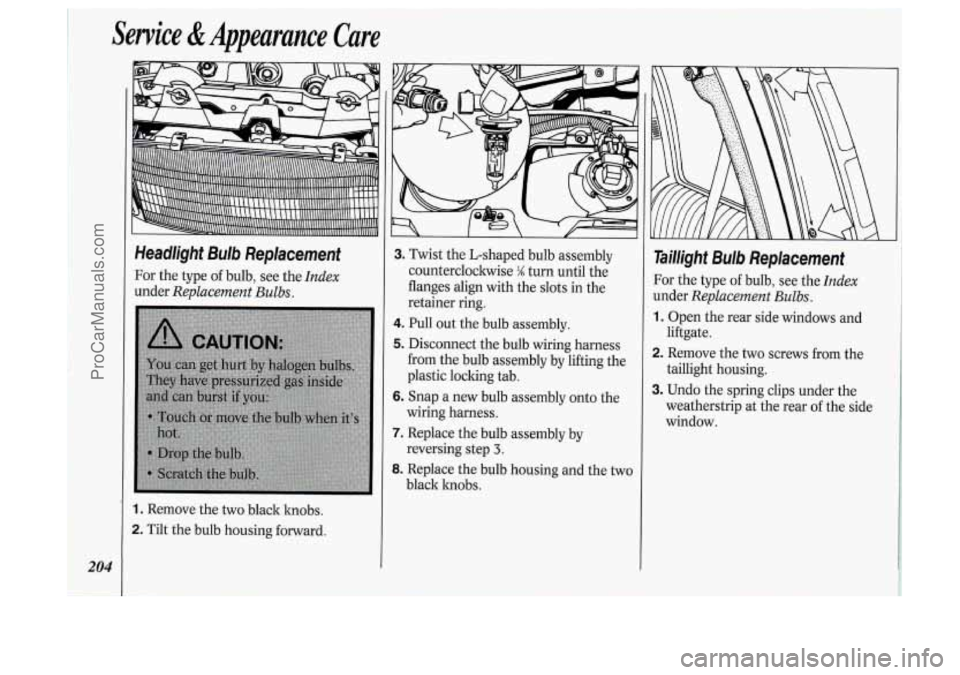
Headlight Bulb Replacement
For the type of bulb, see the Index
under Replacement Bulbs.
1. Remove the two black knobs.
2. Tilt the bulb housing forward.
3. Twist the L-shaped bulb assembly
counterclockwise
M turn until the
flanges align with the slots in the
retainer ring.
4. Pull out the bulb assembly.
5. Disconnect the bulb wiring harness
from the bulb assembly by lifting the
plastic locking tab.
6. Snap a new bulb assembly onto the
7. Replace the bulb assembly by
8. Replace the bulb housing and the two
wiring harness.
reversing step
3.
black knobs.
Taillight Bulb Replacement
For the type of bulb, see the Index
under Replacement Bulbs.
1. Open the rear side windows and
2. Remove the two screws from the
3. Undo the spring clips under the
liftgate.
taillight housing.
weatherstrip at the rear of the side
window.
ProCarManuals.com
Page 208 of 276
Service &Appearance Care
206
GVWR CAWR FRT CAWR RR
THIS VEHICLE CONFORMS TO ALL APPLICABLE US. FEDERAL
MOTOR VEHICLE SAFETY STANDARDS IN EFFECT ON THE DATE
OF MANUFALTURESHOWN ABOVE.
.MODEL.
M.P.V.
MPHY FRT TlRESlZE
RTG RIM WliKP, (COLD1
RR SPA MFD
fly GENERAL MOTORS CORP XWXX
LWKG
SERIAI. NUMBER SPEED
SEE
OWNERS MANUAL FOR ADDI'TIONAL INFORMATlOh
Loading Your Vehicle
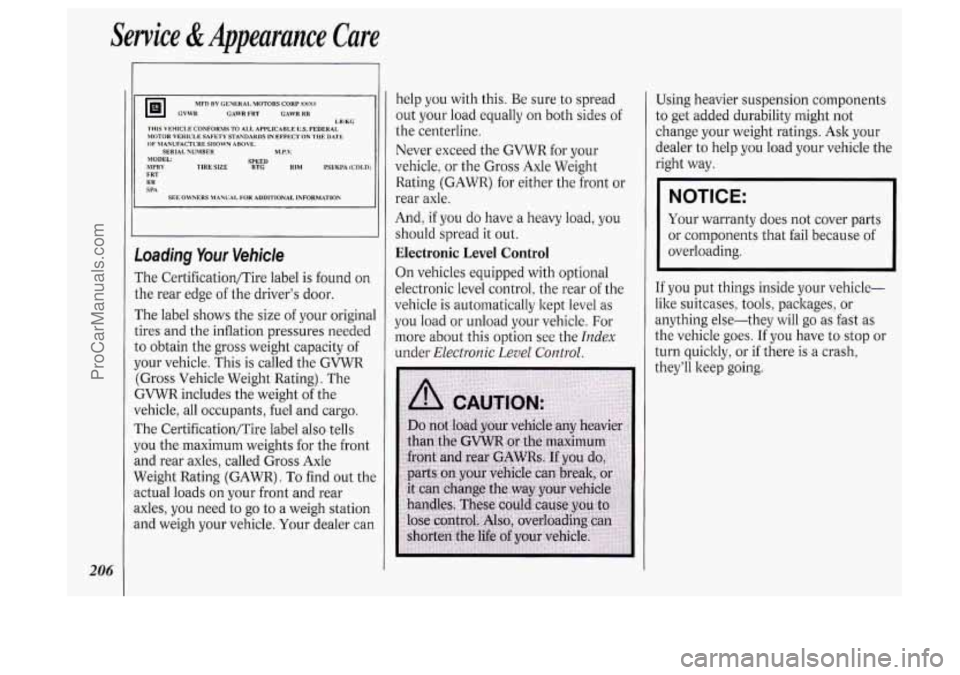
The Certification/Tire label is found on
the rear edge of the driver's door.
The label shows the size
of your original
tires and the inflation pressures needed
to obtain the gross weight capacity
of
your vehicle. This is called the GVWR
(Gross Vehicle Weight Rating). The
GVWR includes the weight of the
vehicle, all occupants, fuel and cargo.
The Certification/Tire label also tells
you the maximum weights for the front
and rear axles, called Gross Axle
Weight Rating (GAWR).
To find out the
actual loads
on your front and rear
axles, you need to go to a weigh station
and weigh your vehicle, Your dealer can help
you with
this. Be sure to spread
out your load equally on both sides
of
the centerline.
Never exceed the
GVWR for your
vehicle, or the Gross Axle Weight
Rating (GAWR) for either the front or
rear axle.
And,
if you do have a heavy load, you
should spread it out.
Electronic Level Control
On vehicles equipped with optional
electronic level control, the rear
of the
vehicle is automatically kept level as
you load or unload your vehicle. For
more about this option see the
Index
under Electronic Level Control.
Using heavier suspension components
to get added durability might not
change your weight ratings. Ask your
dealer to help you load your vehicle the
right way.
NOTICE:
Your warranty does not cover parts
or components that fail because
of
overloading.
If you put things inside your vehicle-
like suitcases, tools, packages, or
anything else-they will go
as fast as
the vehicle goes.
If you have to stop or
turn quickly! or if there is a crash,
they'll keep going.
ProCarManuals.com
Page 210 of 276
Sewice & Appearunce Care
208
Inflation-Tire Pressure
The CertificatiodTire label which is on
the rear edge of the driver’s door shows
the correct inflation pressures for your
tires, when they’re cold. “Cold” means
your vehicle has been sitting for at least
three hours or driven no more than a mile.
NOTICE:
Don’t let anyone tell you that
underinflation
or overinflation is all
right. It’s not. If your tires don’t
have enough air (underinflation)
you can get:
Too much flexing
Too much heat
Tire overloading
Bad wear
Bad handling
Bad fuel economy.
If your tires have too much air
(overinflation) you can get:
Unusual wear
Bad handling
Rough ride
Needless damage from road
hazards.
When to Check
Check your tires once a month or more.
Don’t forget your compact spare tire. It
should be at
60 psi (420 1tPa).
How to Check
Use a good quality pocket-type gage to
check tire pressure. Simply loolting at
the tires will not tell you the pressure,
especially
if you have radial tires -
which may look properly inflated even if
they’re underinflated.
If your tires have valve caps, be sure to
put them back on. They help prevent
leaks by keeping out dirt and moisture.
-
f
x
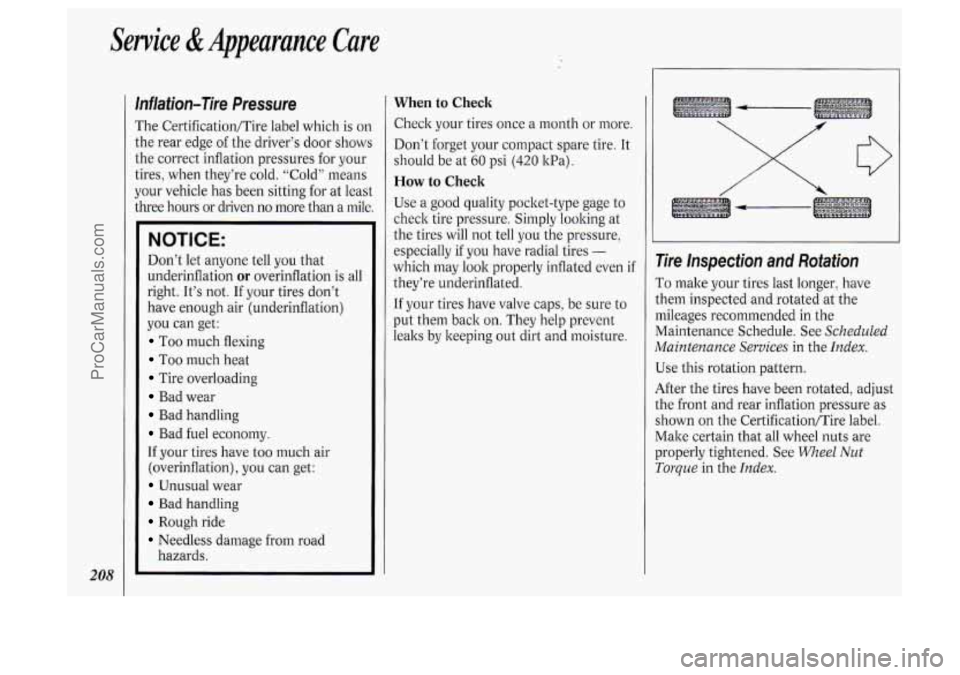
Tire Inspection and Rotation
To make your tires last longer, have
them inspected and rotated at the
mileages recommended in the
Maintenance Schedule. See
Scheduled
Maintenance Services
in the Index.
Use this rotation pattern.
After the tires have been rotated, adjust
the front and rear inflation pressure as
shown on the CertificationlTire label.
Make certain that all wheel nuts are
properly tightened. See
Wheel Nut
Toque in the Index.
ProCarManuals.com