1994 OLDSMOBILE SILHOUETTE tires
[x] Cancel search: tiresPage 212 of 276
Service &Appearance Care
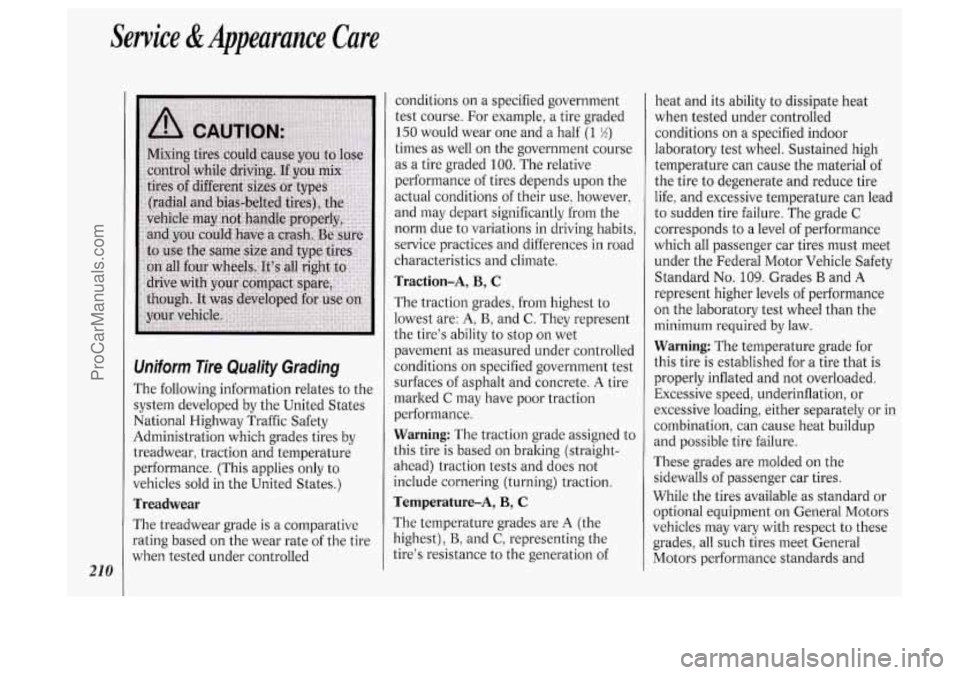
21 0
Uniform Tire Quality Grading
The following information relates to the
system developed by the United States
National Highway Traffic Safety
Administration which grades tires by
treadwear, traction and temperature
performance. (This applies only to
vehicles sold in the United States.)
Treadwear
The treadwear grade is a comparative
rating based on the wear rate
of the tire
when tested under controlled conditions
on a specified government
test course. For example, a tire graded
150 would wear one and a half (1 %)
times as well on the government course
as a tire graded
100. The relative
performance of tires depends upon the
actual conditions of their use, however,
and may depart significantly from the
norm due to variations in driving habits,
service practices and differences in road
characteristics and climate.
Traction-A, B, C
The traction grades, from highest to
lowest are:
A, B, and C. They represent
the tire’s ability to stop on wet
pavement as measured under controlled
conditions on specified government test
surfaces of asphalt and concrete.
A tire
marked
C may have poor traction
performance.
Warning: The traction grade assigned to
this tire is based on braking (straight-
ahead) traction tests and does not
include cornering (turning) traction.
Temperature-A, B, C
The temperature grades are A (the
highest)
B, and C, representing the
tire’s resistance to the generation of heat and its
ability to dissipate heat
when tested under controlled
conditions on a specified indoor
laboratory test wheel. Sustained high
temperature can cause the material
of
the tire to degenerate and reduce tire
life, and excessive temperature can lead
to sudden tire failure. The grade
C
corresponds to a level of performance
which all passenger car tires must meet
under the Federal Motor Vehicle Safety
Standard
No. 109. Grades B and A
represent higher levels of performance
on the laboratory test wheel than the
minimum required by law.
Warning: The temperature grade for
this tire is established for a tire that is
properly inflated and not overloaded.
Excessive speed, underinflation, or
excessive loading, either separately or in
combination, can cause heat buildup
and possible tire failure.
These grades are molded
on the
sidewalls of passenger car tires.
While the tires available as standard or
optional equipment on General Motors
vehicles may vary with respect to these
grades, all such tires meet General
Motors performance standards and
ProCarManuals.com
Page 213 of 276
have been approved for use on General
~ Motors vehicles. All passenger type
(P Metric) tires must conform to
Federal safety requirements in addition
to these grades.
Wheel Alignment and Tire
Balance
The wheels on your vehicle were
aligned and balanced carefully at the
factory to give you the longest tire life
and best overall performance.
In most cases, you will not need to have
your wheels aligned again. However,
if
you notice unusual tire wear or your
vehicle pulling one way or the other, the
alignment may need to be reset. If you
notice your vehicle vibrating when
driving on a smooth road, your wheels
may need
to be rebalanced.
Wheel Replacement
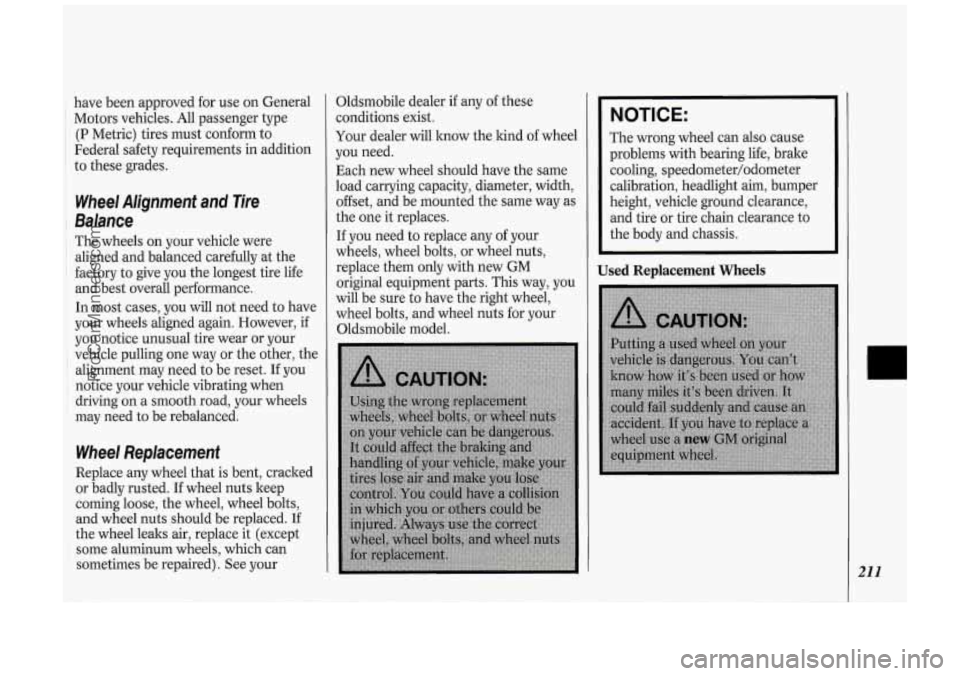
Replace any wheel that is bent, cracked
or badly rusted. If wheel nuts keep
coming loose, the wheel, wheel bolts,
and wheel nuts should be replaced.
If
the wheel leala air, replace it (except
some aluminum wheels, which can
sometimes be repaired). See your Oldsmobile dealer
if any of these
conditions exist.
Your dealer will know the kind of wheel
you need.
Each new wheel should have the same
load carrying capacity, diameter, width,
offset, and be mounted the same way as
the one it replaces.
If you need to replace any of your
wheels, wheel bolts, or wheel nuts,
replace them only with new GM
original equipment parts. This way, you
will be sure to have the right wheel,
wheel bolts, and wheel nuts for your
Oldsmobile model.
NOTICE:
The wrong wheel can also cause
problems with bearing life, brake
cooling, speedometer/odometer
calibration, headlight aim, bumper
height, vehicle ground clearance,
and tire or tire chain clearance to
the body and chassis.
Used Replacement Wheels
21 1
ProCarManuals.com
Page 214 of 276
Service &Appearance Cure
212
Tire Chains
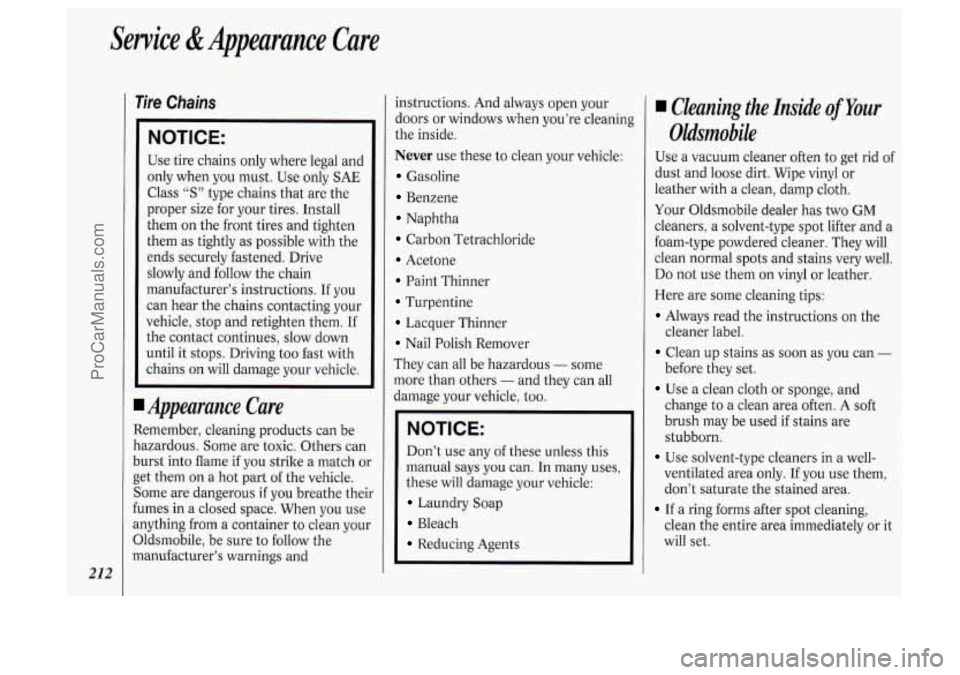
NOTICE:
Use tire chains only where legal and
only when you must. Use only SAE
Class
“S” type chains that are the
proper size for your tires. Install
them on the front tires and tighten
them as tightly as possible with the
ends securely fastened. Drive
slowly and follow the chain
manufacturer’s instructions. If you
can hear the chains contacting your
vehicle, stop and retighten them,
If
the contact continues, slow down
until it stops. Driving too fast with
chains on will damage your vehicle.
Appearance Care
Remember, cleaning products can be
hazardous. Some are toxic. Others can
burst into flame if you strike
a match or
get them on a hot part
of the vehicle.
Some are dangerous
if you breathe their
fumes in a closed space. When you use
anything from a container to clean your
Oldsmobile, be sure to follow the
manufacturer’s warnings and instructions.
And always open your
doors or windows when you’re cleanin,
the inside.
Never use these to clean your vehicle:
Gasoline
Benzene
Naphtha
Carbon Tetrachloride
Acetone
Paint Thinner
Turpentine
Lacquer Thinner
Nail Polish Remover
They can all be hazardous
- some
more than others
- and they can all
damage your vehicle, too.
NOTICE:
Don’t use any of these unless this
manual says you can. In many uses,
these will damage
your vehicle:
Laundry Soap
Bleach
Reducing Agents
Cleaning the Inside of Your
Oldsmobile
Use a vacuum cleaner often to get rid of
dust and loose dirt. Wipe vinyl or
leather with a clean, damp cloth.
Your Oldsmobile dealer has two
GM
cleaners, a solvent-type spot lifter and a
foam-type powdered cleaner. They will
clean normal spots and stains very well.
Do not use them on vinyl or leather.
Here are some cleaning tips:
Always read the instructions on the
cleaner label.
Clean up stains as soon as you can - I
before they set.
Use a clean cloth or sponge, and
change to
a clean area often. A soft
brush may be used
if stains are
stubborn.
Use solvent-type cleaners in a well-
ventilated area only. If you use them,
don’t saturate the stained area.
If a ring forms after spot cleaning,
clean the entire area immediately or it
will set.
ProCarManuals.com
Page 240 of 276
Maintenance Schedule
238
Explanation of Scheduled
Maintenance Services
Following are explanations of the
services listed in Schedule I and
Schedule 11.
The proper fluids and lubricants to use
are listed in Section D. Make sure
whoever services your vehicle uses
these. All parts should be replaced and
all necessary repairs done before you or
anyone else drives the vehicle.
ITEM
NO. SERVICE
1. Engine Oil and Filter Change* -
Always use SH or SG Energy
Conserving
I1 oils of proper viscosity.
The
“SH” or “SG” designation may
be shown alone
or in combination
with others, such as “SH/CD,”
“SH,
SG, CD,” “SG/CD,” etc. To
determine the preferred viscosity for
your vehicle’s engine (e.g.,
SAE 5W-
30 or SAE 10W-30), see
Engine Oil
in the Index.
2. Chassis Lubrication - Lubricate
suspension and steering linkage.
Lubricate the transaxle shift linkage,
and parking brake cable guides,
underbody contact points and
linkage.
3. Tire and Wheel Rotation and
Inspection
- For proper wear and
maximum tire life, rotate your tires
following the instructions in this
manual. See
Tires, Inspection E.
Rotation in the Index. Check the
tires for uneven wear
or damage. If
you see irregular or premature wear,
check the wheel alignment. Check for
damaged wheels also.
Engine Accessory Drive Inspection
- Inspect the drive belt for cracks,
fraying, wear and proper tension.
Replace as needed.
I
Cooling System Servicee - Drain,
flush and refill the system with new
or approved recycled coolant
conforming to GM Specification
I
1825M. Keep coolant at the proper 1
mixture as specified. See Coolant in
the
Index. This provides proper
freeze and boil protection, corrosion
I
inhibitor level and maintains proper ’
engine operating temperature.
Inspect hoses
and replace if they are
cracked, swollen or deteriorated.
Tighten screw-type hose clamps.
Clean the outside of the radiator and
air conditioning condenser. Wash tht
pressure cap and neck.
To help ensure proper operation, we
recommend
a pressure test of both the
cooling system and the pressure cap.
ProCarManuals.com
Page 242 of 276
240
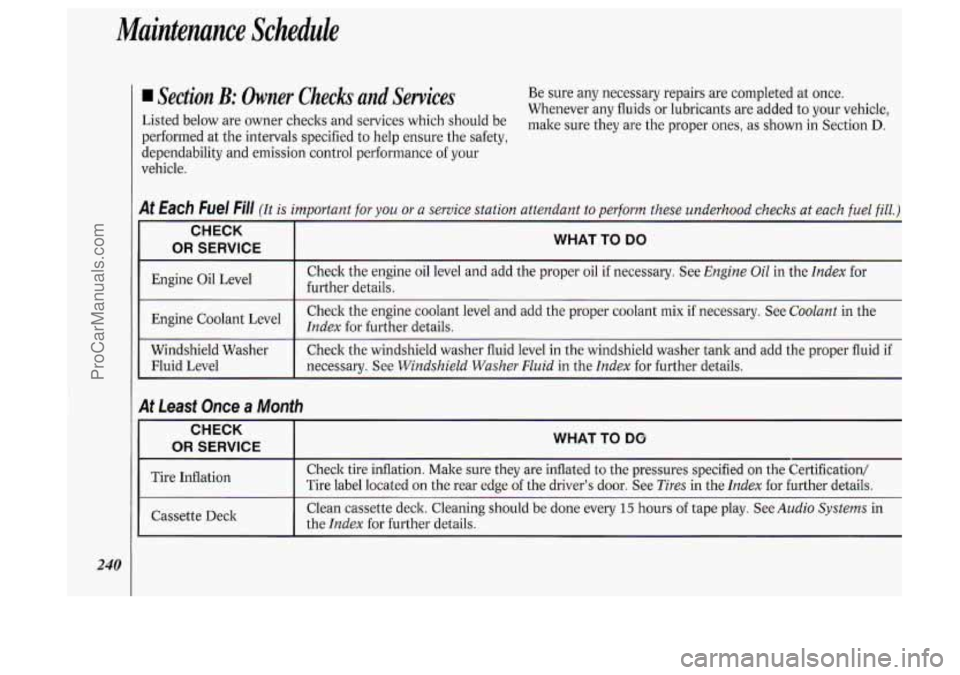
Section B: Owner Checks and Services Be sure any necessary repairs are completed at once.
Whenever any fluids or lubricants are added to your vehicle,
Listed below are owner checks and services which should be malte Sure they are the proper ones, as shown in Section
D.
performed at the intervals specified to help ensure the safety,
dependability and emission control performance of your
vehicle.
Each Fuel Fill (It is important
for you or a service station attendant to perform
these underhood
checks at each fuel fill.)
I
Check the engine coolant level and add the proper coolant mix if necessary. See Coolant in the
Engine Index for further details.
CHECK
OR SERVICE
I
WHAT TO DO
Check the engine oil level and add the proper oil if necessary. See Engine Oil in the Index for
further details.
Engine
Oil Level
Windshield Washer Check the windshield washer fluid level in the windshield washer tank and add the proper fluid if
Fluid Level necessary. See
Windshield Washer Fluid in the Index for further details. I
It Leasf Once a Month
CHECK
OR SERVICE
I
WHAT TO DO I
Tire Inflation I
Check tire inflation. Make sure they are inflated to the pressures specified on the Certification/
Tire label located
on the rear edge of the driver’s door. See Tires in the Index for further details.
Cassette Deck
I
Clean cassette deck. Cleaning should be done every 15 hours of tape play. See Audio Systems in
the
Index for further details.
ProCarManuals.com
Page 270 of 276
Index
268
Recommended Fluids and
Lubricants
....................................... 244
Reminder Light
.................................. 75
Remote Lock Control
......................... 48
Removing Rear Bucket Seats
............. 16
Replacement Fuses
........................... 220
Replacement Parts
........................... 226
Replacing Brake System Parts ......... 203
Replacing Bulbs
........................ 228, 229
Replacing Safety Belts
........................ 41
Replacing Tires
................................. 209
Replacing Windshield Wipers
.......... 205
Restraint, Head
.................................. 14
Restraints, Child ................................. 35
Roadside Assistance ......................... 253
Replacement
Bulbs
.................. 228. 229
Replacing Rear Bucket Seats
............. 18
Replacing Wheels ............................. 2 11
Roads, Hill and Mountain ............... 147
Rocking Your Vehicle
...................... 179
Rotation, Tire
................................... 208
S afety Belts ....................................... 18
Adults ............................................... 22
Center Passenger Position
.............. 31
Checking .......................................... 41
Children
...................................... 34, 39
Child Restraints ............................... 35
Cleaning
......................................... 2 14
Driver Position
................................ 22 Extender
........................................... 41
How to
Wear .................................... 22
Lap-Shoulder Belt
........................... 23
Passenger Belts
................................ 30
Pregnancy. Use During
................... 30
Questions & Answers ... 21.24. 40. 42
Rear Safety Belts
............................. 30
Reminder Light
................................ 22
Replacement
.................................... 41
Right Front. Adult Passenger
.......... 30
Smaller Children and Babies
........... 34
Top Strap
......................................... 36
Torn
.................................................. 42
Twisted
............................................. 26
Why
You Should Wear
Safety Belts
................................... 18
Safety Belt Extender .......................... 41
Safety Belt Reminder Light
................. 22
Safety Defects, Reporting
................ 252
Scheduled Maintenance Services
.... 233
Seat Adjustment
........................... 12, 17
Seat Belts (see
Safety Belts)
Seat Controls ...................................... 12
Head Restraint ................................. 14
Manual Front Seat
........................... 12
Manual Reclining Seatback ............. 13
Manual Seat, Four-Way .................. 12
Power Seat, Six-Way
....................... 13
Rear Seats ........................................ 15
Adjusting ....................................... 17 Removing
...................................... 15
Replacing ....................................... 18
Third Row Entry ........................... 15
Reclining
Seatback .......................... 13
“Service Engine Soon” Light ........... 106
Service Information ......................... 182
Service Parts Identification Label
... 218
Service Publications
......................... 254
Service Station Information
............ 272
Servicing Your Air Bag-Equipped
Oldsmobile
........................................ 29
Setting the Clock
.............................. 117
Setting the Trip Odometer
................. 99
Shifting Into
P (Park) ........................ 66
Shifting the Automatic Transaxle
..... 62
Signaling Turns
.......................... 71, 155
Six-Way Power Seat ........................... 13
Skidding ............................................ 141
Sliding Door
....................................... 51
Sliding Door Ajar Warning Light ..... 107
Snowstorm, If You’re Caught in a ... 149
Sound Equipment, Adding
.............. 117
Sound Systems (see
Audio Systems)
Spare Tire, Compact ........................ 178
Specifications
& Capacities ............. 224
Speed Control (see
Cruise Control)
Speedometer & Odometer ................. 99
Stains, Removing
............................. 213
Starting Your Engine
......................... 58
ProCarManuals.com
Page 271 of 276

Starting Your Vehicle if the Battery is
Steering “Dead” (see
Jump Starting)
In Emergencies .............................. 139
Off-Road Recovery ........................ 140
Power
............................................. 138
Tips ................................................ 138
Steering Wheel. Tilt ............................ 69
Steering Wheel Touch Controls
...... 127
Stereo Sound Systems
(see
Audio Systems )
Storing Your Vehicle ........................ 203
Compact Overhead Console
........... 95
Compartment
................................... 83
Cup Holder ...................................... 89
Locking Bin ..................................... 90
Luggage Carrier
............................... 92
Overhead Console
........................... 79
Rear Compartment
.......................... 91
Sunglasses
........................................ 83
Stuck. If You Are ........................... 179
Sunroof
............................................... 95
Sun Visors
.......................................... 87
Supplemental Restraint
System
(SRS) ................................... 26
Storage
Convenience Net
............................. 91
Garage Door Opener
....................... 80
Glove Boxes
..................................... 88
T achometer ....................................... 99
Taillights
........................................... 204
Tape Player (see
Audio Systems)
Technical Facts & Specifications
Bulbs
...................................... 228. 229
Capacities
& Specifications .......... 224
Circuit Brealters/Relays
................. 222
Add-on
......................... 60. 117. 219
Engine
............................................ 226
Fluids
& Lubricants ...................... 227
Fuses
.............................. 219. 220. 221
Replacement Parts
......................... 226
Service Parts Identification
Label
............................................ 218
Vehicle Identification Number
(VIN)
........................................... 218
Temperature Display
.......................... 81
Temperature Warning ...................... 103
Theft
.................................................... 50
Thermostat ....................................... 199
Tilt Steering Wheel
............................. 69
Time. Setting the
.............................. 117
Tire Loading
..................................... 206
Tires
.................................................. 207
“Blow Out”
.................................... 172
Buying New
................................... 209
Chains
.................................... 178. 212
Electrical
Equipment.
Flat. Changing
............................... 172 Inflation
................... 85. 172. 178.
208
Loading
.......................................... 206
Pressure
......................................... 208
Quality Grading
............................. 210
Spare. Compact
............................. 178
Wear Indicators
............................. 209
Wheel Alignment
& Tire
Balance
........................................ 211
Wheel Replacement
....................... 211
Torque Lock
....................................... 67
Towing a Trailer
............................... 151
Inspection & Rotation ................... 208
Wheel Nut Torque
................. 177, 225
Top Strap
............................................ 36
Towing Your Vehicle
....................... 162
Traction Control System
................... 137
Traction Control System
Warning Light
................................ 105
Trailer Towing
.................................. 151
Brakes ............................................ 154
Maintenance .................................. 156
Parking on
Hills .............................. 156
Safety Chains
................................. 154
(see
Automatic Transaxle)
(see Automatic Transaxle)
Transaxle, Automatic
Transmission, Automatic
Trip Odometer
.................................... 99
Turn Signal Indicator ......................... 71
Turn Signal/Multifunction Lever
...... 70 269
ProCarManuals.com