1994 OLDSMOBILE SILHOUETTE check engine
[x] Cancel search: check enginePage 198 of 276
Service &Appearance Care
196
To get the right reading, the fluid
should be at normal operating
temperature, which is
180°F to 200°F
(82°C to 93°C).
Get the vehicle warmed up by driving
about
15 miles (24 ltm) when outside
temperatures are above
50°F (10°C). If
it's colder than 50°F ( 10°C), you may
have to drive longer.
To Check the Fluid Level
Park your vehicle on a level place.
With the parking brake applied, place
With your foot on the brake pedal,
the
shift lever in
P (Park).
move the shift lever through each gear
range, pausing for about three
seconds in each range. Then, position
the shift lever in
P (Park).
Let the engine run at idle for three to
five minutes.
Then, Without Shutting Off the
Engine, Follow these Steps:
1. Pull out the dipstick and wipe it with
a clean rag or paper towel.
2. Push it back in all the way, wait three
seconds and then pull it back out
again.
3. Check both sides of the dipstick, and
read the lower level. The fluid level
must be in the cross-hatched area.
4. If the fluid level is in the acceptable
range, push the dipstick back in all
the way.
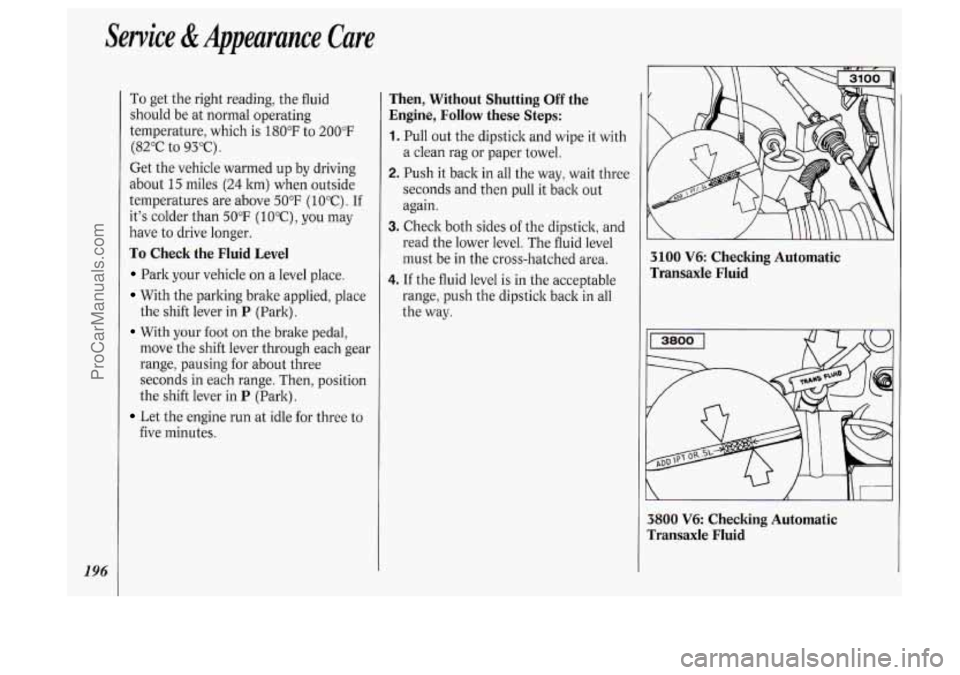
3100 V6: Checking Automatic
rransaxle Fluid
3800 V6: Checking Automatic
rransaxle Fluid
ProCarManuals.com
Page 199 of 276
How to Add Fluid
Refer to the Maintenance Schedule to
determine what kind of transaxle fluid
to use. See
Recommended Fluids and
Lubricants
in the Index.
If the fluid level is low, add only enough
of the proper fluid to bring the level into
the cross-hatched area
on the dipstick.
1. Pull out the dipstick.
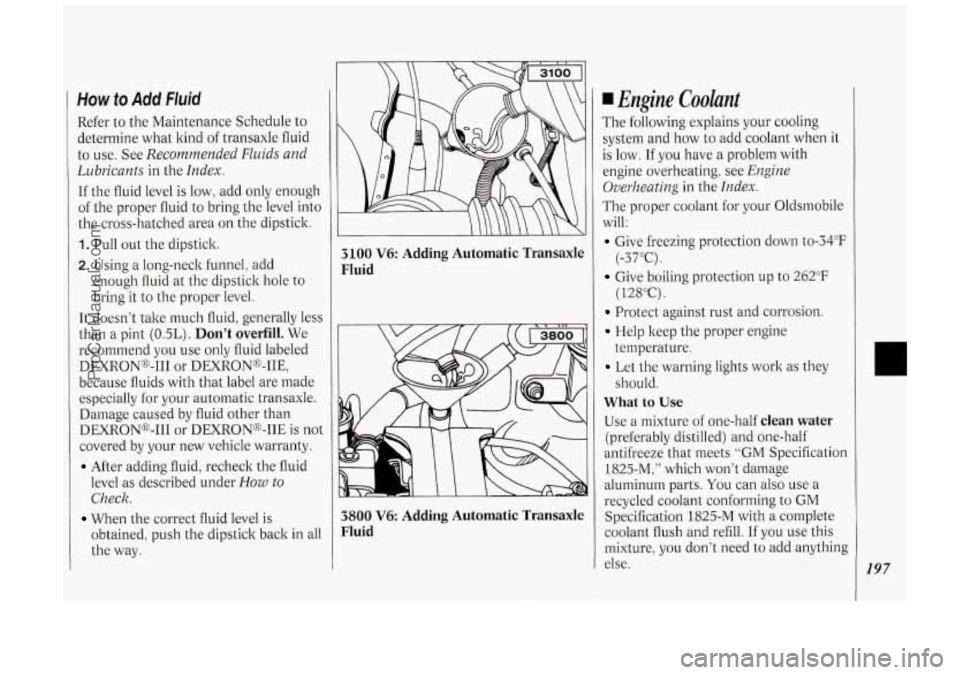
2. Using a long-neck funnel: add
enough fluid at the dipstick hole to
bring it to the proper level.
It doesn’t take much fluid, generally less
than a pint
(OSL). Don’t overfill. We
recommend you use only fluid labeled
DEXRONo-I11 or DEXRON@-IIE,
because fluids with that label are made
especially for your automatic transaxle.
Damage caused by fluid other than
DEXRONo-I11 or DEXRONB-IIE is not
covered by your new vehicle warranty.
After adding fluid, recheck the fluid
level as described under
How to
Check.
obtained, push the dipstick back in all
the way.
When the correct fluid level is
3100 V6: Adding Automatic Transaxle
Fluid
3800 V6: Adding Automatic Transaxle
Fluid
Engine Coolant
The following explains your cooling
system and how to add coolant when it
is
low. If you have a problem with
engine overheating, see
Engine
Overheating
in the Index.
The proper coolant for your Oldsmobile
will:
Give freezing protection down to-34”F
Give boiling protection up to 262°F
Protect against rust and corrosion.
Help keep the proper engine
Let the warning lights work as they
What to Use
Use a mixture of one-half clean water
(preferably distilled) and one-half
antifreeze that meets
“GM Specification
1825-M:” which won’t damage
aluminum parts.
You can also use a
recycled coolant conforming to
GM
Specification 1825-M with a complete
coolant flush and refill.
If you use this
mixture,
you don’t need to add anything
else.
(-37°C).
( 12SoC).
temperature. should.
197
ProCarManuals.com
Page 200 of 276
Service &Appearance Cure
NOTICE:
198
If you use an improper coolant mix,
your engine could overheat and be
badly damaged. The repair
cost
wouldn’t be covered by your
warranty. Too much water in the
mix can freeze and crack the
engine, radiator, heater core and
other parts.
Adding Coolant
To Check Coolant
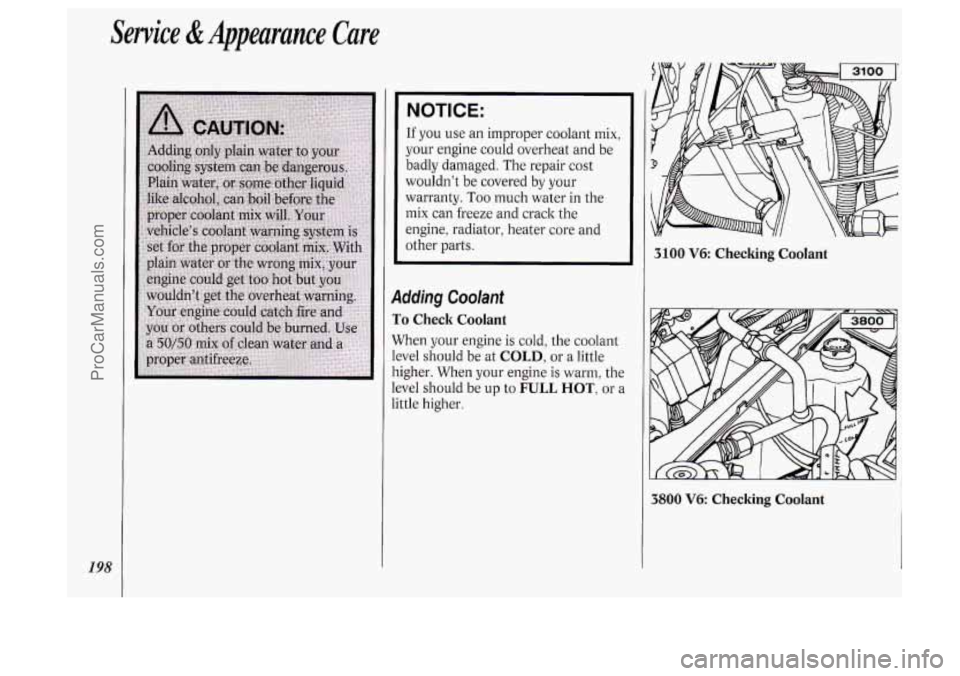
When your engine is cold, the coolant
level should be at
COLD, or a little
higher. When your engine is warm, the
level should be up to
FULL HOT, or a
little higher.
3100 V6: Checking Coolant
3800 V6: Checking Coolant
ProCarManuals.com
Page 201 of 276
To Add Coolant
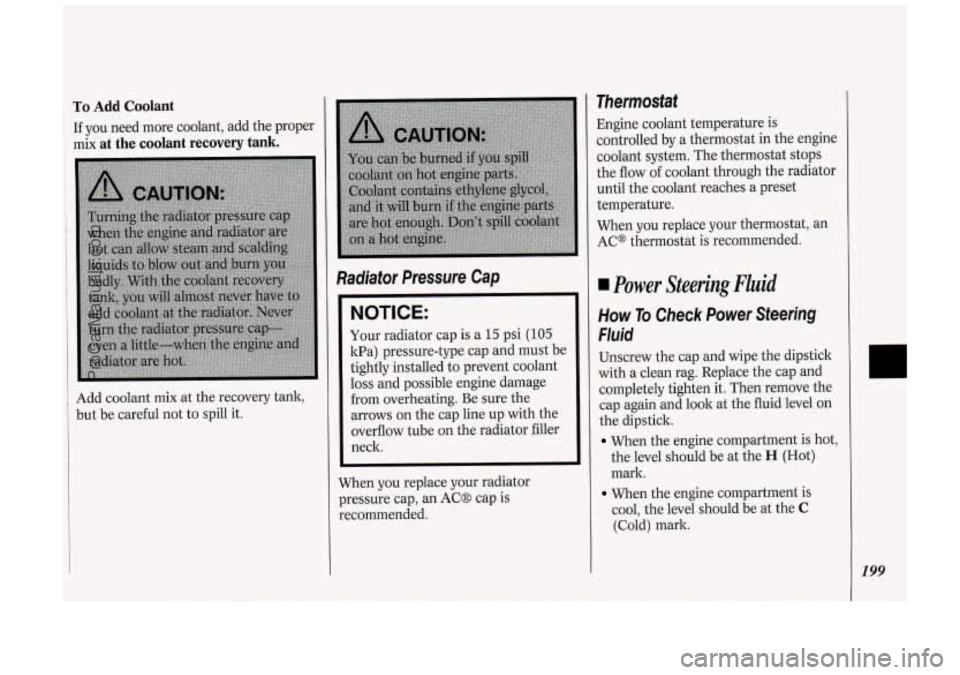
If you need more coolant, add the proper
mix
at the coolant recovery tank.
Add coolant mix at the recovery tank,
but be careful not to spill it.
Radiator Pressure Cap
NOTICE:
Your radiator cap is a 15 psi (105
kPa) pressure-type cap and must be
tightly installed to prevent coolant
loss and possible engine damage
from overheating. Be sure the
arrows on the cap line up with the
overflow tube on the radiator filler
neck.
When you replace your radiator
pressure cap, an AC8 cap is
recommended.
Thermostat
Engine coolant temperature is
controlled by a thermostat in the engine
coolant system. The thermostat stops
the flow of coolant through the radiator
until the coolant reaches a preset
temperature.
When you replace your thermostat, an
AC@ thermostat is recommended.
Power Steering Fluid
How To Check Power Steering
Fluid
Unscrew the cap and wipe the dipstick
with a clean rag. Replace the cap and
completely tighten it. Then remove the
cap again and look at the fluid level on
the dipstick.
When the engine compartment is hot,
the level should be at the
H (Hot)
mark.
When the engine compartment is
cool, the level should be at the
C
(Cold) mark.
199
ProCarManuals.com
Page 225 of 276
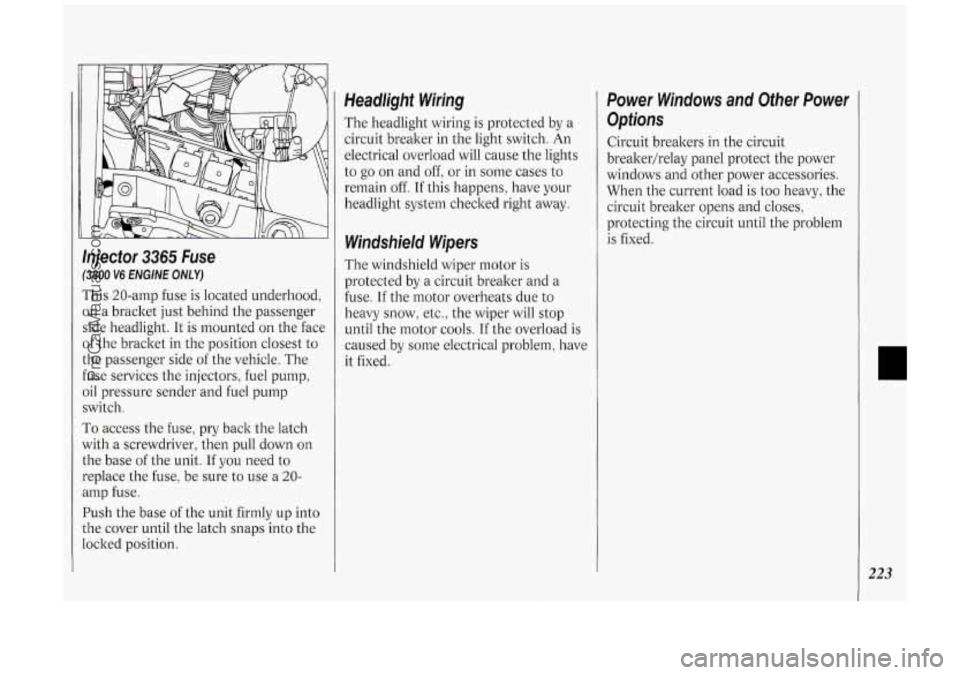
Injector 3365 Fuse
(3800 V6 ENGINE ONLY)
This 20-amp fuse is located underhood,
on a bracket just behind the passenger
side headlight. It is mounted on the face
of the bracket in the position closest to
the passenger side of the vehicle. The
fuse services the injectors, fuel pump,
oil pressure sender and fuel pump
switch.
To access the fuse, pry back the latch
with a screwdriver, then pull down on
the base
of the unit. If you need to
replace the fuse, be sure to use a 20-
amp fuse.
Push the base of the unit firmly up into
the cover until the latch snaps into the
locked position.
Headlight Wiring
The headlight wiring is protected by a
circuit breaker in the light switch. An
electrical overload will cause the lights
to go on and off: or
in some cases to
remain off. If this happens, have your
headlight system checked right away.
Windshield Wipers
The windshield wiper motor is
protected by a circuit breaker and a
fuse.
If the motor overheats due to
heavy snow, etc., the wiper will stop
until the motor cools.
If the overload is
caused by some electrical problem, have
it fixed.
Power Windows and Other Power
Options
Circuit breakers in the circuit
breakerhelay panel protect the power
windows and other power accessories.
When the current load is too heavy, the
circuit breaker opens and closes,
protecting the circuit until the problem
is fixed.
223
ProCarManuals.com
Page 240 of 276
Maintenance Schedule
238
Explanation of Scheduled
Maintenance Services
Following are explanations of the
services listed in Schedule I and
Schedule 11.
The proper fluids and lubricants to use
are listed in Section D. Make sure
whoever services your vehicle uses
these. All parts should be replaced and
all necessary repairs done before you or
anyone else drives the vehicle.
ITEM
NO. SERVICE
1. Engine Oil and Filter Change* -
Always use SH or SG Energy
Conserving
I1 oils of proper viscosity.
The
“SH” or “SG” designation may
be shown alone
or in combination
with others, such as “SH/CD,”
“SH,
SG, CD,” “SG/CD,” etc. To
determine the preferred viscosity for
your vehicle’s engine (e.g.,
SAE 5W-
30 or SAE 10W-30), see
Engine Oil
in the Index.
2. Chassis Lubrication - Lubricate
suspension and steering linkage.
Lubricate the transaxle shift linkage,
and parking brake cable guides,
underbody contact points and
linkage.
3. Tire and Wheel Rotation and
Inspection
- For proper wear and
maximum tire life, rotate your tires
following the instructions in this
manual. See
Tires, Inspection E.
Rotation in the Index. Check the
tires for uneven wear
or damage. If
you see irregular or premature wear,
check the wheel alignment. Check for
damaged wheels also.
Engine Accessory Drive Inspection
- Inspect the drive belt for cracks,
fraying, wear and proper tension.
Replace as needed.
I
Cooling System Servicee - Drain,
flush and refill the system with new
or approved recycled coolant
conforming to GM Specification
I
1825M. Keep coolant at the proper 1
mixture as specified. See Coolant in
the
Index. This provides proper
freeze and boil protection, corrosion
I
inhibitor level and maintains proper ’
engine operating temperature.
Inspect hoses
and replace if they are
cracked, swollen or deteriorated.
Tighten screw-type hose clamps.
Clean the outside of the radiator and
air conditioning condenser. Wash tht
pressure cap and neck.
To help ensure proper operation, we
recommend
a pressure test of both the
cooling system and the pressure cap.
ProCarManuals.com
Page 241 of 276

6. Transaxle Service - Change both
the fluid and filter every
15,000 miles
(25 000 ltm) if the vehicle is mainly
driven under one or more of these
conditions:
In heavy city traffic where the
outside temperature regularly
reaches
90°F (32°C) or higher.
In hilly or mountainous terrain.
When doing frequent trailer towing.
Uses such as found in taxi, police
car or delivery service.
If you do not use your vehicle under
any of these conditions, change both
the
fluid and filter every 100,000 miles
(166 000 ltm) .
7. Spark Plug Replacement::' -
Replace spark plugs with the proper
type. See
Replacement Parts in the
Index.
8. Spark Plug Wire Inspection''-
Inspect for burns, cracks or other
damage. Check the boot fit at the
distributor or coils and at the spark
plugs. Replace wires
as needed.
9. Exhaust Gas Recirculation (EGR)
System 1nspection':t
- Conduct
the
EGR system service as described
in the service manual.
To purchase a
service manual, see
Service
Publications
in the Index.
IO. Air Cleaner Filter Replacement+-
Replace every 30,000 miles
(50 000 ltm) or more often under
dusty conditions.
Ask your dealer
for the proper replacement intervals
for your driving conditions.
11. Air Cleaner Inspection''? - Inspect
all hoses and ducts for proper
hookup. Make sure the valve works
properly.
1nspection';:t - Inspect fuel tank,
cap and lines for damage
or leaks.
Inspect fuel cap gasket for an even
filler neck imprint or any damage.
Replace parts as needed. Periodic
replacement of the fuel filter
is not
required.
12. Fuel Tank, Cap and Lines
13. Engine Timing and Distributor
Check
(3100 Code D engine
only)'xt
- Adjust the timing to the
underhood label specifications.
Inspect the inside and outside
of the
distributor cap and rotor for cracks,
carbon tracking and corrosion.
Clean or replace as needed.
NOTE: To determine your engine's
displacement and code, see
Engine
Identification
in the Index.
': = An Enzission Control Service.
t = The U.S. Environmental Protection Agency
or the California Air Resources Boa1.d has
determined that the failure
to pelform this
maintenance item will
not nullify the
emission warranty
or limit recall liability
prior
to fhe completion of ~~ehicle useful life.
General
Motors: however, urges that all
recornmended maintenance services be
performed at the indicated intervals and the
maintenance be recorded
in "Section E:
Maintenance Record."
239
ProCarManuals.com
Page 242 of 276
240
Section B: Owner Checks and Services Be sure any necessary repairs are completed at once.
Whenever any fluids or lubricants are added to your vehicle,
Listed below are owner checks and services which should be malte Sure they are the proper ones, as shown in Section
D.
performed at the intervals specified to help ensure the safety,
dependability and emission control performance of your
vehicle.
Each Fuel Fill (It is important
for you or a service station attendant to perform
these underhood
checks at each fuel fill.)
I
Check the engine coolant level and add the proper coolant mix if necessary. See Coolant in the
Engine Index for further details.
CHECK
OR SERVICE
I
WHAT TO DO
Check the engine oil level and add the proper oil if necessary. See Engine Oil in the Index for
further details.
Engine
Oil Level
Windshield Washer Check the windshield washer fluid level in the windshield washer tank and add the proper fluid if
Fluid Level necessary. See
Windshield Washer Fluid in the Index for further details. I
It Leasf Once a Month
CHECK
OR SERVICE
I
WHAT TO DO I
Tire Inflation I
Check tire inflation. Make sure they are inflated to the pressures specified on the Certification/
Tire label located
on the rear edge of the driver’s door. See Tires in the Index for further details.
Cassette Deck
I
Clean cassette deck. Cleaning should be done every 15 hours of tape play. See Audio Systems in
the
Index for further details.
ProCarManuals.com