1994 OLDSMOBILE SILHOUETTE brake
[x] Cancel search: brakePage 75 of 276
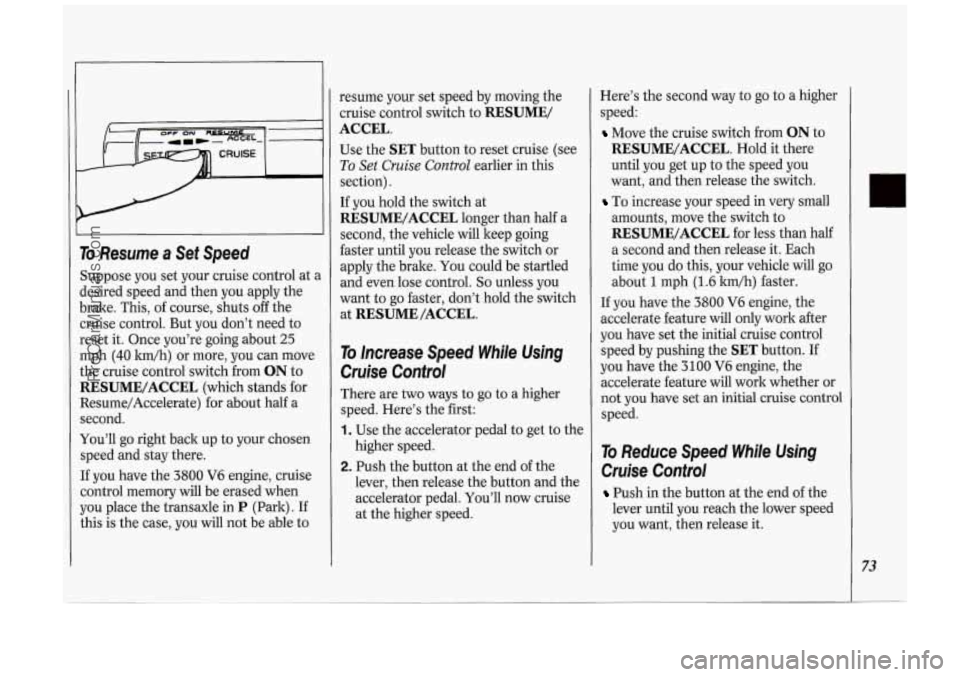
ro Resume a Set Speed
Suppose you set your cruise control at a
lesired speed and then you apply the
brake. This, of course, shuts
off the
mise control. But you don’t need to
reset it. Once you’re going about
25
rnph (40 km/h) or more, you can move
the cruise control- switch from
ON to
RESUME/ACCEL (which stands for
Resume/Accelerate) for about half a
second.
You’ll go right back up to your chosen
speed and stay there.
If you have the
3800 V6 engine, cruise
control memory will be erased when
you place the transaxle in P (Park). If
this is the case, you will not be able to resume
your set speed by moving the
cruise control switch to
RESUME/
ACCEL.
Use the SET button to reset cruise (see
To Set Cruise Control earlier in this
section).
If you hold the switch at
RESUME/ACCEL longer than half a
second, the vehicle will keep going
faster until
you release the switch or
apply the brake. You could be startled
and even lose control.
So unless you
want to go faster, don’t hold the switch
at
RESUME/ACCEL.
To Increase Speed While Using
Cruise Control
There are two ways to go to a higher
speed. Here’s the first:
1. Use the accelerator pedal to get to the
2. Push the button at the end of the
higher
speed.
lever, then release the button and the
accelerator pedal. You’ll now cruise
at the higher speed. Here’s the second
way to go to a higher
speed:
Move the cruise switch from ON to
RESUME/ACCEL. Hold it there
until you get up to the speed you
want, and then release the switch.
To increase your speed in very small
amounts, move the switch to
RESUME/ACCEL for less than half
a second and then release it. Each
time you do this, your vehicle will go
about
1 mph (1.6 km/h) faster.
If you have the 3800 V6 engine, the
accelerate feature will only work after
you have set the initial cruise control
speed by pushing the
SET button. If
you have the
3100 V6 engine, the
accelerate feature will work whether or
not you have set an initial cruise control
speed.
To Reduce Speed While Using
Cruise Control
Push in the button at the end of the
lever until you reach the lower speed
you want, then release it.
73
ProCarManuals.com
Page 76 of 276
74
Features & Controls
To slow down in very small amounts,
push the button for less than half
a
second. Each time you do this, you'll
go
1 mph (1.6 ltm/h) slower.
Passing Another Vehicle While
Using Cruise Control
Use the accelerator pedal to increase
your speed. When you take your foot off
the pedal, your vehicle will slow down
to the cruise control speed you set
earlier.
Using Cruise Control on Hills
How well your cruise control will work
on hills depends upon your speed, load,
and the steepness of the hills. When
going up steep hills, you may have to
step on the accelerator pedal to
maintain your speed. When going
downhill,
you may have to brake or
shift to a lower gear to keep your speed
down. Of course, applying the brake
takes
you out of cruise control. Many
drivers find this to be too much trouble
and don't use cruise control on steep
hills.
To Get Out of Cruise Control
There are two ways to turn off the
cruise control:
Step lightly on the brake pedal; OR
Move the cruise switch to OFF.
If your vehicle has the optional traction
control system
(TCS), the cruise
control will shut
off when TCS is
actively controlling wheel spin. See the
Index under Traction Control System.
To Erase Cruise Speed Memory
When you turn off the cruise control or
the ignition, your cruise control set
speed memory is erased. If you have the
3800 V6 engine, cruise control memory
will also be erased when you place the
transaxle in
P (Park).
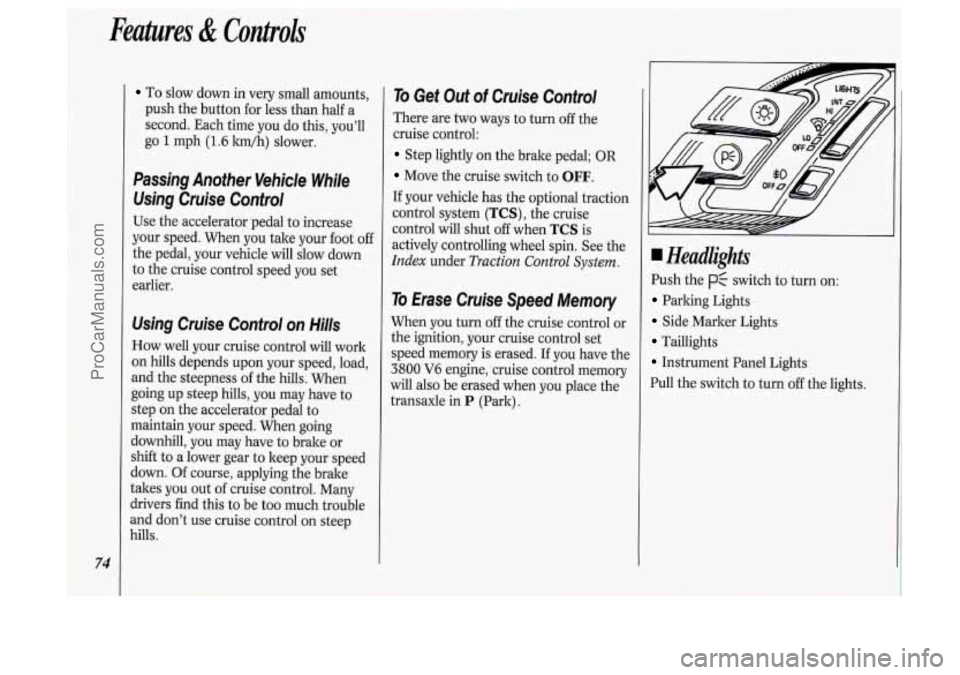
Headlights
Push the p$ switch to turn on:
Parking Lights
Side Marker Lights
Taillights
Instrument Panel Lights
Pull the switch to turn
off the lights.
ProCarManuals.com
Page 103 of 276

The gage moves a little when you turn
The gage doesn’t go back to E when
For your fuel tank capacity, see
Service
Station Information
on the last page of
this manual. a corner, brake or
speed
up.
you turn off the ignition.
_____ 0
‘F
I
00-
- 1/2
Low Fuel Warning Light
When there is between 3 gallons (1 1
liters) and 0.5 gallon (1.8 liters) of fuel
left in the tank, the warning light next
to the fuel symbol will go on.
This light will also come on when you
turn on the ignition, but the engine is
not running, to show you it is working.
If it doesn’t come on as you start your
vehicle, have it fixed right away.
d
Oil Pressure lndicator
(31 00 V6 ENGINE)
Your vehicle is equipped with an oil
pressure indicator rather than an oil
pressure gage. Your oil pressure indicator
lets
you know when you may have a
problem with your engine oil pressure.
When the engine is running, readings
within the white graduation band
indicate the normal operating range.
Readings in or below the red area
indicate that the engine’s oil level may
be dangerously low, or there may be
another problem causing low oil
pressure.
Driving your vehicle with low oil
pressure can cause extensive engine
damage. Have your vehicle serviced
immediately.
101
ProCarManuals.com
Page 105 of 276
18 ‘I I
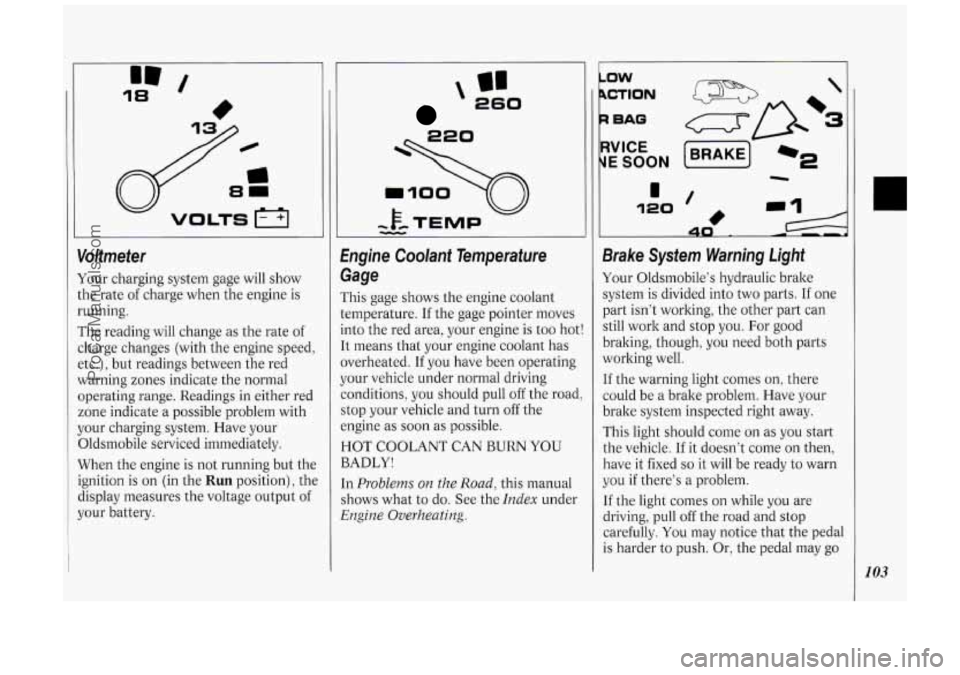
Voltmeter
Your charging system gage will show
:he rate
of charge when the engine is
running.
The reading will change as the rate of
:barge changes (with the engine speed,
?tc.), but readings between the red
warning zones indicate the normal
3perating range. Readings in either red
zone indicate a possible problem with
your charging system. Have your
Oldsmobile serviced immediately.
When the engine is not running but the
ignition
is on (in the Run position), the
display measures the voltage output of
your battery.
I’ 260
1
‘
1
Engine Coolant Temperature
Gage
rhis gage shows the engine coolant
Iemperature. If the gage pointer moves
.nto the red area, your engine is too hot
[t means that your engine coolant has
werheated. If you have been operating
{our vehicle under normal driving
:onditions, you should pull off the road
;top your vehicle and turn off the
mgine as soon as possible.
HOT COOLANT CAN BURN YOU
BADLY!
[n
Problems on the Road, this manual
shows what to do. See the
Index under
Engine Overheating.
LOW
BAG
E SOON
Brake System Warning Light
Your Oldsmobile’s hydraulic brake
system is divided into two parts.
If one
part isn’t working, the other part can
still work and stop you. For good
braking, though, you need both parts
working well.
If the warning light comes on, there
could be a brake problem. Have your
brake system inspected right away.
This light should come on as you start
the vehicle. If it doesn’t come on then,
have it fixed
so it will be ready to warn
you if there’s a problem.
If the light comes on while you are
driving, pull off the road and stop
carefully.
You may notice that the pedal
is harder to push.
Or, the pedal may go
103
ProCarManuals.com
Page 106 of 276
Features & Controls
104
closer to the floor. It may take longer to
stop. If the light is still on, have the
vehicle towed for service. (See
Towing
Your Vehicle in the Index.)
The brake system warning light will also
come on when
you set your parking
brake, and it will stay on if your parking
brake doesn’t release fully. If it stays on
after your parking brake is fully
released, it means you have
a brake
problem.
L Wb
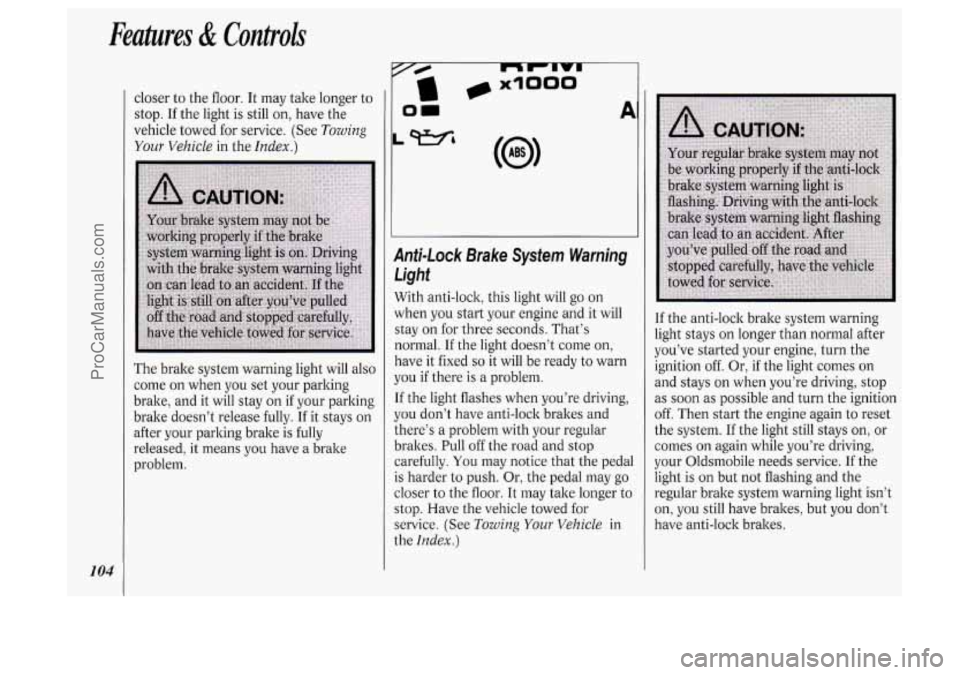
Anti-Lock Brake System Warning
Light
With anti-lock, this light will go on
when you start your engine and it will
stay on for three seconds. That’s
normal. If the light doesn’t come on,
have it fixed
so it will be ready to warn
you if there is a problem.
If the light flashes when you’re driving,
you don’t have anti-lock brakes and
there’s a problem with your regular
brakes. Pull off the road and stop
carefully.
You may notice that the pedal
is harder to push. Or, the pedal may go
closer to the floor. It may take longer to
stop. Have the vehicle towed for
service. (See
Towing Your Vehicle in
the
Index.)
I
If the anti-lock brake system warning
light stays on longer than normal after
you’ve started your engine, turn the
ignition off. Or, if the light comes on
i
and stays on when you’re driving, stop !
as soon as possible and turn the ignition
off. Then start the engine again to reset
! I
the system. If the light still stays on, or j
comes on again while you’re driving, ~
your Oldsmobile needs service. If the !
light is on but not flashing and the
regular brake system warning light isn’t
on,
you still have brakes, but you don’t
have anti-lock brakes.
ProCarManuals.com
Page 107 of 276
(J LOW
TRACTION -'I
AIR BAG
SERVICE
ENGINE
SOON
Low Traction Light (OPTION)
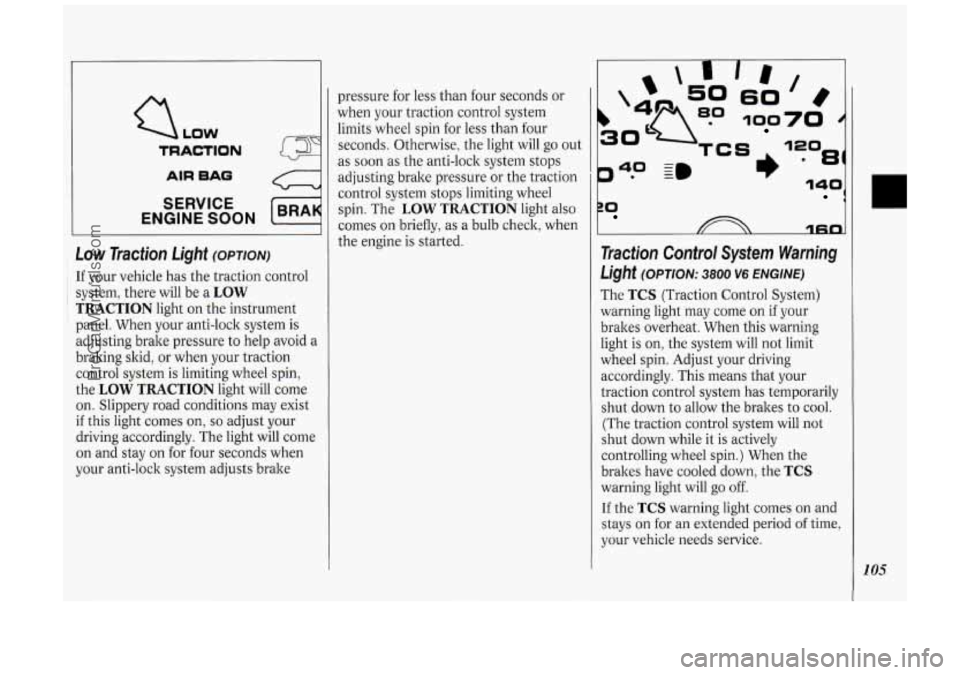
: If your vehicle has the traction control
~ i system, there will be a LOW
TRACTION light on the instrument
panel. When your anti-lock system is
adjusting brake pressure to help avoid a
braking skid, or when your traction
control system is limiting wheel spin,
the
LOW TRACTION light will come
on. Slippery road conditions may exist
if this light comes on, so adjust your
driving accordingly. The light will come
on and stay on for four seconds when
your anti-lock system adjusts brake pressure
for less than four seconds or
when your traction control system
limits wheel spin for less than four
seconds. Otherwise, the light will go out
as soon as the anti-lock system stops
adjusting brake pressure or the traction
control system stops limiting wheel
spin. The
LOW TRACTION light also
comes on briefly,
as a bulb check, when
the engine is started.
P* -
40 ~m
rn
60
100
81)
ZO 1
1fin
Traction Control System Warning
Light (OPTION: 3800 V6 ENGINE)
The TCS (Traction Control System)
warning light may come on if your
brakes overheat. When this warning
light is on, the system will not limit
wheel spin. Adjust your driving
accordingly. This means that your
traction control system has temporarily
shut down to allow the brakes to cool.
(The traction control system will not
shut down while it is actively
controlling wheel spin.) When the
brakes have cooled down, the
TCS
warning light will go off.
If the TCS warning light comes on and
stays on for an extended period of time,
your vehicle needs service.
105
ProCarManuals.com
Page 133 of 276
Here you’ll find infoimation about
driving on different kinds
of roads
and in varying weather conditions
.
We’ve also included many other
useful tips on driving
.
Part 4
Your Driving and the Road
Defensive DrlWg 132
Dmnken Driving
........................................................................\
............................. 132
Control
of a Vehicle
Braking
........................................................................\
.......................................... 134
Anti-Locls: Brakes
........................................................................\
.......................... 135
Traction Control System
........................................................................\
.............. 137
Steering Tips
........................................................................\
................................. 138
Steering in Emergencies ........................................................................\
............... 139
Passing
........................................................................\
.......................................... 140
Driving at Night
........................................................................\
.............................. 142
Driving in the Rain ........................................................................\
.......................... 143
City Driving
........................................................................\
..................................... 145
Freeway Driving
........................................................................\
.............................. 145
Hill and Mountain Roads
........................................................................\
................ 147
Winter Driving
........................................................................\
................................. 148
Towing a Trailer
........................................................................\
.............................. 151
.. ........................................................................\
............................
..
131
ProCarManuals.com
Page 134 of 276

Your Driving and the Road
132
I Defensive Driving
The best advice anyone can give about
driving is: Drive defensively.
Please start with a very important safety
device in your Oldsmobile: Buckle up.
(See
Safety Belts in the Index.)
Defensive driving really means “be
ready for anything.” On city streets,
rural roads, or freeways, it means
“always expect the unexpected.”
Assume that pedestrians or other
drivers are going to be careless and
make mistakes. Anticipate what they
might do. Be ready for their mistakes.
Rear-end collisions are about the most
preventable of accidents. Yet they are
common. Allow enough following
distance. It’s the best defensive driving
maneuver, in both city and rural
driving.
You never know when the
vehicle
in front of you is going to brake
or turn suddenly.
I Drunken Driving
Death and injury associated with
drinking and driving is a national
tragedy. It’s the number one contributor
to the highway death toll, claiming
thousands
of victims every year.
Alcohol takes away three things that
anyone needs to drive a vehicle:
Judgment
Muscular Coordination
Vision
Police records show that almost half of
all motor vehicle-related deaths involve
alcohol
- a driver, a passenger or
someone else, such as a pedestrian, had
been drinking. In most cases, these
deaths are the result of someone who
was drinking and driving. About
20,000
motor vehicle-related deaths occur each
year because
of alcohol, and thousands
of people are injured.
Just how much alcohol is too much
if a
person plans to drive? Ideally, no one
should drink alcohol and then drive.
But if one does, then what’s “too
much”? It can be
a lot less than many
might think. Although
it depends on each person
and situation, here is some
general information on the problem.
The Blood Alcohol Content (BAC) of
someone who is drinking depends upon
four things:
How much alcohol is in the drink.
The drinker’s body weight.
The amount of food that is consumed
before and during drinking.
The length of time it has taken the
drinker to consume the alcohol.
ProCarManuals.com