Page 227 of 1708
ON-BOARD DIAGNOSIS SYSTEM ON-BOARD DIAGNOSIS SYSTEM DESCRIPTION When troubles occur in the main input devices or output devices, check for the cause using the SST. Q Failures of each input and output device are indicated and retrieved from the powertrain control module (engine) as diagnosis trouble code numbers. Note For input devices, the PCME continuously checks for malfunctions. For output devices, it checks for malfunctions only in a three-second period after the ignition switch is turned to ON, or the TEN termi- nal of the data link connector is grounded. - INPUT SIGNALS POWERTRAIN CONTROL MODULE (ENGINE) I- -t INPUT DEVICES FAIL-SAFE FUNCTION . ON-BOARD ,, DIAGNOSIS -+ SYSTEM - - 1 I I MALFUNCTIQN DISPLAY FUNCTION -t b P v C-- MONITOR FUNCTION u SYSTEM SELF-DIAGNOSIS SELECTOR CHECKER I CHECK Gartner Banana
Page 228 of 1708

ON-BOARD DIAGNOSIS SYSTEM PREPARATION SST 1 SELECT SW A STEM SELECT 1 * SYSTEM SEUC . TEST SW - SYSTEM SELECT i # SELF TEST DIAGNOSTIC TROUBLE CODE NUMBER Inspection procedure 1. Connect the SSTs to the data link connector and a ground. 2. Set the select switch to position A. 49 B019 9AO System Selector 3. Set the System Selector to position 1 and SELF TEST as shown. For diagnosis 4. Turn the ignition switch ON. 5. Verify that 88 flashes on the digital display and that the buzzer sounds for 3 sec. after turning the ignition switch ON. 6. If 88 does not flash, check the main relay (Refer to page F-156.), power supply circuit, and check connector wir- mg. 7. If 88 flashes and the buzzer continues for more than 20 sec., check for a short circuit between the powertrain control module (engine) terminal 1 E and the data link connector. Replace the powertrain control module (en- gine) if necessary and perform Steps 3 and 4 again. 8. Note any code numbers and check for the causes by re- ferring to the check sequences shown on pages F-83 to F-93. Repair as necessary. 9. After repairs, cancel the code numbers by performing the "After-repair procedure". (Refer to page F-94.) Gartner Banana
Page 230 of 1708
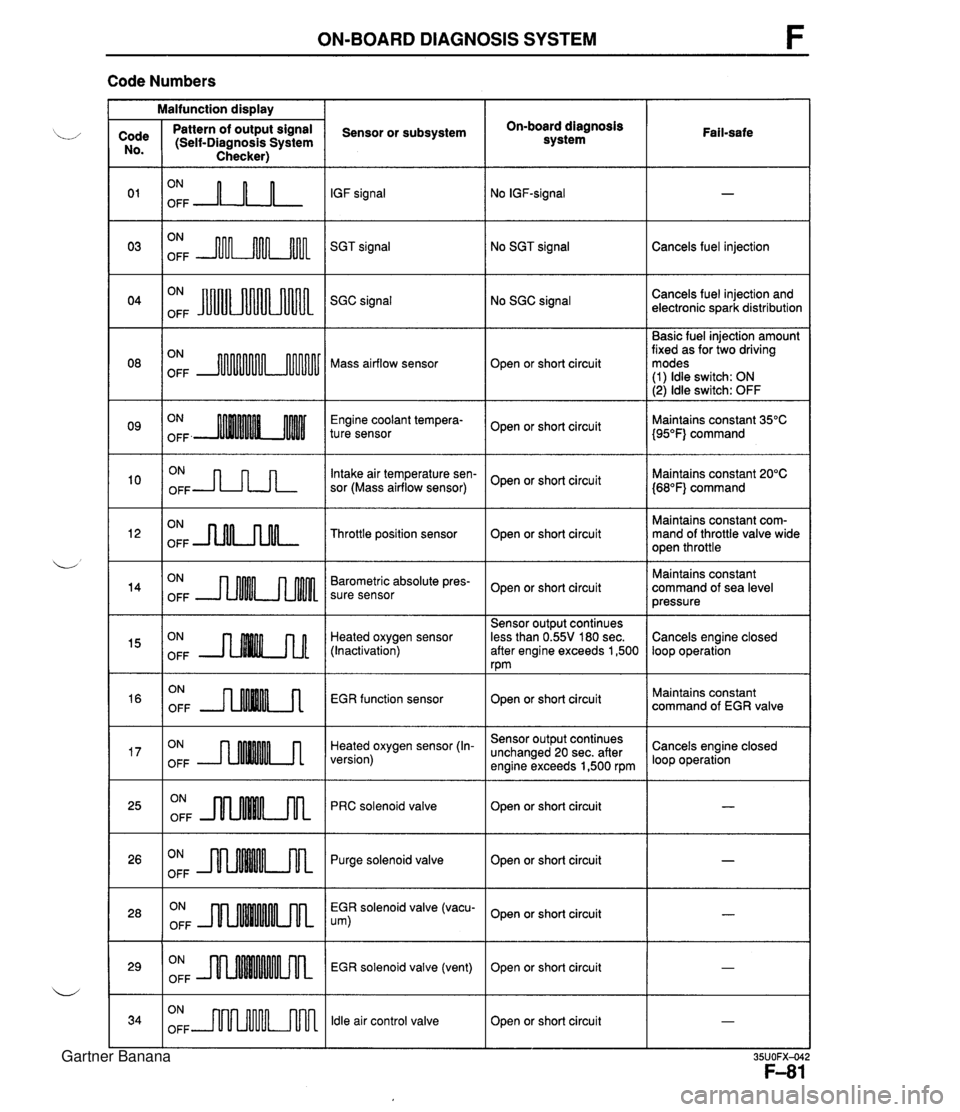
ON-BOARD DIAGNOSIS SYSTEM F Code Numbers Malfunction display On-board diagnosis system Code No. 0 1 03 Pattern of output signal (Self-Diagnosis System Checker) Sensor or subsystem IGF signal SGT signal Fail-safe ON OFF A-n-L ON OFF m No SGT signal ON OFF JuUu Cancels fuel injection No SGC signal Cancels fuel injection and electronic spark distribution SGC signal Basic fuel injection amount fixed as for two driving modes (1) ldle switch: ON (2) ldle switch: OFF ON OFF Mass airflow sensor Open or short circuit Engine coolant tempera- ture sensor ON OFF -JLnn Open or short circuit Intake air temperature sen- sor (Mass airflow sensor) Maintains constant 35°C {95"F} command Maintains constant 20°C {68"F} command Open or short circuit ON OFF -nNLnM- Maintains constant com- mand of throttle valve wide open throttle Throttle position sensor Open or short circuit ON OFF Barometric absolute pres- sure sensor Maintains constant command of sea level pressure Open or short circuit Heated oxygen sensor (Inactivation) EGR function sensor Sensor output continues less than 0.55V 180 sec. after engine exceeds 1,500 rpm Cancels engine closed loop operation ON OFF ON OFF --nMM.A ON OFF --rMMMA Open or short circuit Heated oxygen sensor (In- version) Maintains constant command of EGR valve ON OFF JlnMkm Sensor output continues unchanged 20 sec. after engine exceeds 1,500 rpm PRC solenoid valve Cancels engine closed loop operation Open or short circuit Open or short circuit I - ON OFF m Purge solenoid valve ON OFF EGR solenoid valve (vacu- um) ON OFF Open or short circuit EGR solenoid valve (vent) ldle air control valve - Open or short circuit ON OFF m Open or short circuit I - Gartner Banana
Page 243 of 1708
ON-BOARD DIAGNOSIS SYSTEM SELECT SW A Af ter-repair Procedure 1. Cancel the memory of malfunctions by disconnecting the negative battery cable at least 20 seconds and de- press the brake pedal. Reconnect the negative battery cable. 2. Connect the SST to the data link connector as shown. 3. Turn the ignition switch ON, but do not start the engine for six seconds. 4. Start and warm up the engine, then run it at 2,000 rpm for three minutes. 5. Verify that no code numbers are displayed. Gartner Banana
Page 315 of 1708
CHARGING SYSTEM 1. Disconnect the battery cables from the battery. 2. Connect a voltmeter to the battery. BATTERY Warning Hydrogen gas is produced during normal battery d operation. A battery-related explosion can cause serious injury. Keep all flames (including ciga- rettes), heat, and sparks away from the top and surrounding area of open battery cells. Caution To prevent damage to electrical components or the battery, turn all accessories off and stop the engine before performing maintenance or re- charging the battery. Caution Obtain the code number and deactivate the audio anti-theft system before disconnecting the bat- tery. (Refer to section T.) Inspection Caution When disconnecting the battery, remove the neg- ative cable first and install it last to prevent dam- age to electrical components or the battery. Gartner Banana
Page 317 of 1708
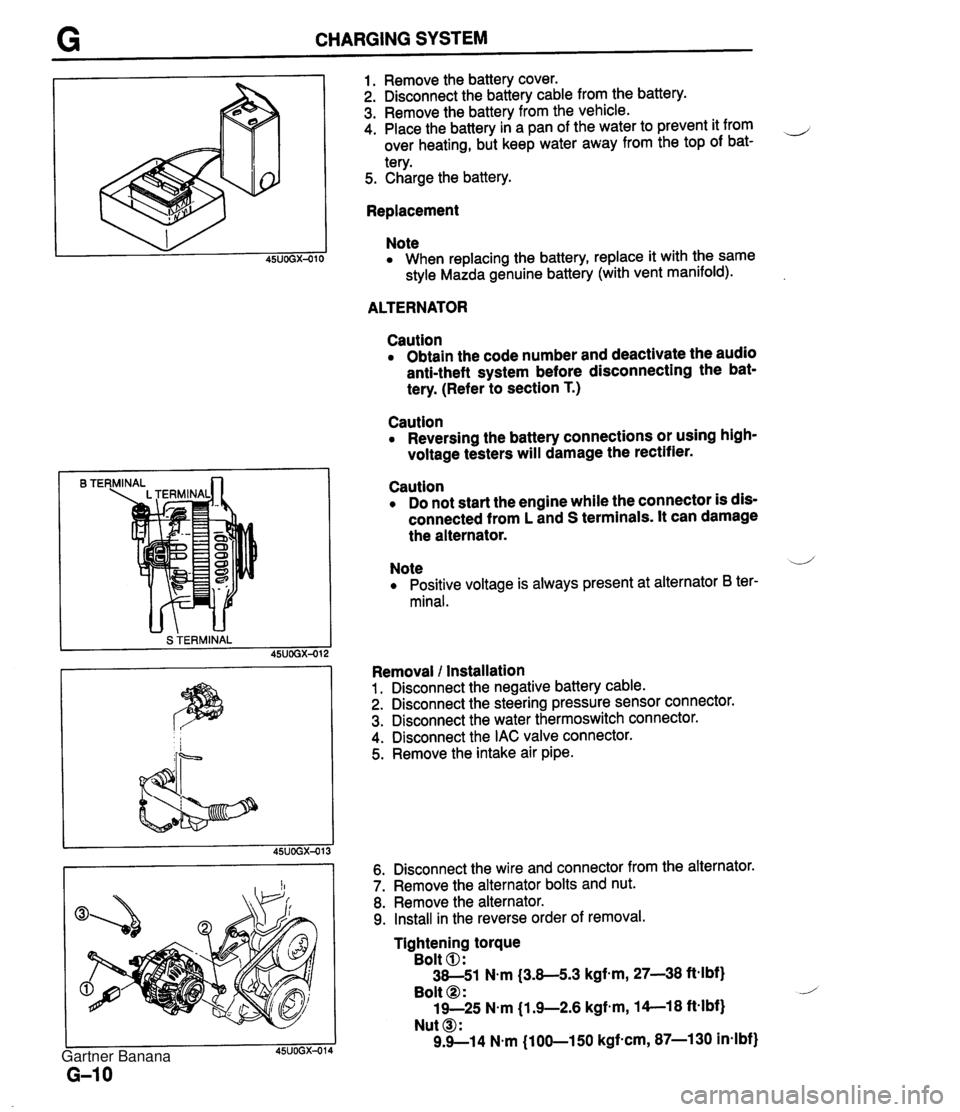
CHARGING SYSTEM B TE S TERMINAL 1. Remove the battery cover. 2. Disconnect the battery cable from the battery. 3. Remove the battery from the vehicle. 4. Place the battery in a pan of the water to prevent it from ,-, over heating, but keep water away from the top of bat- tery. 5. Charge the battery. Replacement Note When replacing the battery, replace it with the same style Mazda genuine battery (with vent manifold). ALTERNATOR Caution Obtain the code number and deactivate the audio anti-theft system before disconnecting the bat- tery. (Refer to section T.) Caution Reversing the battery connections or using high- voltage testers will damage the rectifier. Caution Do not start the engine while the connector is dis- connected from L and S terminals. It can damage the alternator. Note .--,' Positive voltage is always present at alternator B ter- minal. Removal l Installation 1. Disconnect the negative battery cable. 2. Disconnect the steering pressure sensor connector. 3. Disconnect the water thermoswitch connector. 4. Disconnect the IAC valve connector. 5. Remove the intake air pipe. 6. Disconnect the wire and connector from the alternator. 7. Remove the alternator bolts and nut. 8. Remove the alternator. 9. Install in the reverse order of removal. Tightening torque Bolt 0: 38-51 N.m (3.8-5.3 kgf-m, 27-38 ftelbf) Bolt @ : 19-25 N.m j1.9-2.6 kgfem, 14--18 ft-lbf) Nut @I: 9.9--14 N.m (100-150 kgf-cm, 87-1 30 in-lbf) Gartner Banana
Page 410 of 1708

TROUBLESHOOTING If the 3 steps on page K-8 are followed, the cause of the problem should be located. Another guide to faster location of the causes of problems, the QUICK DIAGNOSIS CHART, is on page K-1 0. b In this chart, numbers are used to indicate the components that may be the cause of 22 possible prob- lems. It is necessary to check only those components indicated by numbers during each step of the trouble- shooting process to locate the cause of the problem quickly. QUICK DIAGNOSIS CHART The QUICK DIAGNOSIS CHART shows different .problems and the relationship of components that might be the cause. 1. Components indicated in the "Adjustment" row indicate the possibility that the problem may result from an incorrect adjustment. Check the adjustment of each component, and readjust if necessary. 2. Components indicated in the "Self-DiagnosisWrow are diagnosed by the Powertrain control module (Transmission) self-diagnostic function. 3. Input and output signals of the Powertrain control module (Transmission) for components indicated in the "Tester" row can be easily checked with the Engine signal Monitor. 4. Components indicated in the "Mechanical System Test" row can be checked for malfunction by the re- sults of oil pressure test. 5. Components indicated in the "Road Test" row can be checked for malfunction by the results of the road test. 6. The numbers in the chart indicate the order of inspection for detecting malfunctions. 7. Circled numbers indicate that the transmission must be removed from the vehicle. 8. The checking, adjusting, repair, and replacement procedures for components are described in the page(s) shown in the "Reference page" row. Gartner Banana
Page 651 of 1708

N ENGINE SPEED SENSING POWER STEERING Caution Never hold the steering wheel to the extreme left or right for more than five seconds with the engine running. This could damage the power steering d pump- 8. Turn the steering wheel fully to the left and right and measure the fluid pressure generated by the gear hous- ing. If the pressure is not within specification, replace the gear housing assembly. Gear housing fluid pressure: 7,601--8,335 kPa (77.545.0 kgflcm2, 1,103-1,208 psi) 9. Remove the gauge set. Install and tighten the pressure hose to the specified torque. Tightening torque: 3247 N.m (3.24.8 kgf.m, 24--34 ft.lbf} 10. Bleed the air from the system. (Refer to page N-21.) STEERING WHEEL AND COLUMN Obtain the code number and deactivate the audio anti- theft system before disconnecting the battery. (Refer to section T.) On-vehicle Inspection -1 Steering wheel effort 1. With the vehicle on a hard, level surface, put the wheels in the straight-ahead position. 2. Start the engine and warm the power steering fluid to 50--60°C (1 22-1 40°F). 3. With the engine running at idle, attach a pull scale to the outermost point of the steering wheel spoke. Then, starting with the wheels in the straight-ahead posi- tion, measure the effort required to turn the steering wheel to the left and to the right. Steering wheel effort: 2635 N (2.63.6 kgf, 5.3-7.9 Ibf) (during one turn of the steering wheel) 2 4. If not within specification, check the following: fluid level, air in system, fluid leakage at hose or connections, func- tion of oil pump and steering gear, and tire pressure. Gartner Banana


