1994 JAGUAR XJ6 oil
[x] Cancel search: oilPage 196 of 521

SECTION CONTENTS 0
Sub-Section Title SRO Page
i to iii ............ Preliminary Pages ................................................................ i To iv
10.1
............. Steering System Description ........................................................... 1
10.1.1 ............ Steering System Description. Steering Column Major Components ........................... 1
10.1 .2 ............ Steering System Description. Steering Column Operating Principle ........................... 1
10.1.3 ............ Steering System Description. Hydraulic System Major Components .......................... 2
10.1.4
............ Steering System Description. Hydraulic System Features .................................... 2
10.1.5
............ Steering System Description. Hydraulic System Operating Principle .......................... 2
10.2 ............. Service Procedures-Safety Related ...................................................... 5
10.2.1
............ Service ProceduresSafety Related. Airbag ............................................... 5
10.3
............. Service Procedures ................................................................... 5
10.3.1
............ Service Procedures Working Practices ................................................... 5
10.3.2
............ Service Procedures Working Practices. Fluid Level Check & Topup .......................... 5
10.3.3
............ Service Procedures Working Practices. System Bleed ...................................... 5
10.3.4
............ Service Procedures Working Practices. Fluid Reservoir ..................................... 5
10.3.5.
........... Service Procedures Working Practices. Hydraulic Connections .............................. 5
10.4
............. Diagnostic Procedure ................................................................. 6
10.4.1 ............ Diagnostic Procedure. introduction ..................................................... 6
10.4.2. ........... Diagnostic Procedure. Preliminary Action ................................................ 6
10.4.3 ............ Diagnostic Chart 1 ................................................................... 6
10.4.4. ........... Diagnostic Chart 2 ................................................................... 7
10.4.5 ............ Diagnostic Chart3 ................................................................... 8
10.5
............. Outer Track Rod Ball Joint. Renew ................................ 57.55.02 ............. 9
10.6 ............. Front Hub Assembly, Renew ..................................... 60.25.01 ............. 9
10.7
............. Front Hub Bearing End Float. Check & Adjust ...................... 60.25.12 ............. 9
10.8
............. Front Hub Bearing. Renew ...................................... 60.25.16 ............. 9
10.9
............. Front Hub Oil Seal. Renew ...................................... 60.25.17 ............. 9
X300 VSM i Issue 1 August 1994
Page 200 of 521

10.1 STEERING SYSTEM DESCRIPTION
10.1.1 Steering Column Major Components
Integrated column assembly incorporating power, or manual, reach /tilt mechanism and lock.
Ignition switch.
Ignition interlock solenoid.
Key transponder coil.
Body attachment points.
Depending upon model, the steering column may be adjusted for
tilt and reach, either by electrical or manual means.
Power variants may be either automatically or manually adjusted and all types have the entry / exit feature.
10.1.2 Steering Column Operating Principle
Power Adjust: Two independent motor / gearbox assemblies provide infinite adjustment for reach and height within
approximate ranges of 35mm and
13O respectively. Adjustments may be automatically made in conjunction with the
seat memory facility or manually when the adjustment switch is used. It should be noted that selection of 'Off will
disable the automatic entry / exit mode.
Manual Adjust: The cable operated reach adjustment is infinite within a range of 35mm, with the desired position being
fixed
by a rack and wedge. Tilt variations are stepped at approximately 3O intervals with 6 positions being available,
the uppermost being unlatched.
From the uppermost position the column may be pulled down to engage the first detent without using the
tilt lever.
WARNING: MANUAL ADJUST ONLY: TO AVOID PERSONAL INJURY, COLUMN UPWARD TRAVEL SHOULD BE MAN- UALLY RESTRAINED TO CHECK UPWARD SPRING ASSISTANCE. THIS IS ESPECIALLY IMPORTANT IF
THE STEERING WHEEL HAS BEEN REMOVED FOR MAINTENANCE REASONS.
WARNING: ALL TYPES; DO NOT REMOVE THE STEERING COLUMN FROM THE VEHICLE WITH THE STEERING
WHEEL ATTACHED UNLESS THE STEERING
IS CENTERED AND THE COLUMN LOCK IS ENGAGED. IFTHE
SERVE THIS MAY RESULT IN AN INOPERATIVE AIRBAG SYSTEM. SEE LABEL ON STEERING WHEEL
HUB. LOCK IS TO BE RENEWED, 'LOCK-WIRE THE ASSEMBLY TO PREVENT ROTATION. FAILURE TO OB-
0
X300 VSM 1 Issue 1 August 1994
J57-27L
3 Ignition switch 1 1 Tilt motor 2 Tilt motor flexible coupling 4 Reach motor
Fig.
1 Major components Power operated steering column
Page 201 of 521

@ Steering
10.1.3 Steering Hydraulic System Major Components
Engine driven rotary vane pump (belt driven 12 cylinder; direct drive from timing gear 6 cylinder) with falling
flow characteristic (as
pump speed increases fluid flow decreases) and integral pressure relief valve.
Remote fluid reservoir with integral 'return' side filter.
Steering rack (incorporating speed sensitive transducer).
Steering control module
(SCM).
Fluid cooler integral with engine coolant radiator and associated pipe-work.
10.1.4 Hydraulic System Features
The 'Servotronic' system reduces steering input loads during parking and low speed manoeuvres and progressively
increases input loads as vehicle speed rises. This feature enhances steering feel.
10.1.5
Rotary motion of the steering wheel is converted, via the steering gear pinion to lateral motion of the rack. Hydraulic
assistance is provided by pressurized fluid being directed against the rack bar piston in the rack cylinder. The pressure
applied to each side of the rack piston is controlled by the pinion valve which varies the restriction through which the
flow for each side of the rack piston must pass.
Hydraulic System Operating Principle (see illustrations on next three pages)
Section on X X
J57-277
A. Steering rack F. Torsion bar 0 Radial groove B. Driving pinion G. Oil pump 1 Speedometer
C. Power cylinder H Pressure & flow 2 SCM D. Rotary disc valve limiting valve 3 Transducer
E. Control sleeve N Radial groove
Fig.
1 Major components & hydraulic flow - Neutral position ~
Issue 1 August 1994 X300 VSM 2
Page 206 of 521

10.4.3 Diagnostic chart 2
0 Trouble
'lay at steering wheel
ieavy when stationary
Excessively heavy when
hiving, stationary effort
3K
Too easy when driving,
itationary effort OK
fffort not equal side to
;ide from center
dariation from heavy to
?asy when driving
:yclic load variation at steering wheel - 2 per
.evolution
:losely spaced cyclic
oad variation at steering
Nheel
Cause
Rack damper loose
Pinion bearing loose
Worn intermediate shaft joint
Worn suspension joint
Loose lower column 'pinch' bolt
Transducer not closed
Transducer not closed
- ground short
Transducer not closed
- no feed voltage
Transducer not closed
- defective cable
SCM defective
Delivery pressure or flow too low
Internal rack leakage
tire pressures low
Transducer open too early
Transducer open too early, incorrect SCM
h/Pe
Transducer open too early, incorrect
speedometer signal
Rack 'reaction limitation valve' CLOSED
or setting incorrect
Transducer not open (no oil flow)
Transducer not open, SCM faulty
Transducer not open, incorrect speedom
-
eter signal
Rack 'reaction limiting valve' OPEN or
setting incorrect
Low pressure pipe 'flattened' or re
-
stricted
Blocked reservoir filter
tire pressure high
Rack check valve leak
Rotary valve blockage Incorrect lower column assembly, see
'Cyclic load variations'
Incorrect speedometer signal
Transducer cable
/ connection faulty or
grounded
Lower column universal joint fitting error
Rack damper too tight
Remedy
Renew rack
Renew rack
Renew joint
Renew joint
Tighten to specification
Inspect and check for debris
Renew transducer*
Investigate and repair
Renew cable
Renew module*
Renew pump
Renew rack
Set to specification
Renew transducer*
Renew
SCM*
Renew speedometer transmitter*
Renew rack
Inspect and check for debris
Renew
SCM*
Renew speedometer transmitter*
Renew rack
Renew pipe
Renew filter
Set to specification
Renew rack
Renew rack
Rectify as required
Renew speedometer transmitter*
Investigate and repair
Verify that the lower column assembly is
correct for that drive.
RH and LH assem- blies MUST NOT be interchanged due to
joint phase differences
Renew rack
W: Items marked * should be validated using EDM test procedures.
X300 VSM 7 Issue 1 August 1994
Page 208 of 521
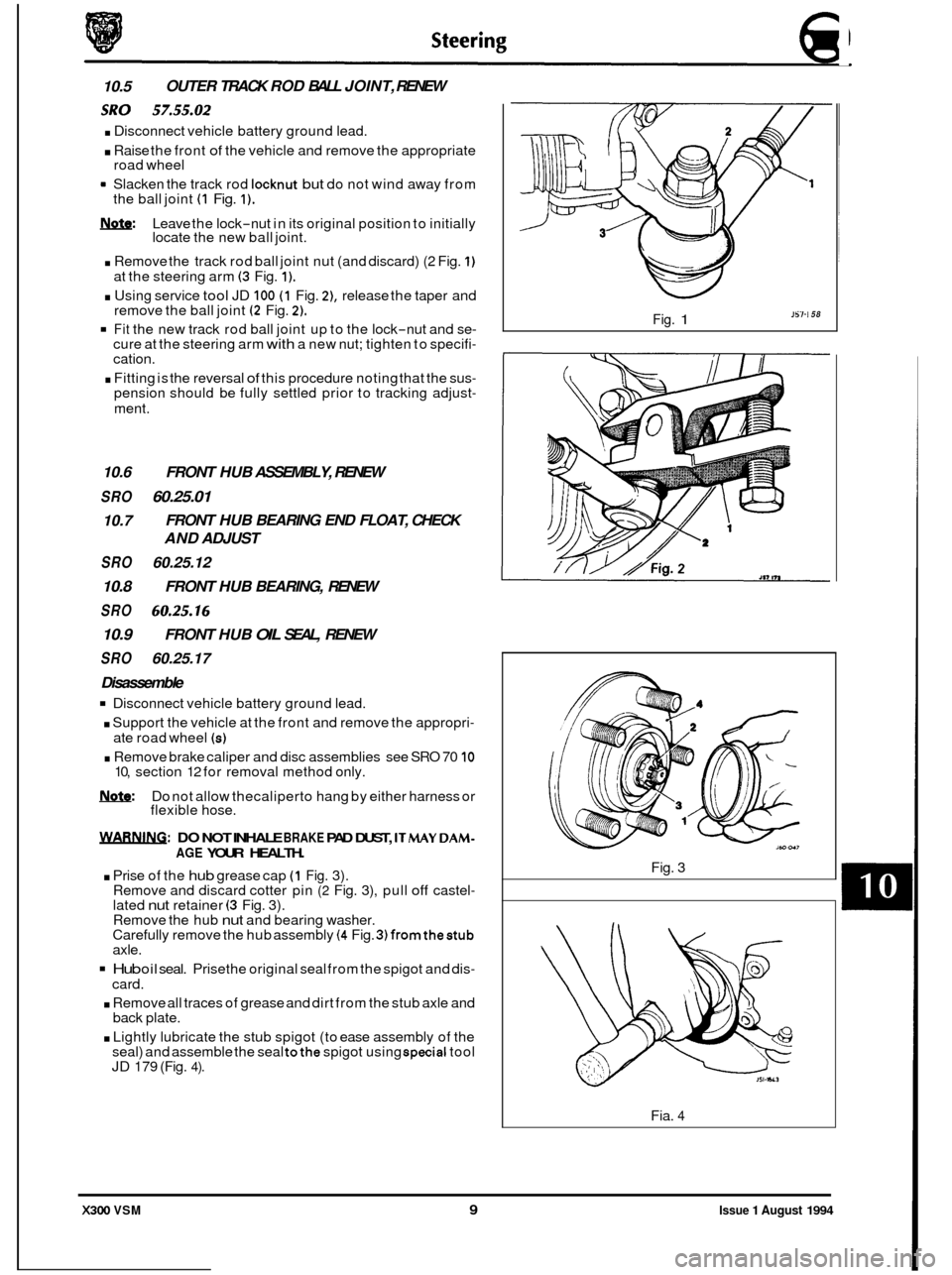
10.5 OUTER
TRACK ROD BALL JOINT, RENEW
sRo . Disconnect 57.55.02 vehicle battery ground lead.
. Raise the front of the vehicle and remove the appropriate
road wheel
Slacken the track rod
locknut but do not wind away from
the ball joint (1 Fig. 1).
m: Leave the lock-nut in its original position to initially
locate the new ball joint.
. Remove the track rod ball joint nut (and discard) (2 Fig. 1)
at the steering arm (3 Fig. 1).
. Using service tool JD 100 (1 Fig. 2), release the taper and
remove the ball joint (2 Fig. 2).
Fit the new track rod ball joint up to the lock-nut and se- cure at the steering arm with a new nut; tighten to specifi- cation.
. Fitting is the reversal of this procedure noting that the sus- pension should be fully settled prior to tracking adjust-
ment.
0 10.6 FRONT HUB ASSEMBLY, RENEW
SRO 60.25.01
10.7
SRO 60.25.12
10.8 FRONT HUB BEARING, RENEW
SRO 60.25.16
10.9
SRO 60.25.17
Disassemble
Disconnect vehicle battery ground lead.
. Support the vehicle at the front and remove the appropri-
. Remove brake caliper and disc assemblies see SRO 70 10
IWQ: Do not allow thecaliperto hang by either harness or
flexible hose.
FRONT HUB BEARING END FLOAT, CHECK
AND ADJUST
FRONT HUB
OIL SEAL, RENEW
ate road wheel (s)
10, section 12 for removal method only.
WARNIM: DO NOT INHALE BRAKE PAD DUST, ITMAY DAM-
0
AGE YOUR HEALTH.
. Prise of the hub grease cap (1 Fig. 3).
Remove and discard cotter pin (2 Fig. 3), pull off castel- lated nut retainer (3 Fig. 3).
Remove the hub nut and bearing washer.
Carefully remove the hub assembly (4 Fig. 3)fromthestub axle.
Hub oil seal. Prise the original seal from the spigot and dis-
card.
. Remove all traces of grease and dirt from the stub axle and
back plate.
. Lightly lubricate the stub spigot (to ease assembly of the
seal) and assemble the seal tothe spigot using special tool JD 179 (Fig. 4).
JS7-i 58 Fig. 1
Fig. 3
Fia.
4
X300 VSM 9 Issue 1 August 1994
Page 209 of 521

@ Steering
. Pack the annular gaps of the oil seal lips with grease.
. Bearing. Wash the hub assembly thoroughly and 'drift' the affected bearing cup(s) from the hub.
!&!$Q:
rn Hub. At this point the hub may be renewed if required.
Assembly
. Bearing. Assemble the inner bearing track to the hub using service tool 18G 134 and adaptor JD 550 - 5 / 1.
Ensure that the hub inner seal diameter is free of debris or damage and is lightly lubricated prior to assembly.
Only replace complete bearings, never cup or race in isolation.
Assemble the outer bearing cup to the hub using service tool
18G 134 and adaptor JD 550 - 5 / 2. Pack each race with approximately 4 ml of grease and position the inner race onto the stub axle.
Apply a smear of grease to hub inner surfaces and bearing cups. Assemble the hub to the stub axle followed by
outer race, bearing washer and hub nut.
It is not necessary to fill the hub cavity with grease, merely protect from corrosion with a coat of IubricanL'Seat'the bear-
ings by slightly tightening the hub nut whilst rotating the hub. Do not apply load without rotation. m:
. End float. Set a Dial Test Indicator (DTI) as shown in Fig. 1 and adjust the hub nut to achieve the correct end float.
As the adjustment is made, continually load the hub axial-
ly in both directions.
. Without disturbing the end float setting, fit the castellated
nut retainer so that it aligns with both hub nut and stub
axle drilling.
. Secure nut retainer using a new cotter pin.
9 Assembly and fitting is the reversal of this procedure not- ing that; all fixings MUST be tightened to specification
and operation of the braking system verified.
Fig. 1
Issue 1 August 1994 10 X300 VSM
Page 217 of 521

Suspension Systems
11.4.3 Front End Inspection
Do not check and adjust front wheel alignment without carrying out the following inspection for front end damage and
wear:
. Check for specified air pressure in all four tires.
Raise front of vehicle off the floor; grasping upper and lower surface of the tire, shake each front wheel to check for
. Check front suspension lower arm ball joint and mounts for looseness, wear and damage.
Check steering gear mountings and all steering linkages for looseness.
. Renew parts if necessary.
. Grasp upper and lower surface of tire and shake each wheel to check wheel bearing end play.
. Check the action of the front dampers and the condition of their attachments, as sticking or binding front dampers
worn
bearings.
Check brake caliper mountings.
may not allow the vehicle to settle in to a normal level position, possibly affecting the front-wheel alignment.
m: Front wheel bearings are adjustable (0.001 to 0.003 in. endfloat).
11.4.4
. Check the wheel bearings.
. Inspect the front suspension upper joint and renew front suspension lower wishbone if needed.
Raise vehicle and position floor jacks beneath the front suspension lower wishbone.
Grasp the lower edge of the tire and move the wheel in and out.
While moving the wheel, observe the upper and lower wishbone.
. Movement between the vertical links and the wishbones indicates abnormal ball joint wear.
. Renew ball joints.
. Check the front wheel bearings.
. Check for excessive play and wear.
Upper / Lower Ball Joint Inspection
11.4.5 Damper Inspection
m: The gas-pressurized hydraulic front dampers are not serviceable, adjustable or refillable.
Verify that all attachments of the suspension components and the front dampers are tight. Renew any front damper
. Check front dampers for external damage.
. Check for oil leakage and vehicle sag.
that
has a damaged integral lower mounting bushing.
0 Oil Leak
Leakage is the condition in which the entire damper body is covered with oil and from where
it will drip on to
the pavement. Due to correct damper lubrication a light film of oil (weepage) can usually be seen on the upper
portion of the damper.
Should there be any leakage, ensure that the fluid does not originate from sources other than the front damper.
Renew worn or damaged dampers.
0 Vehicle Sag
Renewing front dampers will not correct the problem of vehicle sag, as basically this is controlled by the spring
units.
issue 1 August 1994 4 X300 VSM
Page 254 of 521

Body Components & Trim -
Fixing
Seat belts
Front tear loop belt buckle to bracket fixing
Front belt buckle to bracket fixing
Tightening Torque (Nm)
30 - 40
30
- 40
Front belt reel bracket to body fixing
Front belt anchor fixing 30 - 40
30 - 40
7
-10
23
- 27
30
- 40
30 - 40
30
- 40
30 - 40
30
- 40
Front belt upper guide fixing
[Height adjuster to 'B' post screws
Height adjuster to seat belt anchor retaining
nut
Rear inertia belt anchor fixing
Rear inertia belt bracket to body fixing
Rear inertia belt reel securing bracket to body fixing
Rear inertia
/ static belt buckle bracket to body fixing ~
Rear
static belt / inertia buckle bracket to body fixing
: Sunroof ~
Sunroof frame
to roof
30 - 40
4
-5
111. SERVICE MATERIALS
Sunroof to frame 4-5
'Trunk
Compact disc autochanger bracket to body
I Battery clamp to tray
I Warning triangle lower bracket to trunk lid inner panel
9- 11
7
-10
1.5
X300 VSM V Issue 1 August 1994
I trunk lock barrel to lid
j Trunk latch actuator to bracket
Trunk latch actuator mounting to
lid
j Electrical carrier box to body
Load floor support block to body
Trunk seal retainer to body
trunk latch to lid and striker to body
4-5
7
-10
7
-10
7
-10
5
-7
9- 11
9- 11
Description Uses
'Fibrefresh' Carpet Shampoo
'1001' Foam Shampoo
'Novatreat' Cleaning
of water
-based stains from
carpets
Cleaning of water
-based stains from
carpets
Cleaning of water
-based stains from
carpets
Notes
'Genklene' (Trichloroethane)
'Spot Remover' Cleaning
of grease or oil based
stains from carpets
Cleaning of grease or oil based
stains from
caroets