1994 JAGUAR XJ6 roof
[x] Cancel search: roofPage 256 of 521
Body Components & Trim
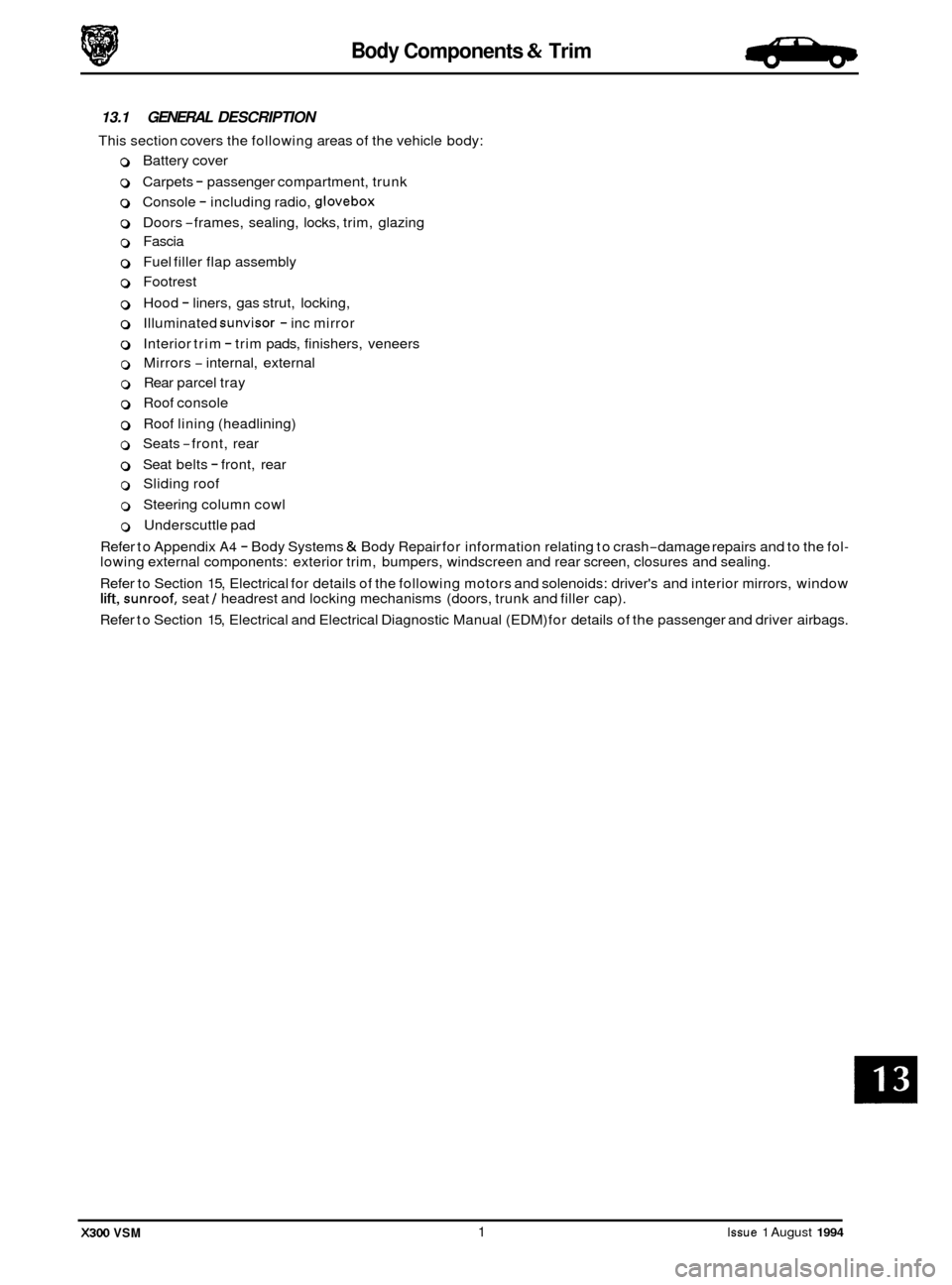
13.1 GENERAL DESCRIPTION
This section covers the following areas of the vehicle body:
0 Battery cover
0 Carpets - passenger compartment, trunk
0 Console - including radio, glovebox
0 Doors -frames, sealing, locks, trim, glazing
0 Fascia
0 Fuel filler flap assembly
0 Footrest
0 Hood - liners, gas strut, locking,
0 Illuminated sunvisor - inc mirror
0 Interior trim - trim pads, finishers, veneers
0 Mirrors - internal, external
0 Rear parcel tray
0 Roof console
0 Roof lining (headlining)
o Seats -front, rear -
0 Seat belts - front, rear
0 Sliding roof
0 Steering column cowl
0 Underscuttle pad
Refer to Appendix
A4 - Body Systems & Body Repair for information relating to crash-damage repairs and to the fol- lowing external components: exterior trim, bumpers, windscreen and rear screen, closures and sealing.
Refer to Section 15, Electrical for details of the following motors and solenoids: driver's and interior mirrors, window
lift, sunroof, seat / headrest and locking mechanisms (doors, trunk and filler cap).
Refer to Section 15, Electrical and Electrical Diagnostic Manual (EDM) for details of the passenger and driver airbags.
X300 VSM 1 Issue 1 August 1994
Page 292 of 521

Body Components & Trim -
13.3.39 Roof lining (Headlining), Description
The roof lining is a one piece construction of 6mm thick polyurethane foam, covered with brush finish, suede effect,
knitted polyester.
13.3.40 Roof lining; Renew
. Position front seats fully rearwards and recline the passen-
. Disconnect vehicle battery ground lead.
. Remove:
ger
seat squab.
0 Sliding roof flange (where fitted).
0 Front passenger door.
0 Rear console (where fitted).
0 Center console.
0 Sunblind and bezel.
0 Combined grab handle and coat hook.
0 Rear quarter upper trim pad LH & RH.
0 Cantrail crash roll.
0 Illuminated sun visor.
0 Roof console.
9 Release multi-plug connectors from clips at roof console
Remove roof console retaining clip from headlining.
. Remove security sensors (where fitted) and disconnect
. Release roof lining to body tags and lower roof lining.
. Remove the roof lining:
Position the roof lining with the rear corner through the
passenger side rear door and the opposite cornerthrough
the driver side rear door.
. Position the roof lining across the car with the roof console
cut-out straddling 'B'-'C' post.
. Tip the roof lining forward against bottom of fascia with
rear edge of roof lining diagonally across door aperture.
. Carefully feed the roof lining out of the passenger side
front door, easing the edge cut-outs over the door aper- ture and any other obstruction.
aperture.
multi
-plugs.
. To
refit, carry out reversal of the above procedure.
X300 VSM 37 Issue 1 August 1994
Page 362 of 521

15.9.2 Interior Lighting, General Description
0
Fig.1 Interior Lighting
The interior lamps consist of
E-Post lamps with or without map lights, a map light combined with switch fitted to the
roof console, sun visor lamps, door courtesy / hazard lamps and a trunk lamp.
Other interior illumination bulbs are fitted within the various switch assemblies.
X300 VSM 21 Issue 1 August 1994
Page 380 of 521

86.52.01
86.91 -83
19.75.21
86.80.24
Universal garage door opener
Security
& Locking Control Module
(SLCM)
Sunroof
Mirror memory control
Seat
/ Mirror Memory (Passenger.)
Speed control
Air conditioning
(NCCM)
Transmission control
Engine Management
BPU (Body Processor Unit)
ABS (Anti
-lock Braking System &
Traction Control (where fitted).
(ABS/TC CM)
Bulb failure
Rear
Front
I Power steering
I Column / mirror ECM
Reader exciter
Location
Roof console panel
LH side upper wheel arch, inside the
trunk below fuel filler pipe
Roof console panel.
Mounted inside driver's
& passenger's
seat.
Behind passenger knee bolster.
RH side of air conditioning unit.
Behind passenger knee bolster.
RH side footwell in front of 'A' post
behind cover.
Behind passenger knee bolster.
Engine compartment below
anti-lock
braking system modulator.
Trunk inside electrical carrier box,
Engine compartment behind each
headlamp assembly.
LH side footwell on
'A' post, behind cover.
On the side of steering column.
Around the lock barrel of steering
column.
Behind passenger knee bolster below the
airbag module.
Behind bumper, LHS of vehicle
Numb
11
13
10
9
14
2
RHD
20 LHD
1
16
RHD
(1 2&6)
7 LHD
(12&16)
6 (12&16)
19 RHD
3 LHD
18 RHD
4 RHD
12
22
& 24
17 5
8
15 RHD
23 LHD
21
X300 VSM 39 issue 1 August 1994
Page 395 of 521

Description Capacity Type
Door guard lamp. 12V 5W Capless long life
Flasher side repeater 12V 5W Capless long life
Fog lamp - Front. 12v 55w Halogen H3
Fog lamp
- Rear guard 12v 21w Bayonet long life
Front turn indicator
I 12v21w I Bayonet long life
Pilot lamp
I 12V 5W I Capless long life
Headlamp
I 12v55w I Halogen HI
High mounted stop lamp (where fitted). 12v Capless long life
Roof console central courtesy lamp
12V 5W Capless long life.
Roof console reading lamp
12V 6W Capless
Luggage compartment lamp
12V 5W Capless long life
License plate lamp 12V 5W Festoon
Rear turn indicator
12v 21w Bayonet yellow long
Rear quarter courtesy lamp (lower section)
12V 5W Capless long life
Rear quarter reading lamp (upper section) 12V 6W Capless
Back
-up lamp 12v 21w Bayonet long life
Stop /Tail lamp
Sun visor vanity mirror lamp
12v 1,2w Capless 286
Tail lamp 12V 5W Bayonet long life
5X5W
12V 21V 5W Twin filament bayonet long life
Indicator bulbs
Bulb Designation Holder Colour Rating
Exhaust temperature warning indicator bulb Orange 12,5V 1,2W
Low oil pressure indicator bulb
Orange 12,5V 1,2W
Seat belt warning indicator bulb
Orange 12,5V 1,2W
Boot open warning indicator bulb
Orange 12,5V 1,2W
Door open warning indicator bulb
Orange 12,5V 1,2W
Coolant level warning indicator bulb
Orange 12,5V 1,2W
Air bag fault indicator bulb Orange 12,5V 1,2W
Parking brake 'on' indicator bulb Orange 12,5V 1,2W
Brake system warning indicator bulb Orange 12,5V 1,2W
Main beam 'on' indicator bulb
Orange 12,5V 1,2W
Right turn indicator bulb Orange 12,5V 1,2W
LCD illumination bulb (right)
Orange 12,5V 1,2W
LCD illumination bulb (left) Orange 12,5V 1,2W
Left turn indicator bulb
Orange 12,5V 1,2W
Traction control 'off indicator bulb
Orange 12,5V 1,2W
Transmission sport mode indicator bulb
Orange 12,5V 1,2W
Charging fault warning bulb
Orange 12,5V 1,2W
Check engine warning indicator bulb Orange 12,5V 1,2W
0
0
0
X300 VSM Issue 1 August 1994 AI-95MY 12
Page 400 of 521

(amps)
F1 Light Blue 15
F3 Light Blue 15
F4 Light Blue 15
F5 Tan 5
F6 F7 Light Green 30
- -
F8 Red 10
F9 Clear 25
FIO Tan 5
F11 Yellow 20 0
Light Green
Light Blue
F18 Light Blue
0'
I
Circuit
Central door locking
Deadlocking (where fitted)
Transmission interlock relay
Key
-switch solenoid relay
Center console switch pack
Interior lighting switch
Seat motors
- left-hand side
Seat motors
- left-hand side
Automatic transmission control module
(TCM)
Not used
Anti
-lock braking system / traction control control module (ABS /
TC CM)
Interior lamps
Luggage compartment lamps
Seat heaters (where fitted)
Data link connector
Fuel pump relay coil
Air conditioning blower motor
- right-hand
Air conditioning
Seat control modules
(SCMs)
Mirror heaters relay
Power assisted steering
Not used
Mirrors, Heated rear window, Cigar lighter
Rear lighting control module
High mounted stop lamp (where fitted)
Window lift (front and rear)
-left-hand side
Windshield wiper system Front screen heaters
Front lighting control module
- left-hand
Water pump relay
Headlamp levelling (where fitted)
Clock
Airbag
Sunroof (where fitted)
Issue 1 August 1994 AI-95MY 17 X300 VSM
Page 413 of 521

General Fitting Instructions
A3.2 GENERAL FITTING INSTRUCTIONS
A3.2.1
Always fit covers to protect the wings before commencing work in the engine compartment. Cover the seats and
carpets, wear clean overalls and wash hands or wear gloves before working inside the car. Avoid spilling hydraulic
fluid, anti
-freeze or battery acid on the paintwork. In the event of spillage, wash off with water immediately. Use poly- thene sheets in the boot to protect carpets. Always use the recommended service tool, or a satisfactory equivalent,
where specified. Protect temporarily exposed screw threads by replacing nuts or fitting caps.
Precautions Against Damage To The Vehicle
A3.2.2 Preparation
Before disassembly, clean the surrounding area as thoroughly as possible. When components have been removed,
blank off any exposed openings using greaseproof paper and masking tape. Immediately seal fuel, oil and hydraulic
lines when separated, using plastic caps or plugs, to prevent loss of fluid and the entry of dirt. Close the open ends
of oilways, exposed by component removal, with tapered hardwood plugs or readily visible plastic plugs. Immediately
a component is removed, place
it in a suitable container; use a separate container for each component and its asso- ciated parts. Before dismantling a component, clean it thoroughly with a recommended cleaning agent: check that the
agent will not damage any of the materials within the component. Clean the bench and obtain marking materials, la-
bels, containers and locking wire before dismantling a component.
A3.2.3 Dismantling
Observe scrupulous cleanliness when dismantling components, particularly when parts of the brake, fuel or hydraulic
system are being worked on. A particle of dirt or a fragment of cloth could cause a dangerous malfunction if trapped in these systems. Clean all tapped holes, crevices, oilways and fluid passages with compressed air.
WRNIFLG: DO NOT PERMIT COMPRESSED AIR TO ENTER AN OPEN WOUND. ALWAYS USE EVE PROTECTION
WHEN USING COMPRESSED AIR.
Ensure that any 'O'-rings used for sealing are correctly refitted or renewed if disturbed. Mark mating parts to ensure
that they are replaced as dismantled. Whenever possible use marking materials which avoid the possibilities of caus- ing distortion or the initiation of cracks, which could occur if a center punch or scriber were used. Wire together mating
parts where necessary to prevent accidental interchange (e.g roller bearing components). Tie labels on to all parts to
be renewed and to parts requiring further inspection before being passed for reassembly.
Place labelled parts and other parts for rebuild
in separate containers.
Do not discard a part which is due for renewal until it has been compared with the new part, to ensure that the correct
part has been obtained.
A3.2.4 Inspection
Before inspecting a component for wear or performing a dimensional check, ensure that it is absolutely clean; a slight
smear of grease can conceal an incipient failure. When a component is to be checked dimensionally against figures
quoted for
it, use the correct equipment (surface plates, micrometers, dial gauges etc.) in serviceable condition. The
use of makeshift equipment can be dangerous. Reject a component if its dimensions are outside the limits quoted,
or if damage is apparent. A part may be refitted if its critical dimension is exactly to the limit size and it is otherwise
satisfactory. Use Plastigauge 12 Type PG-1 for checking bearing surface clearance e.g. big end bearing shell to crank
journal. Instructions for the use of Plastigauge and a scale giving bearing clearances in steps of
0,0025 mm (0.0001
in) are supplied with the package.
0
0
0
X300 VSM Issue 1 August 1994 2
Page 425 of 521

Body Systems & Body Repair
Sub-Section Title SRO Page
A4.4.4 ........... Underhood Labels. Location & Tvpe ................................................... 32
A4.4.5
........... Stonechip Protection Area ............................................................ 33
A4.5.1.1
.......... Glass And Body Preparation .......................................................... 34
A4.5.1.2
.......... Glazing Adhesive Application Temperature ............................................. 34
A4.5
............. Glazing ........................................................................\
... 34
A4.5.1
........... Glazing. Special Notes ............................................................... 34
A4.5.1.3
.......... Glazing Adhesive Application ......................................................... 34
A4.5.1.4
.......... Glazing Adhesive Curing ............................................................. 34
A4.6.1
........... Bumpers ........................................................................\
... 35
A4.6.1.2 .......... Bumpers. Features ................................................................... 35
A4.6.1.3
.......... BUmpeN. Service Procedures ......................................................... 37
A4.6.1.4 .......... Bumpers. Fitted Condition - Front ..................................................... 37
A4.6.2
........... BUmpeN. Cover Damage ............................................................. 39
A4.6.1.1
.......... Bumpers.
Major Components ......................................................... 35
A4.6.1.5 .......... Bumpers. Fitted Condition -Rear ...................................................... 38
A4.6.2.1
.......... Bumpers. Damage Assessment ........................................................ 39
A4.6.2.2
.......... Bumpers. Repair Materials ............................................................ 39
A4.6.3 ........... Bumpers. Refinishing ................................................................ 40
A4.6.3.1
.......... Bumpers. Refinishing - Original ....................................................... 40
A4.6.3.2
.......... Bumpers. Refinishing - New .......................................................... 40
A4.6.3.3
.......... Bumpers. Refinishing - All ............................................................ 40
A4.6.4
........... Bumpers. Replacement Covers ........................................................ 40
A4.6.5
........... Recycled Materials. General Note ..................................................... 40
A4.6.6.1
.......... Body-side Moulding, Introduction ..................................................... 41
A4.6.6.2
.......... Body-side Moulding. Fitted Condition - Illustration ....................................... 41
A4.6.6.3
.......... Body-side Moulding. Fitting Process ................................................... 41
A4.6.7
........... Finisher, Door Frame - Fitted Condition ................................................ 42
A4.6.8
........... Finisher, Roof Drip Rail - Fitted Condition .............................................. 42
A4.7.1
........... Body Exterior Clearances & Alignments ................................................. 43
A4.7.1.1
.......... Body Exterior Clearances & Alignments. Introduction ..................................... 43
A4.6.6
........... Body-side
Moulding ................................................................. 41
A4.7.1.2
.......... Body Exterior Clearances & Alignments. Criteria - Clearances ............................. 43
A4.7.1.3
.......... Body Exterior Clearances & Alignments. Criteria - Alignment .............................. 43
A4.7.1.4
.......... Body Exterior Clearances & Alignments. Criteria - Exterior Fitments ........................ 43
A4.7.1.5
.......... Body Exterior Clearances & Alignments. Illustrations (Specifications) ........................ 43
A4.7.2
........... DOON ........................................................................\
..... 47
A4.7.2.1
.......... DOON. Features ..................................................................... 47
A4.7.2.2
.......... DOON. Removal .................................................................... 47
A4.7.2.3
.......... DOON. Fitting ....................................................................... \
47
A4.7.2.4
.......... DOON. Alignment ................................................................... 47
A4.7.2.5
.......... Door Seals. Table ................................................................... 48
A4.7.2.6 .......... Door Seals - Typical Sections. Illustration ............................................... 48
0
0
0
0
Issue 1 August 1994 X300 VSM ii