1994 JAGUAR XJ6 ECU
[x] Cancel search: ECUPage 164 of 327

6 15.2.8.3 Tachometer
Gauge reads zero, full scale, too high or low
1.
2.
3.
4.
5. Refer
to Section 5, Engine Management for fault diagnosis of tachometer signal.
Check harness wiring and connection from Instrument pack pin
24 (24-way connector) and Engine Management
Control Module (ECM).
If all previous checks prove correct remove and open the instrument pack. Examine flexi-circuit connections to
tachometer, ensuring correct and secure fitment.
Check continuity of flexi
-circuit tracks to tachometer connections.
Check continuity of speedometer driver windings by disconnecting from flexi
-circuit and testing between the
upper central connection pin and each of the other two pins, If open circuit is recorded renew tachometer.
15.2.8.4 Liquid Crystal Display
No (or patchy) illumination
1.
2. If no illumination check rear of instrument pack for attachment of 'PECUS' label. If label is not present then pack
will not have been programmed.
Check bulbs in rear of LCD module, renew as necessary.
Missing or Corrupt Segments
1. Switch ignition off, leave off for a minimum of 5 minutes, switch on and re-check panel display.
2. If display is still faulty remove instrument pack from vehicle and checkconnections between flexi-circuit and LCD
module.
15.2.8.5 Trip Computer
Inaccuracy
1. Check fuel sender, ABS /TC CM and ECM signals to instrument pack.
Issue 1 August 1994 X300 EDM 15.2 - 11
Page 168 of 327
Electrical
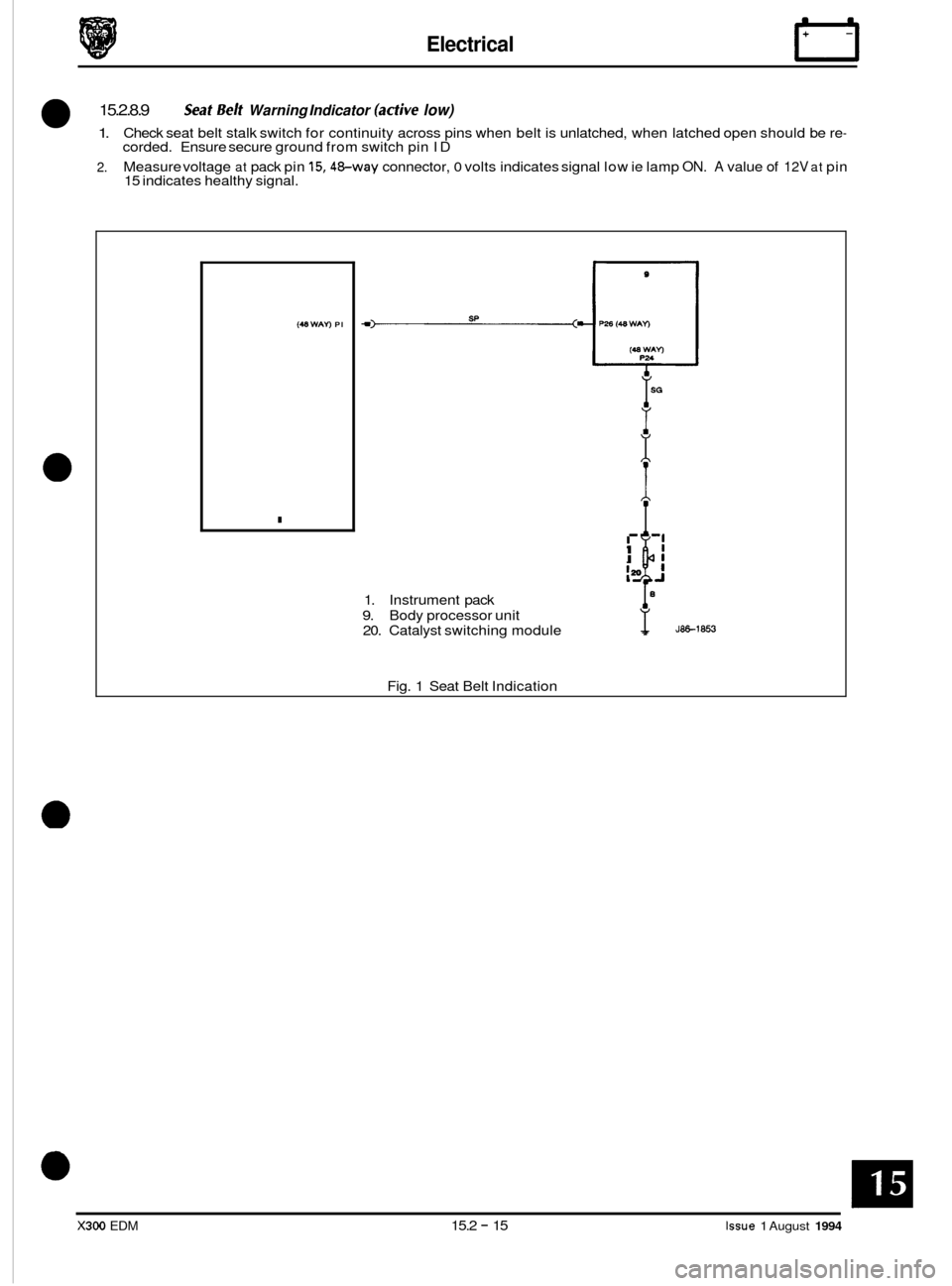
15.2.8.9
1.
2.
Seat Self Warning Indicator (acfive low)
Check seat belt stalk switch for continuity across pins when belt is unlatched, when latched open should be re- corded. Ensure secure ground from switch pin ID
Measure voltage
at pack pin 15,48-way connector, 0 volts indicates signal low ie lamp ON. A value of 12V at pin
15 indicates healthy signal.
(48 WAY) Pl
I
I
I
1. Instrument pack
9. Body processor unit
20. Catalyst switching module
Fig. 1 Seat Belt Indication
X300 EDM 15.2 - 15 Issue 1 August 1994
Page 169 of 327
IT Electrical
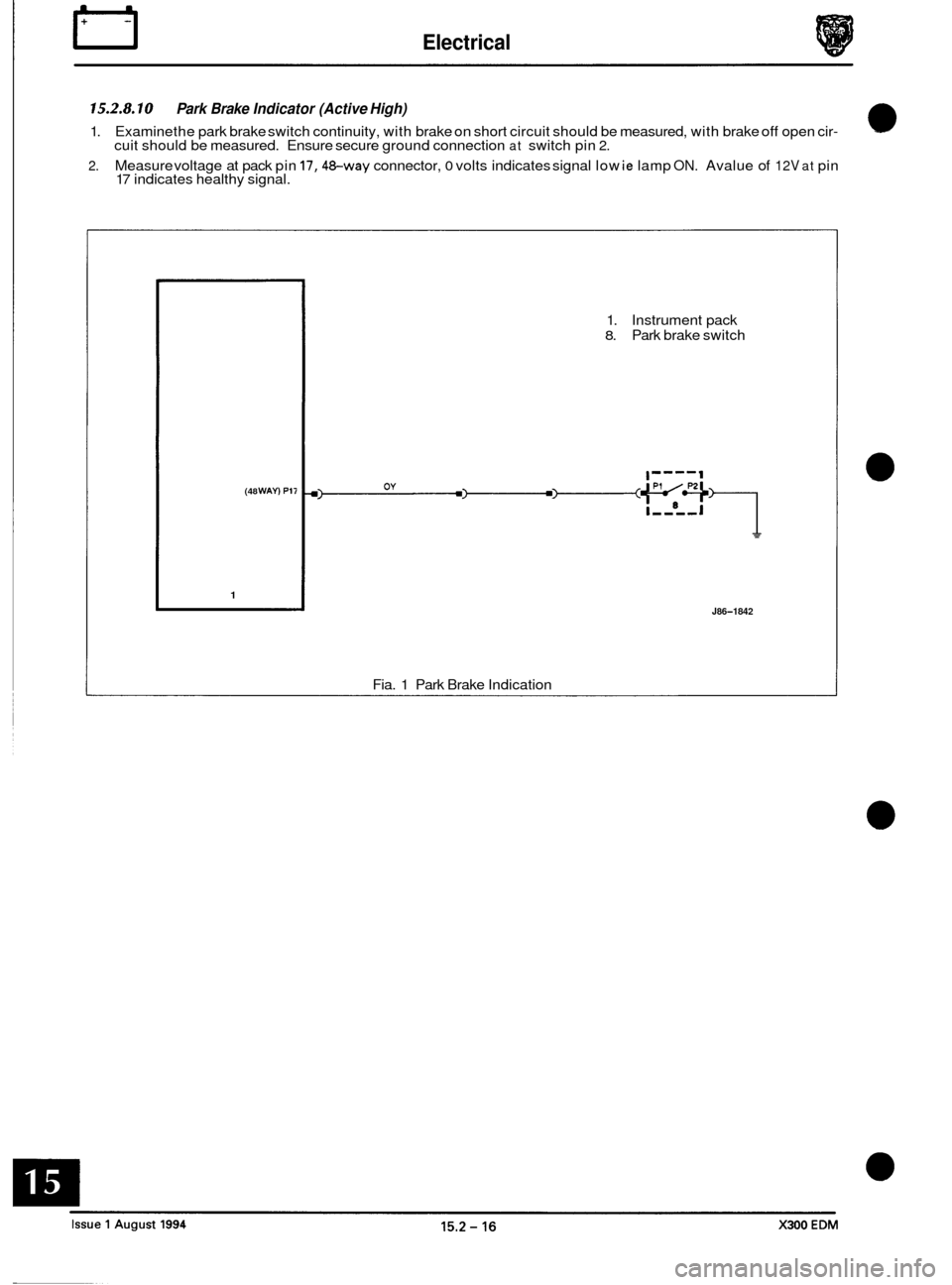
15.2.8.10
1.
2.
Park Brake Indicator (Active High)
Examine the park brake switch continuity, with brake on short circuit should be measured, with brake off open cir- cuit should be measured. Ensure secure ground connection at switch pin 2.
Measure voltage at pack pin 17,48-way connector, 0 volts indicates signal low ie lamp ON. Avalue of 12V at pin
17 indicates healthy signal.
(48 WAYl PI7
1
1. Instrument pack 8. Park brake switch
J86-1842
Fia. 1 Park Brake Indication
e
0
0
0
Page 190 of 327

15.4 DRIVER ERGONOMICS
15.4.1 System Description
Adjustment of the seats, steering column and exterior rear view mirrors position is effected by means of control
switches. The switches maintain the adjustment facility while depressed, movement ceasing when the switch is re- leased.
Manual adjustment can be achieved either with the ignition key in place or with the driver‘s door open, or having been
closed within the last
30 seconds.
The system offers the following facilities:
Entry
/ Exit mode; an automatic seat /column position setting for ease of driver entry into / exit from the vehicle.
Driving position set; automatic recall of up to three preferred settings.
Passenger seat set; automatic recall of up to three preferred settings.
Remote recall; automatic recall of up to two memory positions from
a remote transmitter (in key fob).
Reverse mirror dip; automatic adjustment of passenger rear view mirror when reversing.
U: Vehicles intended for the Japanese market are fitted with an additional ‘fold away’ mirror function. This func- tion allows mirrors to fold flat against the car when parking in enclosed areas.
15.4.1.1 Entry/ Exit Mode
Entry / Exit mode is designed to give easier vehicle entry and exit for the driver. The facility is selected by positioning
the mode switch, located on the LH side of the column cowl, to ‘auto’ which designates the current seat / column posi- tion, ie driving positions, as the memorized position. On removal of ignition key or opening of driver‘s door, with igni- tion key still in place, the driver’s seat will move to the rear (current position allowing) and the column will adopt ‘tilt
away’ mode automatically creating additional space for driver exit
/ entry. Insertion of key in ignition or closure of
driver‘s door (with ignition key in place) returns seat / column positions to the memorized (previous) position.
Operation of eitherthe brake pedal or
seat/column manual controls during entry/exit mode execution will abort posi- tional adjustments. Setting the mode switch to OFF disables operation of entry / exit mode.
15.4.1.2 Driving Position Set
Setting of seat, column and external rear view mirrors to preferred driving position is available using the memory but- tons located on the drivers door switch pack. With the ignition key in place enter settings to be memorized as follows:
Adjust seat, column and mirrors to desired positions.
Press the ’memory’ button
so that it becomes illuminated.
Press button
1,2 or 3 to store configuration within four seconds of memory button operation. Memory light will extin- guish and a chime will sound, indicating procedure complete.
The above procedure may be repeated two more times until each button
(1,2 & 3) has a preferred position stored in
memory, accommodating different driver settings. Operation of any push-button (1,2 or 3) will re-position seat col-
umn and mirrors to the stored settings.
Memory recall will operate under the following conditions:
. Ignition key in and gear selector in park.
8 Ignition key in and handbrake on.
8 Ignition key out and driver’s door open (or having been closed within the last 30 seconds).
Re
-setting the preferred position on any setting button automatically erases previously stored information. Memory
information is not erased if power supply to the seat and column / mirror control modules is lost (e.g. battery discon- nected).
15.4.1.3 Passenger Seat Set
The procedure for setting and recalling a preferred passenger seat position is identical to that for a driving position.
Memory recall will only operate with ignition key in auxiliary position or passenger door open, or having been closed
within the last
30 seconds.
X300 EDM 15.4 - 1 Issue 1 August 1994
Page 202 of 327

E I ect r ical
15.4.2.5 Switch pack
The seat switch pack located on the side of the seat cushion houses the following switches:
Headrest; raise
/ lower
Seat cushion
-front; raise 1 lower
Seat cushion
- rear; raise 1 lower
Squab recline
/ incline
Seat assembly forward
/ backward
Lumbar pad firm
1 relax
Each switch has
a dual function and is capable of bi-directional action, so that any setting made can be reversed using
the same switch.
15.4.3 SEAT CONTROL MODULE
The Seat Control Module (SCM) is located inside the seat frame, below the cushions. The SCM controls the actions
of all position adjustment devices by monitoring switch and feedback potentiometer inputs. The SCM also provides
an interface to and from external devices with a bearing on seat operation. The module works in conjunction with the
ColumnIMirror Control Module (C/M CM) and the Securityand Locking Control Module (S/LCM) to provide positional adjustment memory functions as described previously.
There are four connectors to the SCM, designated
AI, A2, B1 and B2, which connect the various inputs 1 outputs and
peripheral devices to the module. Connections are as listed in subsection 15.4.3.1.
A1A2 B1B2
1 1 1
i 11
1 I
6
I
1' ~
1 7i 1 I 1 122
J86 1903 12 22 12 12 7 12
Fig. 1 SCM
Pin Location Diagram
X300 EDM 15.4 - 5 Issue 1 August 1994
Page 222 of 327

68. Heating (manual seats)
0 a. Examine harness wiring, checking fuse F9 in RH 'A' post base fuse box.
Ensure continuity between heater relay connector pin 85 and BPU yellow 48
-way
connector pin 23. Measure resistance from heater relay pin 87 and console switch
connector pin 10.
Check continuity from BPU black 48
-way connector B pin 38 to center console seat
heater switch module connector pin
4. Operate switch and check continuity from
BPU black 48
-way connector pin 38 to ground.
Check for
+12V supply at seat heater relay connector pins 30 and 86.
Check continuity between cushion heater module and squab module pins; resistance
values
of 1.0-2.052 and 0.5-1.252 respectively should be achieved. Ensure secure
ground connection from squab connector pin 3.
Check continuity from console switch connector pin
10 through console switch LED to
ground;
a resistance value of 0-0.5Q should be recorded.
b.
C.
d.
e.
I' T
I 19 15 16
17 OK
J86 - 1873
Fig. 1 Manual Seat Heaters
Issue 1 August 1994 X300 EDM 15.4 - 25
Page 230 of 327
Electrical rl
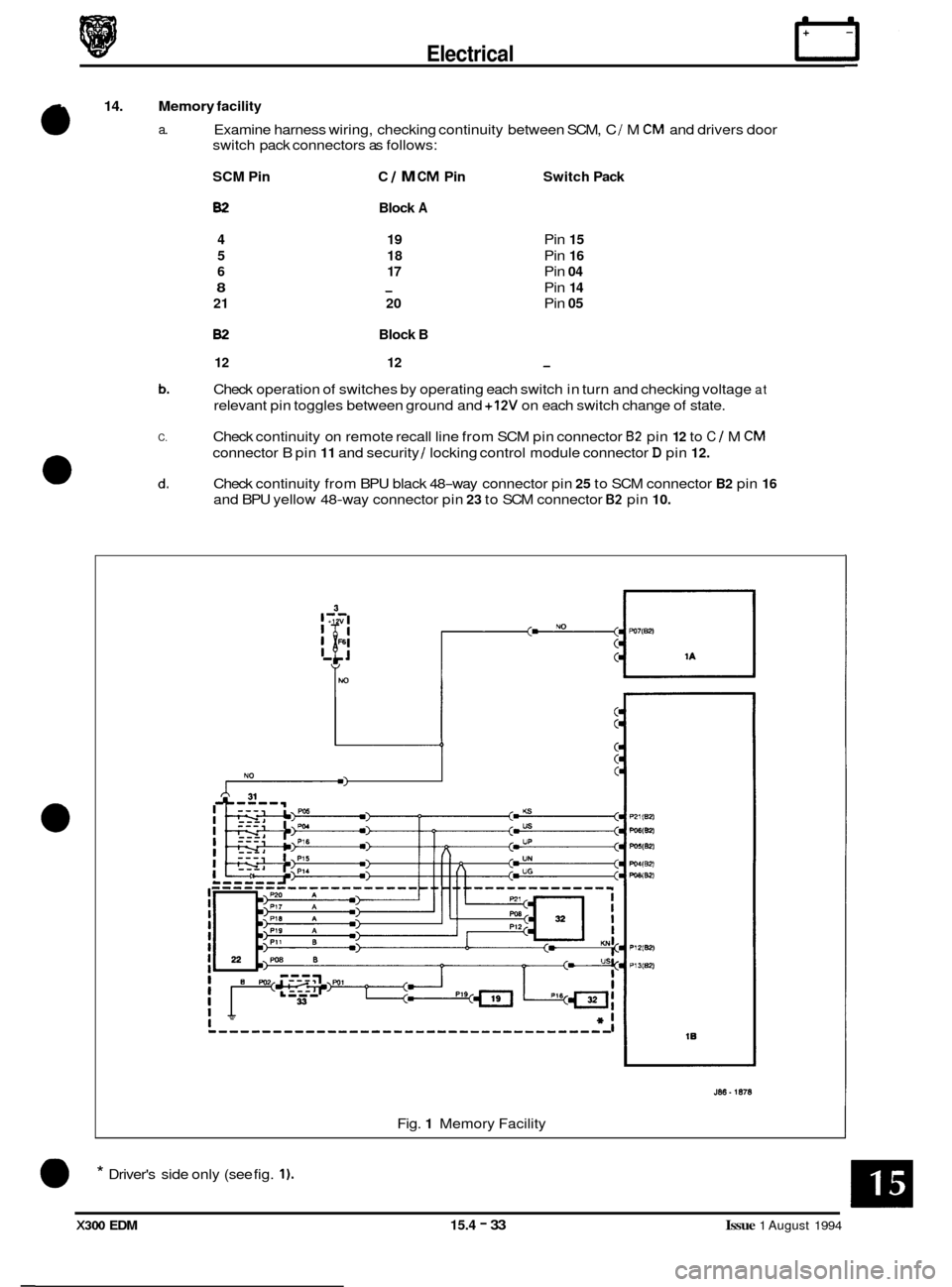
14. Memory facility
a. Examine harness wiring, checking continuity between SCM, C I M CM and drivers door
switch pack connectors as follows:
SCM Pin C / M CM Pin Switch Pack
82 Block A
4 19 Pin 15
5 18
Pin 16
6 17
Pin 04
8 - Pin 14
21 20
Pin 05
82 Block B
12 12 -
Check operation of switches by operating each switch in turn and checking voltage at
relevant pin toggles between ground and +12V on each switch change of state.
Check continuity on remote recall line from SCM pin connector
B2 pin 12 to C I M CM
connector B pin 11 and security / locking control module connector D pin 12.
Check continuity from BPU black 48-way connector pin 25 to SCM connector B2 pin 16
and BPU yellow 48-way connector pin 23 to SCM connector 82 pin 10.
b.
C.
d.
1
J86.1878
Fig. 1 Memory Facility
0 * Driver's side only (see fig. 1).
X300 EDM 15.4 - 33 Issue 1 August 1994