Page 597 of 1413
KNUCKLE
DRIVESHAFT
13. Pull the knuckle outward, and remove the driveshaft
outboard joint from the front wheel hub using I
Dlastic hammer.
Remove the set ring from the inboard joint.
To remove the boot band, pry up the locking tabs
with a screwdriver and raise the end of the band,
CAUTION: Taks caro not to damagc thc boot.
NOTE: Carefully clamp the driveshaft in a vise with
soft iaws.
SET RINGReplace.
- lf the boot band is the welded type, cut it off as
snown,
1.
16-5
Page 611 of 1413
System Description
Fluid Flow Diagram
The system is a compact rotary-valvs-type power stssring, connocted to the st€oring gearbox. Th6 fluid pressure is pro-vided by a vane-type pump which is driven by the engine crank pulley. The amount of fluid and pressurs is regulsted bythe flow control valve built into ths pump, The fluid prssaurs from th6 pump is dolivsred to tho valve unit sround the pin-ion of the steering g€arbox. The vslv€ inside the valvs unit controls the hydraulic prossur€ End changos the direction otthe flow. The fluid then flows to the power cylinder, where rack thrust is gen6rat6d. Fluid returning from th6 powsr cylin-der flows back to the .eservoir, where the fluid is 'filtered" and supplied to the pump Egain.
17-4
Page 612 of 1413

Construetion
The pump is a vane-type incorporating a flow control valve (with an integrated relief valve) and is driven by a V-belt from
the crank pulley. The pump features 10 vanes, Each vane performs two intake/dischsrge operations for every rotation of
the rotor. This means that the hydraulic fluid pressure pulse becomes extremely small during discharge.
CAM RING
FLOW CONTBOL VALVE
DRIVE
Operation
The belt-driven pulley rotates the rotor through the drive shaft, As the rotor rotates, the hydraulic pressure is applied to
the vane chamber of the rotor and the vanes witl rotate while being pushed onto the inner circumference of the cam .ing.
The inner circumference of the cam ring has an extonded portion with respect to the center of the shaft. so the rollers
move downward in the axial direction as the carrier rotates. As a result of this roller movemsnt, the internal volume of the
vane chamber will change, resulting in fluid intake and discharge.
START OF FLUID INTAKE:FLUID INTAKE:FLUID MOVEMENT:FLUID DISCHABGE:
DISCHARGE P('BT
I
SHAF'
The vanes are pushed ontothe inner circumference of th6cam ring.
Th6 volums otth€ van€ cham-ber increasos so that lluid issuckod in.
Th6 sucked-in fluid moves
towsrd the discha196 pon.As the vanes return to th€their original position on theinner side, the volume of thevane chamber decreases sothe fiuid is discharg6d fromthe discharge port.
(cont'd)
INLET PORT
VANE
Page 615 of 1413

System Description
Steering Gearbox
The rack-and-pinion type steering gearbox has a valve unit incorporated with the pinion to control the steering fluid pres-
sure. Steering fluid from the pump is regulated by a rotary valve in the valve unit and is sent through the cylinder pipe to
the power cylinder, where hydraulic pressure is applied. The steering fluid in the other side of the power cylinder returns
through the cylinder pipe and valve unit to the reservoir.
VALVE UNIT
CYLINDER PIPE
POWEB CYLINDER
Valve Unit
Inside the valve unit is the valve, which is coaxial with the pinion shaft, and controls the steering fluid pressure. The valve
housing is connected with the fluid pipe from the pump, return pipe to the pump, and the two cylinder pipes from the
respective power cylinder.
The pinion shaft is double - structured with the input shaft connected to the pinion gear, both of which are interconnected
with the torsion bar.
The pin insened in the valve and the pinion shaft groove engage; this allows the pinion shaft to rotate together with the
Because of this construction, the difference in angle in the circumferential direction between the input shaft and the valve
becomes larger according to the torsional strength of the pinion or steering resistance. However, maximum torsion
between the shafts is regulated by the engaged splines of the shafts at the pin engagement section to hold the torsion bar
within the set value.
This allows the steering system to lunction as an ordinary rack-and-pinion type steering if the steering fluid is not pressur-
ized because of a faulty pump.
VALVE
Difforcnco in .ngl. bo{w€cn thainput shalt rnd pinion !h.tt
ln-1
B
lEngag€ with the pinionshaft groove)
17-8
INPUT SHAFT
Page 662 of 1413

Apply power steering fluid to the surface of the spe-
cial tool. Set the new seal rings over the special tool
from the smaller diameter end of the tool, and
expand the seal rings. Do two rings at a time from
each end of the sleeve,
NOTE:
. Do not over-expand the seal ring. Install the resin
seal rings with care so as not to damage them.
After installation, be sure to contract the seal
rings using the specialtool {sizing tool}.
. There are two types of sleeve seal rings: black
and brown. Do not mix the different types of
sleeve seal rings as they are not compatible.
Set the special tool in the grooves in the sleeve. and
set each ring in each groove securely.
NOTE: After installation, compress the seal rings
with your fingers temporarily.
BALL JOINT BOOT CLIP GUIDEo?MAG - SL001d)
14. Apply power steering fluid to the seal rings on the
sleeve and to the entire inside surface of the special
tool.
15. Insert the sleeve into the specialtool slowly.
16. Move the sl€eve each direction several times to
make the seal rings snugly fit in the sleeve.
NOTE: Be sure that the seal rings are not turned up.
SLEEVE SEAL RINGSIZING TOOL
13.
07974 - 5450200
Cutout,
't7.Apply power steering fluid to the surface ol the pin-
ion shaft, then assemble the sleeve over the pinion
shaft, aligning the locating pin on the inside of the
sleeve with the cutout in the shaft,
NOTE: Be careful not to damage the valve seal ring
when inserting the sleeve.
Install the circlip securely in the pinion shaft groove.
NOTE: Install rh€ circlip with its tapered side facing
OUI.
19. Apply power steering fluid to the seal ring lip of the
valve oil seal. Then install the seal in the valve
housing using a hydraulic press and special tools as
shown.
18.
ATTACHMENT,32x35mm077{6 - 0010100
{cont'd)
VALVE OIL SEAL
17-55
ir
Page 922 of 1413
Windshield, Rear Window, Ouarter Glass
lndex
NOTE: The numbers after the part names show the quantities of the parts used.
Hatchback
RIGHT SIDE
UPPER RUBBER DAM
CLIP E. 2 Whir€
Cl-lP F, 2 Loft. WhitoRight. Bluo
CLIP A, I Rod
RETAINER, 6 Orengo
CLIP B, 2 O.an96
CLIP C, 2 Black
LEFT SIDE MOLDING
CLIP D. 2 G.6en
AINER, 2 Ysllow
UPPER SEAL
UPPER FASTENER, 2(S€lt-adh.sive-type, glass sid6l
UPPER FASTENER, 2(Self-6dhosiv6-type, hatch sidel
e.'.
RET
REAR WINDOW MOLOINGReplacement, page 2O-65
SIDE RUAAERDAM. 2
SIOE SPACER. 2
REAR WINDOWRemoval, page 20'6'1Instaflataon, page 20-62
f ? *
""'^i^r.{"'/\
LOWER FASTENER. 2{Self-adh6siv€-type,glass sidel
LOWER FASTENER, 2{Selt-adhosive-1ype,hatch sid6)TAPE B, 2
20-53
UPPER MOLOING
Removal, page 20-55Installation, page 20-56
ADHESIVE
Page 923 of 1413
Windshield, Rear Window
lndex
part names show the quantities of the parts used.
RIGHT SIDE MOLDING
WINDSHIELDRemoval, page 20-55Installation, page 20-56
CLIP F, 2 L6ft. WhltoRighl. Bluo
CLIP A, I Rod
€
e
&...- *aro,nr*. 6 o'!.gc
CLIP B, 2 B?own
AINER. 2 Yollow
,@
/'GLASS BRACKET, 2
REAR WINDOWRemoval, page 20-68Installation,page 20-69
NOTE: The numbers after the
Sodan
bq
UPPER MOLDII{GUPPER RUEBER OAM
cLtP E, 2 Whir6
A
\
RET
REAR WINDOW MOLOING
R.-.......-"-.owER FA'TENER. 2
lsolf-.dhe3ivo-type, sla$ sidol
LOWER FASTENER, 2(Solt-rdhe.lvo-typo. body sidol
UPPER FASTENER, 2
{S.ll-.dho!lvo-typo, gh$ .ldcl
g
.qB.....--
urra" FAslEr{ER, 2(Cllp-typo, body .ld.l
&'.....- r,o, sPAcER, 4
20-54
LOWER COVER
ffit*--
Page 1015 of 1413
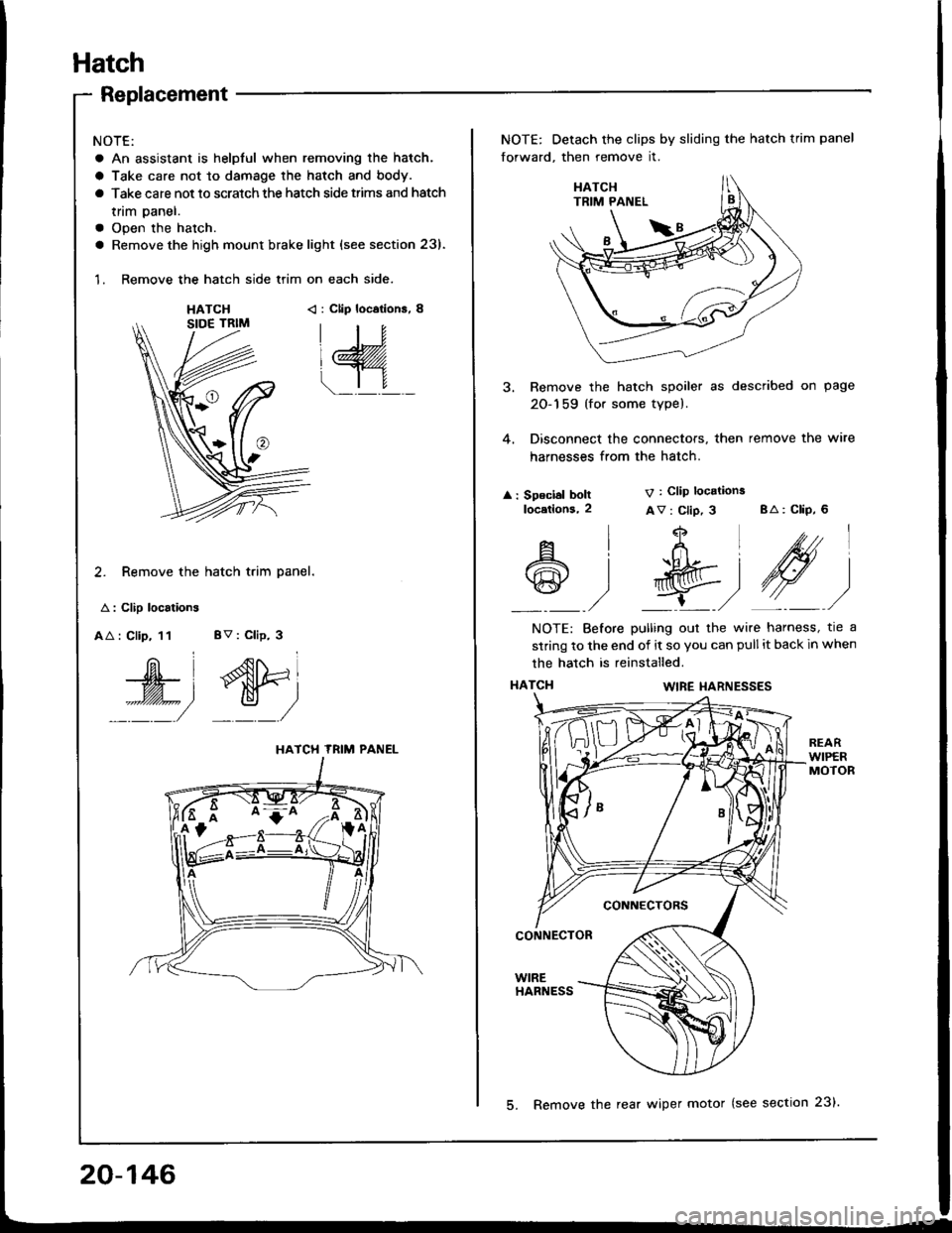
Hatch
Replacement
NOTE:
a An assistant is helpful when removing the hatch.
a Take care not to damage the hatch and body.
a Take care not to scratch the hatch side trims and hatch
tnm paner.
a Open the hatch.
a Remove the high mount brake light {see section 23).
1. Remove the hatch side trim on each side.
HATCH< : Clip locations, 8
2. Remove the hatch trim panel.
A : Clip localions
AA : Clip, 11 BV : Clip, 3
W', dtri
::::/ _:_/
HATCH TRIM PANEL
NOTE: Detach the clips by sliding the hatch trim panel
forward, then remove it.
3. Remove the hatch spoiler as described on page
20-159 (for some type).
4. Disconnect the connectors, then remove the wire
harnesses from the hatch.
: Speclal boltlocetlons,2
V : Clip locations
Av : Clip, 3 BA: CliP, 6
4
t+Ltfrl
l'R@t
,/ L,/
A
@
l
)
NOTE: Before pulling out the wire harness, tre a
strinq to the end of it so you can pull it back in when
the hatch is reinstalled.
HATCI{WIRE I{ARNESSES
CONNECTORS
CONNECTOR
WIREHARNESS
20-146
5. Remove the rear wiper motor (see section 23).


