1994 CHEVROLET TRACKER tires
[x] Cancel search: tiresPage 118 of 258

Slow down, especially on higher
speed roads. Your headlights can light
up
only so much road ahead.
0 In remote areas. watch for animals.
0 If you're tired, pull off the road in a
safe place md rest.
Night Vision
No one can see 11s well at night as in the
daytime.
But as we get older these
differences increase. A SO-year-old driver
may require at least twice as much
light to
see the same thing
a( night :is a
20-year-old.
What you do
in the daytime can also
affect your night vision. For example.
if
you spend the day in bright sunshine you
are wise
to wear sunglasses. Your eyes
will have less trouble adjusting
to night.
But
if you're driving, don't wear
sunglasses at night. They may cut down
on glare from headlights. but they also
make
a lot of things invisible.
You can be temporarily blinded by
approaching lights. It c;tn take a second or
two,
or even several seconds, for your
eyes
to readjust to the dark. When you are
ked with severe glare
(as from a driver
who doesn't lower the high beams. or a vehicle with Inisaimed headlights), slow.
down
a little. Avoid staring directly into
the approaching lights.
Keep your windshield and
all the glass on
your vehicle clean - inside and out.
Glare
at night is nladc much worse by dirt
on the glass. Even the inside of the glass
can build up a film caused by dust. Dirty
glass makes lights dazzle and flash more
than clean
glass would. making the pupils
of
your eyes contract repeatedly.
Remember that your hcacilights light
up
far less of' LI roadway when you are in a
turn or curve.
Kecp your eycs moving: that way,
it's
casier to pick out dimly lighted objects.
Just
as your headlights should be checked
regularly for proper aim.
so should your
eyes be examined regulurly.
Some drivers
suffer from night blindness
- the
inability to see
in dim light - and aren't
even aware
of it.
Driving in the Rain
Rain and wet roads can mean driving
trouble. On
a wet road you can't stop,
accelerate
or turn as well because your
tire-to-road traction isn't as good as on
dry roads. And,
if your tires don't have
much tread left, you'll get even less
traction.
It's always wise to go slower and
be cautious if
rain starts to fall while you
are driving. The surface may get wet
suddenly when your reflexes are tuned for
driving
on dry pavement.
The heavier the rain. the harder
it is to
see. Even if your windshield wiper blades
are
in good shape. a heavy rain can make
it harder to see road signs and traffic
signals, pavement markings,
the edge of
the road, and even people walking.
117 ...
ProCarManuals.com
Page 119 of 258

Your Driving and the Road
It’s wise to keep your wiping equipment
in good shape and keep your windshield
washer tank filled. Replace your
windshield wiper inserts when they show
signs of streaking or missing areas on the
windshield, or when strips of rubber start
to separate from the inserts.
Driving too fast through large water
puddles or even going through some car
washes can cause problems, too. The
water may affect your brakes. Try to
avoid puddles. But
if you can’t, try to
slow down before you hit them.
Hydroplaning
Hydroplaning is dangerous. So much
water can build
up under your tires that
they can actually ride on the water. This
can happen if the road is
wet enough and
you’re going fast enough. When your
vehicle is hydroplaning,
it has little or no
contact
with the road.
Hydroplaning doesn’t happen often.
But it
can if your tires haven’t much tread or
if
the pressure in one or more is low. It can
happen
if a lot of water is standing on the
road.
If you can see reflections from trees,
telephone poles, or other vehicles, and
raindrops “dimple” the water’s surface,
there could be hydroplaning.
Hydroplaning usually happens at higher speeds. There just isn’t a hard and fast
rule about hydroplaning. The best advice
is to slow down when it is raining.
Some Other Rainy Weather Tips
Turn on your low-beam headlights -
not just your parking lights - to help
make you more visible to others.
0 Besides slowing down, allow some
extra following distance. And be
especially careful when you pass
another vehicle. Allow yourself more
. . .I18
ProCarManuals.com
Page 120 of 258

clear room ahead, and be prepared to
have your view restricted by road
spray.
0 Have good tires with proper tread
depth. (See "Tires"
in the Index.)
City Driving
One ofthe biggest problems with city
streets is the arnount of trafl'ic
on them.
You'll want
to watch out for what the
other drivers are doing and pay attention
to traffic signals.
Here are ways to increase
your safety in
city driving:
0 Know the best way to get to where
you are going. Get
a city rnap and plan
your trip into an unknown part of the
city just
as you would for a
cross-country trip.
Try to use the freeways that rlrn and
crisscross tnost large cities.
You'll
save time and energy. (See the next
section, "Freeway Driving.")
Treat a green light as a warning signal.
A traffic light is there because the
corner is busy enough to need
it.
When a light turns green, and just
before
you start to move, check both
ways for vehicles that have not
cleared the intersection or may be
running the red light.
119.. . ProCarManuals.com
Page 122 of 258

0
0
Wiper Blades: Are they in good
shape?
Fuel, Engine Oil, Other Fluids:
Have you checked all levels?
Lights: Are they all working? Are the
lenses clean?
Tires: They are vitally important to a
safe, trouble-free trip. Is the tread
good enough for long-distance
driving? Are the tires all inflated to
the recommended pressure?
Weather Forecasts: What’s the
weather outlook along your route?
Should you delay your trip a short
time to avoid a major storm system?
Maps: Do you have up-to-date
maps?
Highway Hypnosis
Is there actually such a condition as
“highway hypnosis”? Or is it just plain
falling asleep at the wheel? Call
it
highway hypnosis, lack of awareness, or
whatever.
There is something about an easy stretch
of road with
the same scenery, along with
the hum of the tires
on the road, the drone
of the engine, and the rush of the wind
against the vehicle that can make you sleepy. Don’t let it happen
to you! If it
does, your vehicle can leave the road in
less than a second, and
you could crash
and be injured.
What can you do about highway
hypnosis? First, be aware that
it can
happen.
Then here are some tips:
0 Make sure your vehicle is well
ventilated, with a comfortably cool
interior.
0 Keep your eyes moving. Scan the
road ahead and to
the sides. Check
your mirrors and your instruments
frequently.
0 If you get sleepy, pull off the road into
a rest, service, or parking area and
take a nap, get some exercise,
or both.
For safety, treat drowsiness on the
highway as an emergency.
Hill and Mountain
Roads
Driving on steep hills or mountains is
different from driving
in flat or rolling
terrain. If you drive regularly in steep
country, or
if you’re planning to visit
there, here are some tips that can make
your trips safer and more enjoyable.
(See “Off-Road Driving” in the Index
for information about driving off-road.)
Keep your vehicle in good shape.
Check all fluid levels and also the
brakes, tires, cooling system and
transmission. These parts can work
hard
on mountain roads.
ILI . . .
ProCarManuals.com
Page 124 of 258

Include an ice scraper7 a small brush or
broom. a supply of windshield washer
fluid,
a rag, some winter outer clothing, a
small shovel, a flashlight, a red cloth, and
a couple of reflective warning triangles.
And,
if you will be driving under severe
conditions, include
:I small bag of sand, ;I
piece of old carpet or a couple of burlap
bags to
help provide traction. Be sure yo11
properl}, secure these item in your
vehicle.
Driving on Snow or Ice
Most of the time. those placcs where your
tires meet the road probably have good
traction.
Howe\w-.
it’ thcrc is snow or ice between
your tires antl the road, you can Iwve ;I
very slippery situation. You‘ll have ;t lot
less traction or “grip“ and will need to be
very careful.
What‘s the worst time
for this’? “Wet ice.”
Very cold snow
or ice can be slick and
hurd to drive on. Rut wet ice can be even
more trouble because
it nlay offer the
least traction
of all. You can get ”wet ice”
when it’s about freezing
(32°F; 0°C) and
freezing rain begins to fall. Try to avoid
hiving on wet ice
until salt and sand
:rews
can get there. Whatever the condition
- smooth ice.
packed. blowing or loose snow
- drive
with caution.
Accelerate gently. Try not
to break the
fragile traction. If you accelerate too fast,
the drive wheels will spin and polish the
surface under the tires even more.
Your anti-lock brakes improve your
ability
to make a hard stop on a slippery
road. Even though you have
an anti-lock
braking system.
you’ll want to begin
stopping sooner than
you would on dry
pavement.
See “Anti-lock” in the Index.
0
0
Allow greater following distance on
any slippery road.
Watch for slippery spots. The road
might be fine
until you hit H spot that’s
covered with ice.
On an otherwise
clear road. ice patches may appear
in shaded areas where the sun can’t
reach: around clumps
of trees. behind
buildings, or under bridges.
Sometimes the surftlce
of a curve or
an overpass may remain icy when the
surrounding roads are clear.
If you
see a patch of ice ahead of you, brake
before you are on
it. Try not to brake
while
you’re actually on the ice, and
avoid sudden steerins maneuvers.
123 ...
ProCarManuals.com
Page 126 of 258

Towing a Trailer
NOTICE:
Pulling a trailer improperly can dam-
age your vehicle and result in costly
repairs not covered by your warranty,
To pull a trailer correctly, follow the
advice in this section, and see your
Geo dealer for important information
about towing a trailer with your
vehicle. Your
vehicle can tow a trailer. To identify
what the vehicle trailering capacity
is for
your vehicle,
you should read the
information in “Weight
of the Trailer” that
appears later in this section.
But trailering
is different than just driving your vehicle
by itself. Trailering means changes in
handling, durability, and fuel economy.
Successful, safe trailering takes correct
equipment, and it has to be used properly.
That’s the reason for this section.
In it are
many time-tested, important trailering
tips and safety rules. Many of these are
important for your safety and that of your
passengers.
So please read this section
carefully before you pull a trailer.
Load-pulling components such as the
engine, transmission, wheel assemblies,
and tires are forced to work harder against
the drag of the added weight. The engine
is required to operate at relatively higher
speeds and under greater loads,
generating extra heat. What’s more, the
trailer adds considerably to wind
resistance, increasing the pulling
requirements.
If You Do Decide to Pull a Trailer
If you do, here are some important points.
There are many different laws having
to do with trailering. Make sure your
rig will be legal, not only where you
live but also where you’ll be driving.
A good source for this information
can be state or provincial police.
Consider using a sway control. You
can ask a hitch dealer about sway
controls.
Don’t tow a trailer at all during the
first
500 miles (800 km) your new
vehicle is driven. Your engine, axle or
other parts could be damaged.
Then, during the first
500 miles (800
km) that you tow a trailer, don’t drive
over
50 mph (80 km/h) and don’t
make starts at
full throttle. This helps
your engine and other parts
of your
vehicle wear in at the heavier loads.
125 ...
ProCarManuals.com
Page 127 of 258
Your Driving and the Road
Three important considerations have to do
with weight:
Weight of the Trailer
How heavy can a trailer safely be?
It should never weigh more than 1,000
pounds (450 kg), But even that can be too
heavy.
It depends
on how you plan to use your
rig. For example, speed, altitude, road
grades, outside temperature and how
much your vehicle is used to pull a trailer
are all important. And, it can also depend
on any special equipment that you have
on your vehicle.
You can ask your dealer for our trailering
information or advice, or you can
write us
at:
Customer Assistance Department
Chevrolet/Geo
P.O.
Box 7047
Troy, MI 48007-7047
In Canada, write to:
General Motors of Canada Limited
Customer Assistance Center
1908 Colonel Sam Drive
Oshawa, Ontario L1H 8P7
A B
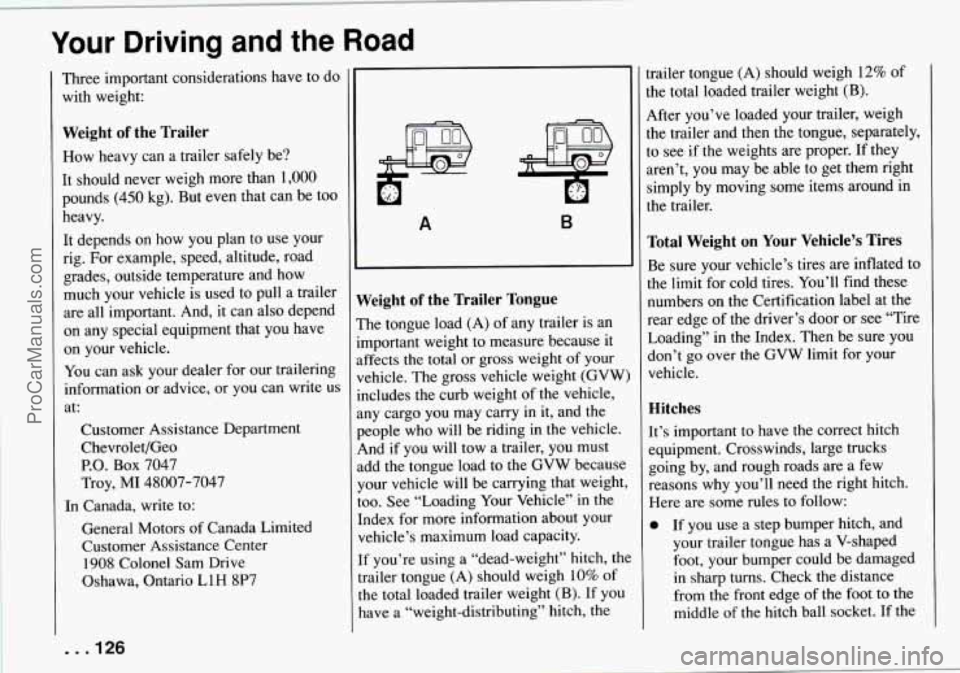
Weight of the Trailer Tongue
The tongue load (A) of any trailer is an
important weight to measure because it
affects the total or
gross weight of your
vehicle. The gross vehicle weight (GVW
includes the curb weight of the vehicle,
any cargo you may carry in it, and the
people who will be riding in the vehicle.
And if you will tow a trailer, you must
add the tongue load to the GVW because
your vehicle will be carrying that weight,
too. See “Loading Your Vehicle” in the
Index for more information about your
vehicle’s maximum load capacity.
If you’re using a “dead-weight” hitch, the
trailer tongue
(A) should weigh 10% of
the total loaded trailer weight
(B). If you
have a “weight-distributing” hitch, the :railer tongue
(A) should weigh 12% of
;he
total loaded trailer weight (B).
After you’ve loaded your trailer, weigh
the trailer and then the tongue, separately,
to see if the weights are proper. If they
uen’t, you may be able to get them right
simply by moving some items around
in
the trailer.
Total Weight on Your Vehicle’s Tires
Be sure your vehicle’s tires are inflated to
the limit for cold tires. You’ll find these
numbers
on the Certification label at the
rear edge of the driver’s door
or see “Tire
Loading” in the Index. Then be sure you
don’t
go over the GVW limit for your
vehicle.
Hitches
It’s important to have the correct hitch
equipment. Crosswinds, large trucks
going by, and rough roads are a few
reasons why you’ll need the right hitch.
Here are some rules to follow:
0 If you use a step bumper hitch, and
your trailer tongue has a V-shaped
foot, your bumper could be damaged
in sharp turns. Check the distance
from the front edge
of the foot to the
middle
of the hitch ball socket. If the
. . ,126
ProCarManuals.com
Page 128 of 258

0
distance is less than 12 inches, take
the foot off the trailer tongue.
Will you have to make any holes
in
the body of your vehicle when you
install a trailer hitch?
If you do, then
be sure
to seal the holes later when
you remove the hitch. If you don't
seal them, deadly carbon monoxide
(CO) from your exhaust can get into
your vehicle (see "Carbon Monoxide"
in the Index). Dirt and water can, too.
Safety Chains
You should always attach chains between
your vehicle and your trailer. Cross the
safety chains under the tongue of the
trailer
so that the tongue will not drop to
the road if
it becomes separated from the
hitch. Instructions about safety chains
may be provided by the hitch
manufacturer
or by the trailer
manufacturer. Follow the manufacturer's
recommendation
for attaching safety
chains. Always leave just enough slack
so
you can turn with pour rig. And, never
allow safety chains
to drag on the ground.
Trailer Brakes
If your trailer weighs more than 1,000
pounds (450 kg) loaded, then it needs its
own brakes -and they must be adequate.
Be sure
to read and follow the instructions
for the trailer brakes so you'll be able to
install, ad-just and maintain them properly.
Don't tap into your vehicle's brake
system
if the trailer's brake system
will use more than 0.02 cubic inch
(0.3 cc) of fluid from your vehicle's
master cylinder.
If it does. both
systems won't work well. You could
even lose your brakes.
Will the trailer brake parts take
3,000
psi (20 650 kPa) of pressure? If not,
the trailer brake system must not be
used
with your vehicle.
If everything checks out this far. then
make the brake fluid tap at the port on
the master cylinder that sends fluid
to
the rear brakes. But don't use copper
tubing for
this. If you do, it will bend
and finally break off. Use steel brake
tubing.
Driving with a Trailer
Towing a trailer requires a certain amount
of experience. Before setting out for the
open road, you'll want
to get to know
your rig. Acquaint yourself
with the feel
of handling and braking with the added
weight
of the trailer. And always keep in
mind that the vehicle you are driving is
now a good deal longer and not nearly so
responsive as your vehicle is by itself.
Before you start, check the trailer hitch
and platform. safety chains, electrical
contwxtor. lights, tires and mirror
adjustment. If the trailer has electric
brakes, start your vehicle and trailer
moving and then apply the trailer brake
controller by hand to be sure the brakes
are working. This lets you check your
electrical connection
at the same time.
During your trip, check occasionally to be
sure that the load is secure. and that the
lights and any trailer brakes are
still
working.
Following Distance
Stay at least twice as far behind the
vehicle ahead as
you would when driving
your vehicle without
a trailer. This can
help you avoid situations that require
heavy braking and sudden turns.
Passing
You'll need more passing distance up
ahead when you're towing a tnliler. And.
because you're
B good deal longer, you'll
need to go much farther beyond the
127 ...
ProCarManuals.com