1994 CHEVROLET SUBURBAN check engine light
[x] Cancel search: check engine lightPage 74 of 385
If Your Diesel Engine Won’t Start
If you’ve run out of fuel, look at “Running Out of Fuel” (see “Diesel Fuel
Requirements and Fuel System” in the Index).
If you’re not out of fuel, and your engine won’t start, do this:
Turn your ignition key to RUN. Make sure that the “GLOW PLUGS” light
is out. Then turn the ignition key to
START.
If the light doesn’t go off, wait a few seconds, then try starting your engine
again. And, see your dealer as soon as you can for a starting system check.
If the light comes on and then goes off and you know your batteries are
charged, but your engine still won’t start, your vehicle needs service.
If the light does not come
on when the engine is cold, your vehicle needs
service.
If your batteries don’t have enough charge to start your engine, see
“Battery” in the Index.
Be sure you have the right oil for your engine, and that you’ve changed the
oil at the proper times. If you use the wrong oil, your engine may be harder
to start.
If the engine starts, runs a short time, then stops, your vehicle needs service.
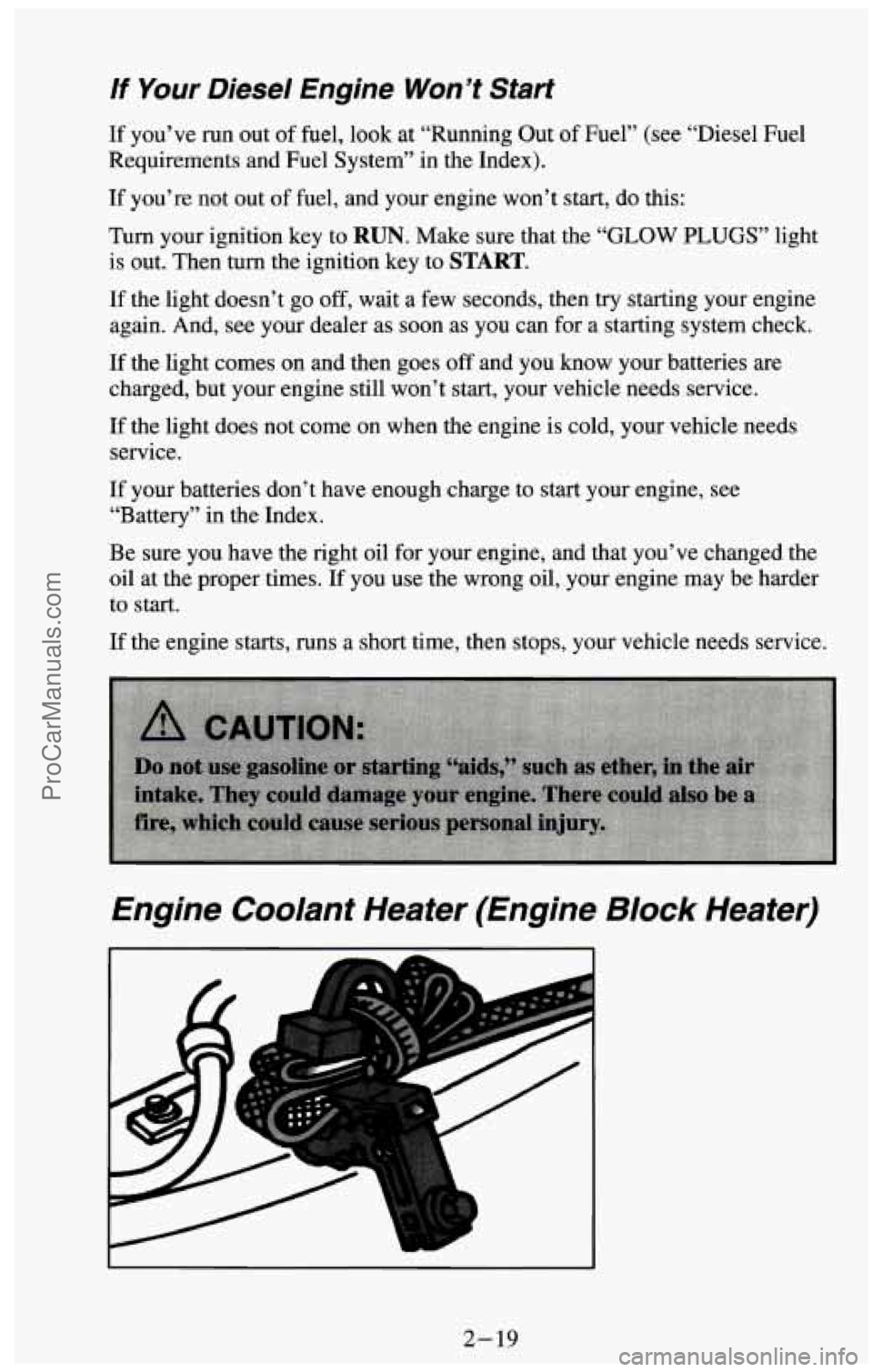
Engine Coolant Heater (Engine Block Heater)
2- 19
ProCarManuals.com
Page 121 of 385
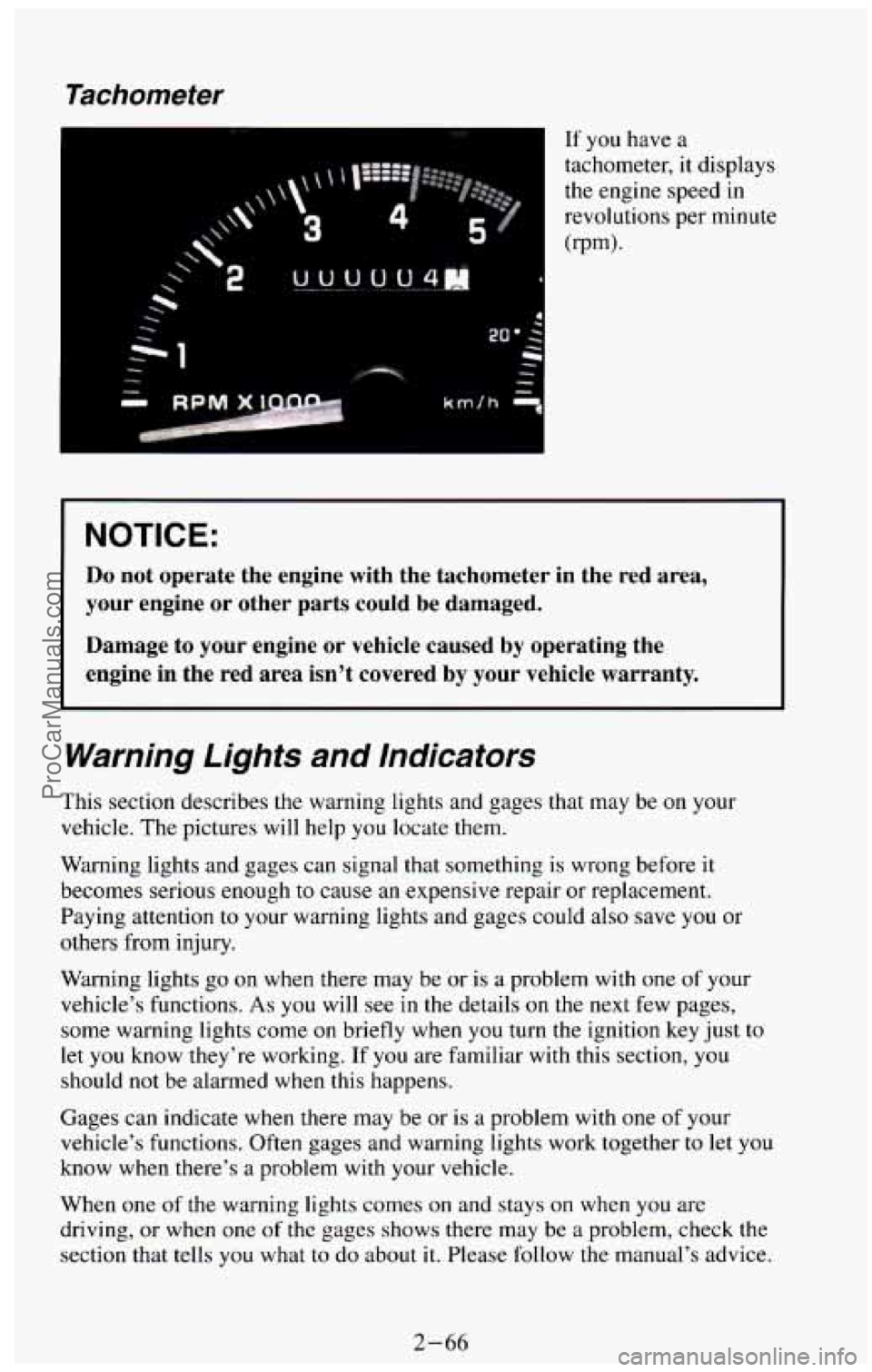
Tachometer
4
If you have a
tachometer,
it displays
the engine speed in
revolutions per minute
(rpm).
I NOTICE:
Do not operate the engine with the tachometer in the red area,
your engine
or other parts could be damaged.
Damage to your engine
or vehicle caused by operating the
engine in the red area isn't covered by your vehicle warranty.\
Warning Lights andl Indicators
This section describes the warning lights and gages that may be on your
vehicle. The pictures will help you locate them.
Warning lights and gages can signal that something
is wrong before it
becomes serious enough to cause
an expensive repair or replacement.
Paying attention to your warning lights and gages could also save you or
others from injury.
Warning lights
go on when there may be or is a problem with one of your
vehicle's functions.
As you will see in the details on the next few pages,
some warning lights come on briefly when you turn the ignition key
just to
let you know they're working. If you are familiar with this section, you
should not be alarmed when this happens.
Gages can indicate when there may be or is a problem with one of your
vehicle's functions. Often gages and warning lights work together
to let you
know when there's
a problem with your vehicle.
When one
of the warning lights comes on and stays on when you are
driving,
or when one of the gages shows there may be a problem, check the
section that tells you what to
do about it. Please follow the manual's advice.
2-66
ProCarManuals.com
Page 124 of 385
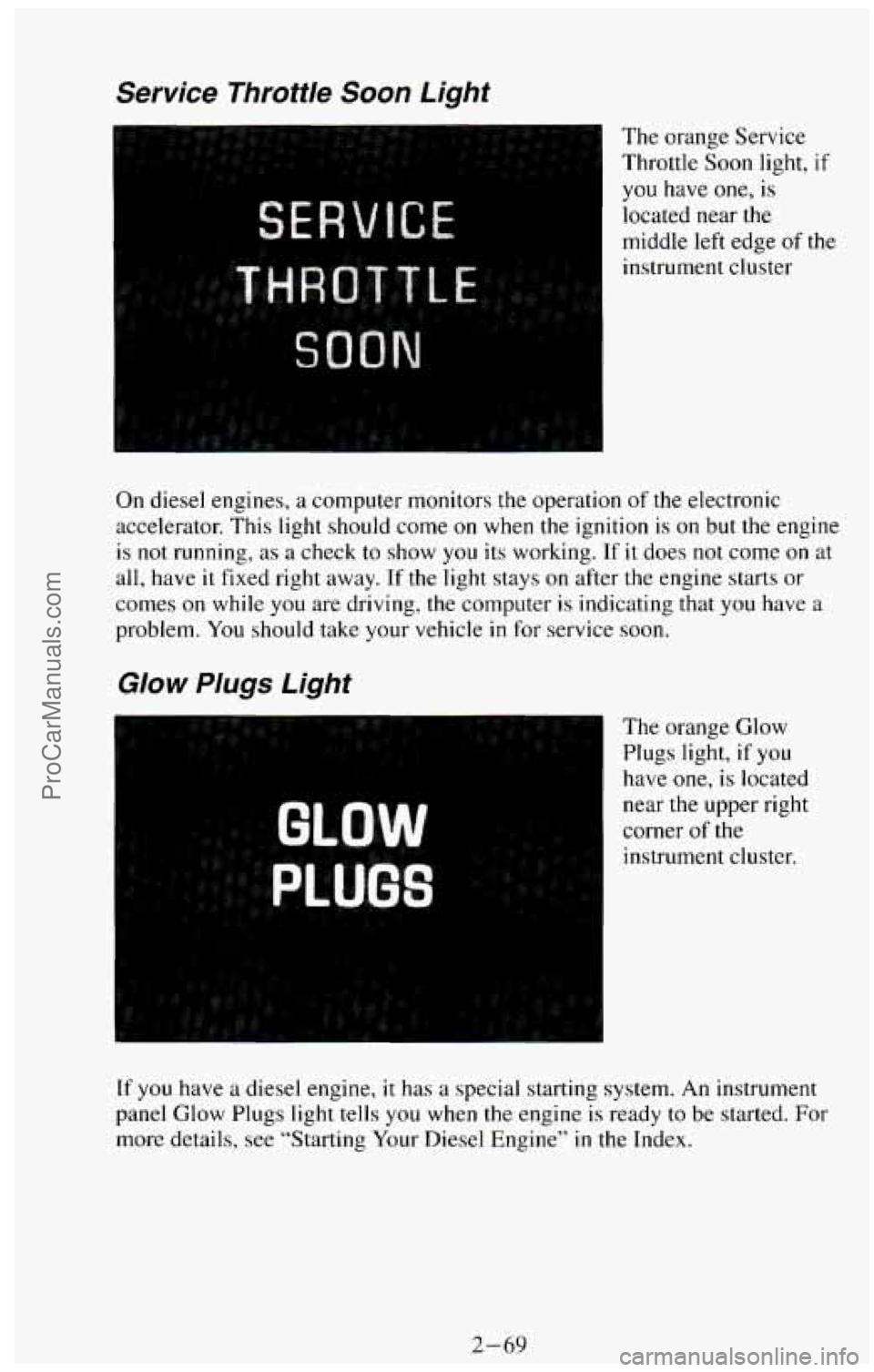
Service Throttle Soon Light
The orange Service
Throttle Soon light,
if
you have one, is
located near the
middle left edge
of the
instrument cluster
On diesel engines, a computer monitors the operation of the electronic
accelerator. This light should come
on when the ignition is on but the engine
is not running, as a check to show you its working. If it does not come on at
all, have it fixed right away.
If the light stays on after the engine starts or
comes on while you are driving, the computer is indicating that you have a
problem. You should take your vehicle in for service soon.
Glow Plugs Light
The orange Glow
Plugs light, if you
have
one, is located
near the upper right
corner
of the
instrument cluster.
If you have a diesel engine, it has a special starting system. An instrument
panel Glow Plugs light tells you when
the engine is ready to be started. For
more details, see “Starting Your Diesel Engine” in the Index.
2-69
ProCarManuals.com
Page 125 of 385
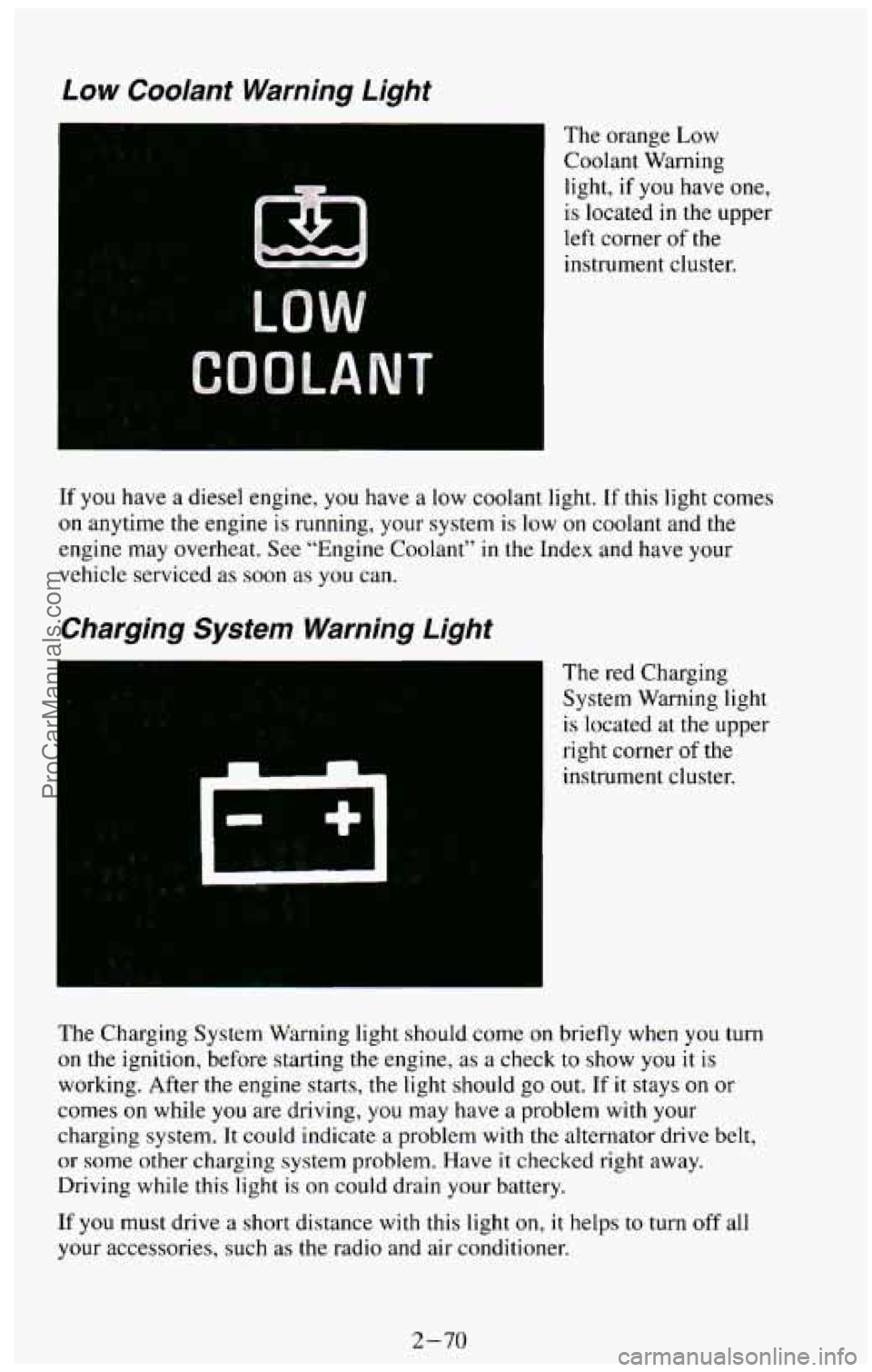
Low Coolant Warning Light
The orange Low
Coolant Warning
light, if
you have one,
is located in the upper
left corner of the
instrument cluster.
If
you have a diesel engine, you have a low coolant light. If this light comes
on anytime the engine is running, your system is low on coolant and the
engine may overheat. See “Engine Coolant”
in the Index and have your
vehicle serviced
as soon as you can.
Charging System Warning Light
The red Charging
System Warning light
is located at the upper
right corner of the
instrument cluster.
The Charging System Warning light should come on briefly when you turn
on the ignition, before starting the engine, as a check to show you it is
working. After the engine starts, the light should go out. If it stays on or
comes
on while you are driving, you may have a problem with your
charging system. It could indicate a problem with the alternator drive belt,
or
some other charging system problem. Have it checked right away.
Driving while this light is on could drain your battery.
If
you must drive a short distance with this light on, it helps to turn off all
your accessories, such
as the radio and air conditioner.
2-70
ProCarManuals.com
Page 126 of 385
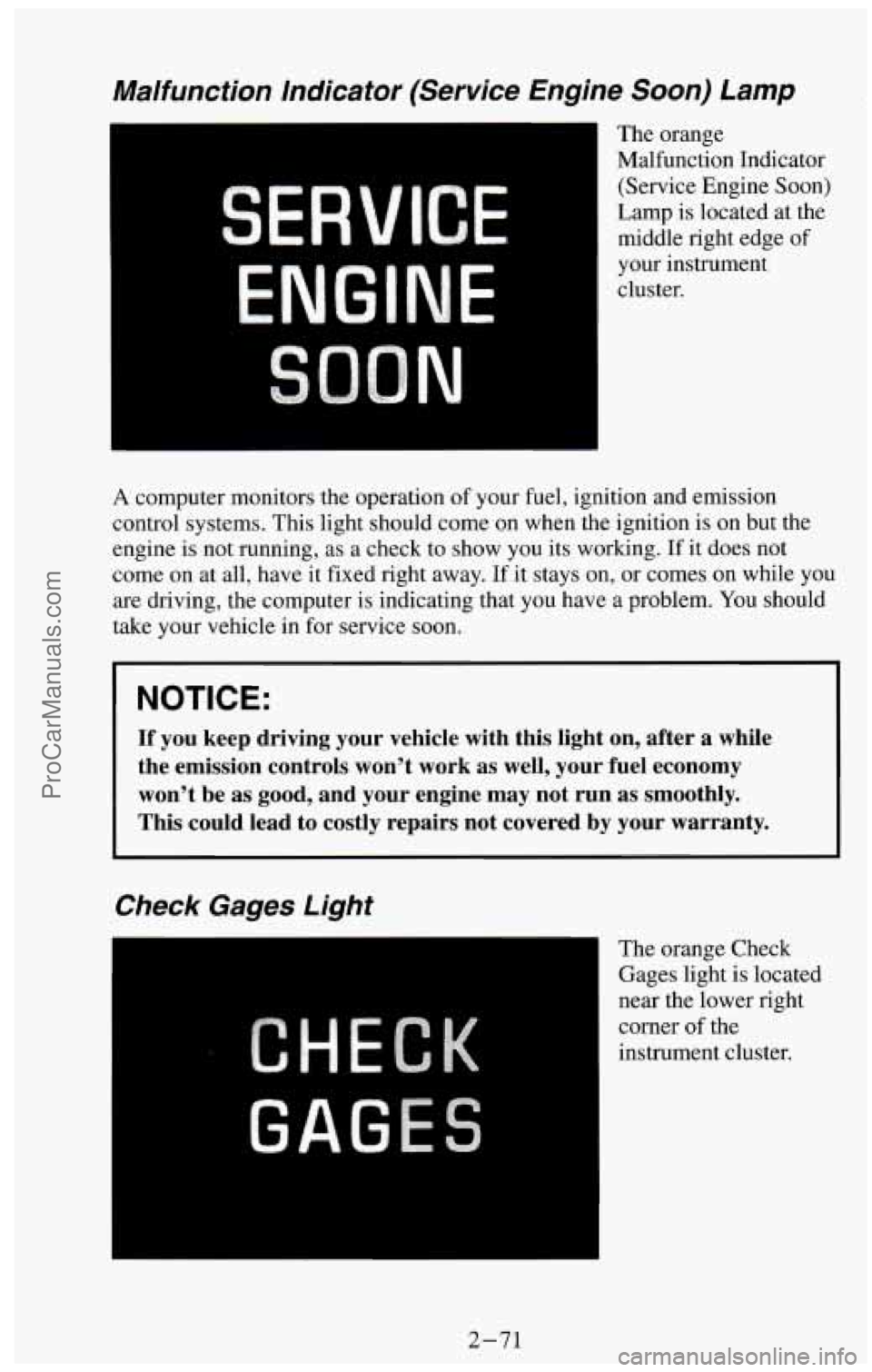
Malfunction Indicator (Service Engine Soon) Lamp
ENGINE
N
The orange
Malfunction Indicator
(Service Engine Soon)
Lamp is located at the
middle right edge of
your instrument
cluster.
A computer monitors the operation of your fuel, ignition and emission
control systems. This light should come on when the ignition is on but the
engine is not running, as a check to show you its working. If it does not
come on at all, have it fixed right away. If it stays on, or comes
on while you
are driving, the computer is indicating that you have a problem.
You should
take your vehicle in for service soon.
NOTICE:
If you keep driving your vehicle with this light on, after a while
the emission controls won’t work as well, your fuel economy \
won’t be as good, and your engine may not run as smoothly.
This could lead to costly repairs not covered by your warranty\
.
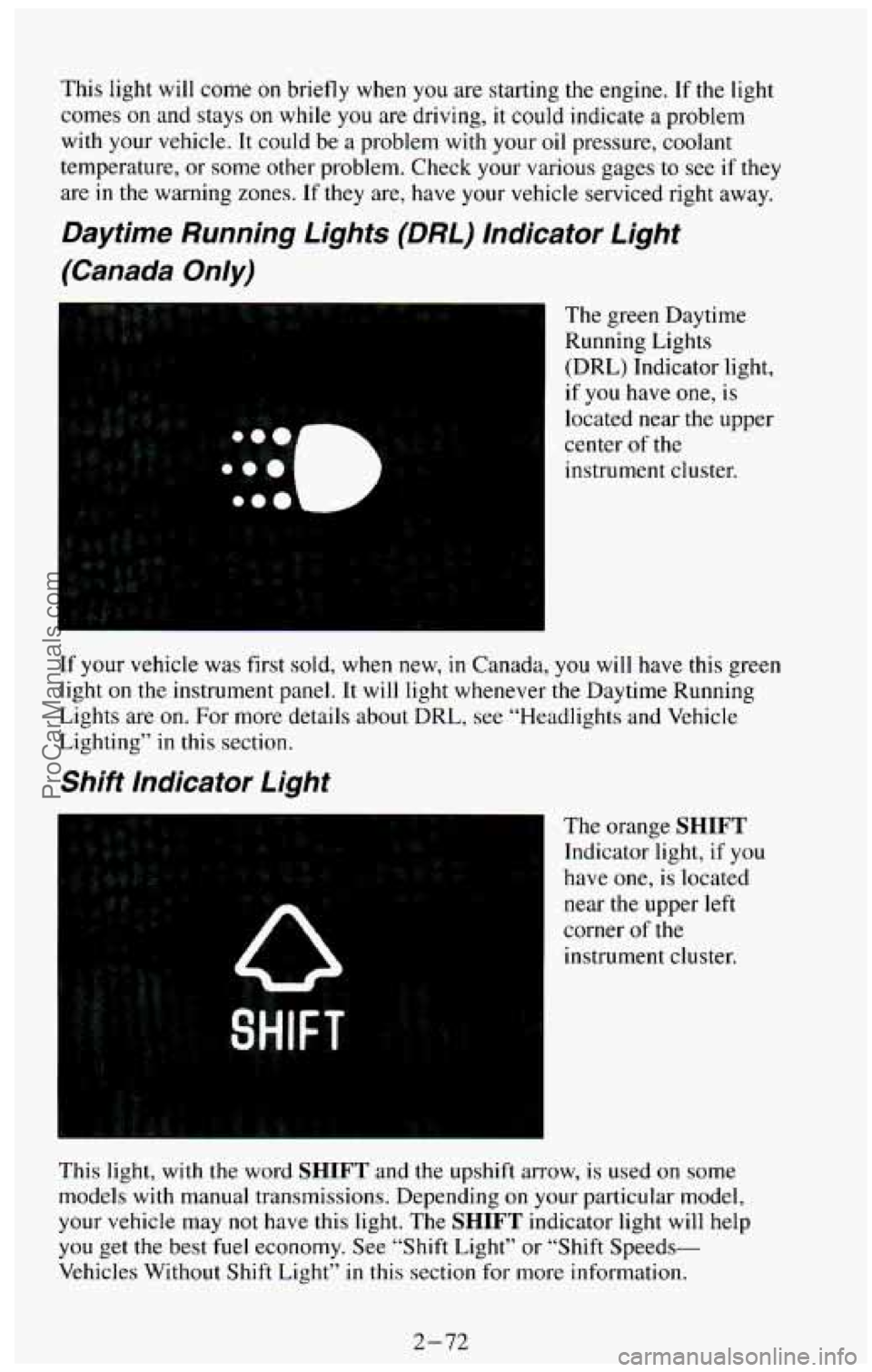
Check Gages Light
The orange Check
Gages light is located
near the lower right
corner
of the
instrument cluster.
2-71
ProCarManuals.com
Page 127 of 385
This light will come on briefly when you are starting the engine. If the light
comes
on and stays on while you are driving, it could indicate a problem
with your vehicle. It could be a problem with your oil pressure, coolant
temperature, or some other problem. Check your various gages to see
if they
are
in the warning zones. If they are, have your vehicle serviced right away.
Daytime Running Lights (DRL) Indicator Light
(Canada Only)
The green Daytime
Running Lights
(DRL) Indicator light,
if you have one,
is
located near the upper
center of the
instrument cluster.
If your vehicle was first sold, when new,
in Canada, you will have this green
light on the instrument panel. It will light whenever the Daytime Running
Lights are on.
For more details about DRL, see “Headlights and Vehicle
Lighting” in this section.
Shift Indicator Light
The orange SHIFT
Indicator light, if you
have one, is located
near the upper left
corner
of the
instrument cluster.
This light, with the word
SHIFT and the upshift arrow, is used on some
models with manual transmissions. Depending
on your particular model,
your vehicle may not have this light. The SHIFT indicator light will help
you get the best fuel economy. See “Shift Light” or “Shift Speeds-
Vehicles Without Shift Light”
in this section for more information.
2-72
ProCarManuals.com
Page 187 of 385
Once you are moving on the freeway, make certain you allow a reasonable
following distance. Expect to move slightly slower
at night.
When you want to leave the freeway, move to the proper lane well
in
advance. If you miss your exit do not, under any circumstances, stop and
back up. Drive on to the next exit.
The exit ramp can be curved, sometimes quite sharply.
The exit speed is usually posted.
Reduce your speed according to your speedometer, not to your sense of
motion. After driving for
any distance at higher speeds, you may tend to
think you
are going slower than you actually are.
Before Leaving on a Long Trip
Make sure you’re ready. Try to be well rested. If you must start when you’re
not fresh
- such as after a day’s work - don’t plan to make too many
miles that first part of the journey. Wear comfortable clothing and shoes you
can easily drive
in.
Is your vehicle ready for a long trip? If you keep it serviced and maintained,
it’s ready
to go. If it needs service, have it done before starting out. Of
course, you’ll find experienced and able service experts in vehicle
dealerships all across North America. They’ll be ready and willing
to help if
you need
it.
Here are some things you can check before a trip:
0
0
0
0
0
0
Windshield Washer Fluid: Is the reservoir full? Are all windows clean
inside and outside?
Wiper Blades: Are they in good shape?
Fuel, Engine OiZ, Other Fluids: Have you checked all levels?
Lights: Are they all working? Are the lenses clean?
Tires: They are vitally important to a safe, trouble-free trip. Is the tread
good enough for long-distance driving? Are the tires all inflated to the
recommended pressure?
Weather Forecasts: What’s the weather outlook along your route?
Should you delay your trip a short time to avoid a major storm system?
Maps: Do you have up-to-date maps?
4-28
ProCarManuals.com
Page 201 of 385
Making Turns
When you’re turning with a trailer, make wider turns than normal. Do this
so your trailer won’t strike soft shoulders, curbs, road signs, trees, or other
objects. Avoid jerky or sudden maneuvers. Signal well
in advance.
Turn Signals When Towing a Trailer
When you tow a trailer, your vehicle has to have a different turn signal
flasher and extra wiring, The green arrows on your instrument panel will
flash whenever you signal a turn or lane change. Properly hooked up, the
trailer lights will also flash, telling other drivers you’re about to turn,
change lanes or stop.
When towing a trailer,
the green arrows on your instrument panel will flash
for turns even if the bulbs on the trailer are burned out. Thus, you may think
drivers behind you are seeing your signal when they are not. It’s important
to check occasionally
to be sure the trailer bulbs are still working.
Driving On Grades
Reduce speed and shift to a lower gear before you start down a long or
steep downgrade. If
you don’t shift down, you might have to use your
brakes
so much that they would get hot and no longer work well.
On
a long uphill grade, shift down and reduce your speed to around 45 mph
(70 kdh) to reduce the possibility of engine and transmission overheating.
If you have an automatic transmission, you should use “D” (or, as you need
to, a lower gear) when towing
a trailer. Operating your vehicle in “D” when
towing a trailer will minimize heat buildup and extend
the life of your
transmission.
If
you have a manual transmission and you are towing a trailer, it’s better
not
to use fifth gear. Just drive in fourth gear (or, as you need to, a lower
gear).
Parking on Hills
You really should not park your vehicle, with a trailer attached, on a hill. If
something goes wrong, your rig could start to move. People can be injured,
and both your vehicle and the trailer can be damaged.
But
if you ever have to park your rig on a hill, here’s how to do it:
1. Apply your regular brakes, but don’t shift into “P’ (Park) yet, or in gear
for a manual transmission.
2. Have someone place chocks under the trailer wheels.
3. When the wheel chocks are in place, release the regular brakes until the
chocks absorb
the load.
4-42
ProCarManuals.com