Page 187 of 385
Once you are moving on the freeway, make certain you allow a reasonable
following distance. Expect to move slightly slower
at night.
When you want to leave the freeway, move to the proper lane well
in
advance. If you miss your exit do not, under any circumstances, stop and
back up. Drive on to the next exit.
The exit ramp can be curved, sometimes quite sharply.
The exit speed is usually posted.
Reduce your speed according to your speedometer, not to your sense of
motion. After driving for
any distance at higher speeds, you may tend to
think you
are going slower than you actually are.
Before Leaving on a Long Trip
Make sure you’re ready. Try to be well rested. If you must start when you’re
not fresh
- such as after a day’s work - don’t plan to make too many
miles that first part of the journey. Wear comfortable clothing and shoes you
can easily drive
in.
Is your vehicle ready for a long trip? If you keep it serviced and maintained,
it’s ready
to go. If it needs service, have it done before starting out. Of
course, you’ll find experienced and able service experts in vehicle
dealerships all across North America. They’ll be ready and willing
to help if
you need
it.
Here are some things you can check before a trip:
0
0
0
0
0
0
Windshield Washer Fluid: Is the reservoir full? Are all windows clean
inside and outside?
Wiper Blades: Are they in good shape?
Fuel, Engine OiZ, Other Fluids: Have you checked all levels?
Lights: Are they all working? Are the lenses clean?
Tires: They are vitally important to a safe, trouble-free trip. Is the tread
good enough for long-distance driving? Are the tires all inflated to the
recommended pressure?
Weather Forecasts: What’s the weather outlook along your route?
Should you delay your trip a short time to avoid a major storm system?
Maps: Do you have up-to-date maps?
4-28
ProCarManuals.com
Page 190 of 385
Winter Driving
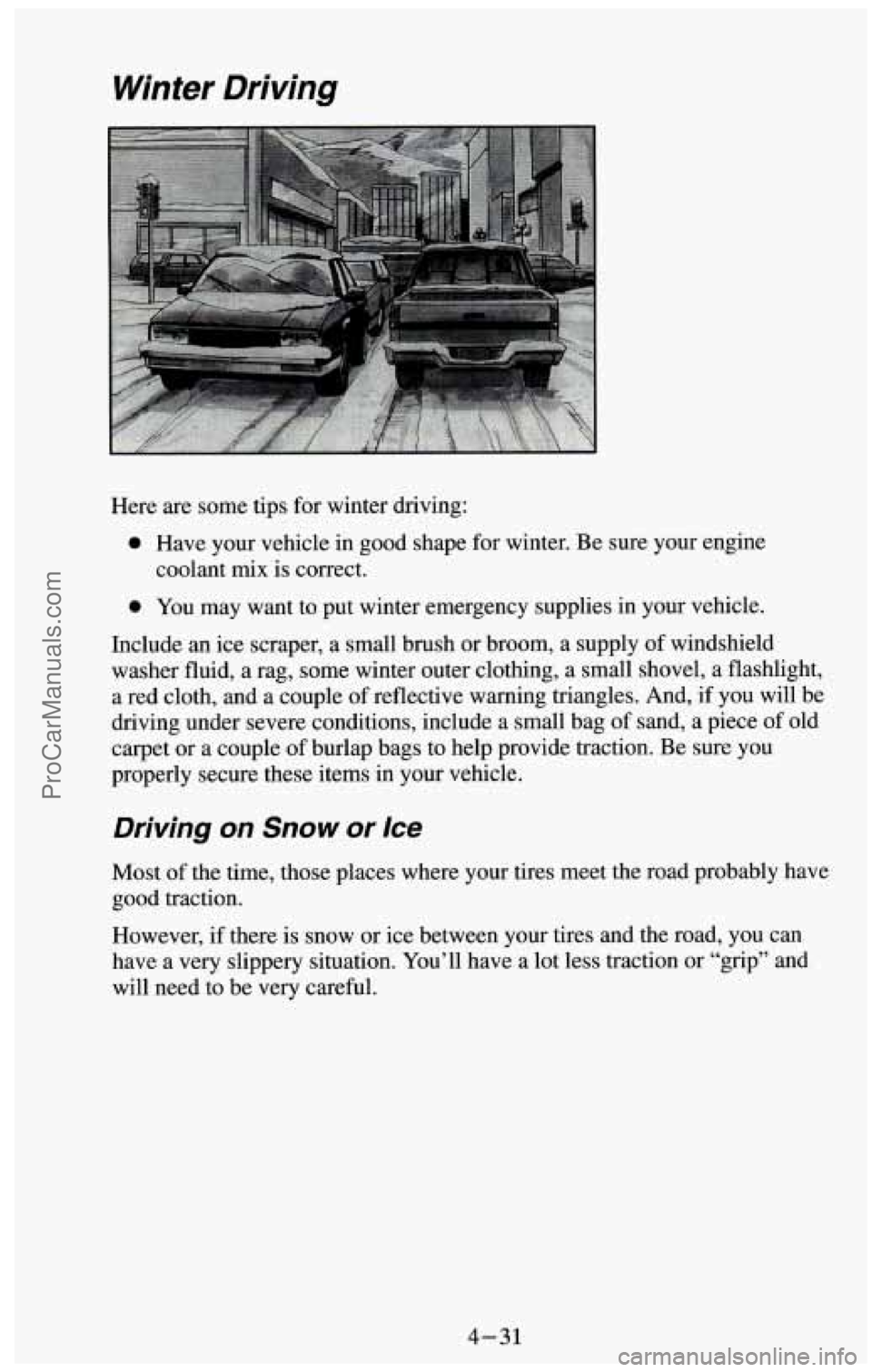
Here are some tips for winter driving:
0 Have your vehicle in good shape for winter. Be sure your engine
coolant
mix is correct.
0 You may want to put winter emergency supplies in your vehicle.
Include an ice scraper, a small brush or broom, a supply
of windshield
washer fluid, a rag, some winter outer clothing, a small shovel, a flashlight,
a red cloth, and a couple
of reflective warning triangles. And, if you will be
driving under severe conditions, include a small bag of sand, a piece
of old
carpet or a couple of burlap bags to help provide traction. Be sure you
properly secure these items in your vehicle.
Driving on Snow or Ice
Most of the time, those places where your tires meet the road probably have
good traction.
However, if there is snow or ice between your tires and the road, you can
have a very slippery situation. You’ll have a lot less traction or “grip” and
will need
to be very careful.
4-31
ProCarManuals.com
Page 193 of 385
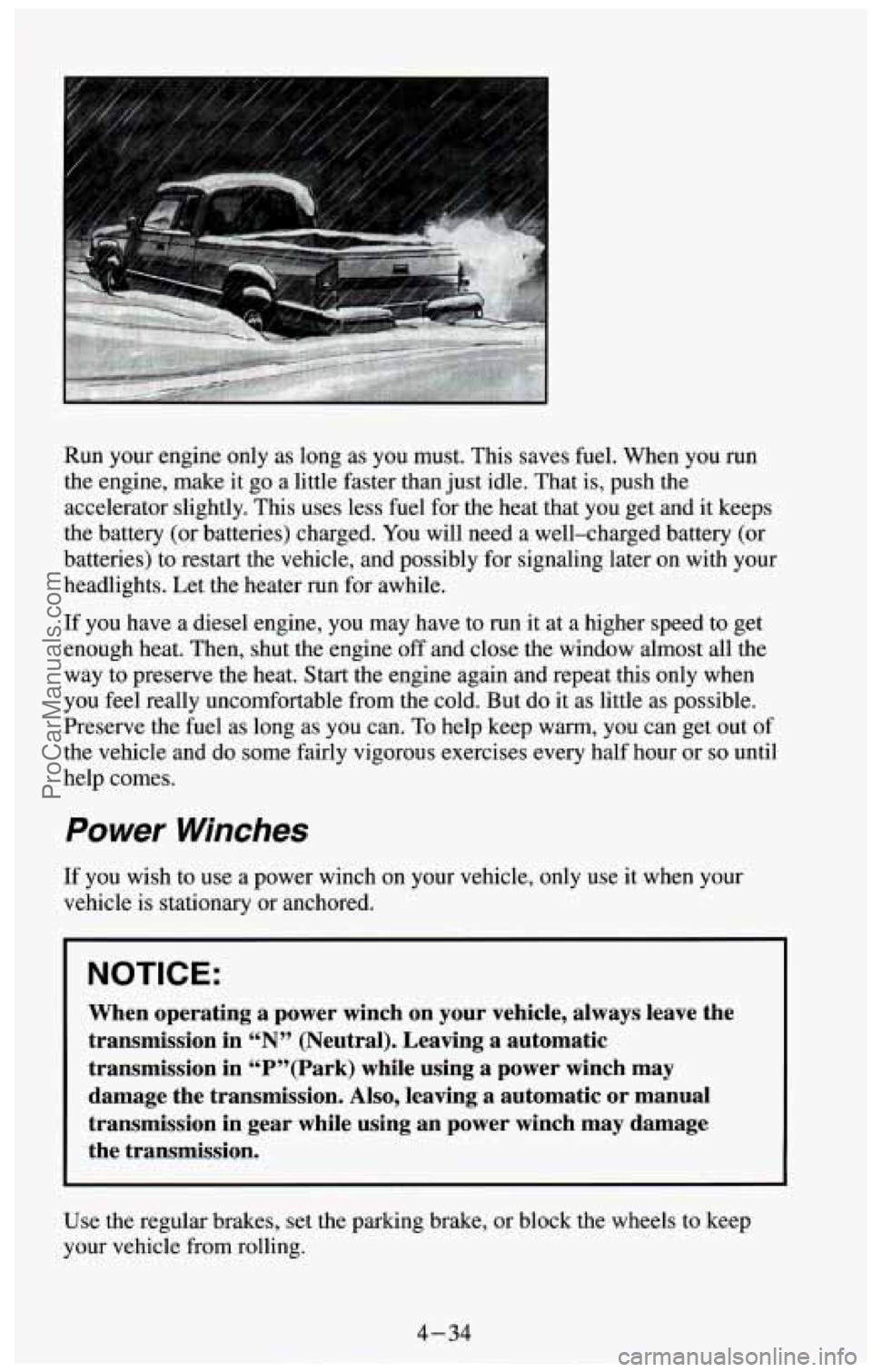
Run your engine only as long as you must. This saves fuel. When you run
the engine, make it
go a little faster than just idle. That is, push the
accelerator slightly. This uses less fuel for the heat that you get and it keeps
the battery (or batteries) charged.
You will need a well-charged battery (or
batteries) to restart the vehicle, and possibly for signaling later on with your
headlights. Let the heater run for awhile.
If you have a diesel engine, you may have to run it at a higher speed to get
enough heat. Then, shut the engine
off and close the window almost all the
way to preserve the heat. Start the engine again and repeat this only when
you feel really uncomfortable from the cold. But do it as little as possible.
Preserve the fuel as long as you can.
To help keep warm, you can get out of
the vehicle
and do some fairly vigorous exercises every half hour or so until
help comes.
Power Winches
If you wish to use a power winch on your vehicle, only use it when your
vehicle is stationary or anchored.
NOTICE:
When operating a power winch on your vehicle, always leave the
transmission in “N” (Neutral). Leaving a automatic
transmission in “P”(Park) while using a power winch may \
damage the transmission. Also, leaving a automatic or manual
transmission in gear while using an power winch may damage
the transmission.
Use the regular brakes, set the parking brake, or block the wheels to keep
your vehicle from rolling.
4-34
ProCarManuals.com
Page 199 of 385
Trailer Brakes
If your trailer weighs more than 1,000 pounds (450 kg) loaded, then it needs
its own brakes
- and they must be adequate. Be sure to read and follow the
instructions for the trailer brakes
so you’ll be able to install, adjust and
maintain them properly.
Your trailer brake system can tap into your vehicle’s hydraulic brake system,
but consider the following:
Will the trailer brake system use more than 0.02 cubic inch (0.3 cc) of
fluid from your vehicle’s master cylinder? If it will, don’t tap into your
vehicle’s brake system. Both braking systems
won’t work well, and you
could even lose your brakes altogether.
not, the trailer brake system must not be used with your vehicle.
If everything checks
out this far, make the brake tap at the port on the
master cylinder that sends the fluid to the rear brakes. But don’t use copper
tubing for this. if you do, it will bend and finally break
off. Use steel brake
tubing.
Will the trailer brake parts take 3,000 psi (20 650 kPa) of pressure? If
Driving with a Trailer
Towing a trailer requires a certain amount of experience. Before setting out
for the open road,
you’ll want to get to know your rig. Acquaint yourself
with the feel
of handling and braking with the added weight of the trailer.
And always keep
in mind that the vehicle you are driving is now a good
deal longer and not nearly so responsive as your vehicle is by itself.
Before
you start, check the trailer hitch and platform, safety chains,
electrical connector, lights, tires and mirror adjustment. If the trailer has
electric brakes, start your vehicle and trailer moving and then apply the
trailer brake controller by hand to be sure the brakes are working. This lets
you check your electrical connection at the same time.
4-40
ProCarManuals.com
Page 200 of 385
During your trip, check occasionally to be sure that the load is secure, and
that the lights and any trailer brakes are still working.
Following Distance
Stay at least twice as far behind the vehicle ahead as you would when
driving your
vehicle without a trailer. This can help you avoid situations that
require heavy braking and sudden turns.
Passing
You’ll need more passing distance up ahead when you’re towing a trailer.
And, because you’re a good deal longer, you’ll need
to go much farther
beyond the passed vehicle
before you can return to your lane.
Backing Up
Hold the bottom of the steering wheel with one hand. Then, to move the
trailer to
the left, just move that hand to the left. To move the trailer to the
right, move your hand to the right. Always back up slowly and,
if possible,
have someone guide you.
4-41 ProCarManuals.com
Page 201 of 385
Making Turns
When you’re turning with a trailer, make wider turns than normal. Do this
so your trailer won’t strike soft shoulders, curbs, road signs, trees, or other
objects. Avoid jerky or sudden maneuvers. Signal well
in advance.
Turn Signals When Towing a Trailer
When you tow a trailer, your vehicle has to have a different turn signal
flasher and extra wiring, The green arrows on your instrument panel will
flash whenever you signal a turn or lane change. Properly hooked up, the
trailer lights will also flash, telling other drivers you’re about to turn,
change lanes or stop.
When towing a trailer,
the green arrows on your instrument panel will flash
for turns even if the bulbs on the trailer are burned out. Thus, you may think
drivers behind you are seeing your signal when they are not. It’s important
to check occasionally
to be sure the trailer bulbs are still working.
Driving On Grades
Reduce speed and shift to a lower gear before you start down a long or
steep downgrade. If
you don’t shift down, you might have to use your
brakes
so much that they would get hot and no longer work well.
On
a long uphill grade, shift down and reduce your speed to around 45 mph
(70 kdh) to reduce the possibility of engine and transmission overheating.
If you have an automatic transmission, you should use “D” (or, as you need
to, a lower gear) when towing
a trailer. Operating your vehicle in “D” when
towing a trailer will minimize heat buildup and extend
the life of your
transmission.
If
you have a manual transmission and you are towing a trailer, it’s better
not
to use fifth gear. Just drive in fourth gear (or, as you need to, a lower
gear).
Parking on Hills
You really should not park your vehicle, with a trailer attached, on a hill. If
something goes wrong, your rig could start to move. People can be injured,
and both your vehicle and the trailer can be damaged.
But
if you ever have to park your rig on a hill, here’s how to do it:
1. Apply your regular brakes, but don’t shift into “P’ (Park) yet, or in gear
for a manual transmission.
2. Have someone place chocks under the trailer wheels.
3. When the wheel chocks are in place, release the regular brakes until the
chocks absorb
the load.
4-42
ProCarManuals.com
Page 203 of 385
Maintenance When Trailer Towing
Your vehicle will need service more often when you’re pulling a trailer. See
the Maintenance Schedule for more on this. Things that are especially
important in trailer operation are automatic transmission fluid (don’t
overfill), engine oil, axle lubricant, belt, cooling system, and brake
adjustment. Each
of these is covered in this manual, and the Index will help
you find them quickly. If you’re trailering, it’s a good idea to review these
sections before you start your trip.
Check periodically to see
that all hitch nuts and bolts are tight.
Trailer Light Wiring
See “Trailer Wiring Harness” in the Index.
4-44
ProCarManuals.com
Page 205 of 385
Hazard Warning Flashers
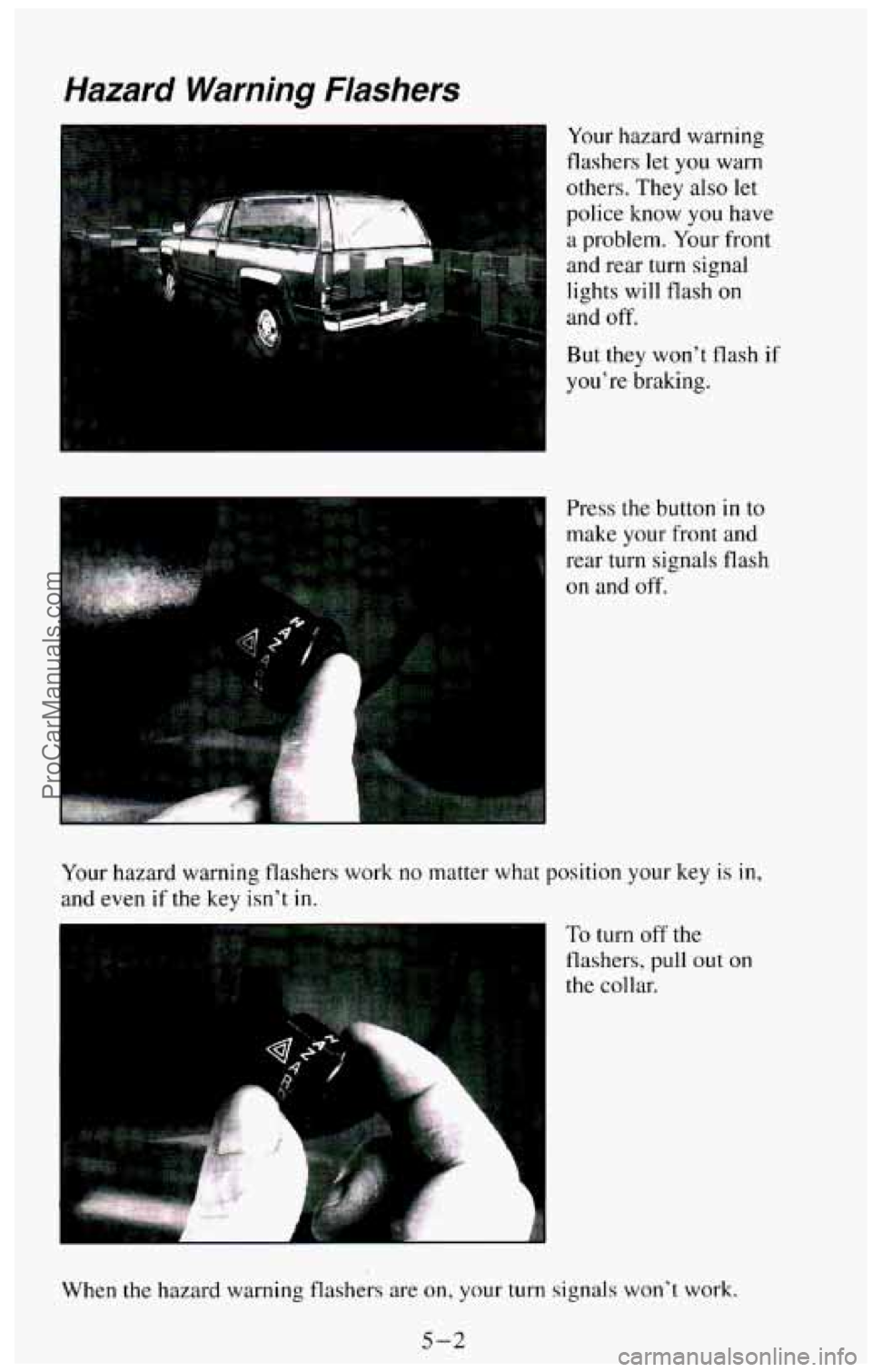
Your hazard warning
flashers let you warn
1
others. They also let
police know you have
a problem. Your front
and rear turn signal
lights will flash
on
and off.
But they won’t flash if
you’re braking.
Press the button
in to
make your front and
rear turn signals flash
on and
off.
Your hazard warning flashers work no matter what position your key is in,
and even if the key isn’t in.
PP . . lo turn orr me
flashers, pull out on
the collar.
When the
hazard warning flashers are on, your turn signals won’t work.
5-2
ProCarManuals.com