Page 193 of 385
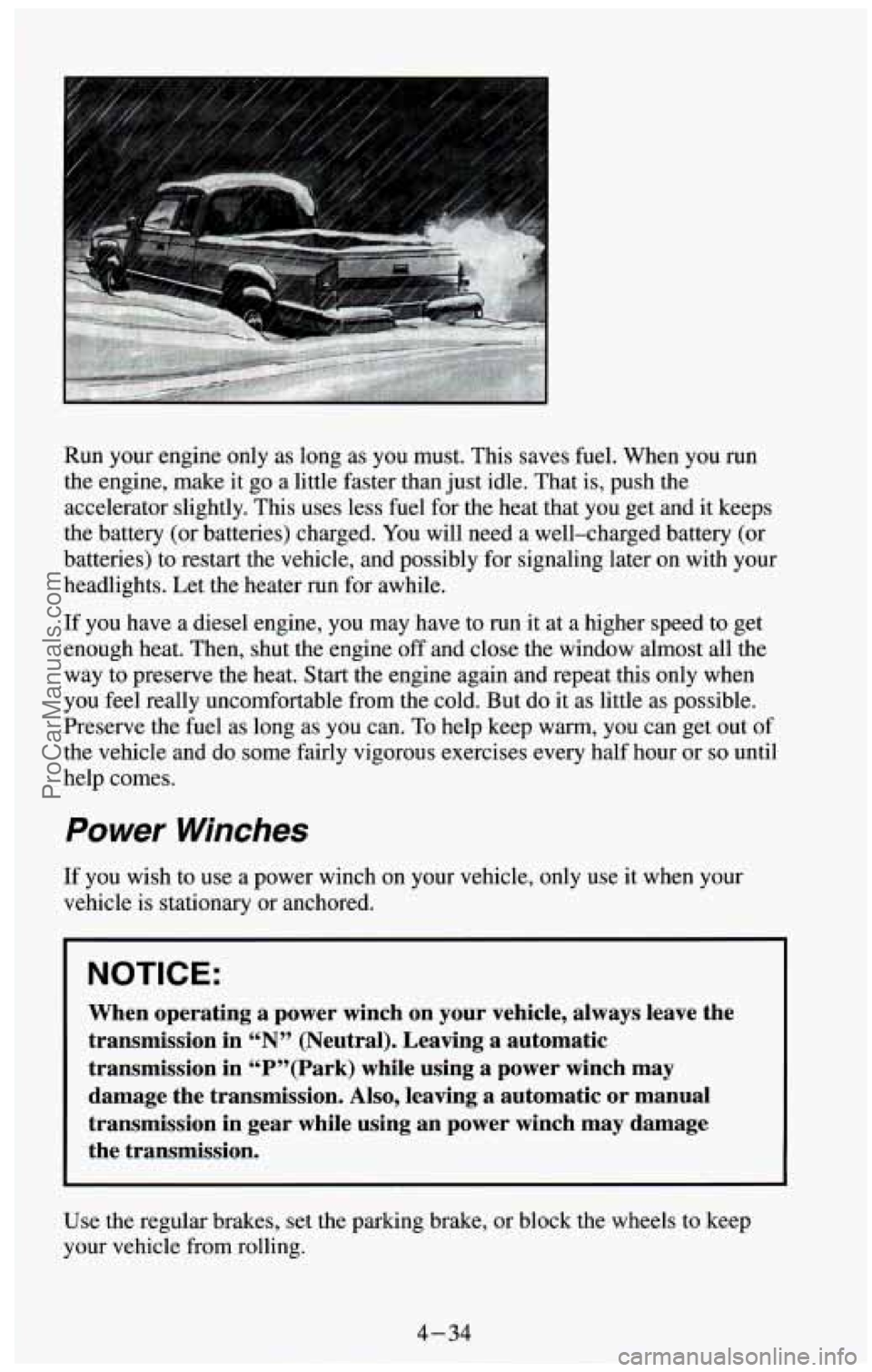
Run your engine only as long as you must. This saves fuel. When you run
the engine, make it
go a little faster than just idle. That is, push the
accelerator slightly. This uses less fuel for the heat that you get and it keeps
the battery (or batteries) charged.
You will need a well-charged battery (or
batteries) to restart the vehicle, and possibly for signaling later on with your
headlights. Let the heater run for awhile.
If you have a diesel engine, you may have to run it at a higher speed to get
enough heat. Then, shut the engine
off and close the window almost all the
way to preserve the heat. Start the engine again and repeat this only when
you feel really uncomfortable from the cold. But do it as little as possible.
Preserve the fuel as long as you can.
To help keep warm, you can get out of
the vehicle
and do some fairly vigorous exercises every half hour or so until
help comes.
Power Winches
If you wish to use a power winch on your vehicle, only use it when your
vehicle is stationary or anchored.
NOTICE:
When operating a power winch on your vehicle, always leave the
transmission in “N” (Neutral). Leaving a automatic
transmission in “P”(Park) while using a power winch may \
damage the transmission. Also, leaving a automatic or manual
transmission in gear while using an power winch may damage
the transmission.
Use the regular brakes, set the parking brake, or block the wheels to keep
your vehicle from rolling.
4-34
ProCarManuals.com
Page 194 of 385
Power Take-Off (PTO)
NOTICE:
If you will be using the PTO while the vehicle remains in one
place, drive the vehicle to warm it up before operating the
PTO.
Don’t use the PTO for more than four hours without driving
your vehicle again. If you don’t follow these guidelines, your
transfer case or transmission could be damaged.
NOTICE:
Don’t have a PTO that will exceed 35 horsepower installed on
your vehicle. It could damage your transmission or transfer
case.
Before using a power take-off, refer to the manufacturer’s or installer’s
instructions.
To engage a power take-off:
1. Set the parking brake.
2. Shift the transmission into “N” (Neutral).
3. Hold the clutch pedal down and engage the power take-off.
If
you are going to drive the vehicle, shift the transmission into the gear
you want. Then shift the transfer case into the range you want (if you
have four-wheel drive), apply the regular brakes and release the
parking brake.
When
you release the clutch, the power take-off will start.
4. Release the clutch (and the regular brakes) as you normally would.
Using a Transfer Case Mounted Power Take-Off
(Manual Transmission)
I. Set the parking brake.
2. Shift the transfer case into “N” (Neutral).
3. Hold the clutch pedal down. If the vehicle will remain in the same
place, shift the transmission
into the highest gear.
4-35
ProCarManuals.com
Page 195 of 385
4. Engage the power take-off.
If you are going to drive the vehicle, shift the transmission into the gear
you want. Then shift the transfer case into the range you want, apply
the regular brakes and release the parking brake.
When
you release the clutch, the power take-off will start.
5. Release the clutch (and the regular brakes) as you normally would.
Using a Transfer Case Mounted Power Take-Off
(Automatic Transmission)
1. Set the parking brake.
2. Shift the transfer case into “N” (Neutral).
3. Shift the transmission into “N’ (Neutral).
4. Engage the power take-off.
If you are going to drive the vehicle, shift the transfer case into the
range you want. Then apply the regular brakes and release the parkin\
g
brake.
5. Shift the transmission to “D” (Drive) to start the power take-off.
6. Release the regular brakes to drive the vehicle.
Towing a Trailer
4-36
ProCarManuals.com
Page 201 of 385
Making Turns
When you’re turning with a trailer, make wider turns than normal. Do this
so your trailer won’t strike soft shoulders, curbs, road signs, trees, or other
objects. Avoid jerky or sudden maneuvers. Signal well
in advance.
Turn Signals When Towing a Trailer
When you tow a trailer, your vehicle has to have a different turn signal
flasher and extra wiring, The green arrows on your instrument panel will
flash whenever you signal a turn or lane change. Properly hooked up, the
trailer lights will also flash, telling other drivers you’re about to turn,
change lanes or stop.
When towing a trailer,
the green arrows on your instrument panel will flash
for turns even if the bulbs on the trailer are burned out. Thus, you may think
drivers behind you are seeing your signal when they are not. It’s important
to check occasionally
to be sure the trailer bulbs are still working.
Driving On Grades
Reduce speed and shift to a lower gear before you start down a long or
steep downgrade. If
you don’t shift down, you might have to use your
brakes
so much that they would get hot and no longer work well.
On
a long uphill grade, shift down and reduce your speed to around 45 mph
(70 kdh) to reduce the possibility of engine and transmission overheating.
If you have an automatic transmission, you should use “D” (or, as you need
to, a lower gear) when towing
a trailer. Operating your vehicle in “D” when
towing a trailer will minimize heat buildup and extend
the life of your
transmission.
If
you have a manual transmission and you are towing a trailer, it’s better
not
to use fifth gear. Just drive in fourth gear (or, as you need to, a lower
gear).
Parking on Hills
You really should not park your vehicle, with a trailer attached, on a hill. If
something goes wrong, your rig could start to move. People can be injured,
and both your vehicle and the trailer can be damaged.
But
if you ever have to park your rig on a hill, here’s how to do it:
1. Apply your regular brakes, but don’t shift into “P’ (Park) yet, or in gear
for a manual transmission.
2. Have someone place chocks under the trailer wheels.
3. When the wheel chocks are in place, release the regular brakes until the
chocks absorb
the load.
4-42
ProCarManuals.com
Page 202 of 385
4. Re-apply the regular brakes. Then apply your parking brake, and then
shift to
“P” (Park), or “R’ (Reverse) for a manual transmission.
5. If you have a four-wheel-drive vehicle, be sure the transfer case is in a
6. Release the regular brakes. drive
gear-not in “N” (Neutral).
When You Are Ready to Leave After Parking on a Hill
1. Apply your regular brakes and hold the pedal down while you:
Start your engine;
Shift into a gear; and
Release the parking brake.
2. Let up on the brake pedal.
3. Drive slowly until the trailer is clear of the chocks.
4. Stop and have someone pick up and store the chocks.
4-43
ProCarManuals.com
Page 207 of 385
Tu Jump Start Your Vehicle;
1. Check the other vehicle. It must have a 12-volt battery with a negative
ground system.
I NOTICE:
I
If the other system isn’t a 12-volt system with a negative
ground, both vehicles can be damaged.
If you have a diesel engine vehicle with two batteries (or more), you
should know before you begin that, especially in cold weather, you may
not be able to get enough power from a single battery in another
vehicle to start your diesel engine.
If your vehicle has more than one battery, use the battery that’s on the
passenger side
of the vehicle - this will reduce electrical resistance.
2. Get the vehicles close enough so the jumper cables can reach, but be
sure the vehicle’s aren’t touching each other.
If they are, it could cause
a ground connection
you don’t want. You wouldn’t be able to start your
vehicle, and the bad grounding could damage the electrical systems.
You could be injured if
the vehicles roll. Set the parking brake firmly
on each vehicle. Put an automatic transmission in “P’ (Park) or a
manual transmission in “N’ (Neutral). If you have a four-wheel-drive
vehicle, be sure the transfer case is not in “N” (Neutral).
3. Turn off the ignition on both vehicles. Turn off all lights that aren’t
needed, and radios. This will avoid sparks and help save both batteries.
And it could save your radio!
NOTICE:
If you leave your radio on, it could be badly damaged. The
repairs wouldn’t
be covered by your warranty.
4. Open the hoods and locate the batteries. Find the positive (+) and
negative
(-) terminals on each battery.
5-4
ProCarManuals.com
Page 211 of 385
0 Whether you can move the shift lever for the transmission and transfer
case,
if you have one.
If there was an accident, what was damaged.
When your vehicle is being towed, have the ignition key off. The steering
wheel should be clamped
in a straight-ahead position, with a clamping
device designed for towing service,
Do not use the vehicle’s steering
column lock for this.
The transmission and transfer case, if you have one,
should be in Neutral and the parking brake released.
5-8 ProCarManuals.com
Page 253 of 385
To drain water:
1. Stop and park the vehicle in a safe place. Turn off the engine and apply
2. Remove the fuel tank cap.
the parking brake.
3. Place a
fuel-resistant container under the filter
drain hose.
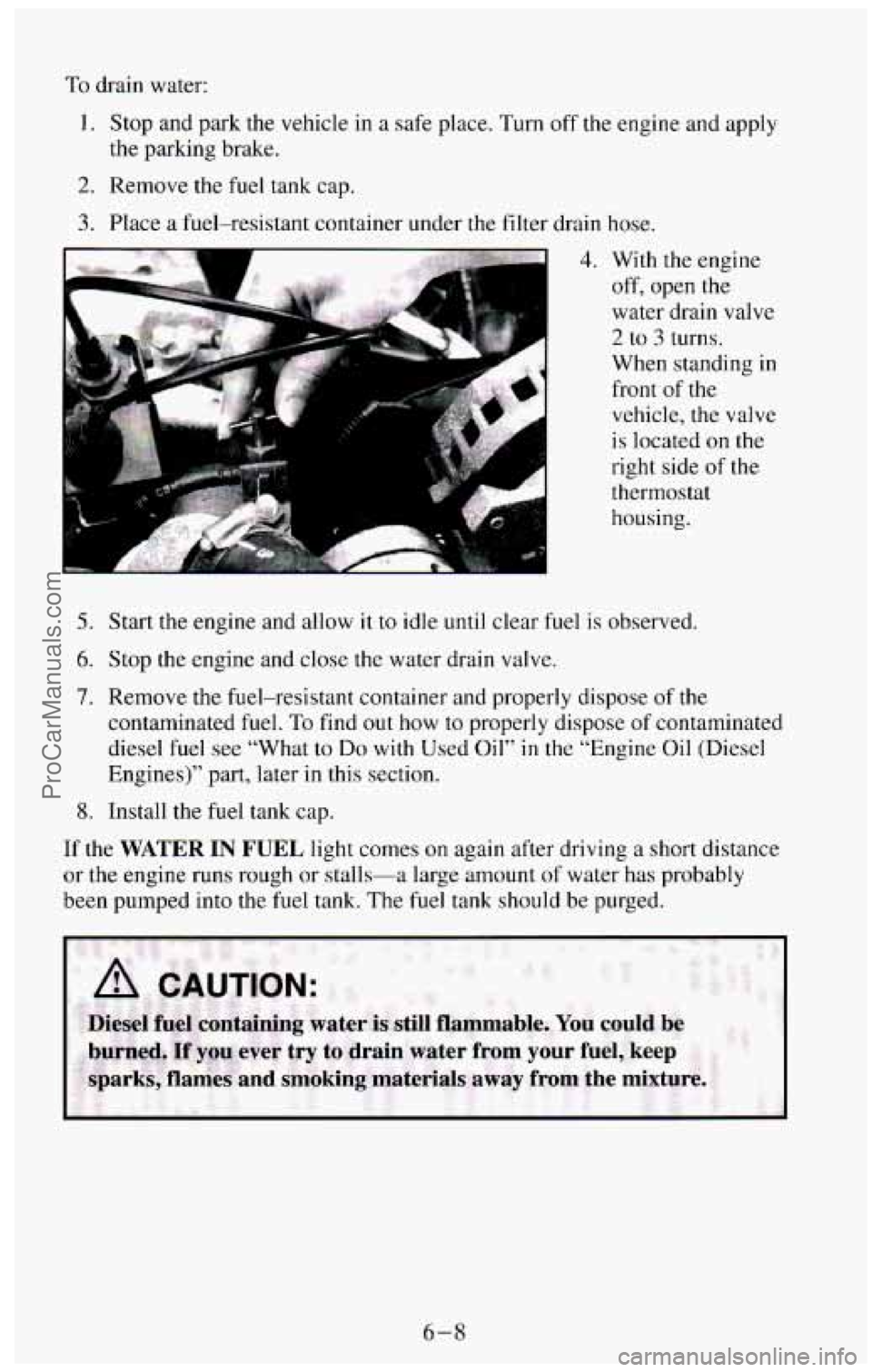
4. With the engine
off, open the
water drain valve
2 to 3 turns.
When standing in
front of the
vehicle,
the valve
is located
on the
right side
of the
thermostat housing.
5. Start the engine and allow it to idle until clear fuel is observed.
6. Stop the engine and close the water drain valve.
7. Remove the fuel-resistant container and properly dispose of the
contaminated fuel. To find out how
to properly dispose of contaminated
diesel
fuel see “What to Do with Used Oil” in the “Engine Oil (Diesel
Engines)” part, later in
this section.
8. Install the fuel tank cap.
If the
WATER IN FUEL light comes on again after driving a short distance
or the engine
runs rough or stalls-a large amount of water has probably
been pumped into the fuel tank. The fuel tank should be purged.
6-8
ProCarManuals.com