1994 CHEVROLET SUBURBAN warning light
[x] Cancel search: warning lightPage 125 of 385
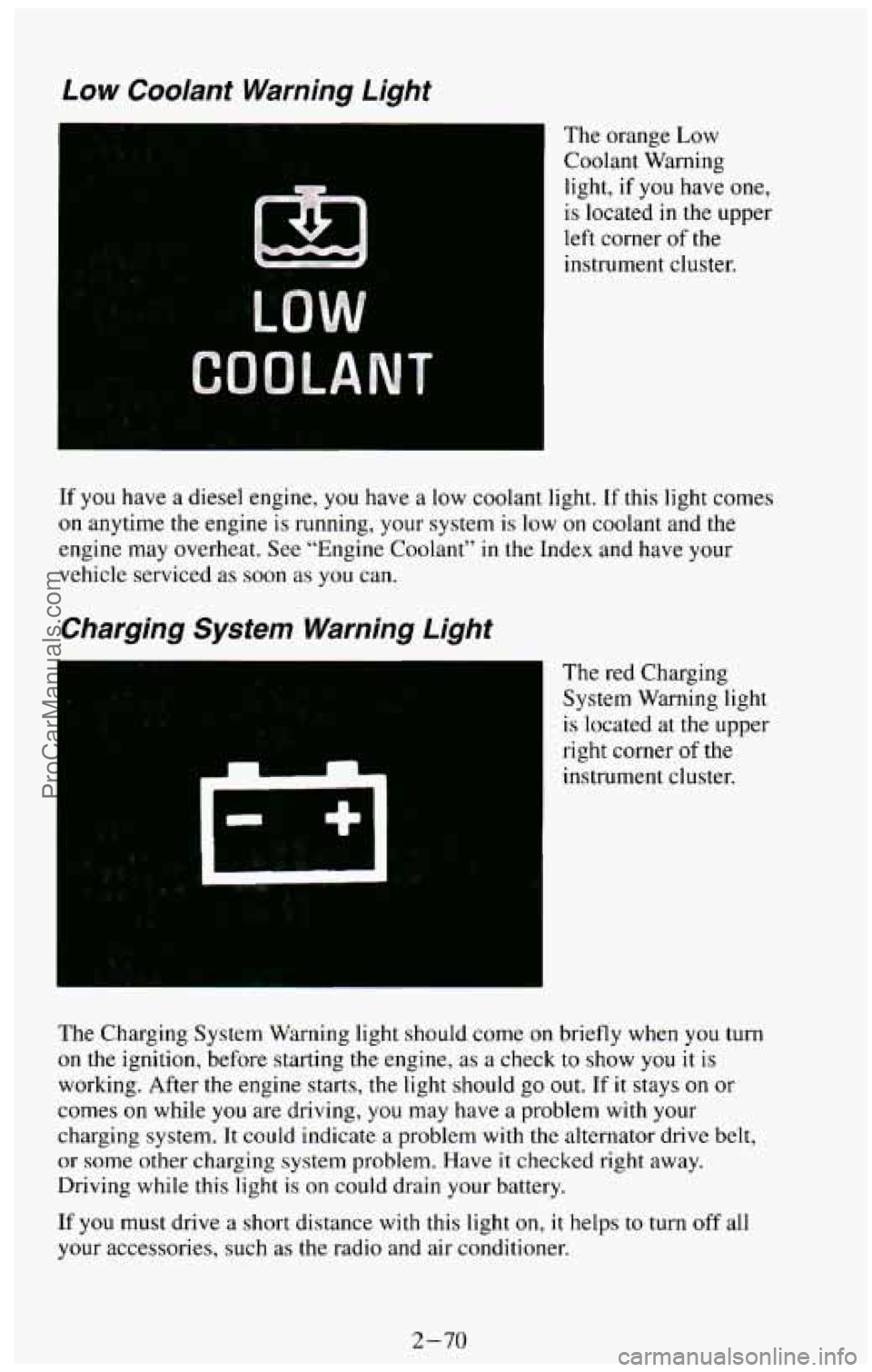
Low Coolant Warning Light
The orange Low
Coolant Warning
light, if
you have one,
is located in the upper
left corner of the
instrument cluster.
If
you have a diesel engine, you have a low coolant light. If this light comes
on anytime the engine is running, your system is low on coolant and the
engine may overheat. See “Engine Coolant”
in the Index and have your
vehicle serviced
as soon as you can.
Charging System Warning Light
The red Charging
System Warning light
is located at the upper
right corner of the
instrument cluster.
The Charging System Warning light should come on briefly when you turn
on the ignition, before starting the engine, as a check to show you it is
working. After the engine starts, the light should go out. If it stays on or
comes
on while you are driving, you may have a problem with your
charging system. It could indicate a problem with the alternator drive belt,
or
some other charging system problem. Have it checked right away.
Driving while this light is on could drain your battery.
If
you must drive a short distance with this light on, it helps to turn off all
your accessories, such
as the radio and air conditioner.
2-70
ProCarManuals.com
Page 127 of 385
This light will come on briefly when you are starting the engine. If the light
comes
on and stays on while you are driving, it could indicate a problem
with your vehicle. It could be a problem with your oil pressure, coolant
temperature, or some other problem. Check your various gages to see
if they
are
in the warning zones. If they are, have your vehicle serviced right away.
Daytime Running Lights (DRL) Indicator Light
(Canada Only)
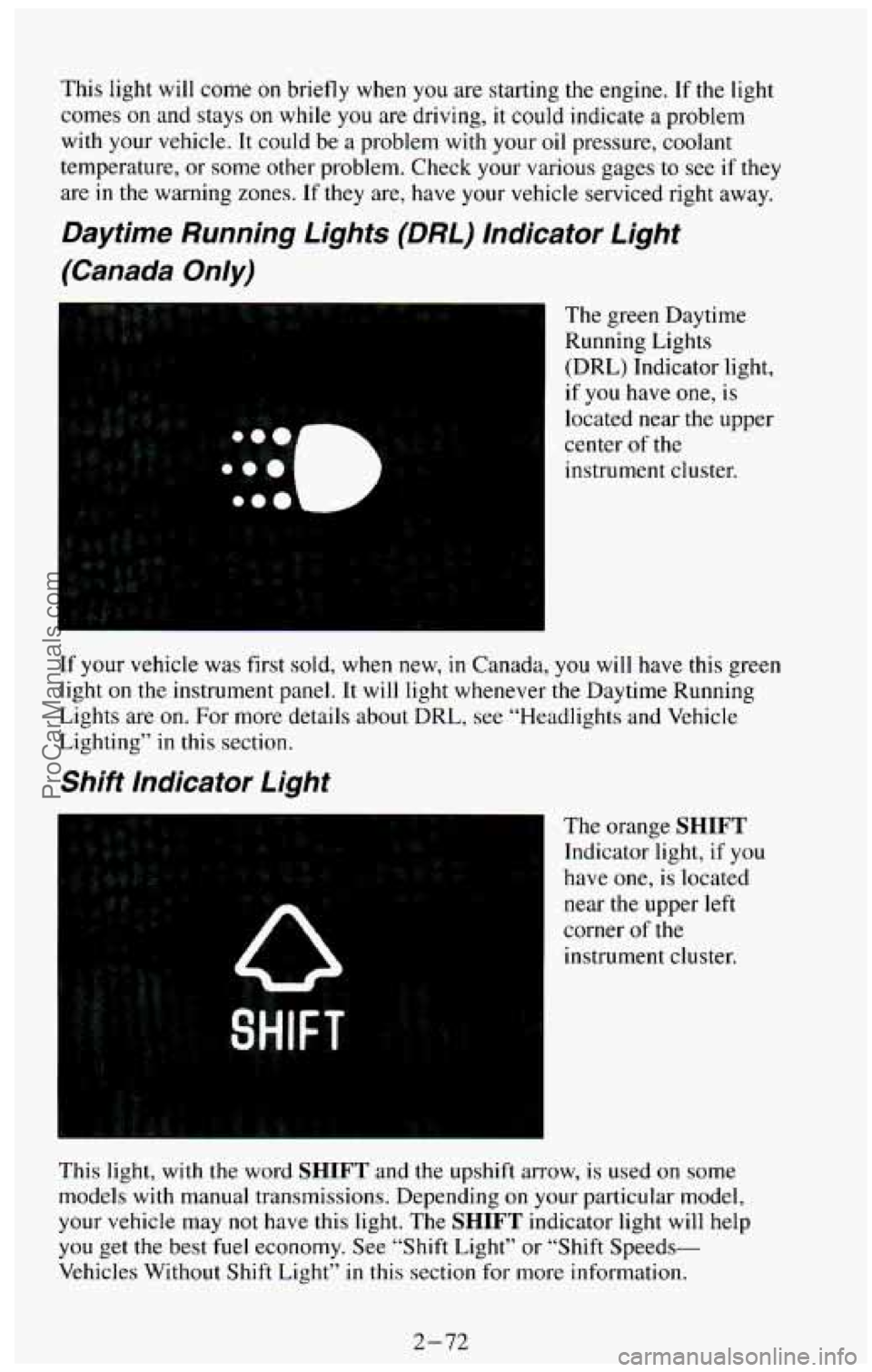
The green Daytime
Running Lights
(DRL) Indicator light,
if you have one,
is
located near the upper
center of the
instrument cluster.
If your vehicle was first sold, when new,
in Canada, you will have this green
light on the instrument panel. It will light whenever the Daytime Running
Lights are on.
For more details about DRL, see “Headlights and Vehicle
Lighting” in this section.
Shift Indicator Light
The orange SHIFT
Indicator light, if you
have one, is located
near the upper left
corner
of the
instrument cluster.
This light, with the word
SHIFT and the upshift arrow, is used on some
models with manual transmissions. Depending
on your particular model,
your vehicle may not have this light. The SHIFT indicator light will help
you get the best fuel economy. See “Shift Light” or “Shift Speeds-
Vehicles Without Shift Light”
in this section for more information.
2-72
ProCarManuals.com
Page 186 of 385
e
e
e
Know the best way to get to where you are going. Get a city map and
plan your trip into an unknown part
of the city just as you would for a
cross-country trip.
Try to use the freeways that rim and crisscross most large cities. You’ll
save time and energy. (See the
next section, “Freeway Driving.”)
Treat a green light as a warning signal.
A traffic light is there because
the corner is busy enough to need
it. When a light turns green, and just
before you start to move, check both ways for vehicles that have not
cleared the intersection or may be running
the red light.
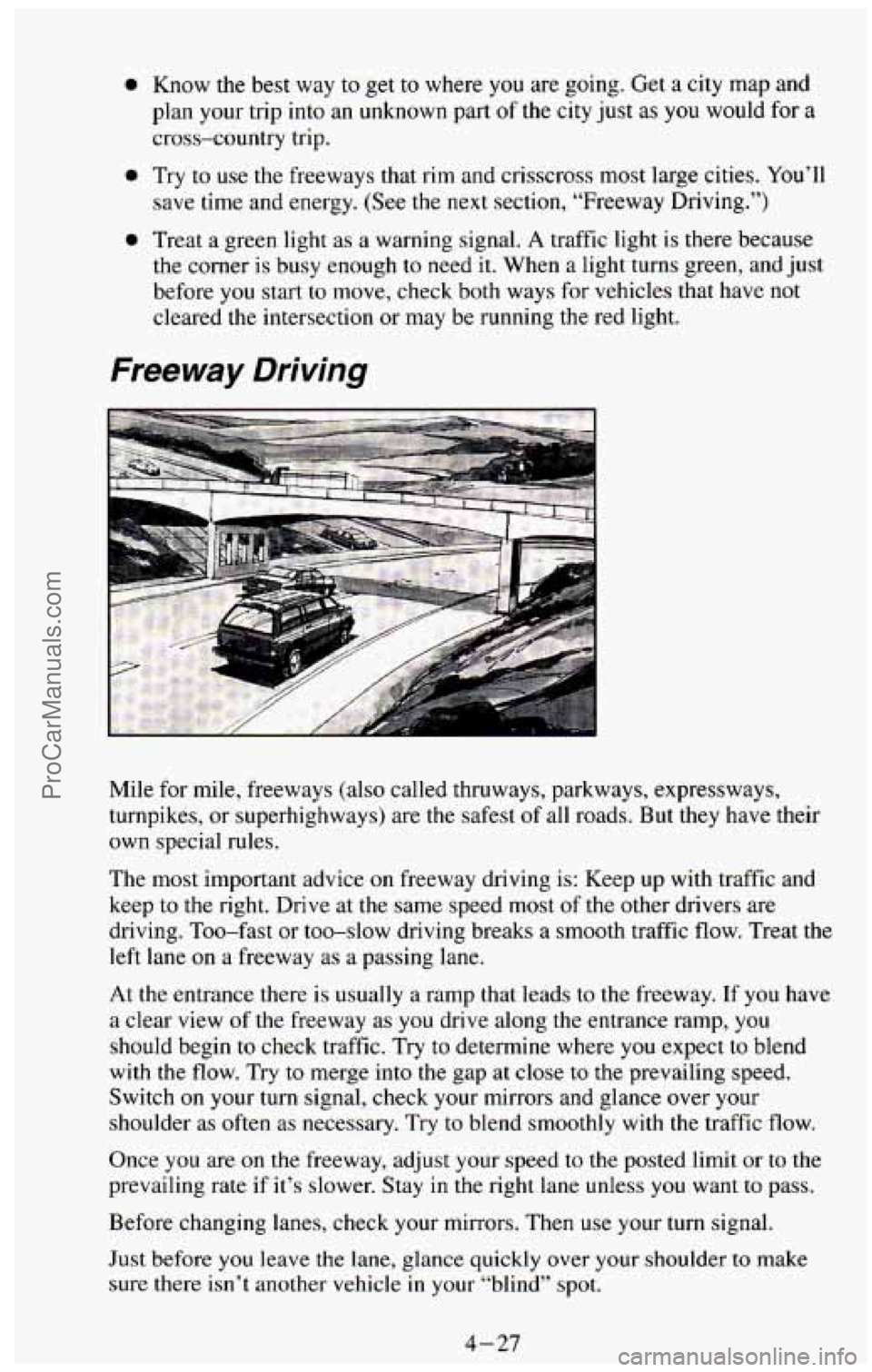
Freeway Driving
Mile for mile, freeways (also called thruways, parkways, expressways,
turnpikes, or superhighways) are
the safest of all roads. But they have their
own special rules.
The most important advice
on freeway driving is: Keep up with traffic and
keep to
the right. Drive at the same speed most of the other drivers are
driving.
Too-fast or too-slow driving breaks a smooth traffic flow. Treat the
left lane on a freeway as a passing lane.
At the entrance there is usually a ramp that leads to the freeway.
If you have
a clear view of the freeway as you drive along the entrance ramp, you
should begin to check traffic. Try to determine where you expect to blend
with the flow. Try to merge into the gap at close to the prevailing speed.
Switch
on your turn signal, check your mirrors and glance over your
shoulder as often as necessary.
Try to blend smoothly with the traffic flow.
Once you are on the freeway, adjust your speed to the posted limit or to the
prevailing rate
if it’s slower. Stay in the right lane unless you want to pass.
Before changing lanes, check your mirrors, Then use your turn signal.
Just before you leave the lane, glance quickly over your shoulder to make
sure there isn’t another vehicle
in your “blind” spot.
4-27
ProCarManuals.com
Page 190 of 385
Winter Driving
Here are some tips for winter driving:
0 Have your vehicle in good shape for winter. Be sure your engine
coolant
mix is correct.
0 You may want to put winter emergency supplies in your vehicle.
Include an ice scraper, a small brush or broom, a supply
of windshield
washer fluid, a rag, some winter outer clothing, a small shovel, a flashlight,
a red cloth, and a couple
of reflective warning triangles. And, if you will be
driving under severe conditions, include a small bag of sand, a piece
of old
carpet or a couple of burlap bags to help provide traction. Be sure you
properly secure these items in your vehicle.
Driving on Snow or Ice
Most of the time, those places where your tires meet the road probably have
good traction.
However, if there is snow or ice between your tires and the road, you can
have a very slippery situation. You’ll have a lot less traction or “grip” and
will need
to be very careful.
4-31
ProCarManuals.com
Page 205 of 385
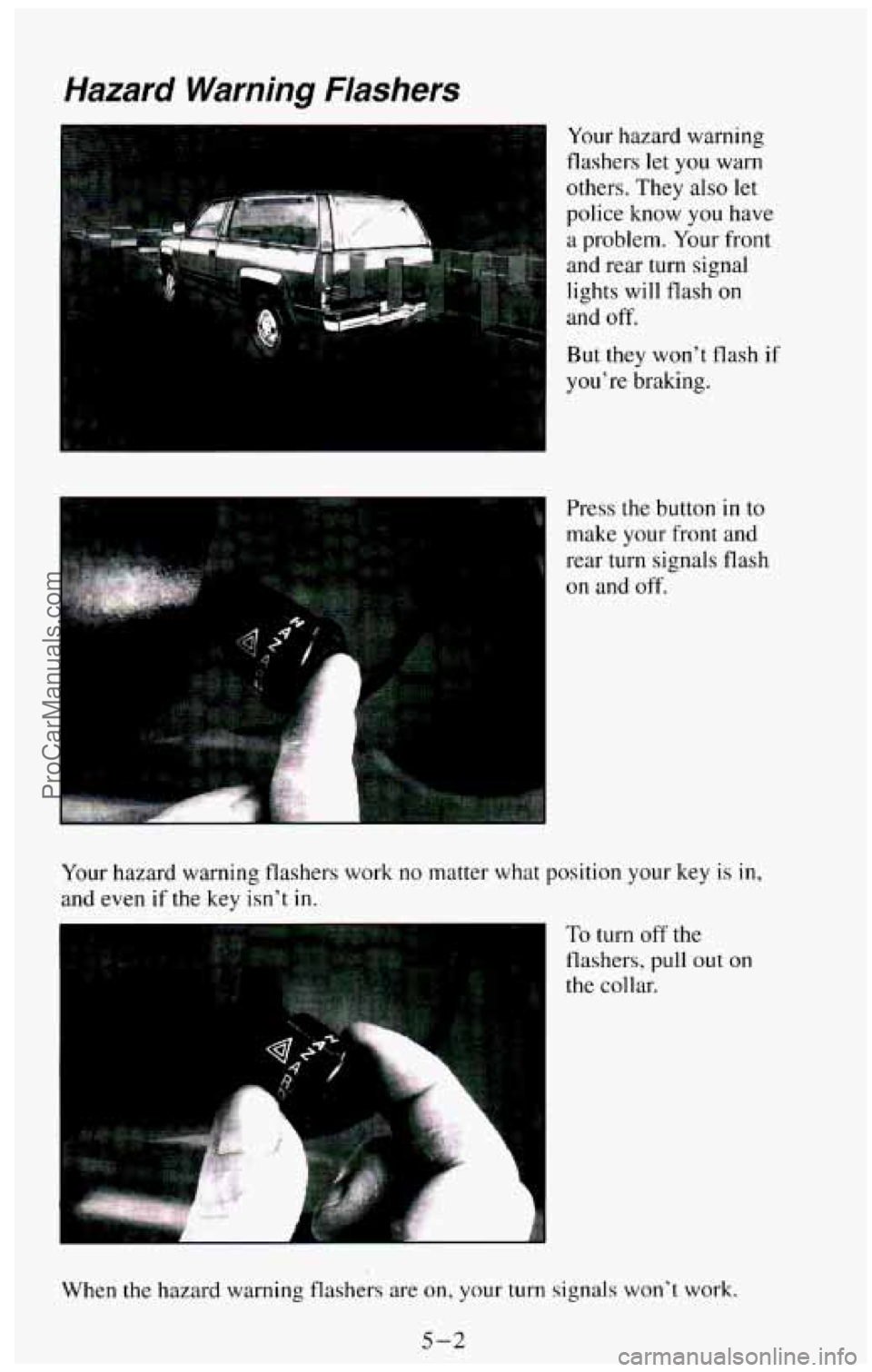
Hazard Warning Flashers
Your hazard warning
flashers let you warn
1
others. They also let
police know you have
a problem. Your front
and rear turn signal
lights will flash
on
and off.
But they won’t flash if
you’re braking.
Press the button
in to
make your front and
rear turn signals flash
on and
off.
Your hazard warning flashers work no matter what position your key is in,
and even if the key isn’t in.
PP . . lo turn orr me
flashers, pull out on
the collar.
When the
hazard warning flashers are on, your turn signals won’t work.
5-2
ProCarManuals.com
Page 252 of 385
Water in Fuel
Sometimes, water can be pumped into your fuel tank along with your diesel
fuel. This can happen if a service station doesn’t regularly inspect and clean
its fuel tanks, or if it gets contaminated fuel from its suppliers.
If this happens, a “WATER IN FUEL” light will come on. If it does, the
excess water
must be drained. Your dealer can do this for you.
This light
also should come on briefly when you start your engine, as a
check. If it doesn’t, have it fixed so it will be there to let you know if you
ever do get water
in your fuel.
If the light comes on at any other time, use this chart.
“WATER IN FUEL” LIGHT CHART
Problem
Light comes on intermittently.
Light stays on:
1. At temperatures above
freezing.
2. At temperatures below
freezing.
Recommended Action
Drain water from fuel filter.
Drain fuel filter immediately.
If no
water can be drained and light stays
on, see your dealer for assistance.
Drain fuel filter immediately. If no
water can be drained
- water may
be frozen. Open
the air bleed valve
to check for
fuel pressure. If no fuel
pressure
is present, replace the fuel
fi 1 ter.
3. Immediately after refueling - Fuel tank purging required. See
large amount
of water possibly your dealer for assistance.
pumped into fuel tank.
Hesitation or “flat” performance at
high speed or during hard acceleration
may be an indication of premature fuel filter plugging due to dirty or
contaminated
fuel. The filter element may need to be changed if this
happens. See your dealer for assistance.
If you drive when this warning light is on, you can damage your
fuel injection system and your engine.
If the light comes on right
after you refuel,
it means water was pumped into your fuel tank.
Turn
off your engine immediately. Then, have the water drained
at once.
6-7
ProCarManuals.com
Page 266 of 385
Engine Oil Additives
Don’t add anything to your oil. Your GM dealer is ready to advise if you
think something should be added.
When to Change Engine Oil
See if any one of these is true for you:
Most trips are less than 4 miles (6 km).
0 It’s below freezing outside and most trips are less than 10 miles (16 km).
The engine is at low speed most of the time (as in door-to-door
You tow a trailer often.
delivery,
or in stop-and-go traffic).
Most trips are through dusty places.
The vehicle is frequently operated off-road.
If any one
of these is true for your vehicle, then you need to change your oil
andfifilter every 3,000 miles (5 000 km) or 3 months - whichever comes
first
.
Light Duty Emissions:
If none of them is true, change the oil every 7,500 miles (12 500 km) or
12 months - whichever comes first. Change the filter at the first oil change
and at every other oil change after that.
Heavy Duty Emissions:
If none of them is true, change the oil every 6,000 miles ( 10 000 km) or
12 months - whichever comes first. Change the filter at the first oil change
and at every other oil change after that if mileage determines when you
change your oil.
If time determines when you change your oil, change the
filter each time you change your
oil.
Engine Coolant Heater (Engine Block Heater)
An engine coolant heater can be a big help if you have to park outside in
very cold weather,
0°F (-1 8 “C) or colder. If your vehicle has this option,
see “Engine Coolant Heater
” in the Index.
What to Do with Used Oil
Did you know that used engine oil contains certain elements that may be
unhealthy for your skin and could even cause cancer? Don’t let used oil stay
on your skin for very long. Clean your skin and nails with soap and water,
or
a good hand cleaner. Wash or properly throw away clothing or rags
containing
used engine oil. (See the manufacturer’s warnings about the use
and disposal of oil products.)
6-21
ProCarManuals.com
Page 280 of 385
Front Axle
When to Check and Change Lubricant
Refer to the Maintenance Schedule to determine how often to check the
lubricant and when to change
it. See “Scheduled Maintenance Services” in
the Index.
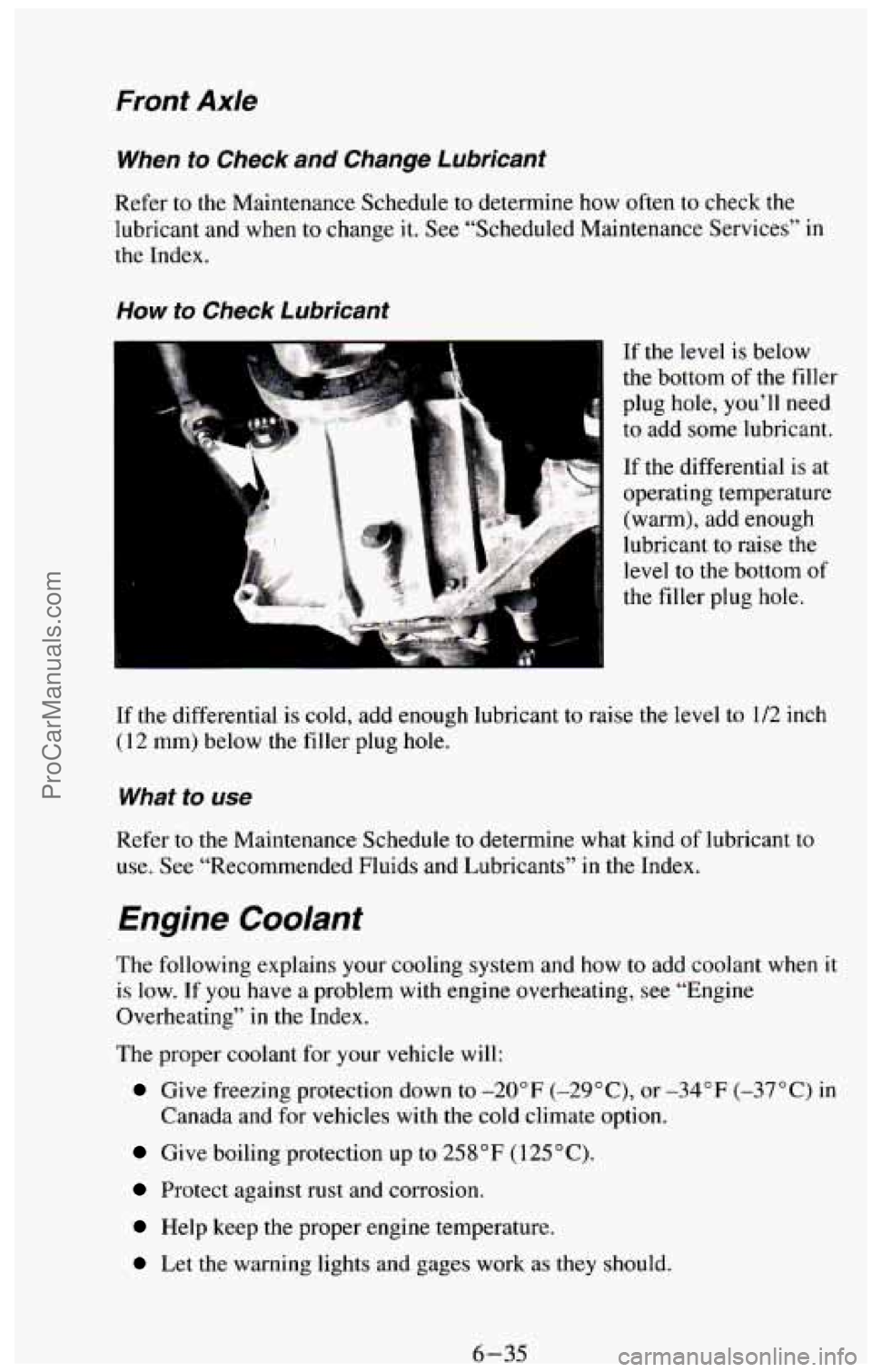
How to Check Lubricant
If the level is below
the bottom of the filler
plug hole, you’ll need
to add some lubricant.
If the differential is at
operating temperature
(warm), add enough
lubricant to raise the level
to the bottom of
the filler plug hole.
If the differential is cold, add enough lubricant to raise the level to
1/2 inch
(12 mm) below the filler plug hole.
What to use
Refer to the Maintenance Schedule to determine what kind of lubricant to
use. See “Recommended Fluids and Lubricants” in the Index.
Engine Coolant
The following explains your cooling system and how to add coolant when it
is low. If you have a problem with engine overheating, see “Engine
Overheating”
in the Index.
The proper coolant for your vehicle will:
Give freezing protection down to -20°F (-29”C), or -34°F (-37°C) in
Give boiling protection up to 258°F (1 25°C).
Protect against rust and corrosion.
Help keep the proper engine temperature.
Canada
and for vehicles with the cold climate option.
Let the warning lights and gages work as they should.
6-35 ProCarManuals.com