Page 123 of 385
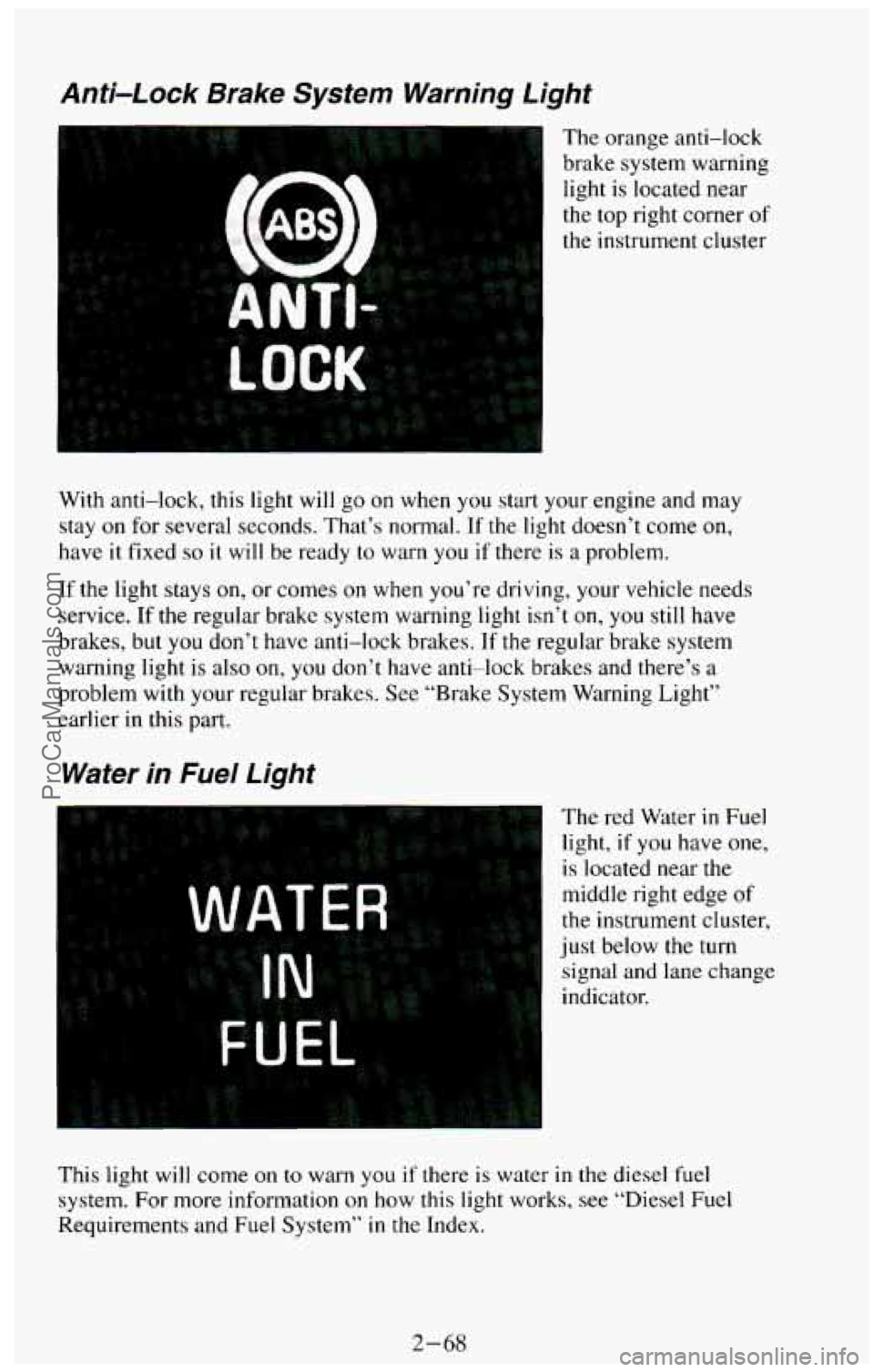
Anti-Lock Brake System Warning Light
The orange anti-lock
brake system warning light is located near
the top right corner
of
the instrument cluster
mi
With anti-lock, this light will go on when you start your engine and may
stay
on for several seconds. That’s normal. If the light doesn’t come on,
have it fixed
so it will be ready to warn you if there is a problem.
If the light stays on, or comes on when you’re driving, your vehicle needs
service.
If the regular brake system warning light isn’t on, you still have
brakes, but you don’t have anti-lock brakes. If the regular brake system
warning light is also
on, you don’t have anti-lock brakes and there’s a
problem with your regular brakes. See “Brake System Warning Light’’
earlier in this part.
Water in Fuel Light
The red Water in Fuel
light, if
you have one,
is located near the
middle right edge of
the instrument cluster,
just below the turn
signal and lane change
indicator.
This light will come on
to warn you if there is water in the diesel fuel
system.
For more information on how this light works, see “Diesel Fuel
Requirements and Fuel System”
in the Index.
2-68
ProCarManuals.com
Page 124 of 385
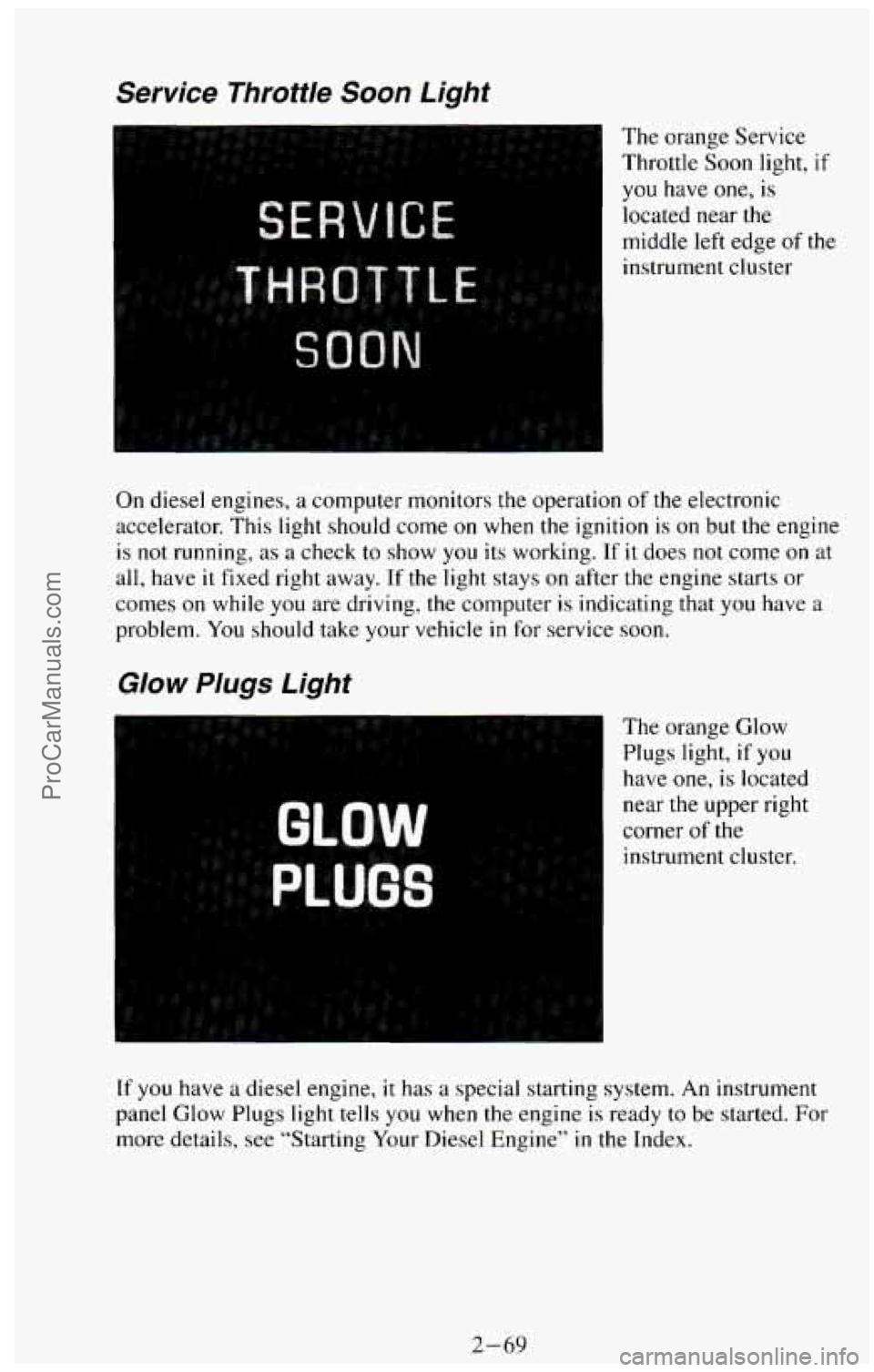
Service Throttle Soon Light
The orange Service
Throttle Soon light,
if
you have one, is
located near the
middle left edge
of the
instrument cluster
On diesel engines, a computer monitors the operation of the electronic
accelerator. This light should come
on when the ignition is on but the engine
is not running, as a check to show you its working. If it does not come on at
all, have it fixed right away.
If the light stays on after the engine starts or
comes on while you are driving, the computer is indicating that you have a
problem. You should take your vehicle in for service soon.
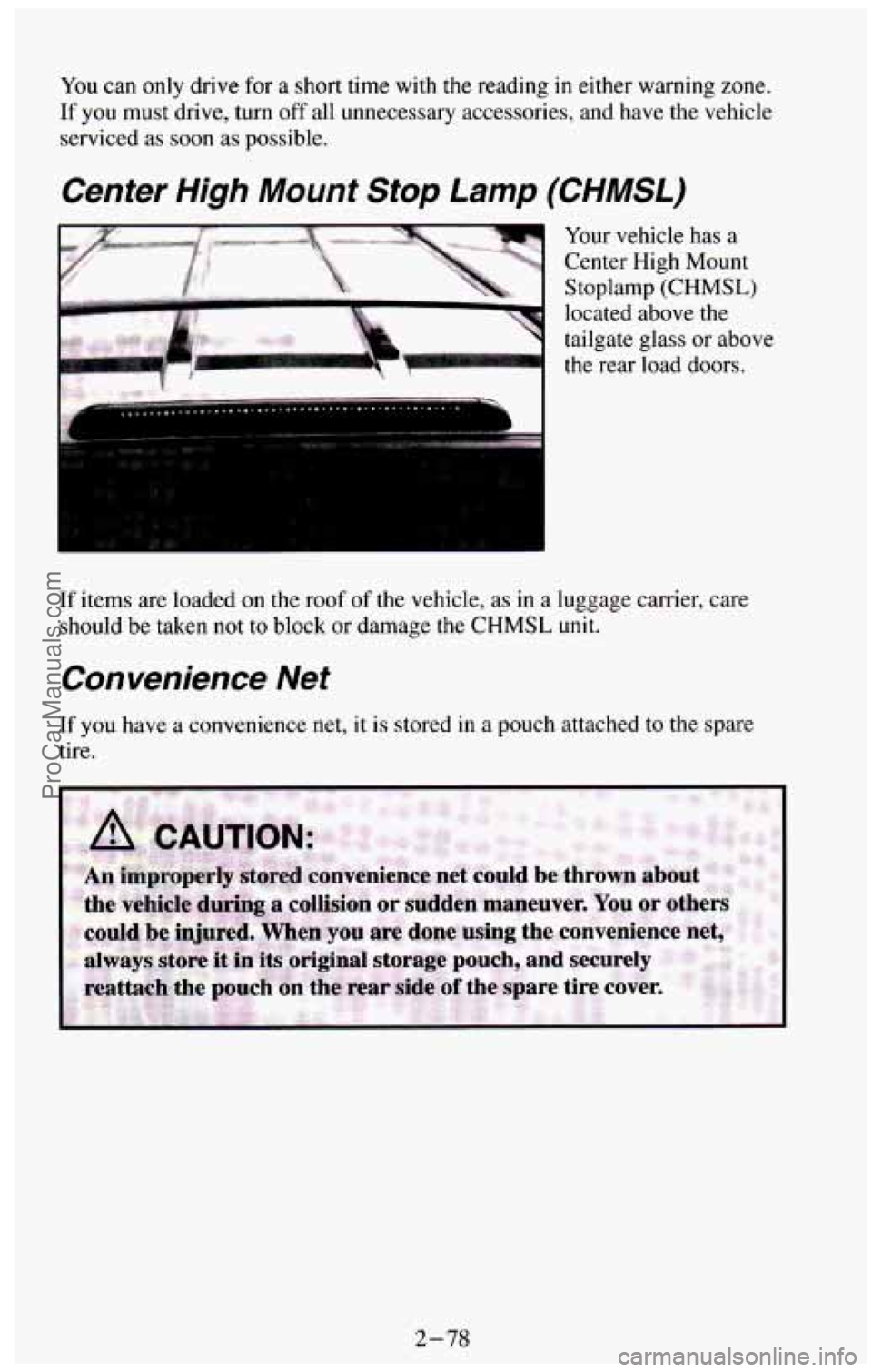
Glow Plugs Light
The orange Glow
Plugs light, if you
have
one, is located
near the upper right
corner
of the
instrument cluster.
If you have a diesel engine, it has a special starting system. An instrument
panel Glow Plugs light tells you when
the engine is ready to be started. For
more details, see “Starting Your Diesel Engine” in the Index.
2-69
ProCarManuals.com
Page 125 of 385
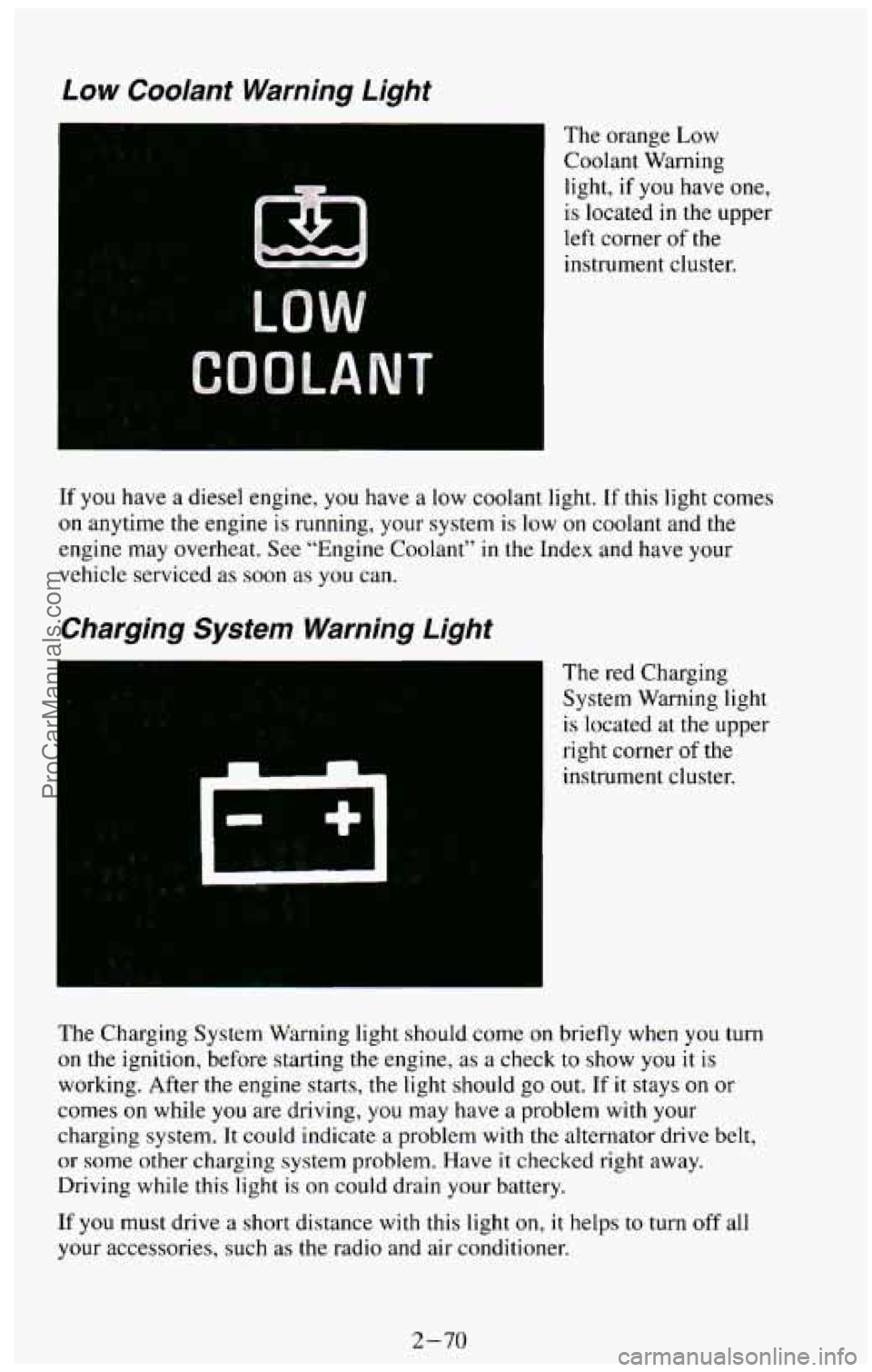
Low Coolant Warning Light
The orange Low
Coolant Warning
light, if
you have one,
is located in the upper
left corner of the
instrument cluster.
If
you have a diesel engine, you have a low coolant light. If this light comes
on anytime the engine is running, your system is low on coolant and the
engine may overheat. See “Engine Coolant”
in the Index and have your
vehicle serviced
as soon as you can.
Charging System Warning Light
The red Charging
System Warning light
is located at the upper
right corner of the
instrument cluster.
The Charging System Warning light should come on briefly when you turn
on the ignition, before starting the engine, as a check to show you it is
working. After the engine starts, the light should go out. If it stays on or
comes
on while you are driving, you may have a problem with your
charging system. It could indicate a problem with the alternator drive belt,
or
some other charging system problem. Have it checked right away.
Driving while this light is on could drain your battery.
If
you must drive a short distance with this light on, it helps to turn off all
your accessories, such
as the radio and air conditioner.
2-70
ProCarManuals.com
Page 126 of 385
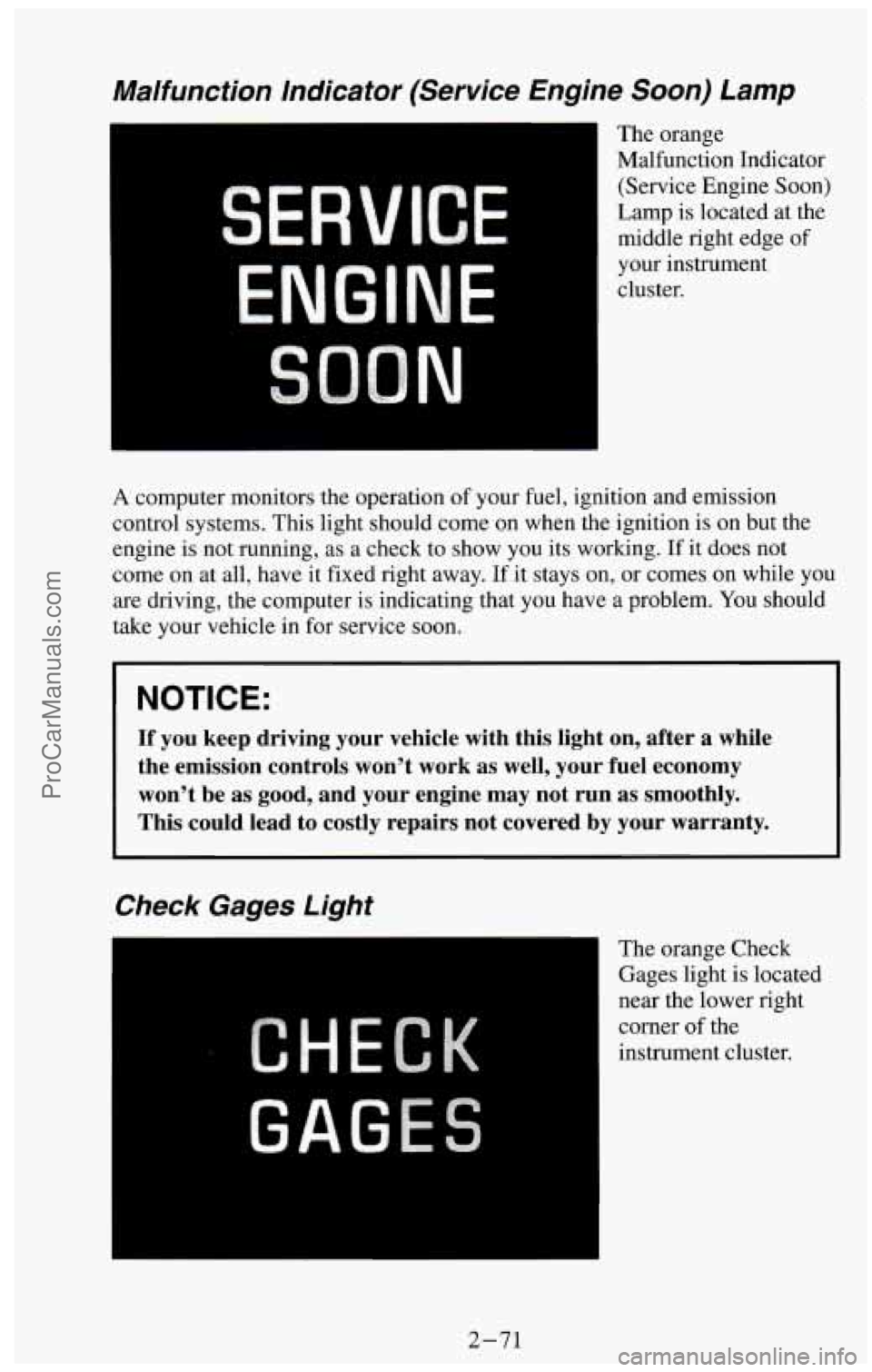
Malfunction Indicator (Service Engine Soon) Lamp
ENGINE
N
The orange
Malfunction Indicator
(Service Engine Soon)
Lamp is located at the
middle right edge of
your instrument
cluster.
A computer monitors the operation of your fuel, ignition and emission
control systems. This light should come on when the ignition is on but the
engine is not running, as a check to show you its working. If it does not
come on at all, have it fixed right away. If it stays on, or comes
on while you
are driving, the computer is indicating that you have a problem.
You should
take your vehicle in for service soon.
NOTICE:
If you keep driving your vehicle with this light on, after a while
the emission controls won’t work as well, your fuel economy \
won’t be as good, and your engine may not run as smoothly.
This could lead to costly repairs not covered by your warranty\
.
Check Gages Light
The orange Check
Gages light is located
near the lower right
corner
of the
instrument cluster.
2-71
ProCarManuals.com
Page 127 of 385
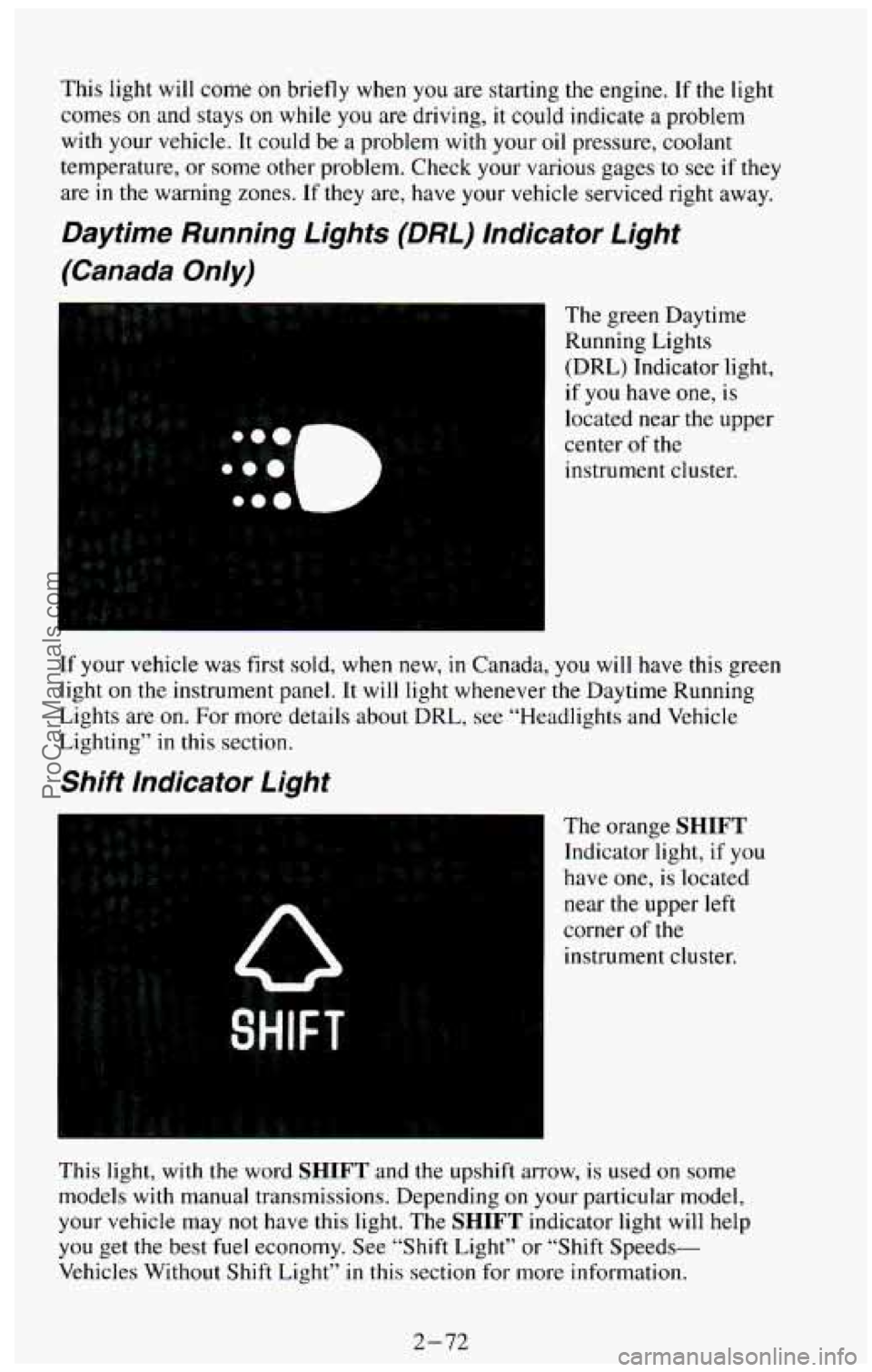
This light will come on briefly when you are starting the engine. If the light
comes
on and stays on while you are driving, it could indicate a problem
with your vehicle. It could be a problem with your oil pressure, coolant
temperature, or some other problem. Check your various gages to see
if they
are
in the warning zones. If they are, have your vehicle serviced right away.
Daytime Running Lights (DRL) Indicator Light
(Canada Only)
The green Daytime
Running Lights
(DRL) Indicator light,
if you have one,
is
located near the upper
center of the
instrument cluster.
If your vehicle was first sold, when new,
in Canada, you will have this green
light on the instrument panel. It will light whenever the Daytime Running
Lights are on.
For more details about DRL, see “Headlights and Vehicle
Lighting” in this section.
Shift Indicator Light
The orange SHIFT
Indicator light, if you
have one, is located
near the upper left
corner
of the
instrument cluster.
This light, with the word
SHIFT and the upshift arrow, is used on some
models with manual transmissions. Depending
on your particular model,
your vehicle may not have this light. The SHIFT indicator light will help
you get the best fuel economy. See “Shift Light” or “Shift Speeds-
Vehicles Without Shift Light”
in this section for more information.
2-72
ProCarManuals.com
Page 133 of 385
You can only drive for a short time with the reading in either warning zone.
If you must drive, turn off all unnecessary accessories, and have the vehicle
serviced as soon as possible.
Center High Mount Stop Lamp (CHMSL)
If items are loaded on the roof of the vehicle, as in a luggage carrier, care
should be taken not to block or damage the CHMSL unit.
Convenience Net
If you have a convenience net, it is stored in a pouch attached to the spare
tire.
2-78
ProCarManuals.com
Page 159 of 385
REPT Butfon
Press the REPT button to repeat the currently playing selection on the tape.
For the
REPT mode to repeat a selection, there must be at least a 4-second
gap between selections on the tape.
Care of Your Cassette Tape Player
A tape player that is not cleaned regularly can result in reduced sound
quality, ruined cassettes, or a damaged player mechanism. Cassette tapes
should be stored in their plastic cases away from contaminants, direct
sunlight, and extreme heat. If they aren’t, they may not operate properly or
cause failure
of the tape player.
As regular maintenance, your tape player should be cleaned each month or
after every
15 hours of use. If you notice a reduction in sound quality, try a
known good cassette to see
if the tape or the tape player is at fault. If this
other cassette has
no improvement in sound quality, clean the tape player.
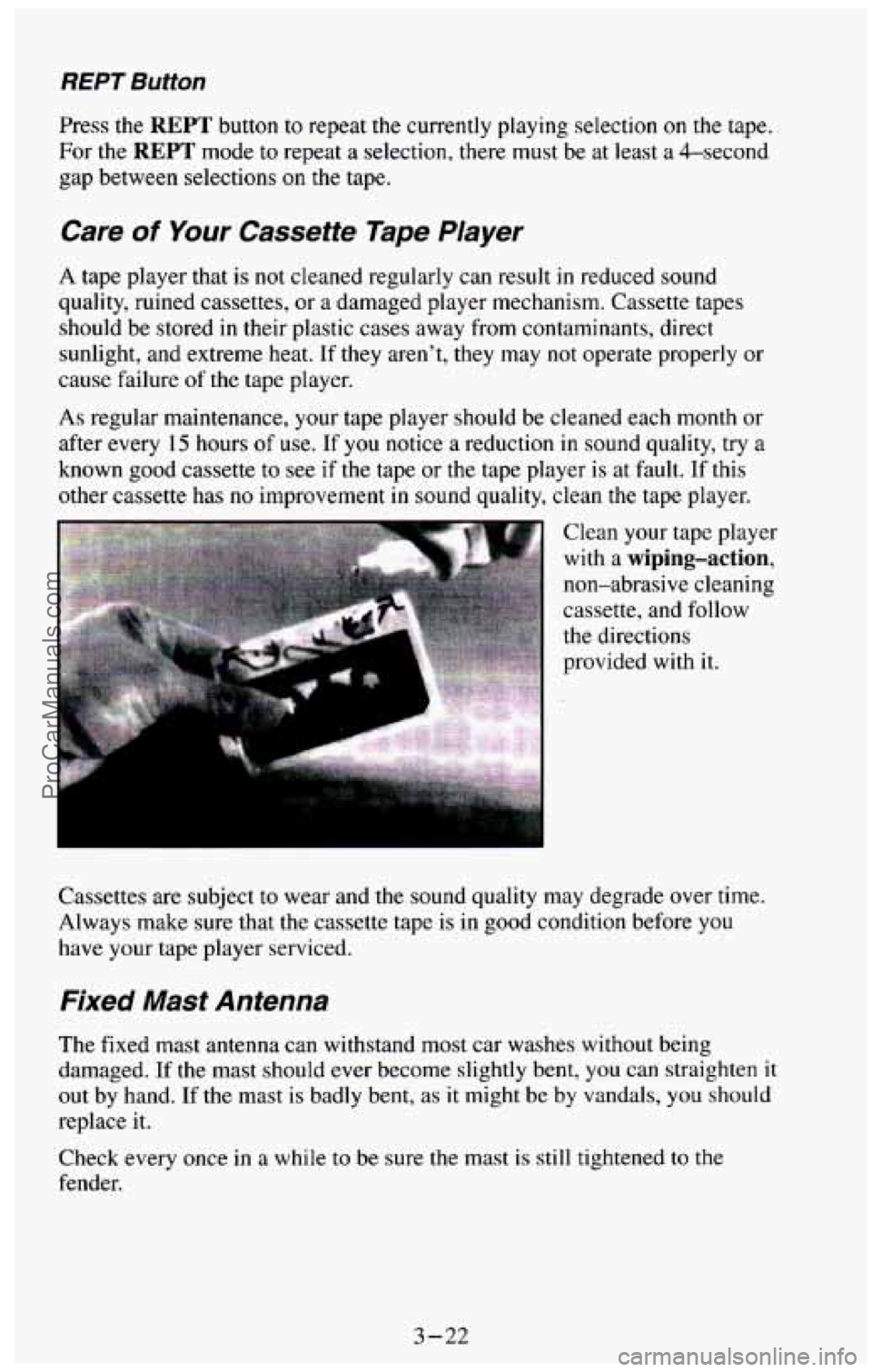
Clean your tape player
with a wiping-action,
non-abrasive cleaning
cassette, and follow
the directions
provided with it.
Cassettes are subject to wear and
the sound quality may degrade over time.
Always make sure that the cassette tape is in
good condition before you
have your tape player serviced.
Fixed Mast Antenna
The fixed mast antenna can withstand most car washes without being
damaged.
If the mast should ever become slightly bent, you can straighten it
out by hand. If the mast is badly bent, as it might be by vandals, you should
replace it.
Check every once
in a while to be sure the mast is still tightened to the
fender.
3-22
ProCarManuals.com
Page 171 of 385
Off-Road Driving with Your
Four- Wheel Drive Vehicle
This off-road guide is for vehicles that have four-wheel drive.
Also, see “Anti-lock Brakes”
in the Index.
If your vehicle doesn’t have four-wheel drive, you shouldn’t drive off-road
unless you’re
on a level, solid surface.
Off-road driving
can be great fun. But it does have some definite hazards.
The greatest of these is the terrain itself.
“Off-roading” means you’ve left the great North American road system
behind. Traffic lanes aren’t marked. Curves aren’t banked. There are no
road signs. Surfaces can be slippery, rough, uphill or downhill. In short,
you’ve gone right back
to nature.
Off-road driving involves some new skills. And that’s
why it’s very
important that you read this guide. You’ll find many driving tips and
suggestions. These will help make your off-road driving safer and more
enjoyable.
Before You Go Off-Roading
There are some things to do before you go out. For example, be sure to have
all necessary maintenance and service work done. Be sure you read
all the
information about your four-wheel drive vehicle
in this manual. Is there
enough fuel?
Is the spare tire fully inflated? Are the fluid levels up where
they should be? What are the local laws that apply to off-roading where
you’ll be driving? If you don’t know, you should check
with law
enforcement people in the area. Will you be on someone’s private land? If
so, be sure to get the necessary permission.
Loading Your Vehicle for Off-Road Driving
There are some important things to remember about how to load your
vehicle.
The heaviest things should be on the load floor and forward of your
Be sure the load is secured properly, so driving on the off-road terrain
rear axle.
Put heavier items as far forward as you can.
doesn’t toss things around.
4-12
ProCarManuals.com