Page 222 of 385
If the coolant inside the coolant surge tank is boiling, don't do anything else
until it cools down.
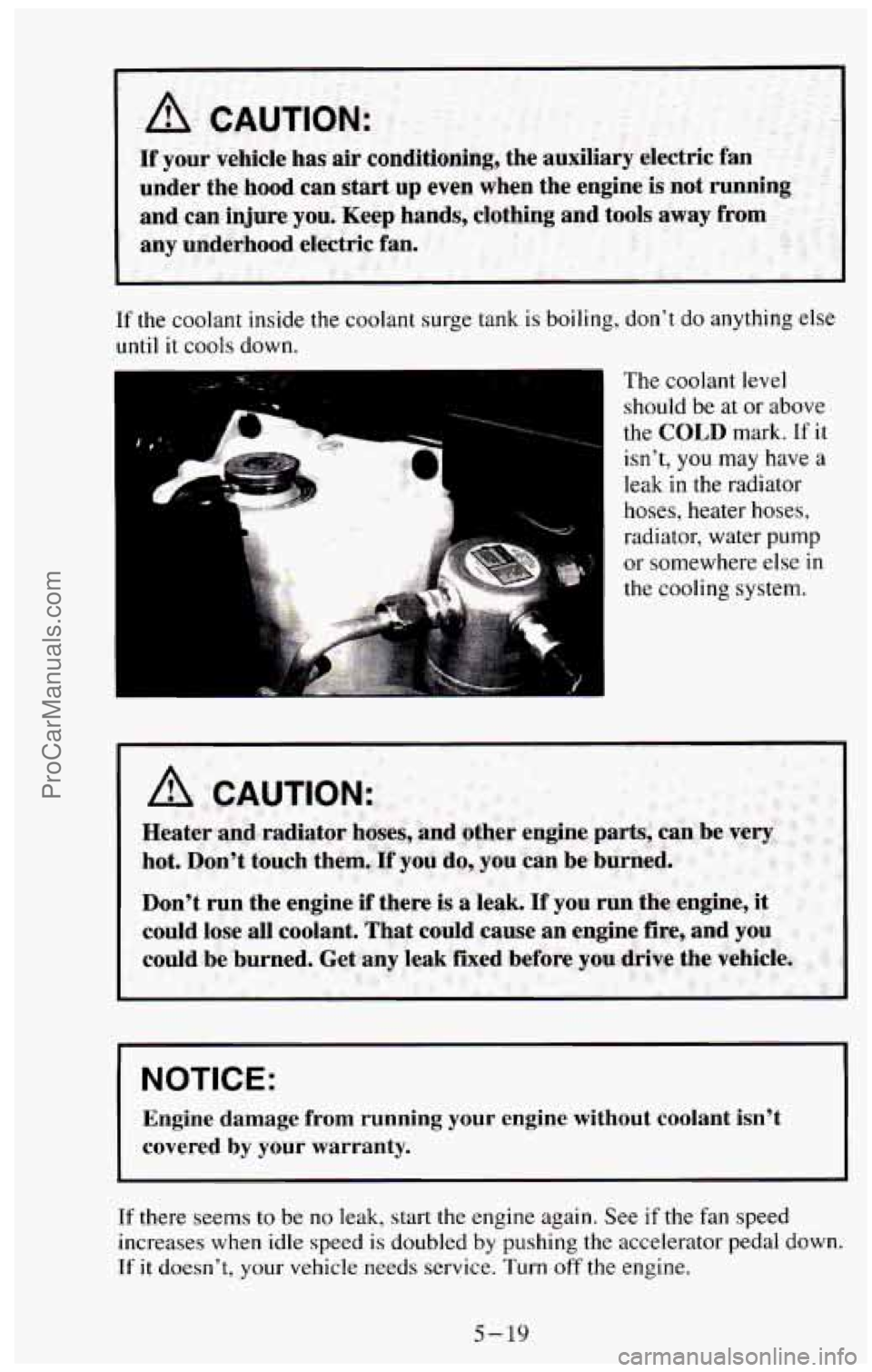
The coolant level
should be at
or above
the
COLD mark. If it
isn't, you may have
a
leak in the radiator
hoses, heater hoses,
radiator, water
pump
or somewhere else in
the cooling system.
NOTICE:
Engine damage from running your engine without coolant isn't
covered by your warranty.
If there seems to be no leak, start the engifie again. See if the fan speed
increases when idle speed
is doubled by pushing the accelerator pedal down
If
it doesn't, your vehicle needs service. Turn off the engine.
5-19
ProCarManuals.com
Page 224 of 385
NOTICE:
In cold weather, water can freeze and crack the engine, radiat\
or,
heater core and other parts.
So use the recommended coolant.
1. You can remove the coolant surge tank pressure cap when the cooling
system, including the coolant surge tank pressure cap and upper
radiator
hose, is no longer hot.
5-21
ProCarManuals.com
Page 226 of 385
While filling the surge tank, watch to see if coolant begins to stream out
the air bleed valve. When coolant begins to stream out, close the valve.
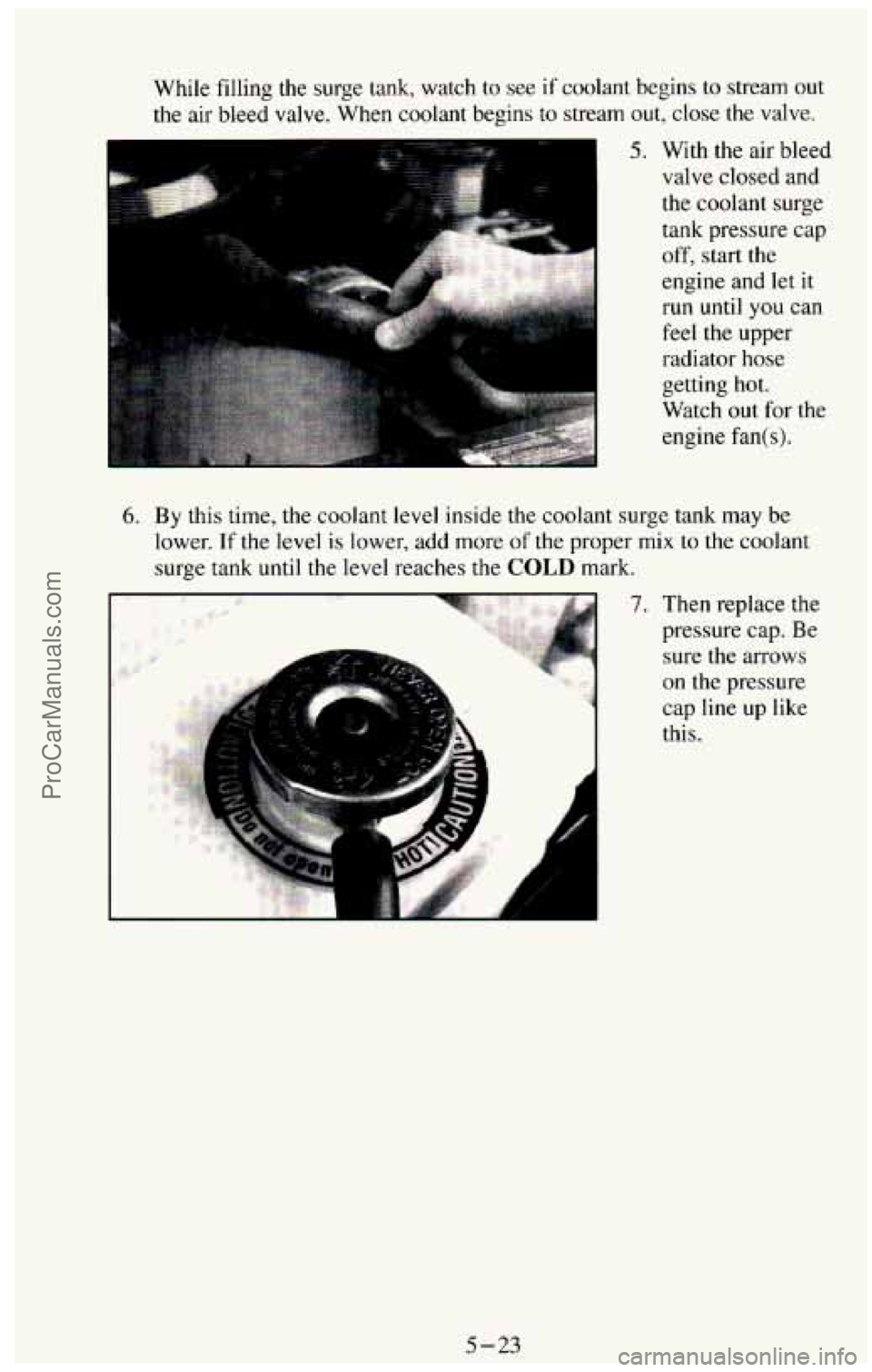
5. With the air bleed
valve closed and
the coolant surge
tank pressure cap
off, start the
engine and let
it
run until you can
feel
the upper
radiator hose
getting hot.
Watch out for the
engine fan(
s).
6. By this time, the coolant level inside the coolant surge tank may be
lower.
If the level is lower, add more of the proper mix to the coolant
surge tank until the level reaches the
COLD mark.
7. Then replace the
pressure cap.
Be
sure the arrows
on the pressure
cap line up like
this.
5-23
ProCarManuals.com
Page 281 of 385
What to Use
use a mixture of one-half clean water (preferably distilled) and one-half
antifreeze that meets
“GM Specification 6038-M,” which won’t damage
aluminum
parts. You can also use a recycled coolant conforming to “GM
Specification 6038-M” with a complete coolant flush and refill. If you use
this mixture, you don’t need
to add anything else.
NOTICE:
If you use an improper coolant mix, your engine could overheat
and be badly damaged. The repair cost wouldn’t be covered by
your warranty.
TOO much water in the mix can freeze and crack
the engine, radiator, heater core and other parts.
Some conditions, such as air trapped in the cooling system, can affect the
coolant level in the radiator. Check the coolant level when the engine is cold
and follow the steps under “Adding Coolant” for
the proper way to add
coolant.
If you have to add coolant more than four times a year, have your dealer
check your cooling system.
NOTICE:
If you use the proper coolant, you don’t have to add extra
inhibitors
or additives which claim to improve the system. These
can be harmful.
6-36
ProCarManuals.com
Page 284 of 385
Radiator Pressure Cap-Gas Engines
I I
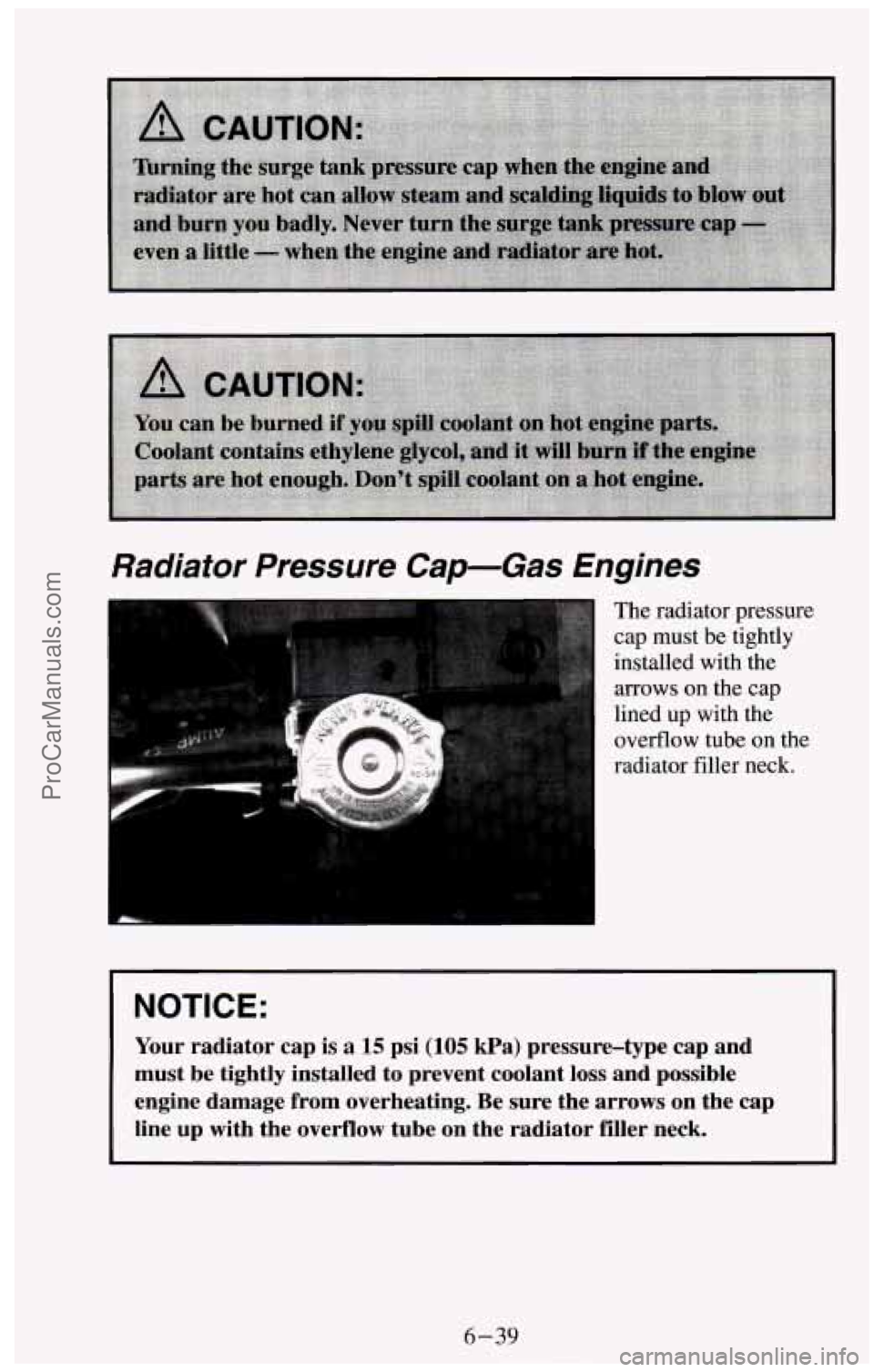
The radiator pressure
cap must be tightly
installed with the
arrows on the cap
lined up with the
ovefflow tube on the
radiator filler neck.
NOTICE:
Your radiator cap is a 15 psi (105 kPa) pressure-type cap and
must be tightly installed
to prevent coolant loss and possible
engine damage from overheating. Be sure the arrows on the cap
line up with the overflow tube on the radiator filler neck.
ProCarManuals.com
Page 285 of 385
Surge Tank Pressure Cap- Diesel Engines
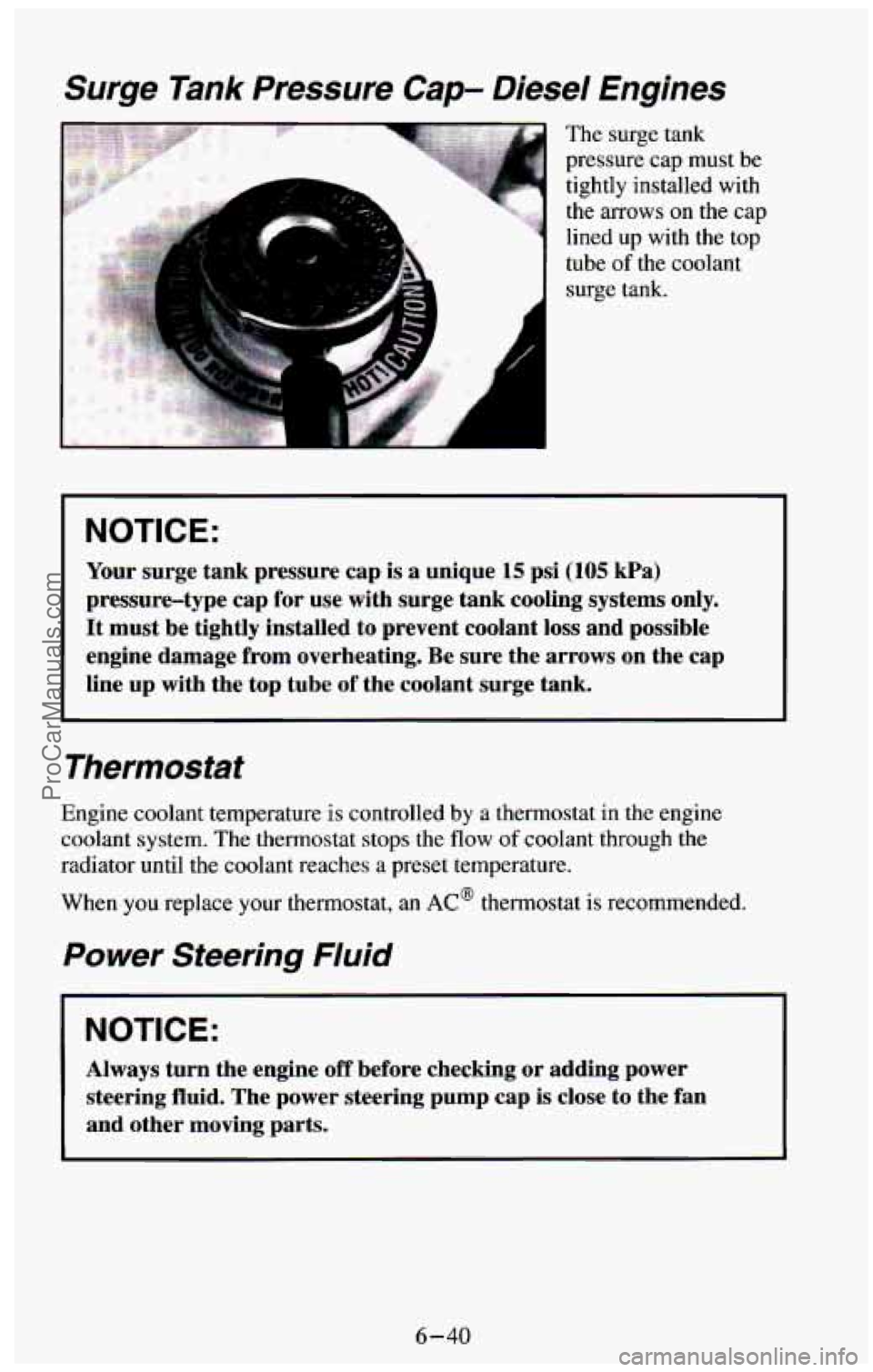
The surge tank
pressure cap must be
tightly installed with
the arrows
on the cap
lined up with the top
tube
of the coolant
surge tank.
NOTICE:
Your surge tank pressure cap 1s a unique 15 psi (105 kPa)
pressure-type cap for use with surge tank cooling systems only.
It must be tightly installed to prevent coolant loss and possible
engine damage from overheating. Be sure the arrows on the cap
line up with the top tube
of the coolant surge tank.
Thermostat
Engine coolant temperature is controlled by a thermostat in the engine
coolant system. The thermostat stops the flow
of coolant through the
radiator until the coolant reaches a preset temperature.
When you replace your thermostat, an
AC@ thermostat is recommended.
Power Steering Fluid
I NOTICE:
Always turn the engine off before checking or adding power
steering
fluid. The power steering pump cap is close to the fan
and other moving parts.
6-40
ProCarManuals.com
Page 287 of 385
Hydro-Boost Brake System (Hydraulic Pump)
The power steering pump is also used as the Hydro-boost pump. Refer to
“Power Steering System” in this section when checking fluid level
or
adding fluid.
Windshield Washer Fluid
To Add
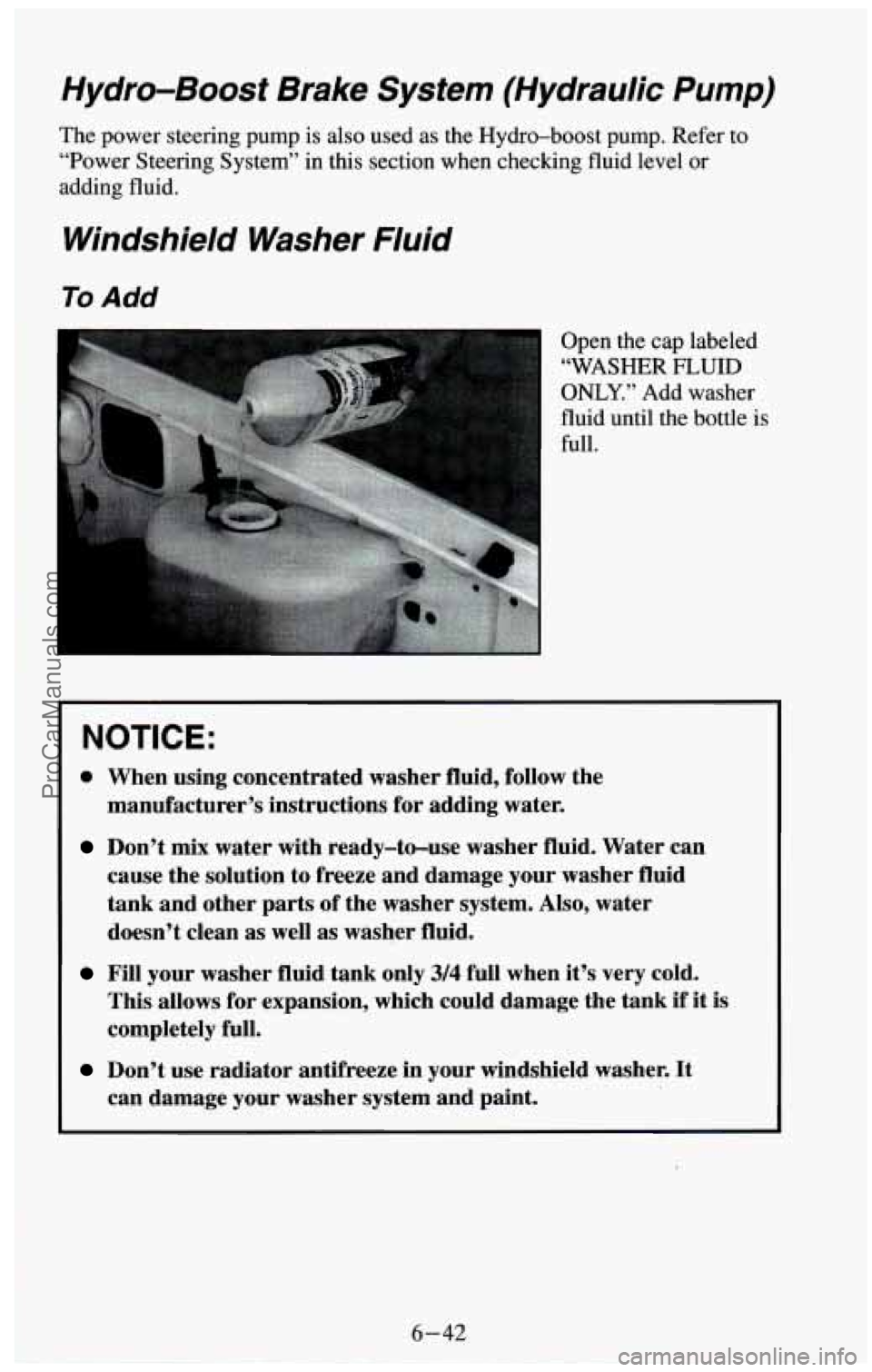
Open the cap labeled
“WASHER
FLUID
ONLY.” Add washer
fluid until the bottle is
full.
~ NOTICE:
0 When using concentrated washer fluid, follow the
manufacturer’s instructions for adding water.
Don’t mix water with ready-to-use washer fluid. Water can
cause the solution to freeze and damage your washer fluid
tank and other parts of the washer system. Also, water
doesn’t clean as well
as washer fluid.
Fill your washer fluid tank only 3/4 full when it’s very cold.
This allows for expansion, which could damage the tank
if it is
completely full.
Don’t use radiator antifreeze in your windshield washer. It
can damage your washer system and paint.
ProCarManuals.com
Page 296 of 385
NOTICE:
Avoid touching the bulb or letting it come in contact with
anything damp. Oil from
your skin or moisture on the bulb can
cause the bulb to explode when it is turned on. If either comes in
contact with the bulb, clean
it with alcohol or a suitable
degreaser and wipe the bulb dry.
Composite Headlights
.' --6n k
'I
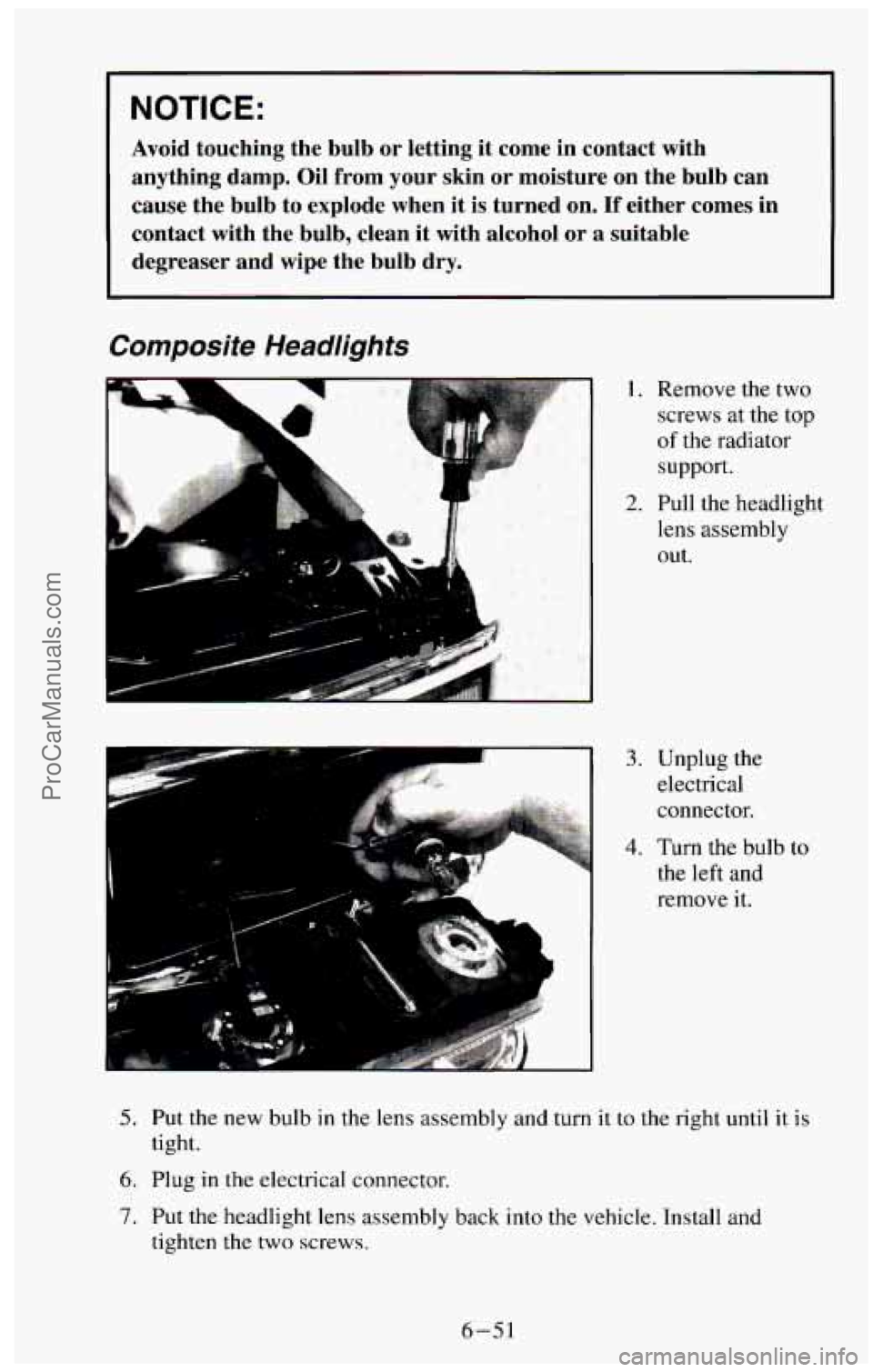
i 1. Remove the two
screws at the top
of the radiator
support.
2. Pull the headlight
lens assembly
out.
3. Unplug the
electrical
connector.
4. Turn the bulb to
the left and
remove it.
5. Put the new bulb in the lens assembly and turn it to the right until it is
6. Plug in the electrical connector.
7. Put the headlight lens assembly back into the vehicle. Install and
tight.
tighten the two screws.
6-51
ProCarManuals.com