Page 248 of 385
Service
Your GM dealer knows your vehicle best and wants you to be happy with it.
We hope you’ll go to your dealer for all your service needs. You’ll get
genuine GM parts and GM-trained and supported service people.
We hope
you’ll want to keep your GM vehicle all GM. Genuine GM parts
have one
of these marks:
Doing Your Own Service Work
If you want to do some of your own service work, you’ll want to get the
proper GM Service Manual. It tells you much more about how
to service
your vehicle than this manual can.
To order the proper service manual, see
“Service Publications”
in the Index.
You should keep a record with all parts receipts and list the mileage and the
date of
any service work you perform. See “Maintenance Record” in the Index.
I NOTICE:
I
If you try to do your own service work without knowing enough
about it, your vehicle could be damaged.
6-3 ProCarManuals.com
Page 249 of 385
Maintenance Schedule
Section 7 of this manual, “Scheduled Maintenance Services”, explains the
maintenance your new vehicle needs, and when
it should be done. It also
has a form that you can
use to record the maintenance work done on your
vehicle. Be sure to read this information.
Fuel (Gasoline Engine)
If your vehicle has a diesel engine, see “Diesel Fuel Requirements and Fuel
System” in this Section. For vehicles with gasoline engines, please read this.
Use regular unleaded gasoline rated at
87 octane or higher. It should meet
specifications ASTM
D4814 in the U.S. and CGSB 3.5-92 in Canada.
These fuels should have the proper additives,
so you should not have to add
anything to the
fuel.
In the U.S. and Canada, it’s easy to be sure you get the right kind of
gasoline (unleaded). You’ll see
“UNLEADED” right on the pump. And only
unleaded nozzles will fit into your vehicle’s filler neck.
Be sure the posted octane
is at least 87. If the octane is less than 87, you
may get a heavy knocking noise when you drive. If it’s bad enough, it can
damage your engine.
If you’re using fuel rated
at 87 octane or higher and you still hear heavy
knocking, your engine needs service. But don’t worry
if you hear a little
pinging noise when you’re accelerating or driving up
a hill. That’s normal
and
you don’t have to buy a higher octane fuel to get rid of pinging. It’s the
heavy, constant knock that means
you have a problem.
What about gasoline with blending materials that contain oxygen
(oxygenates), such
as MTBE or alcohol?
MTBE is “methyl tertiary-butyl ether.” Fuel that is no more than
15% MTBE is fine for your vehicle.
Ethanol is ethyl or grain alcohol. Properly-blended fuel that is no more than
10% ethanol is fine for your vehicle.
Methanol is methyl or wood alcohol.
NOTICE:
Fuel that is more than 5 % methanol is bad for your vehicle.
Don’t use it.
It can corrode metal parts in your fuel system and
also damage plastic and rubber parts. That damage wouldn’t be
covered under your warranty. And even at
5% or less, there
must
be “cosolvents” and corrosion preventers in this fuel to
help avoid these problems.
6-4
ProCarManuals.com
Page 272 of 385
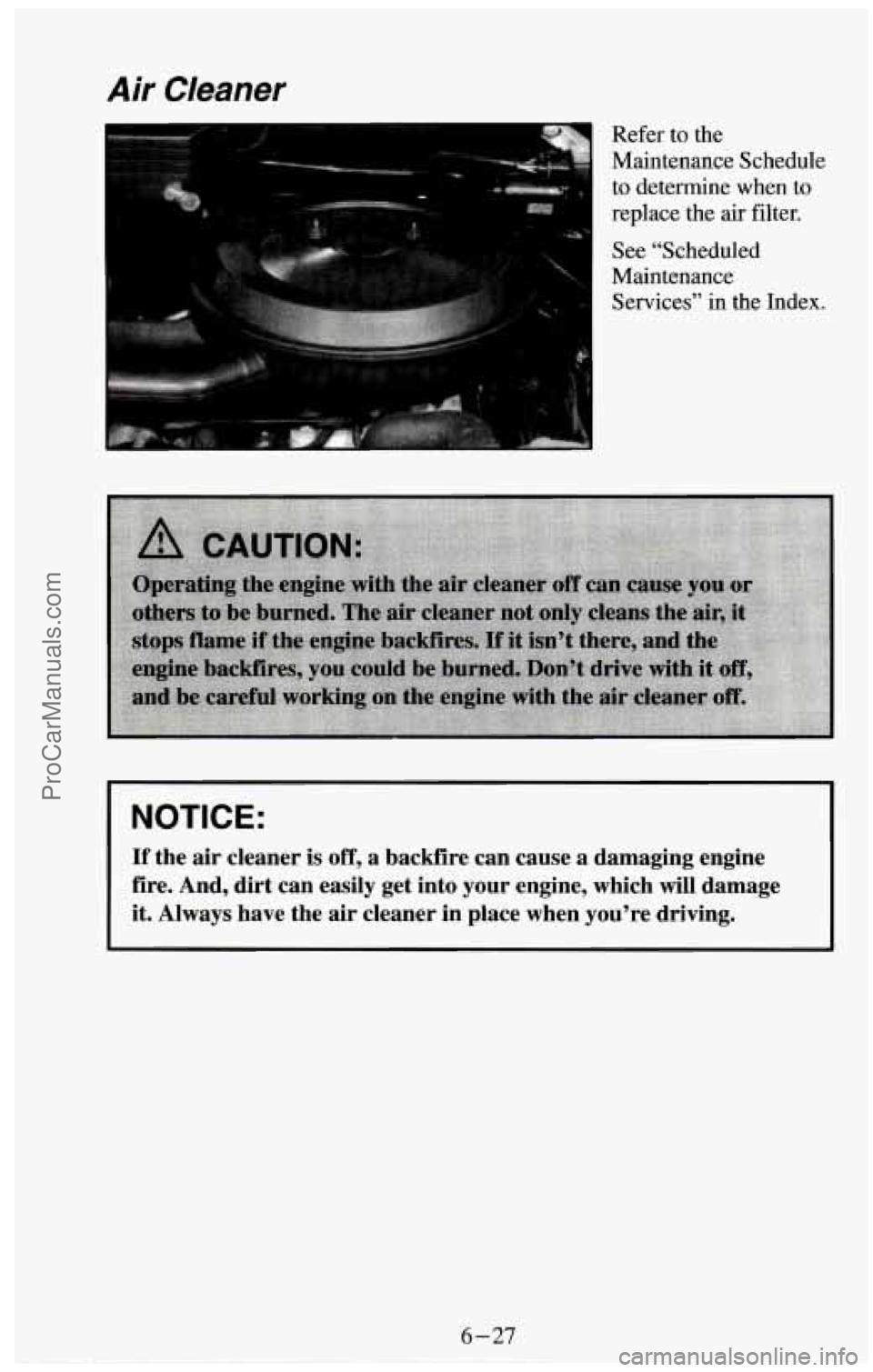
Air Cleaner
Refer to the
Maintenance Schedule to determine when to
replace the air filter.
See “Scheduled
Maintenance Services” in the Index.
NOTICE:
If the air cleaner is off, a backfire can cause a damaging engine
fire. And, dirt can easily get into your engine, which will d\
amage it. Always have the air cleaner in place when you’re drivin\
g.
6-27
ProCarManuals.com
Page 273 of 385
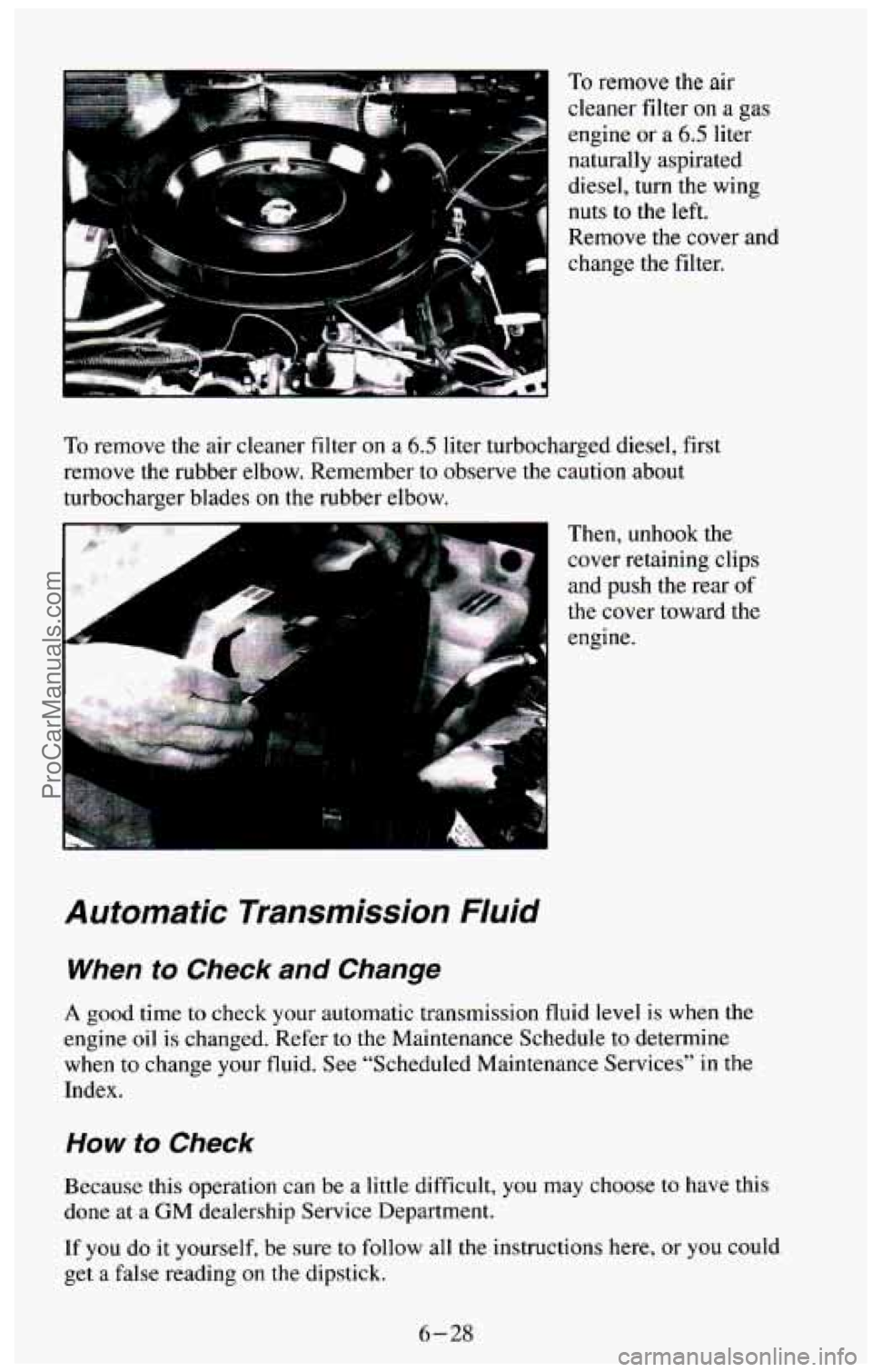
To remove the air
cleaner filter
on a gas
engine or
a 6.5 liter
naturally aspirated
diesel, turn the wing
nuts
to the left.
Remove the cover and
change the filter.
To remove the air cleaner filter on a 6.5 liter turbocharged diesel, first
remove the rubber elbow. Remember to observe the caution about
turbocharger blades on the rubber elbow,
Then, unhook the
cover retaining clips
and push the rear
of
the cover toward the
engine.
Automatic Transmission Fluid
When to Check and Change
A good time to check your automatic transmission fluid level is when the
engine
oil is changed. Refer to the Maintenance Schedule to determine
when to change your fluid.
See “Scheduled Maintenance Services” in the
Index.
How to Check
Because this operation can be a little difficult, you may choose to have this
done at a
GM dealership Service Department.
If you do it yourself, be sure to follow all the instructions here, or you could
get
a false reading on the dipstick.
6-28
ProCarManuals.com
Page 276 of 385
WOW to Add Fluid
Refer to the Maintenance Schedule to determine what kind of transmission
fluid to use. See “Recommended Fluids and Lubricants’’ in the Index.
If the fluid level
is low, add only enough of the proper fluid to bring the
level up to the
COLD area for a cold check or the HOT area for a hot check.
It doesn’t take much fluid, generally
less than a pint. Don’t overfill. We
recommend you use
only fluid labeled DEXRON@-I11 or DEXRON@-IIE,
because fluids with that label are made especially for your automatic
transmission. Damage caused
by fluid other than DEXRON@-I11 or
DEXRON@-IIE is not covered
by your new vehicle warranty.
After adding fluid, recheck the fluid level as described under “How to
Check.”
When the correct fluid level is obtained, push the dipstick back in all
the way; then flip the handle down to lock the dipstick
in place.
Manual Transmission Fluid
When to Check
A good time to have it checked is when the engine oil is changed. However,
the fluid
in your manual transmission doesn’t require changing.
How to Check
Because this operation can be a little difficult, you may choose to have this
done at a
GM dealership Service Department.
If you do it yourself, be sure to follow all the instructions here, or you could
get
a false reading.
NOTICE:
Too much or too little fluid can damage your transmission. Too
much can mean that some of the fluid could come out and fall on
hot engine parts or exhaust system, starting a fire. Be sure to get
an accurate reading if
you check your transmission fluid.
Check the fluid level only when your engine is off, the vehicle is parked on
a level place and the transmission is cool enough for you to rest your fingers
on the transmission case.
6-31 ProCarManuals.com
Page 277 of 385
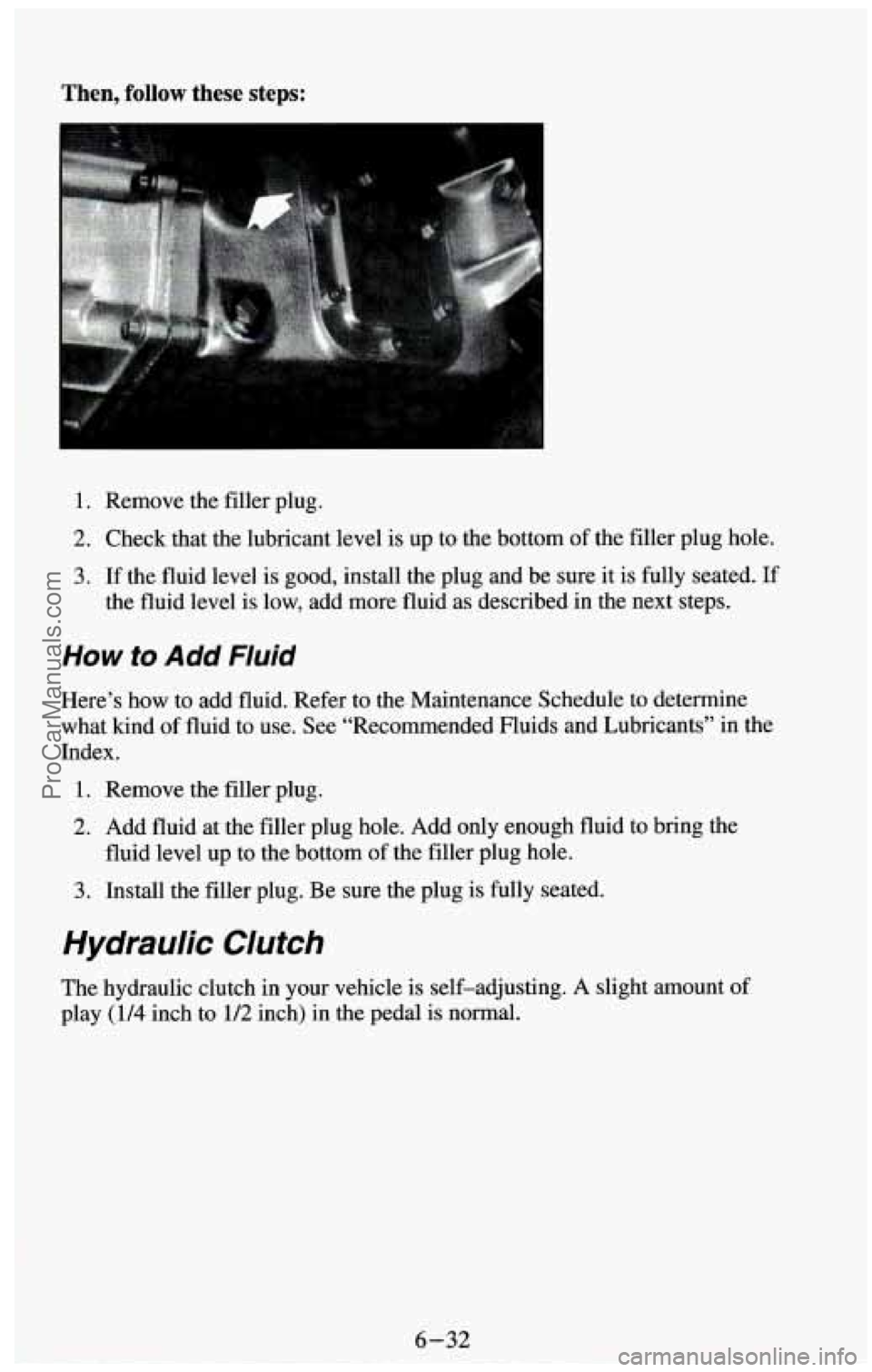
Then, follow these steps:
1. Remove the filler plug.
2. Check that the lubricant level is up to the bottom of the filler plug hole.
3. If the fluid level is good, install the plug and be sure it is fully seated. If
the fluid level is low, add more fluid as described in the next steps.
How to Add Fluid
Here’s how to add fluid. Refer to the Maintenance Schedule to determine
what kind
of fluid to use. See “Recommended Fluids and Lubricants” in the
Index.
1. Remove the filler plug.
2. Add fluid at the filler plug hole. Add only enough fluid to bring the
fluid level up to the bottom of the filler plug hole.
3. Install the filler plug. Be sure the plug is fully seated.
Hydraulic Clutch
The hydraulic clutch in your vehicle is self-adjusting. A slight amount of
play (1/4 inch to 1/2 inch) in the pedal is normal.
ProCarManuals.com
Page 278 of 385
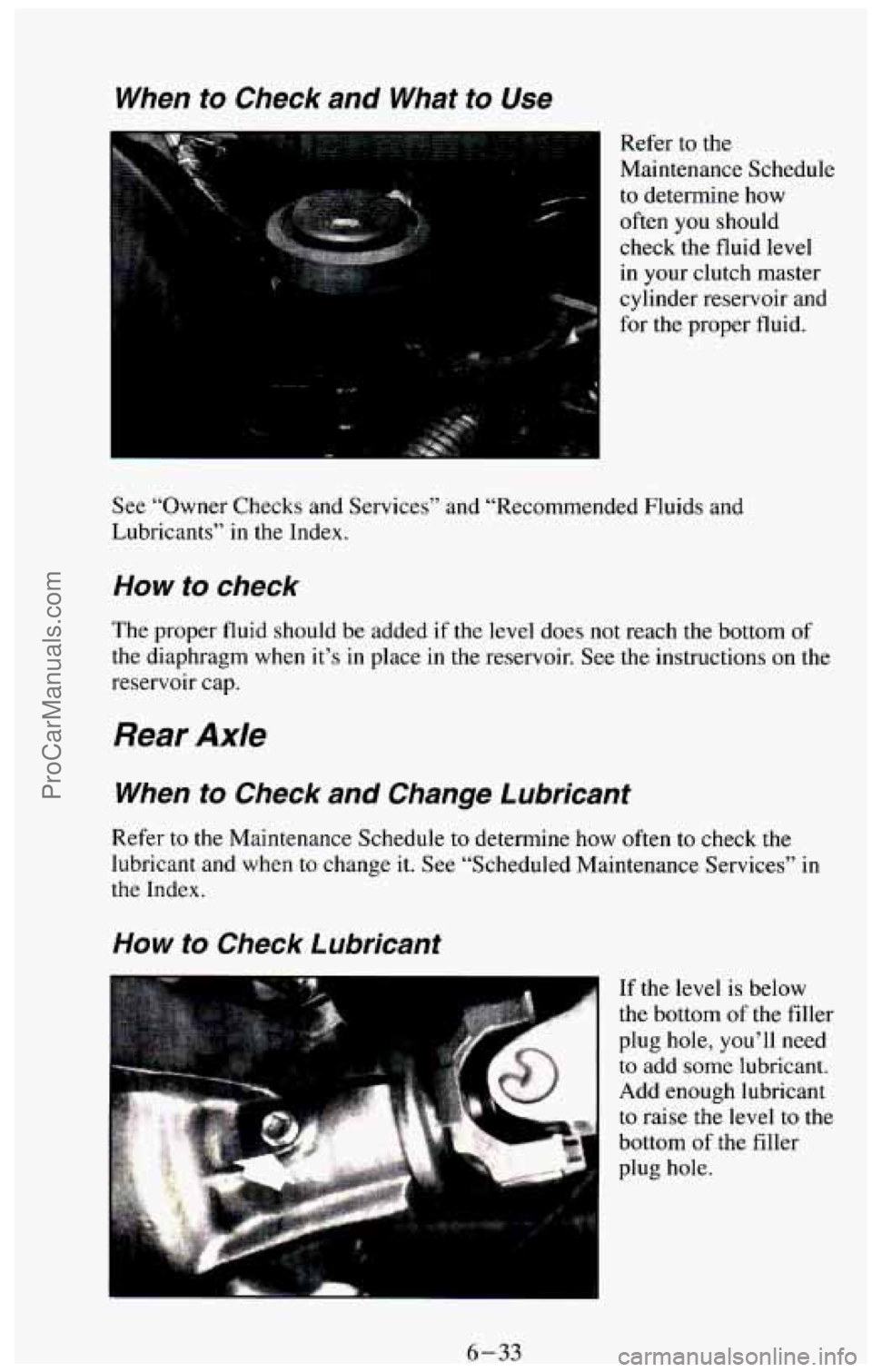
When to Check and What to Use
Refer to the
Maintenance Schedule
to determine how
often you should
check the fluid
level
in your clutch master
cylinder reservoir and
for the proper fluid.
See “Owner Checks and Services” and “Recommended Fluids and
Lubricants’’
in the Index.
How to check
The proper fluid should be added if the level does not reach the bottom of
the diaphragm when it’s
in place in the reservoir. See the instructions on the
reservoir cap.
Rear Axle
When to Checkand Change Lubricant
Refer to the Maintenance Schedule to determine how often to check the
lubricant and when to change it. See “Scheduled Maintenance Services” in
the Index.
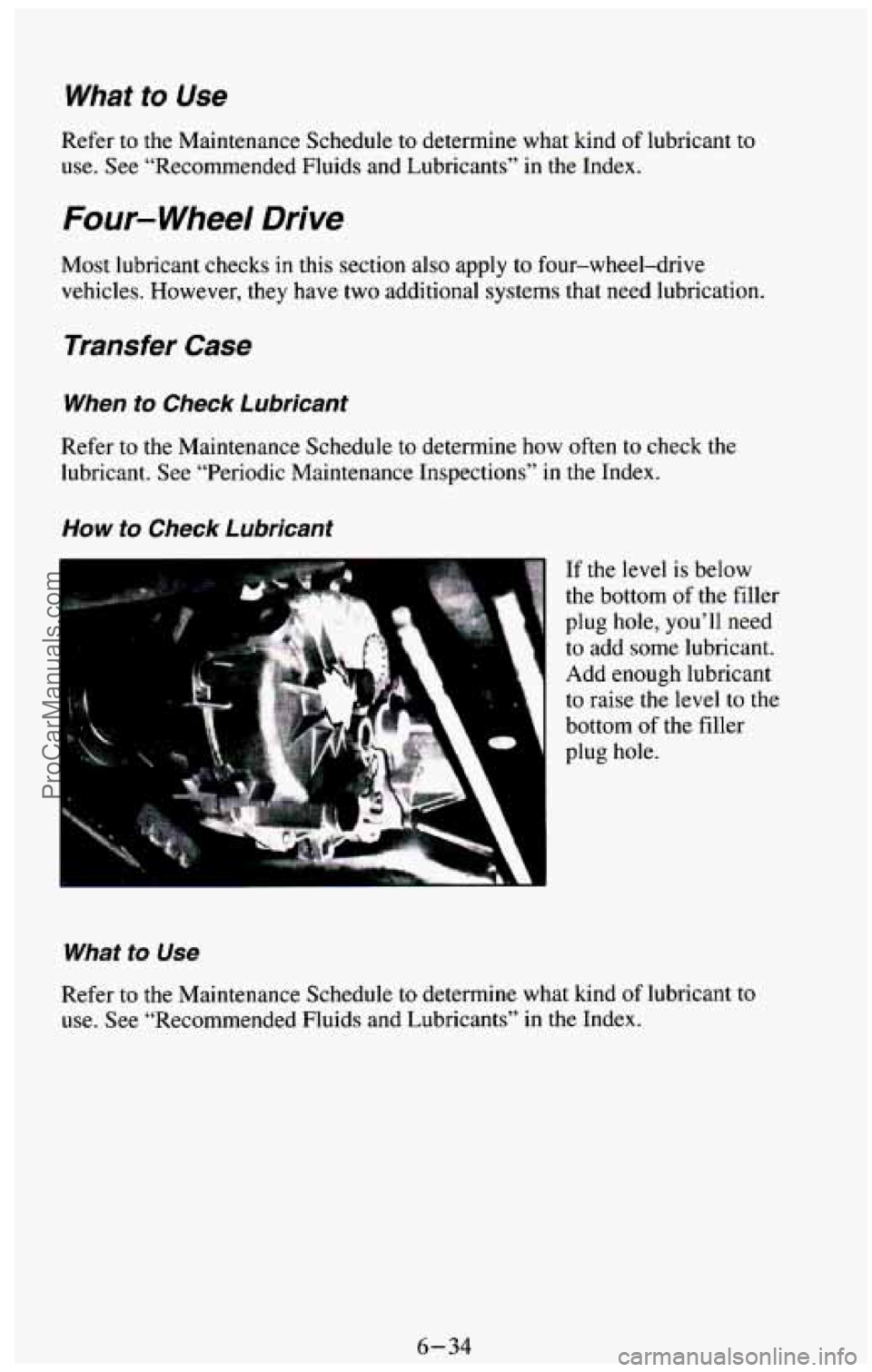
How to Check Lubricant
If the level is below
the bottom
of the filler
plug hole,
you’ll need
to add some lubricant.
Add enough lubricant
to raise the level
to the
bottom
of the filler
plug hole.
6-33 ProCarManuals.com
Page 279 of 385
Whai to Use
Refer to the Maintenance Schedule to determine what kind of lubricant to
use. See “Recommended Fluids and Lubricants” in the Index.
Four- Wheel Drive
Most lubricant checks in this section also apply to four-wheel-drive
vehicles. However, they have two additional systems that need lubrication.
Transfer Case
When to Check Lubricant
Refer to the Maintenance Schedule to determine how often to check the
lubricant.
See “Periodic Maintenance Inspections” in the Index.
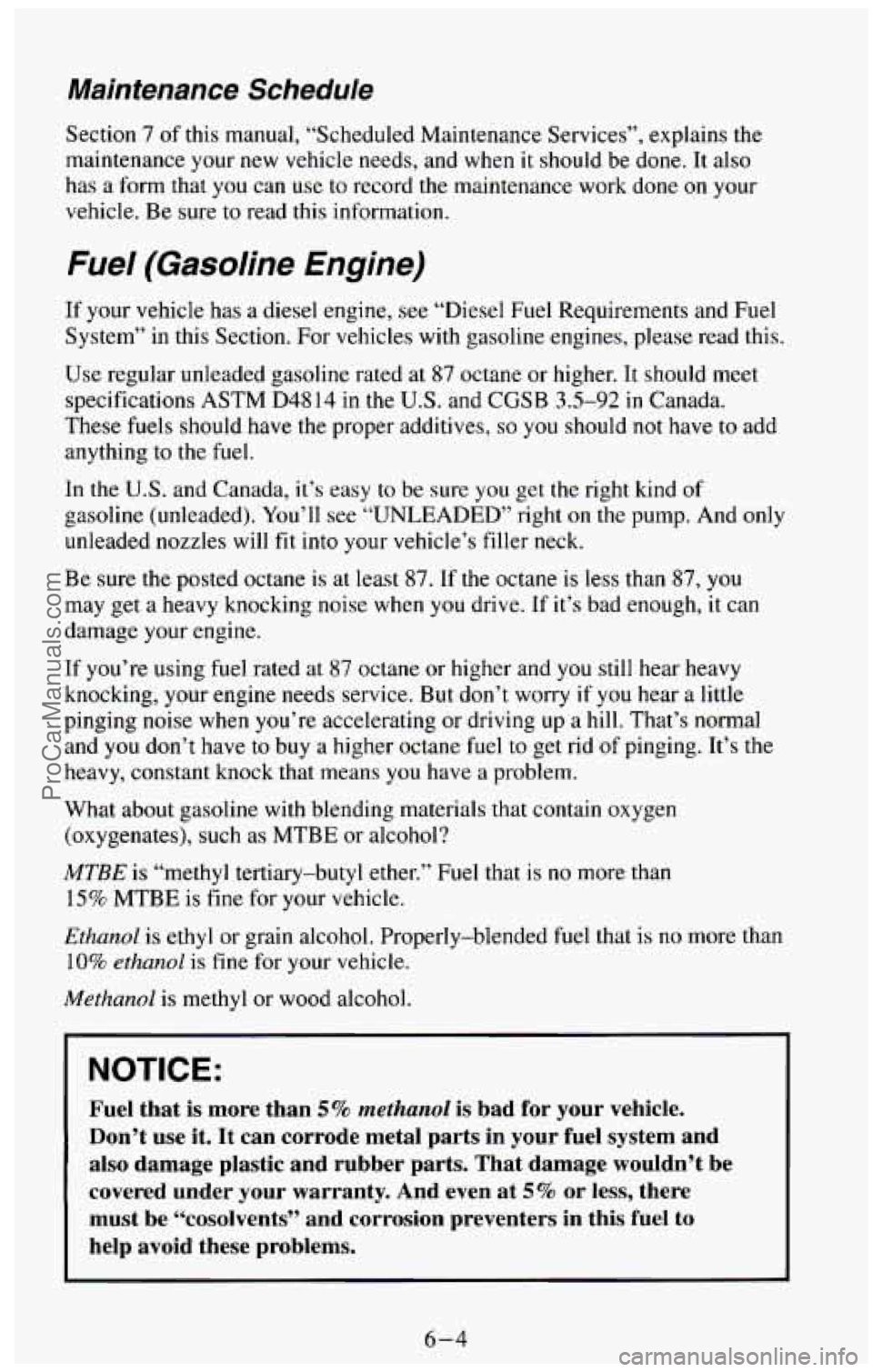
How to Check Lubricant
What to Use
If the level is below
the bottom of the filler
plug hole, you’ll
need
to add some lubricant.
Add enough lubricant
to raise the level to
the
bottom of the filler
plug hole.
Refer to the Maintenance Schedule
to determine what kind of lubricant to
use. See “Recommended Fluids and Lubricants” in the Index.
6-34
ProCarManuals.com