Page 263 of 340

Downloaded from www.Manualslib.com manuals search engine Engine Control Module System
This system has an oxygen (02) sensor that helps keep your engine’s
air-fuel mixture at a proper level. Use only unleaded fuel in your vehicle.
If
you use leaded fuel, you could damage your oxygen (02) sensor and affect
your vehicle’s emissions.
Loading Your Vehicle
The CertificatiodTire label is found on the driver’s door lock pillar. The
label shows the size of your original tires and the inflation pressures needed
to obtain the
gross weight capacity of your vehicle. This is called the
GVWR (Gross Vehicle Weight Rating). The GVWR includes the weight of
the vehicle,
all occupants, fuel and cargo.
The CertificatiodTire label
also tells you the maximum weights for the
front and rear axles, called Gross Axle Weight Rating
(GAWR). To find out
the actual
loads on your front and rear axles, you need to go to a weigh
station and weigh
your vehicle. Your dealer can help you with this. Be sure
to spread out your load equally
on both sides of the centerline.
Never exceed the GVWR for your vehicle, or the Gross Axle Weight Rating
(GAWR) for either the front or rear axle.
And, if you do have a heavy load, you should spread it out.
6-45
Page 270 of 340
Downloaded from www.Manualslib.com manuals search engine Inflation - Tire Pressure
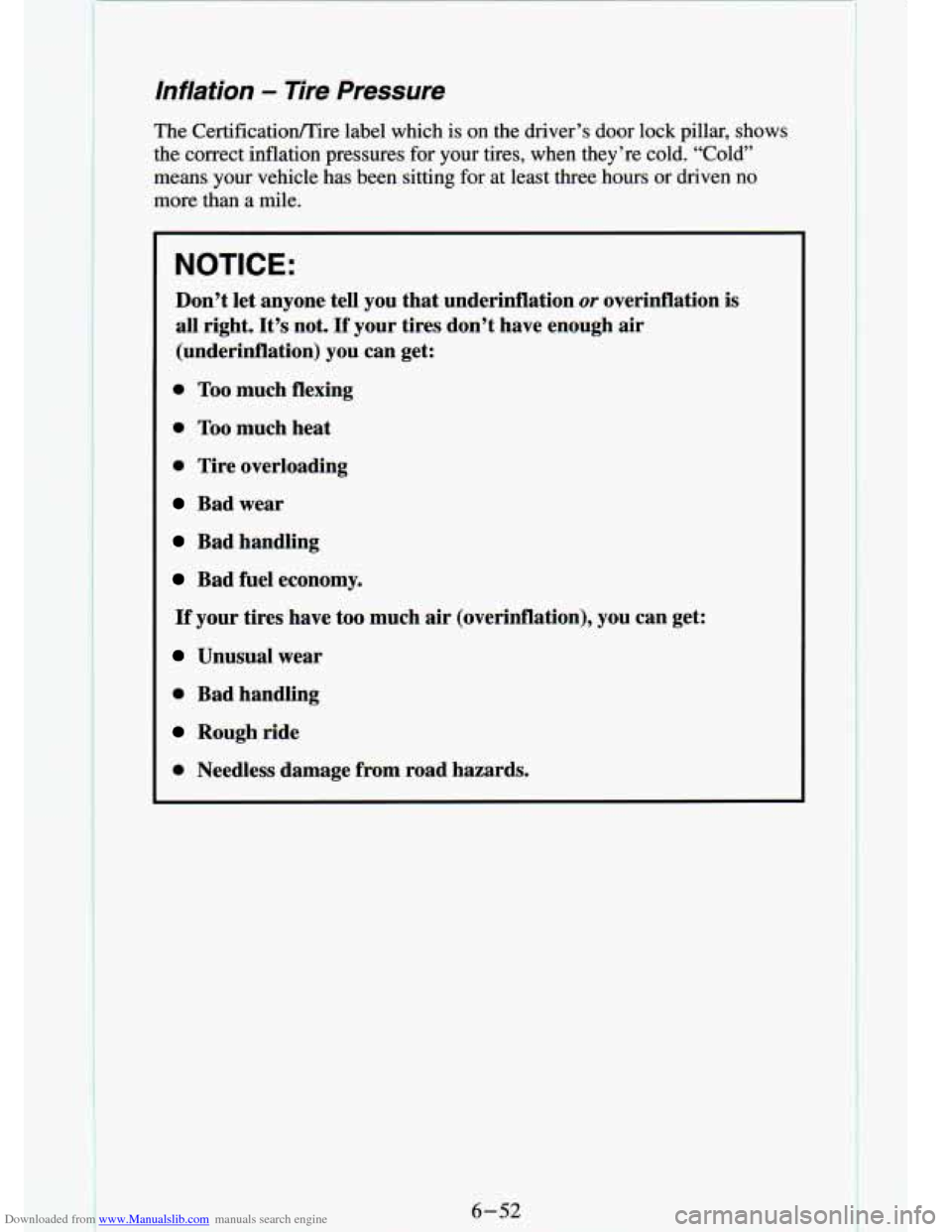
The CertificatiodTire label which is on the driver’s door lock pillar, shows
the correct inflation pressures for your tires, when they’re cold. ‘‘C01d’~
means your vehicle has been sitting for at least three hours or driven no
more than a mile.
NOTICE:
Don’t let anyone tell you that underinflation or overinflation is
all right. It’s not. If your tires don’t have enough air
(underinflation) you can get:
0 Too much flexing
0 Too much heat
0 Tire overloading
Bad wear
Bad handling
Bad fuel economy.
If your tires have too much air (overinflation), you can get:
Unusual wear
0 Bad handling
Rough ride
0 Needless damage from road hazards.
Page 271 of 340
Downloaded from www.Manualslib.com manuals search engine When to Check
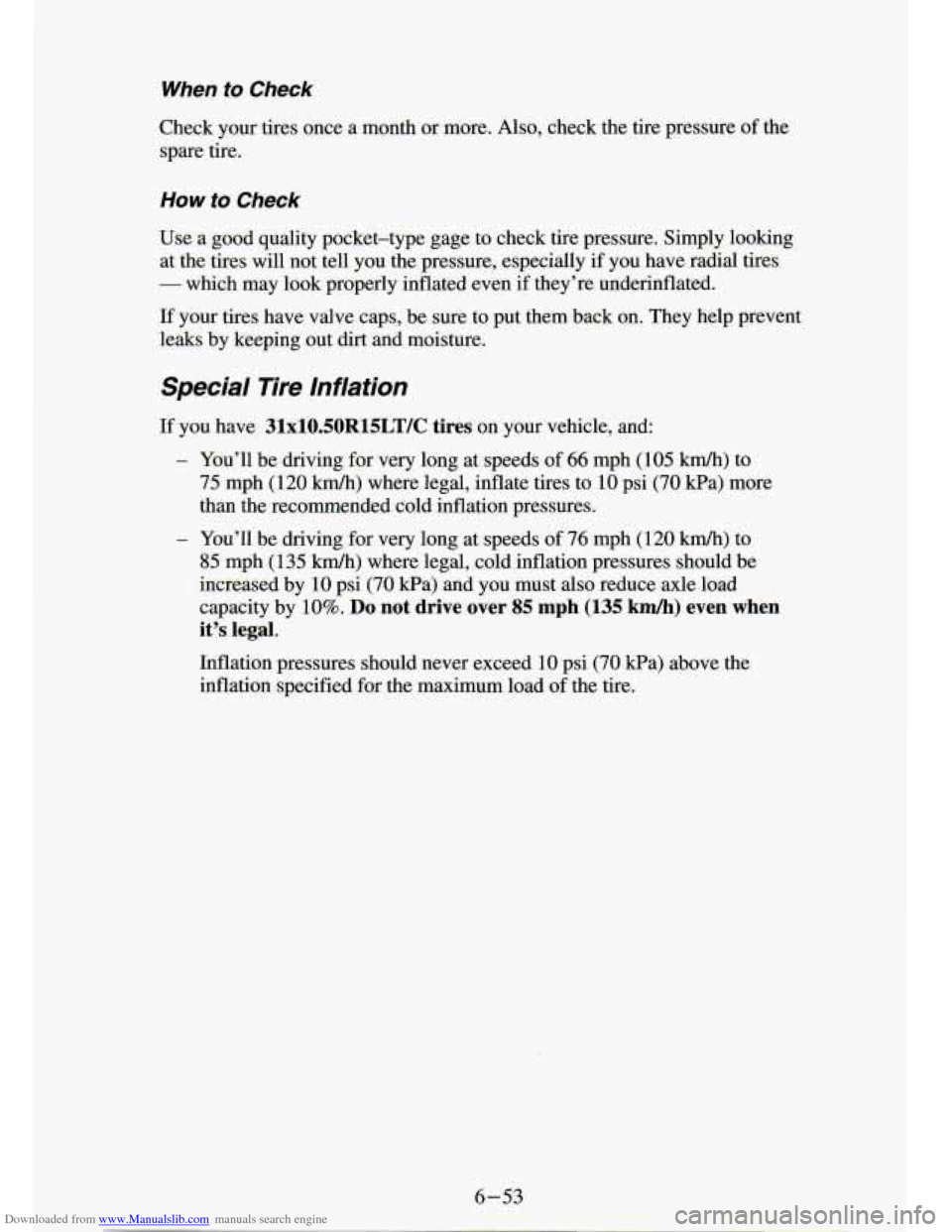
Check your ..’ :s once a month or more. Also, check the tire pressure of the
spare tire.
How to Check
Use a good quality pocket-type gage to check tire pressure. Si\
mply looking at the tires will
not tell you the pressure, especially if you have radial tires
- which may look properly inflated even if they’re underinflated.
If your tires have valve caps, be sure to put them back on. The\
y help prevent
leaks by keeping out
dirt and moisture.
Special Tire Inflation
If you have 31xlOSOR15LT/C tires on your vehicle, and:
- You’ll be driving for very long at speeds of 66 mph (105 km/h) to
75 mph (120 km/h) where legal, inflate tires to 10 psi (70 Wa) more
than the recornended cold inflation pressures.
- You’ll be driving for very long at speeds of 76 mph (120 km/h) to
85 mph (1 35 km/h) where legal, cold inflation pressures should be
increased by
10 psi (70 Wa) and you must also reduce axle load
capacity by
10%. Do not drive over 85 mph (135 km/h) even when
it’s legal.
Inflation pressures should never exceed 10 psi (70 Pa) above the
inflation specified for
the maximum load of the tire.
Page 272 of 340
Downloaded from www.Manualslib.com manuals search engine lire Inspection and Rotation
To make your tires last longer, have them inspected and rotated at the
mileages recommended in the Maintenance Schedule. See “Schedul\
ed
Maintenance Services” in the Index.
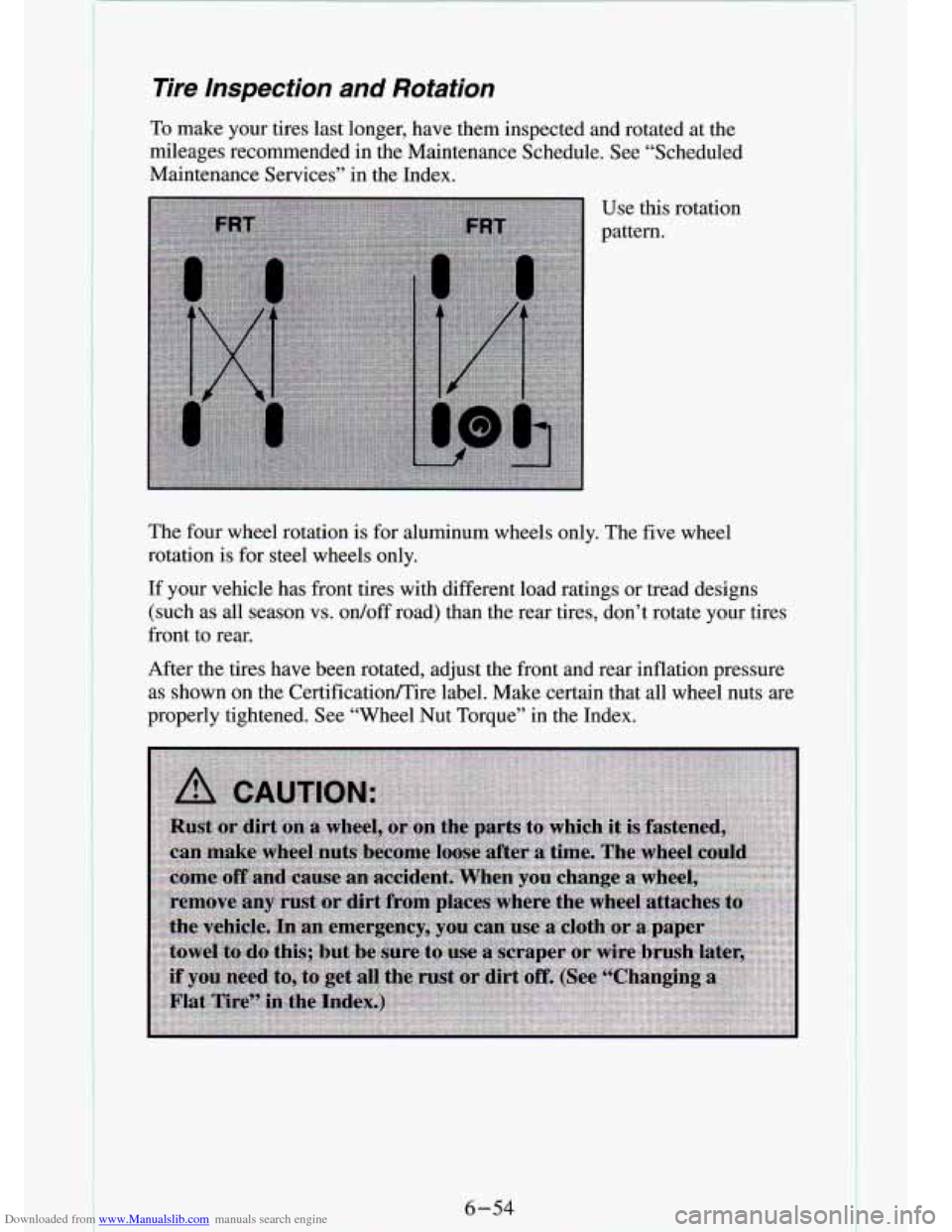
Use this rotation
pattern.
The four wheel rotation is for aluminum wheels only. The five wheel
rotation is for steel wheels only.
If your vehicle has front tires with different load ratings or tr\
ead designs
(such as all season vs. ordoff road) than the rear tires, d\
on’t rotate your tires
front to rear.
After the tires have been rotated, adjust the front and rear inflation pressure
as shown on the CertificatiodTire label. Make certain that all wheel nuts are
properly tightened. See “Wheel Nut Torque” in the Index.
6-54
Page 306 of 340

Downloaded from www.Manualslib.com manuals search engine Owner Checks and Services
Listed below are owner checks and services which would be made\
at the
time period specified to help ensure proper safety, emission pe\
rformance,
and dependability
of your vehicle.
Be sure any necessary repairs
are completed at once. Whenever any fluids
or lubricants are added to your vehicle, make sure they are t\
he proper ones,
as shown in this section.
At Least Once a Month
Tire Inflation Pressure Check - Check the tires for proper inflation. If
they
are low, inflate them to the level specified on the Certification \
label.
See “Inflation-Tire Pressure” in the Index.
At feast Four Times a Year
Tailgate Lubrication - Lubricate tailgate latch bolt, handle assembly pivot
points, and hinges with lubricant recommended in
this section. Lubricate
every
3,000 miles (5 000 kilometers) if following Maintenance Schedule I, or
every
7,500 &les (12 500 kilometers) if following Maintenance Schedule II.
At Least Once a Year
Key Lock Cylinder Lubrication - Lubricate key lock cylinders with one
of the lubricants recammended in
this section.
Transmission Neutral or Clutch Start Switch Operation -
1.
2.
3.
4.
Before you start, be sure you have enough room around the veh\
icle.
Firmly apply both the manual parking brake, and the regular br\
ake. See
“Brakes” and “Parking Brake” in the Index.
Do not use the accelerator
pedal.
Be ready to
turn off the engine immediately if it starts.
On automatic transmission vehicles,
try to start the engine in each gear.
The starter should work only in
T“ (Park) or “N’ (Neutral).
On manual transmission vehicles, put the shift lever in “N’ (Neutral),
push the clutch down halfway, and
try to start the engine. The starter
should work only when the clutch is pushed down
all the way to the floor.
7-10
Page 331 of 340
Downloaded from www.Manualslib.com manuals search engine Gages ......................................................... 2-58
Coolant Temperature Gage
...................................... 2-60
Fuel Gage
................................................... 2-66
Odometer .............................................. 2-56, 2-57
Oil Pressure Gage ............................................. 2-62
Speedometer
................................ ..-.............. 2-56
Tachometer .................................................. 2-57
Trip Odometer
................................................ 2-57
Voltmeter
.................................................... 2-67
Gages (continued)
H
I
If You’re Stuck
in Sand. Mud. Ice. or Snow ........................... 5-35
Ignitionswitch
.................................................. 2-10
Inflation-Tire Pressure
............................................ 6-52
Jackstorage
............................................... 5-21, 5-29
Jump Starting ................................................ 5-3’5-4
K
Key Release Lever ................................................ 2-11
Keys
........................................................... 2-3
5
.