Page 201 of 340
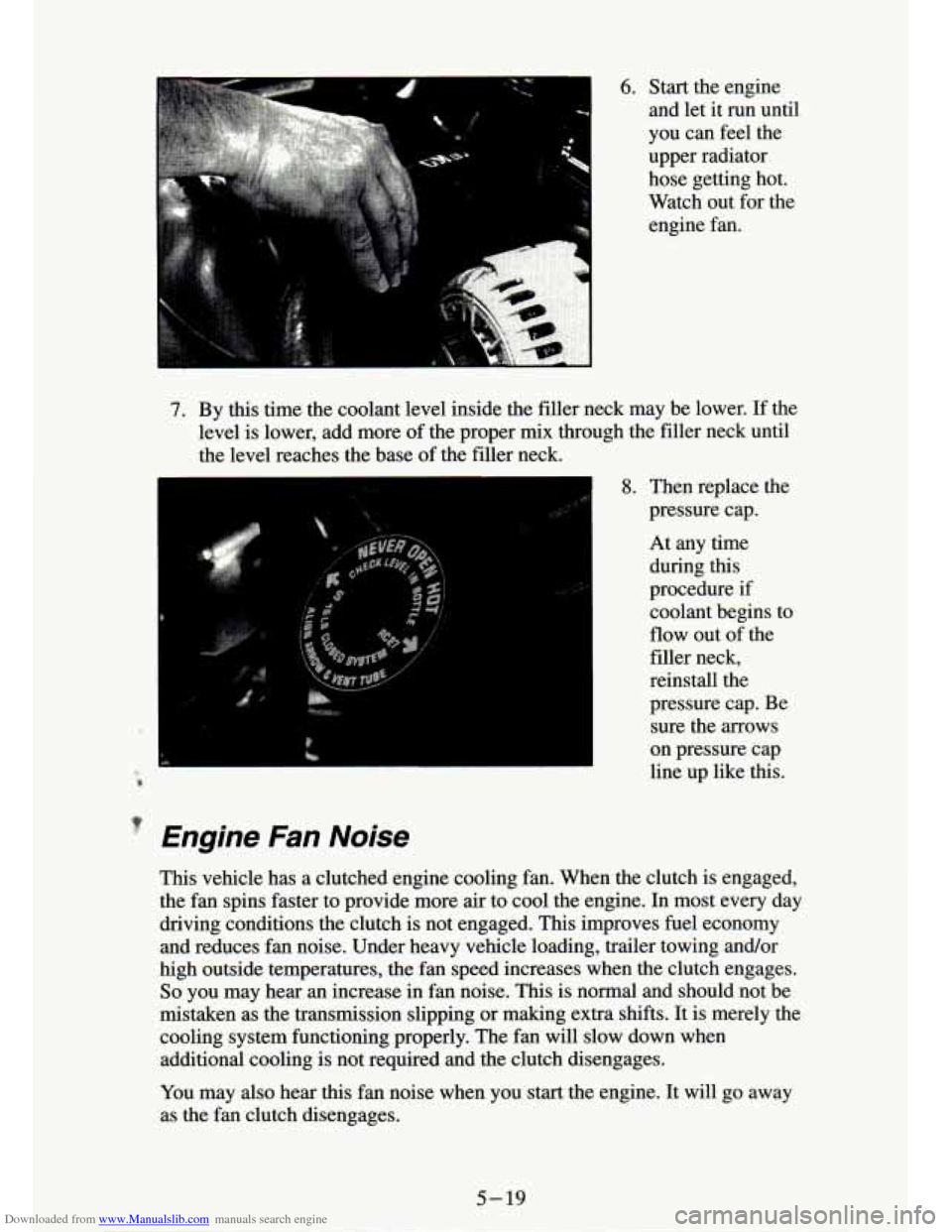
Downloaded from www.Manualslib.com manuals search engine 7. By this time the coolant level inside the filler neck may be lower. If the
level is lower, add more of the proper
mix through the filler neck until
the level reaches the base of the filler neck.
8. Then replace the
pressure cap.
At any time during
this
procedure if coolant begins to
flow out of the
filler neck,
reinstall the
pressure cap. Be sure the arrows
on pressure cap
line up like this.
P
' Engine Fan Noise
This vehicle has a clutched engine cooling fan. When the clutch is engaged,
the fan spins faster to provide more air
to cool the engine. In most every day
driving conditions the clutch is not engaged. This improves fuel economy
and reduces fan noise. Under heavy vehicle loading, trailer towing and/or
high outside temperatures, the fan speed increases when the clutch engages.
So you may hear an increase in fan noise. This is normal and should not be
mistaken as the transmission slipping or making extra shifts. It is merely the
cooling system functioning properly. The fan will slow down when
additional cooling is not required and the clutch disengages.
You may also hear this fan noise when you
start the engine. It will go away
as the
fan clutch disengages.
5-19
Page 219 of 340
Downloaded from www.Manualslib.com manuals search engine Service & Appearance Care
I
Section
Here you will find information about the care of your vehicle . This part
begins with service and fuel information. and then it shows ho\
w to check important fluid and lubricant levels
. There is also technical information
about your vehicle. and a section devoted to its appearance care
.
Service ................................................... 6-2
Fuel
..................................................... 6-3
Engineoil
.............................................. 6-9
Aircleaner
............................................ 6-14
Automatic Transmission Fluid
............................. 6-15
Manual Transmission Fluid
............................... 6-18
Hydraulic Clutch
........................................ 6-20
RearAxle
............................................. 6-20
Transfer Case
.......................................... 6-21
FrontAxle
............................................. 6-22
Power Steering Fluid
.................................... 6-26
Windshield Washer Fluid
................................. 6-28
Checking Things Under the Hood
.............................. 6-6
Engine Coolant
......................................... 6-23
Brake Master Cylinder
................................... 6-29
Replacing Brake System Parts
................................ 6-32
Bulb Replacement
......................................... 6-33
Battery
.................................................. 6-32
Vehiclestorage
........................................... 6-32
Other Maintenance Items
.................................... 6-39
Loading Your Vehicle
...................................... 6-45
Tires
.................................................... 6-51
Appearancecare
.......................................... 6-59
Vehicle Identification Number (VIN)
.......................... 6-68
Service Parts Identification Label
............................. 6-70
Fuses and Circuit Breakers
.................................. 6-70
Capacities and Specifications Charts
........................... 6-73
6-1
Page 222 of 340

Downloaded from www.Manualslib.com manuals search engine Gasolines for Cleaner Air
Your use of gasoline with deposit control additives will help prevent
deposits from forming in your engine and fuel system. That hel\
ps keep your
engine
in tune and your emission control system working properly. It’s \
good
for your vehicle, and you’ll be doing your part for cleaner air.
Many gasolines are now blended with oxygenates. General Motc
recommends that you use gasolines with these blending niaterials,
sucn as
MTBE and ethanol. By doing so, you can help clean the air, especially in
those parts of the country that have high carbon monoxide levels.
In addition, some gasoline suppliers are now producing reformulated
gasolines. These gasolines are specially designed to reduce vehi\
cle
emissions. General Motors recommends that you use reformulated g\
asoline.
By doing
so, you can help clean the air, especially in those parts of the
country that have high ozone levels.
You should ask your service station operators
if their gasolines contain
deposit control additives and oxygenates, and if they have been\
reformulated to reduce vehicle emissions.
Fuels in Foreign Countries
If you plan on driving in another country outside the U.S. or Canada,
unleaded fuel may be hard to find. Do not use leaded gasoline. If you use
even one tankful, your emission controls won’t work well or \
at all. With
continuous use, spark plugs can get fouled, the exhaust system \
can corrode, and your engine oil can deteriorate quickly. Your vehicle’s oxygen sensor
will be damaged. All of that means costly repairs that wouldn’t be covered
by your warranty.
To check on fuel availability, ask an auto club, or contact a ma\
jor oil
company that does business in the country where you’ll be d\
riving.
You can also write us at the following address for advice.
Just tell us where.
you’re going and give your Vehicle Identification Number (VI\
N).
General Motors Overseas Distribution Corporation
North American Export Sales (NAES)
1908 Colonel Sam Drive
Oshawa, Ontario
L1H 8P7
6-4
Page 223 of 340
Downloaded from www.Manualslib.com manuals search engine Filling Your Tank
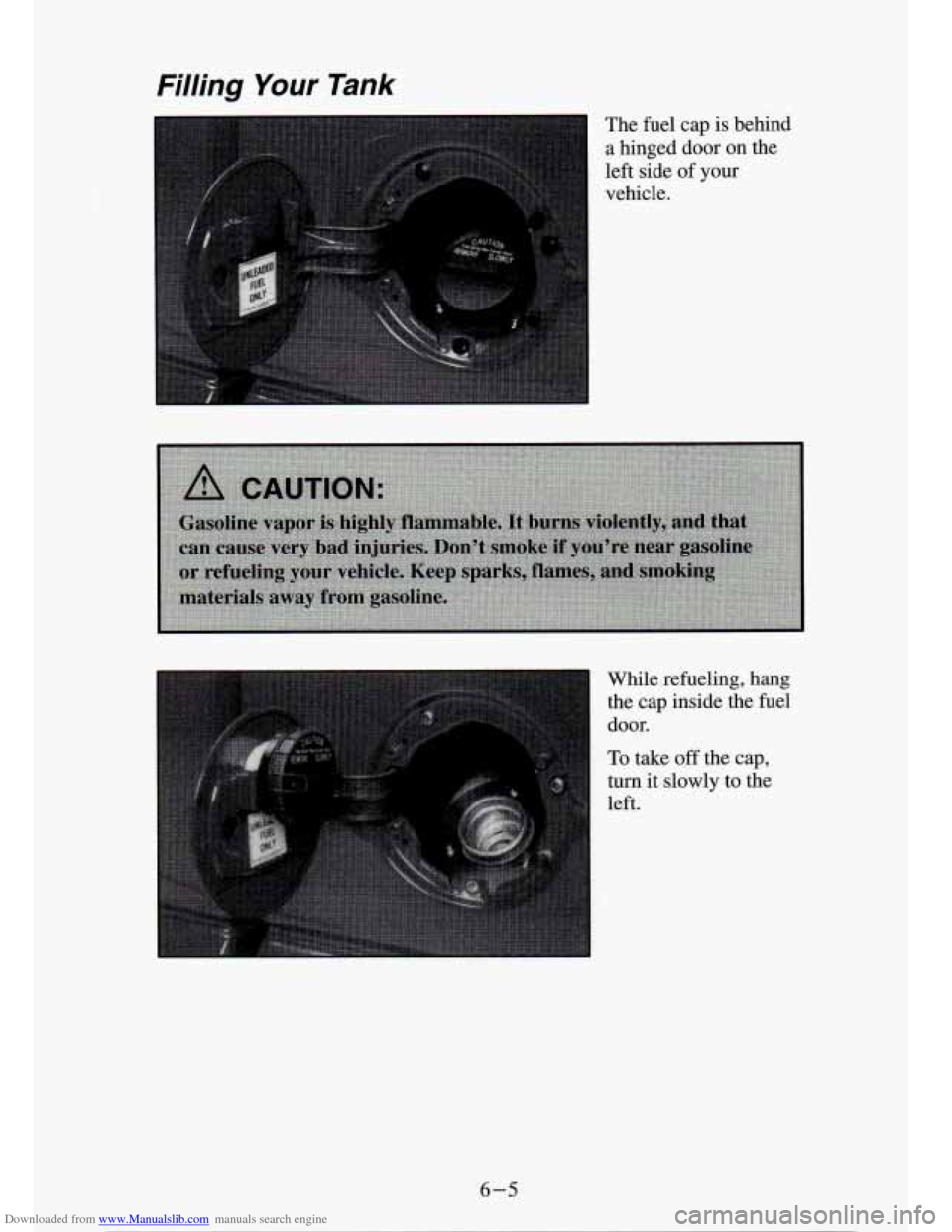
The fuel cap is behind
a hinged door on the
left side
of your
vehicle.
While refueling, hang the cap inside the fuel
door.
To take
off the cap,
turn it
slowly to the
left.
6-5
Page 224 of 340
Downloaded from www.Manualslib.com manuals search engine Be careful not to spill gasoline. Clean gasoline from painted surfaces as
soon as possible. See “Cleaning the Outside of Your Vehicle” in the Index.
When
you put the cap back on, turn it to the right until you hear a clicking
noise.
NOTICE:
If you need a new cap, be sure to get the right type. Your dea\
ler
can get one for you. If you get the wrong type, it may not fit or
have proper venting, and your fuel tank and emissions system
might be damaged.
Checking Things Under fhe Hood
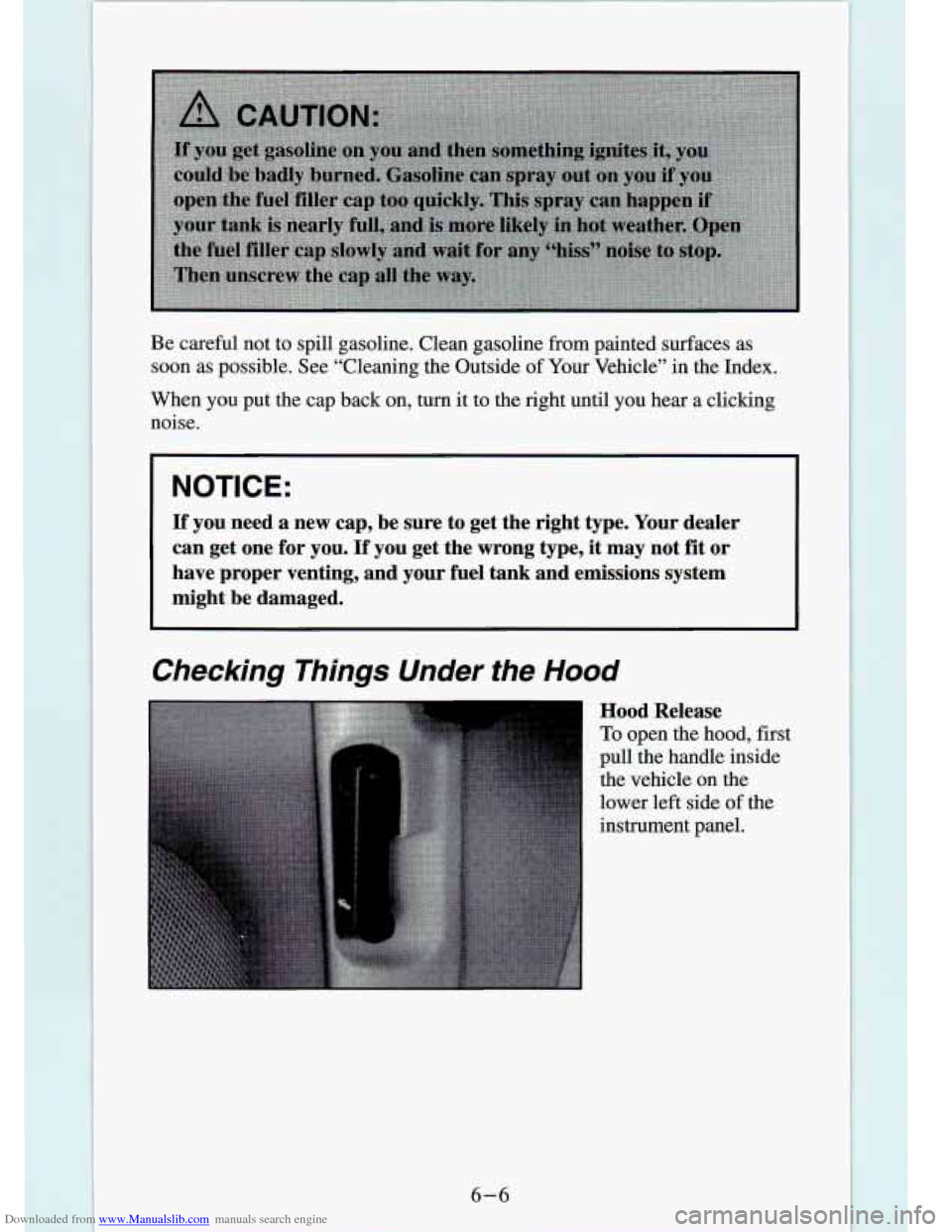
Hood Release
To open the hood, first
pull the handle inside
the vehicle on the
, lower left side of the
~ instrument panel.
6-6
Page 227 of 340
Downloaded from www.Manualslib.com manuals search engine Engine Oil
It’s a good idea to check your engine oil every time you get fuel. In order to
get an accurate reading, the oil must be warm
and the vehicle must be on
level ground.
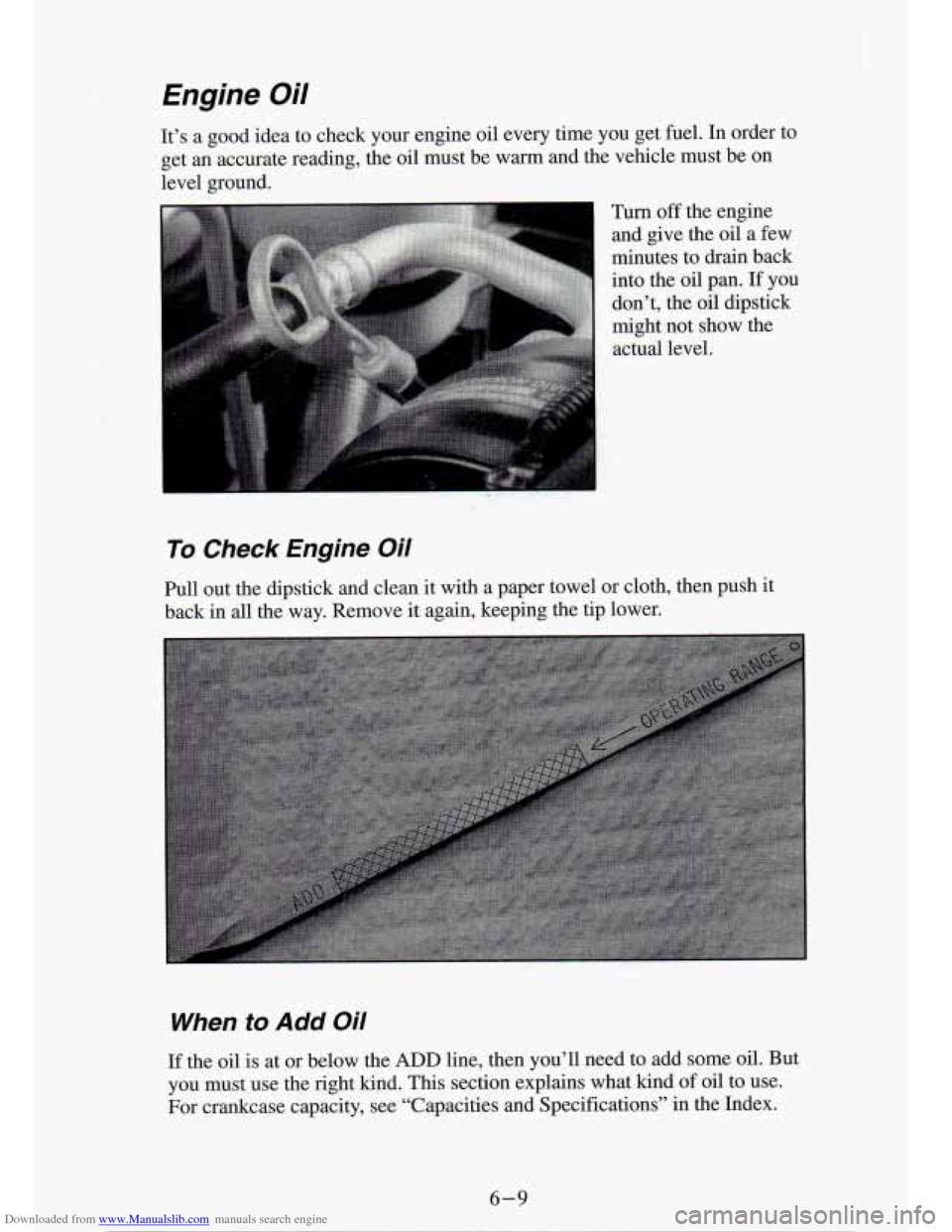
Turn
off the engine
and give the oil a
few
rninutes to drain back
into the
oil pan. If you
don’t, the oil dipstick
might not show the
actual level.
To Check Engine Oil
Pull out the dipstick and clean it with a paper towel or cloth, then push it
back in all the way. Remove it again, keeping the tip lower.
When to Add Oil
If the oil is at or below the ADD line, then you’ll need to add some oil. But
you must use the right kind.
This section explains what kind of oil to use.
For crankcase capacity, see “Capacities and Specifications” in the Index.
6-9
Page 229 of 340
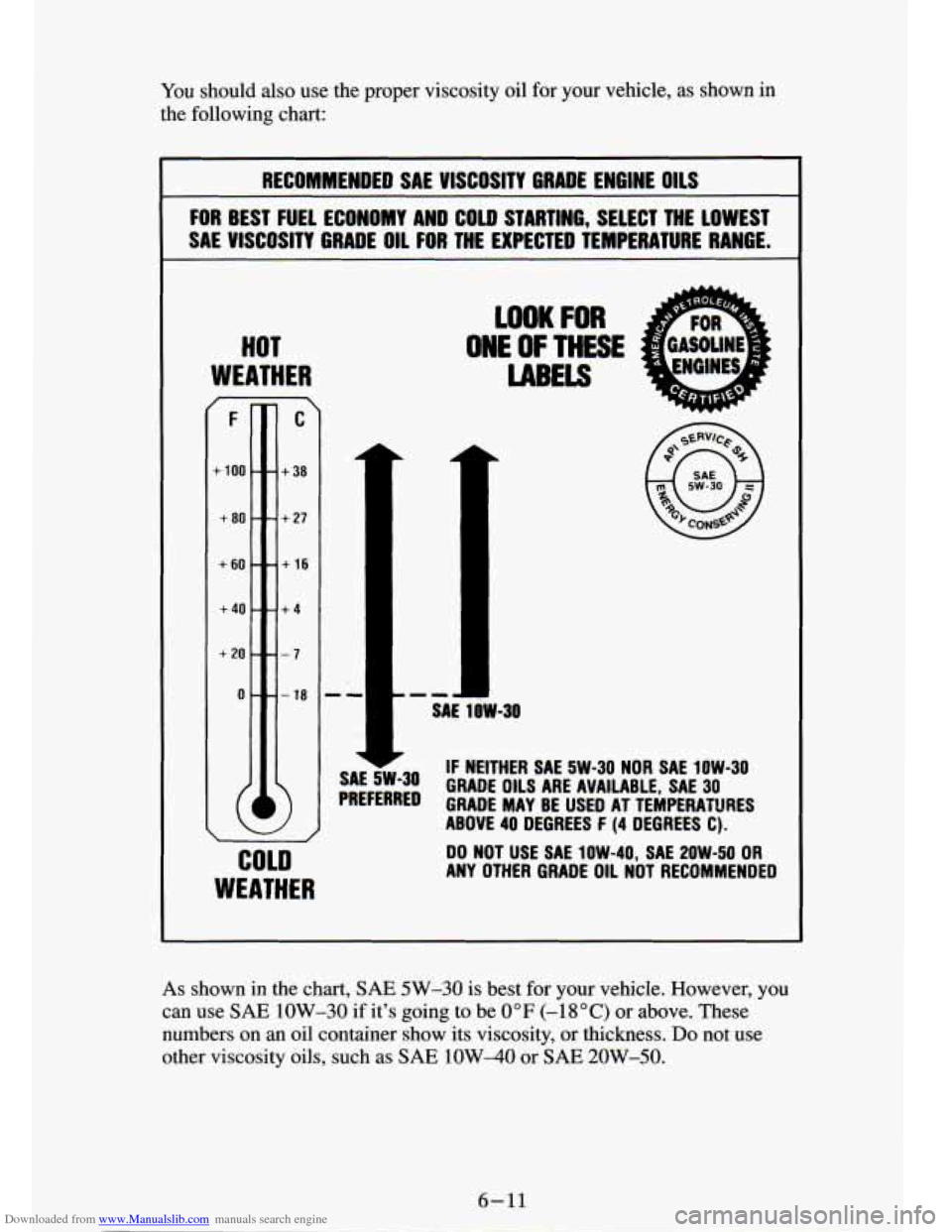
Downloaded from www.Manualslib.com manuals search engine You should also use me proper viscosity oil for your vehicle, as shown in
the following chart:
RECOMMENDED SAE VISCOSITY GRADE ENGINE OILS
FOR BEST FUEL ECONOMY AND COLD STARTING, SELECT THE LOWEST
SAE VISCOSITY GRADE
OIL FOR THE €XPECTED TEMPERATURE RANGE.
HOT
WEATHER
/F
-
+loo - -
+80 --
+60 --
+40 - -
+20 - -
O--
1
C
- +38
- + 27
- +16
-+4
- -7
- -18
COLD
WEATHER
SAE SW-30
PREFERRED
LOOK FOR
ONE OF THESE
LABELS
SA! 1OW-30
IF NEITHER SAE 5W-30 NOR SAE 1OW-30
GRADE
OILS ARE AVAILABLE, SAE 30
GRADE MAY BE USED AT TEMPERATURES
ABOVE
40 DEGRfES F (4 DEGREES C).
ANY OTHER GRADE OIL NOT RECOMMENDED
DO
NOT USE SAE 1OW-40, SAE
2OW-50 OR
As shown in the chart, SAE 5W-30 is best for your vehicle. However, you
can use
SAE 1OW-30 if it's going to be 0°F (-18 "C) or above. These
numbers on an
oil container show its viscosity, or thickness. Do not use
other viscosity oils, such as
SAE 1OW-40 or SAE 20W-50.
6-11
Page 230 of 340
Downloaded from www.Manualslib.com manuals search engine If you cannot find oils with the new “starburst” symbol on the front of the
container,
you should look for and use oils containing the following three
things:
SHor SG
“SH or SG” must be on the oil container, either by itself or combined
with other quality designations, such as “SWCD,”
“SH, SG, CD,”
“SG/CD,”etc. These letters show American Petroleum Institute\
(API)
levels of quality.
0 SAE 5W-30
Energy Conserving I1
Oils with these words on the container will help you save fuel.
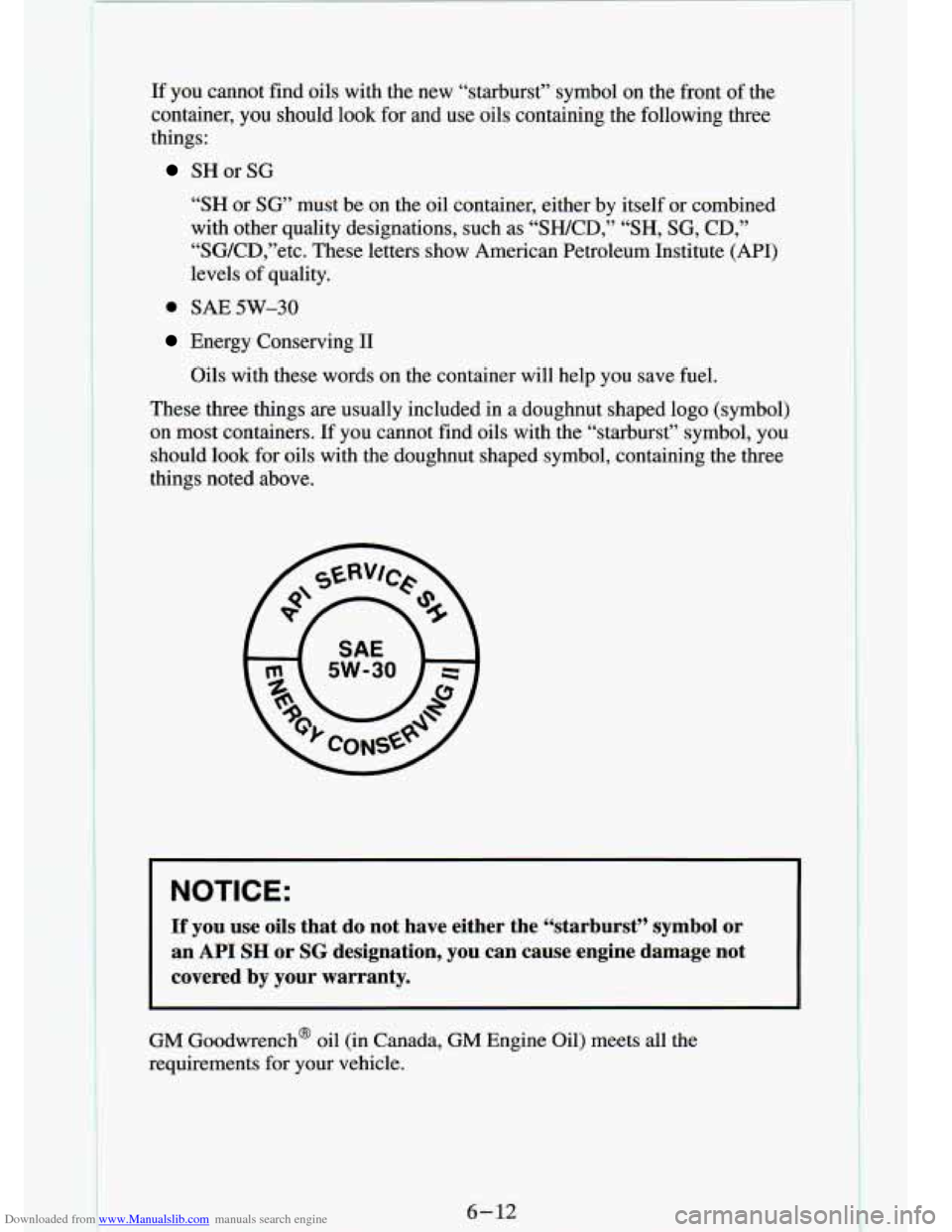
These three things are usually included in a doughnut shaped logo (\
symbol)
on most containers.
If you cannot find oils with the “starburst” symbol, you
should look for oils with the doughnut shaped symbol, containing the three
things noted above.
NOTICE:
If you use oils that do not have either the “starburst” symbol or
an
API SH or SG designation, you can cause engine damage not
covered by your warranty.
GM Goodwrench@ oil (in Canada, GM Engine Oil) meets all the
requirements for your vehicle.
1
6- 12