1994 CHEVROLET CAVALIER service
[x] Cancel search: servicePage 171 of 243
Downloaded from www.Manualslib.com manuals search engine ~~ ~ Service & Appearance Care
170
I Hydraulic Clutch
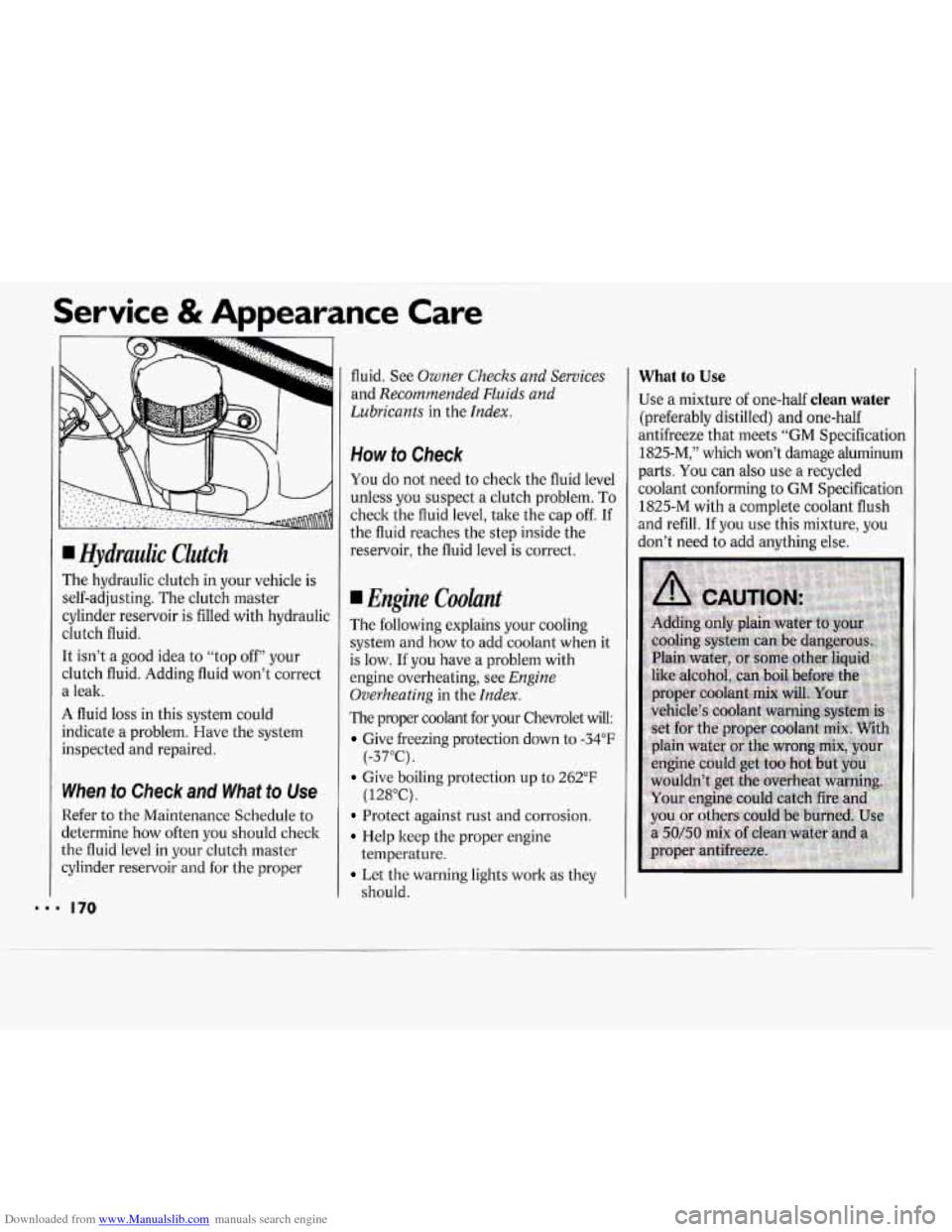
The hydraulic clutch
in your vehicle is
self-adjusting. The clutch master
cylinder reservoir is filled with hydraulic
clutch fluid.
It isn’t
a good idea to “top off” your
clutch fluid. Adding fluid won’t correct
a leak.
A fluid loss in this system could
indicate a problem. Have the system
inspected and repaired.
When to Check and What to Use
Refer to the Maintenance Schedule to
determine how often
you should check
the fluid level in your clutch master
cylinder reservoir and for the proper fluid. See
Owner Checks and
Services
and Recommended Fluids and
Lubricants
in the Index.
How to Check
You do not need to check the fluid level
unless you suspect a clutch problem.
To
check the fluid level, take the cap off. If
the fluid reaches the step inside the
reservoir, the fluid level is correct.
I Engine Coolunt
The following explains your cooling
system and how
to add coolant when it
is low.
If you have a problem with
engine overheating, see
Engine
Overheating
in the Index.
The proper coolant for your Chevrolet will:
Give freezing protection down to -34°F
Give boiling protection up to 262°F
Protect against rust and corrosion.
Help keep the proper engine
Let the warning lights work as they
(-37°C).
(128°C).
temperature.
should.
What to Use
Use a mixture
of one-half clean water
(preferably distilled) and one-half
antifreeze that meets “GM Specification
1825-M,” which won’t damage aluminum
parts. You can also use a recycled
coolant conforming to GM Specification
1825-M with
a complete coolant flush
and refill. If you use this mixture, you
don’t need to add anything else.
Page 173 of 243
Downloaded from www.Manualslib.com manuals search engine Dl
~ ~~ ~~ ~
Service & Appearance Care
ID
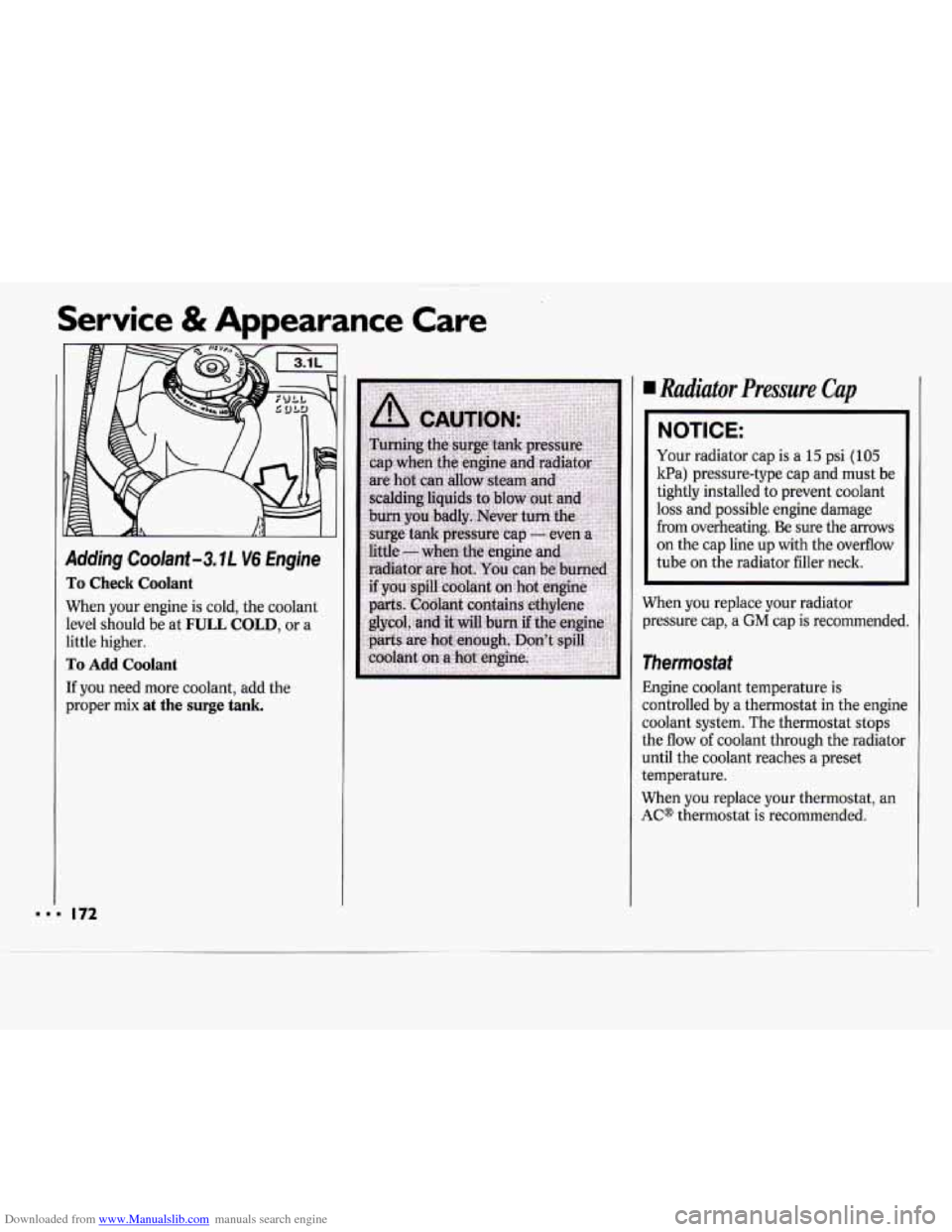
Adding Coolant -3. IL V6 Engine
To Check Coolant
When your engine is cold, the coolant
level should be at
FULL COLD, or a
little
higher.
To Add Coolant
If you need more coolant, add the
proper
mix at the surge tank.
I72
Radiator Pressure Cap
NOTICE:
Your radiator cap is a 15 psi (105
kPa) pressure-type cap and must be
tightly installed to prevent coolant
loss and possible engine damage
from overheating. Be sure the arrows
on the cap line up with the overflow
tube on the radiator filler neck.
When
you replace your radiator
pressure cap, a
GM cap is recommended.
Thermostat
Engine coolant temperature is
controlled by a thermostat in the engine
coolant system. The thermostat stops
the flow of coolant through the radiator
until the coolant reaches a preset
temperature.
When
you replace your thermostat, an
AC@ thermostat is recommended.
Page 175 of 243
Downloaded from www.Manualslib.com manuals search engine Service & Appearance Care
NOTICE:
When using concentrated washer
fluid, follow the manufacturer’s
instructions for adding water.
Don’t mix water with ready-to-
use washer fluid. Water can cause
the solution to freeze and damage
your washer fluid tank and other
parts of the washer system. Also,
water doesn’t clean as well
as
washer fluid.
Fill your washer fluid tank only %
full when it’s very cold. This
allows for expansion, which could
damage the tank if it is
completely full.
Don’t use radiator antifreeze in
your windshield washer. It can
damage your washer system and
paint.
I Brakes
Brake Master Cylinder
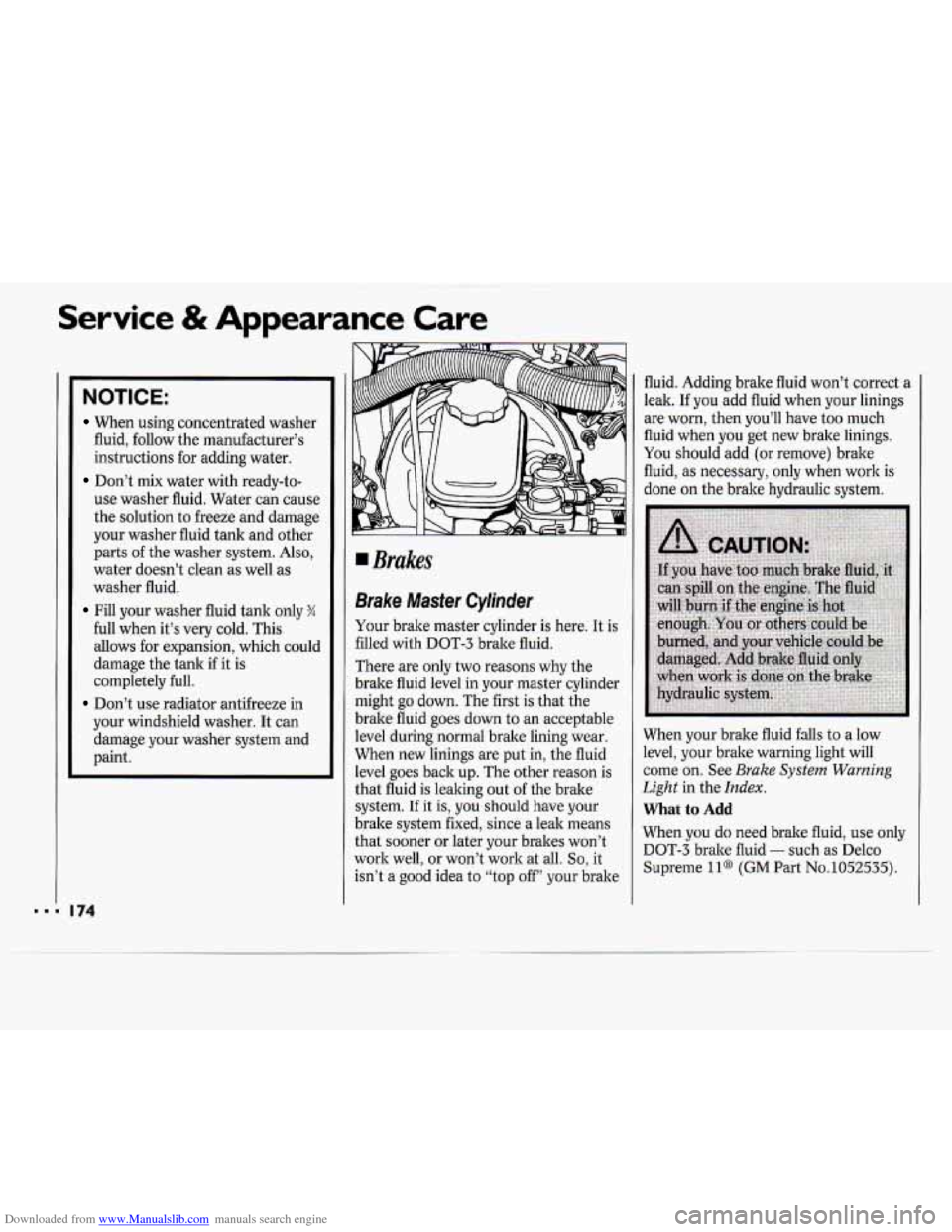
Your brake master cylinder is here. It is
filled with DOT-3 brake fluid.
There are only two reasons why the
brake fluid level in your master cylinder
might go down. The first is that the
brake fluid goes down to an acceptable
level during normal brake lining wear.
When new linings are put in, the fluid
level goes back up. The other reason is
that fluid is leaking out of the brake
system.
If it is, you should have your
brake system fixed, since a leak means
that sooner or later your brakes won’t
work well,
or won’t work at all. So, it
isn’t a good idea to “top off” your brake fluid. Adding brake fluid won’t correct a
leak.
If you add fluid when your linings
are worn, then you’ll have too much
fluid when
you get new brake linings.
You should add (or remove) brake
fluid, as necessary, only when work
is
done on the brake hydraulic system.
When your brake fluid falls
to a low
level, your brake warning light will
come on. See
Brake System Warning
Light in the Index.
What to Add
When you do need brake fluid, use only
DOT-3 brake fluid
- such as Delco
Supreme
11@ (GM Part No.1052535).
Page 177 of 243
Downloaded from www.Manualslib.com manuals search engine Service & Appearance Care
If your brake pedal goes down farther
than normal, your rear drum brakes
may need adjustment. Adjust them by
backing up and firmly applying the
brakes a few times.
Replacing Brake System Pa&
The braking system on a modern
vehicle is complex. Its many parts ha
to be
of top quality and work well we
together
if the vehicle is to have really
good braking. Vehicles we design and
test have top-quality GM brake parts in
them, as your Chevrolet does when it is
new. When you replace parts
of your
braking system
- for example, when
your brake linings wear down and you
have to have new ones put in
- be sure
you get new genuine
GM replacement
parts. If
you don’t, your brakes may no
longer work properly. For example, if
someone puts in brake linings th,at are
wrong for your vehicle, the balance
between your front and rear brakes can
change, for the worse. The braking
performance you’ve come to expect can
change in many other ways
if someone
puts in the wrong replacement brake
parts.
Battery
Every new Chevrolet has a Delco
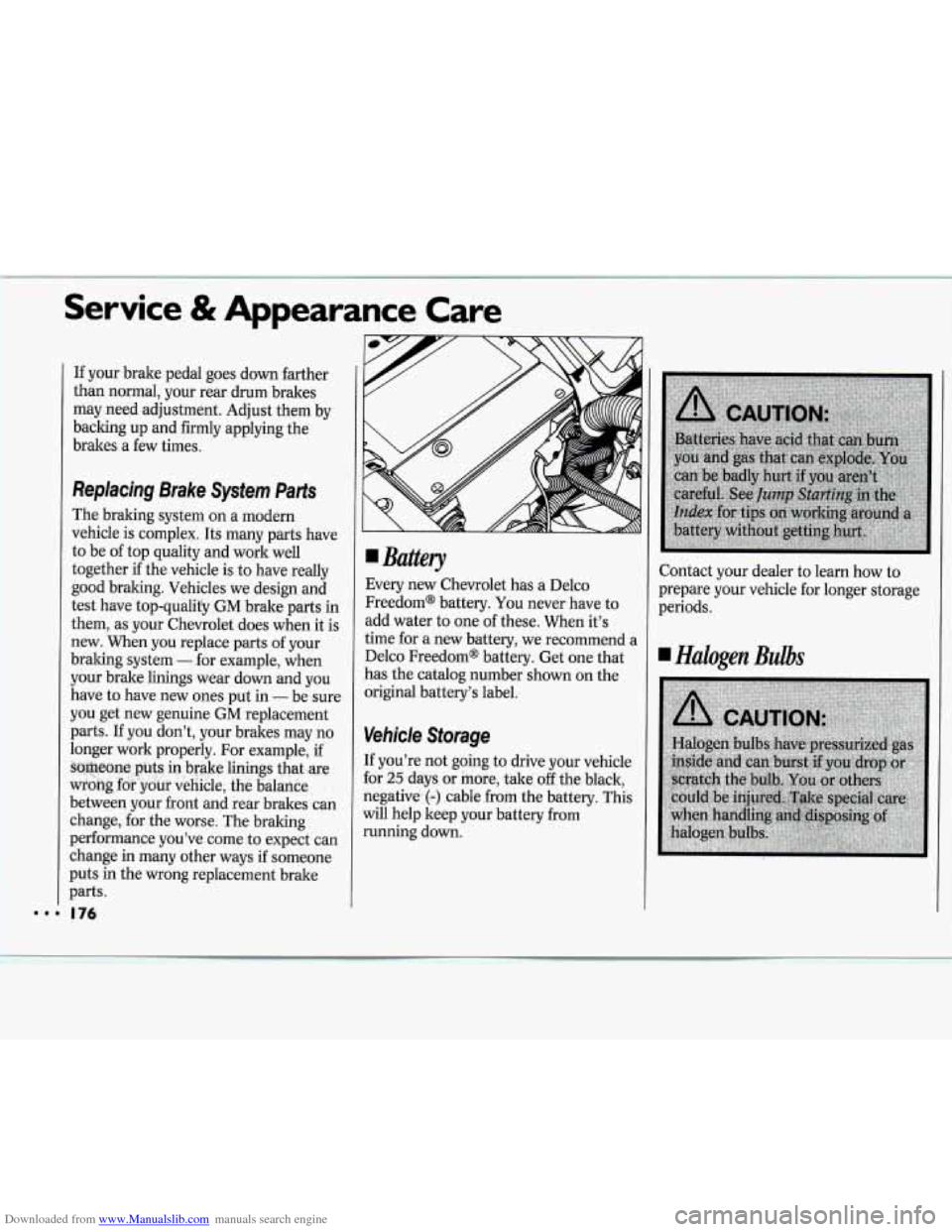
Freedom* battery.
You never have to
add water to one of these. When it’s
time for a new battery, we recommend a
Delco Freedom* battery. Get one that
has the catalog number shown on the
original battery’s label.
Vehicle Storage
If you’re not going to drive your vehicle
for
25 days or more, take off the black,
negative
(-) cable from the battery. This
will help keep your battery
from
running down. Contact
your dealer to learn how to
prepare your vehicle for longer storage
periods.
Halogen Bulbs
Page 179 of 243
Downloaded from www.Manualslib.com manuals search engine __~
Service & Appearance Care
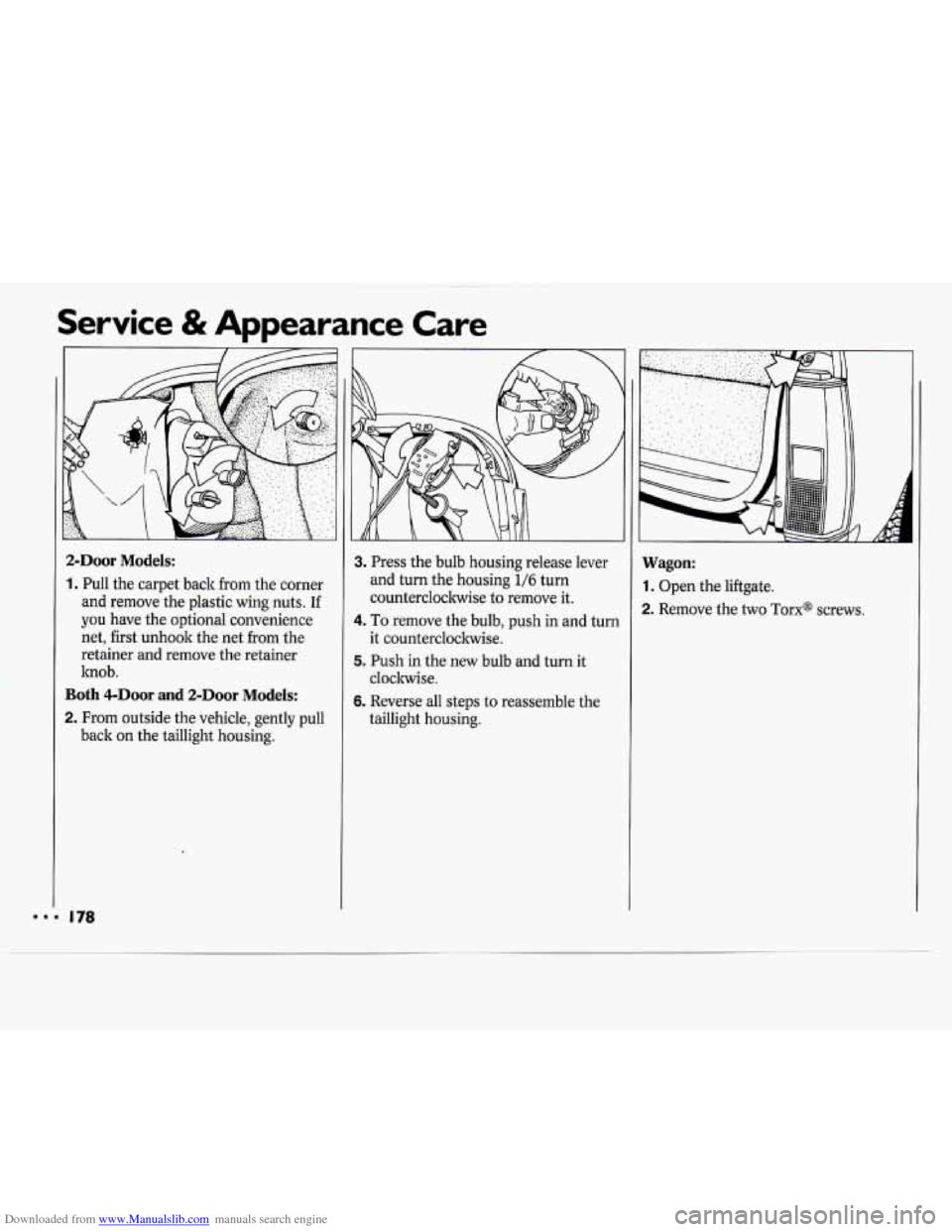
2-Door Models:
1. Pull the carpet back from the corner
and remove the plastic wing nuts.
If
you have the optional convenience
net, first unhook the net from the
retainer and remove the retainer
knob.
Both 4-DOOr and 2-Door Models:
2. From outside the vehicle, gently pull
back on the taillight housing.
3. Press the bulb housing release lever
and turn the housing
1/6 turn
countercloclnvise to remove it.
it countercloclnvise.
cloclnvise.
taillight housing.
4. To remove the bulb, push in and turn
5. Push in the new bulb and turn it
6. Reverse all steps to reassemble the
Wagon:
1. Open the liftgate.
2. Remove the two Torxs screws.
Page 181 of 243
Downloaded from www.Manualslib.com manuals search engine Service & Appearance Care
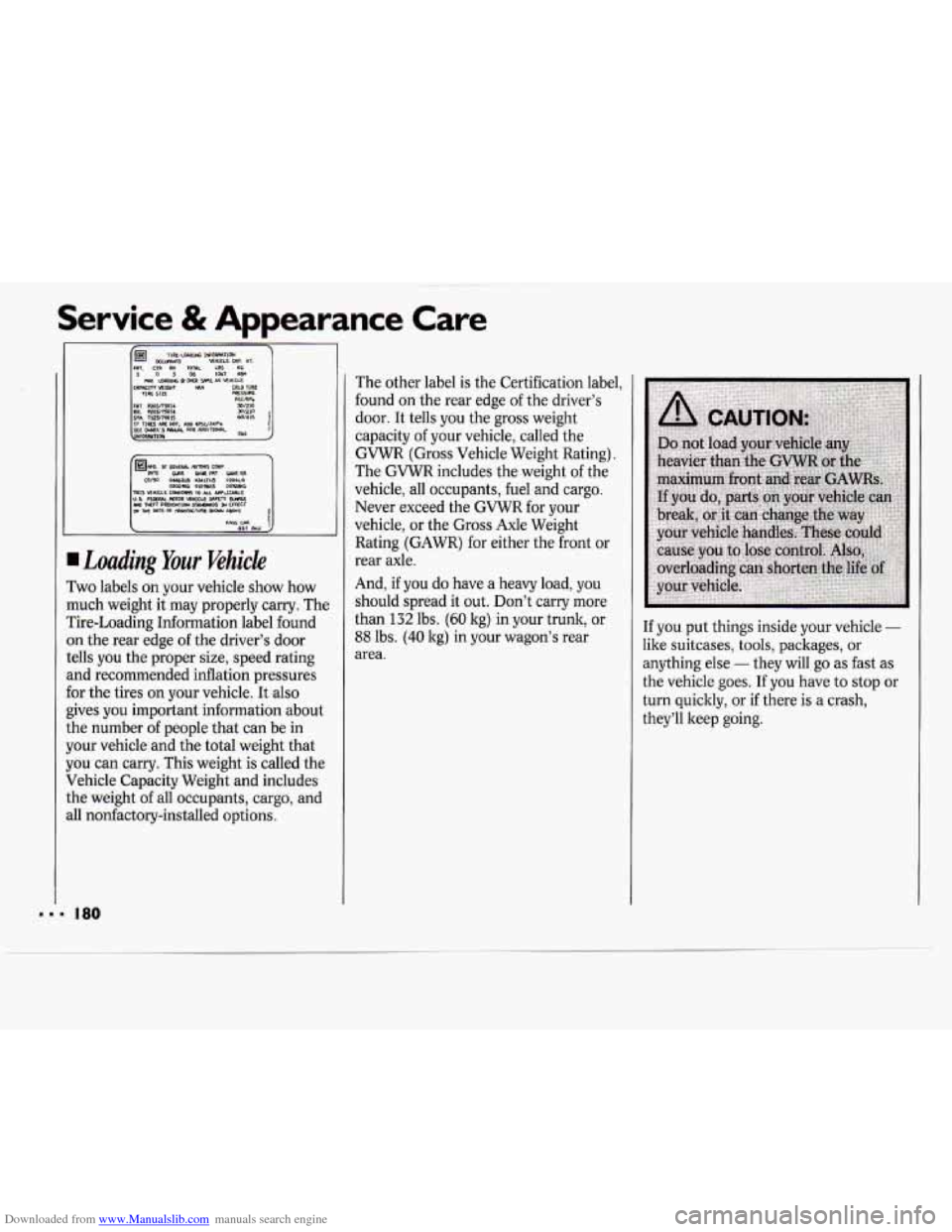
I Loading Your Vehicle
Two labels on your vehicle show how
nuch weight it may properly carry. The
rire-Loading Information label found
In the rear edge of the driver's door
.ells you the proper size, speed rating
md recommended inflation pressures
or the tires on your vehicle. It also
:ives you important information about
.he number of people that can be in
four vehicle and the total weight that
rou can carry. This weight
is called the
Jehicle Capacity Weight and includes
.he weight
of all occupants, cargo, and
111 nonfactory-installed options. The other label is
the Certification label,
found on the rear edge of the driver's
door. It tells you the gross weight
capacity of your vehicle, called the
GVWR (Gross Vehicle Weight Rating).
The
GVWR includes the weight of the
vehicle, all occupants, fuel and cargo.
Never exceed the GVWR for your
vehicle,
or the Gross Axle Weight
Rating (GAWR) for either the front or
rear axle.
And, if you do have a heavy load, you
should spread it out. Don't carry more
than
132 lbs. (60 kg) in your trunk, or
88 lbs. (40 kg) in your wagon's rear
area. If you put things inside your vehicle -
like suitcases, tools, packages, or
anything else
- they will go as fast as
the vehicle goes. If you have to stop or
turn quicltly, or
if there is a crash,
they'll keep going.
Page 183 of 243
Downloaded from www.Manualslib.com manuals search engine Service & Appearance Care
Inflation-Tire Pressure
The Tire-Loading Information label
which is on the rear edge of the driver’s
door shows the correct inflation
pressures for your tires, when they’re
cold.
Cold means your vehicle has been
sitting for at least three hours or driven
no more than a mile.
NOTICE:
Don’t let anyone tell you that
underinflation
or overinflation is all
right. It’s not. If your tires don’t
have enough air (underinflation)
you can get:
Too much flexing
Too much heat
Tire overloading
Bad wear
Bad handling
Bad fuel economy.
If your tires have
too much air
(overinflation), you can get:
Unusual wear
Bad handling
Rough ride
Needless damage from road hazards.
Page 184 of 243
Downloaded from www.Manualslib.com manuals search engine When to Check
Check your tires once a month or more.
Don't forget your compact spare tire. It
should be at
60 psi (420 1tPa).
How to Check
Use a good quality pocket-type gage to
check tire pressure. Simply looking at
the tires
will not tell you the pressure,
especially if you have radial tires
-
which may look properly inflated even if
they're underinflated.
If your tires have valve caps, be sure to
put them back on. They help prevent
leaks by keeping out dirt and moisture.
x
Tire lnspection and Rotation
To make your tires last longer, have
them inspected and rotated at the
mileages recommended in the
Maintenance Schedule. See
Scheduled
Maintenance Services
in the Index.
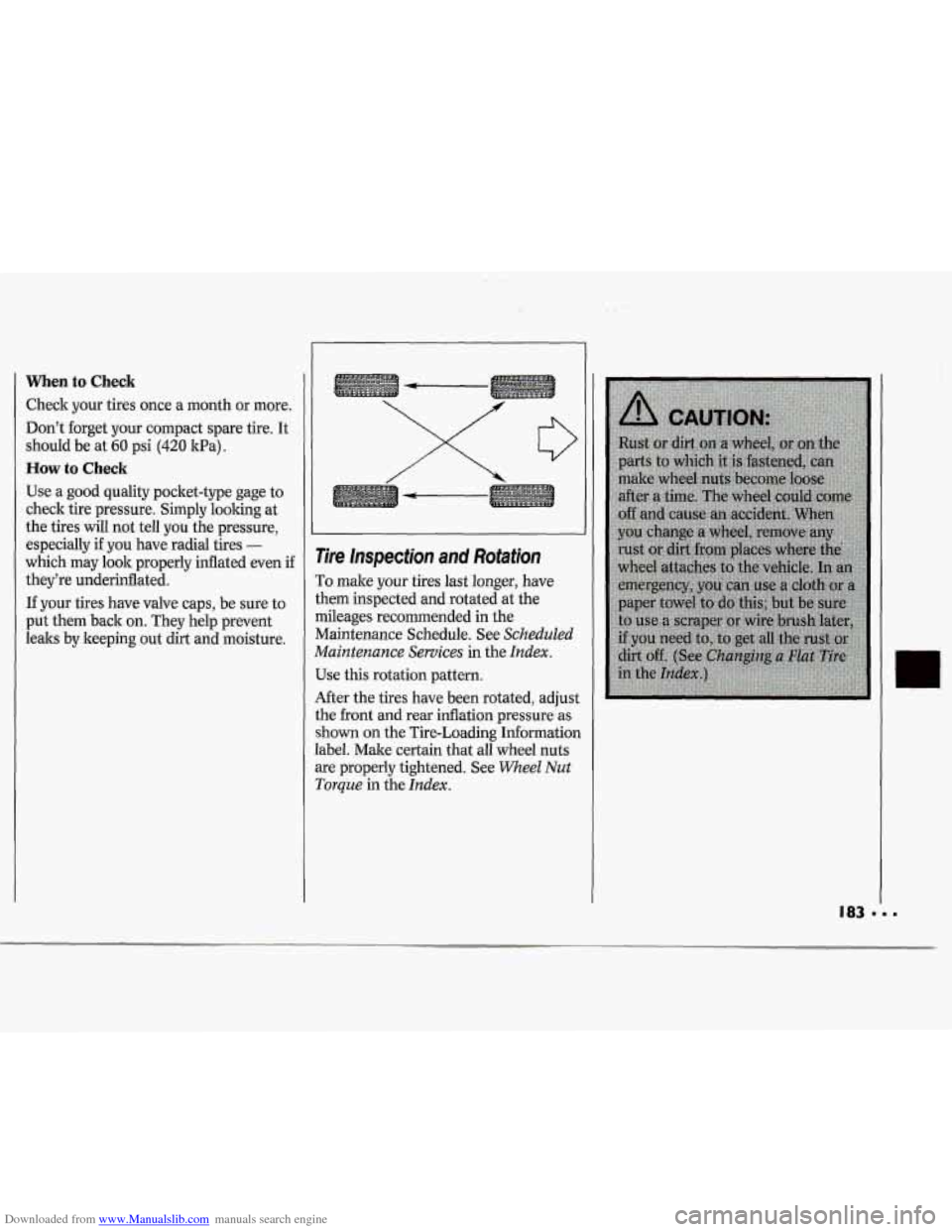
Use this rotation pattern.
After the tires have been rotated, adjust
the front and rear inflation pressure as
shown on the Tire-Loading Information
label. Make certain that all wheel nuts
are properly tightened. See
Wheel Nut
Torque in the Index.