Page 228 of 348
Downloaded from www.Manualslib.com manuals search engine e
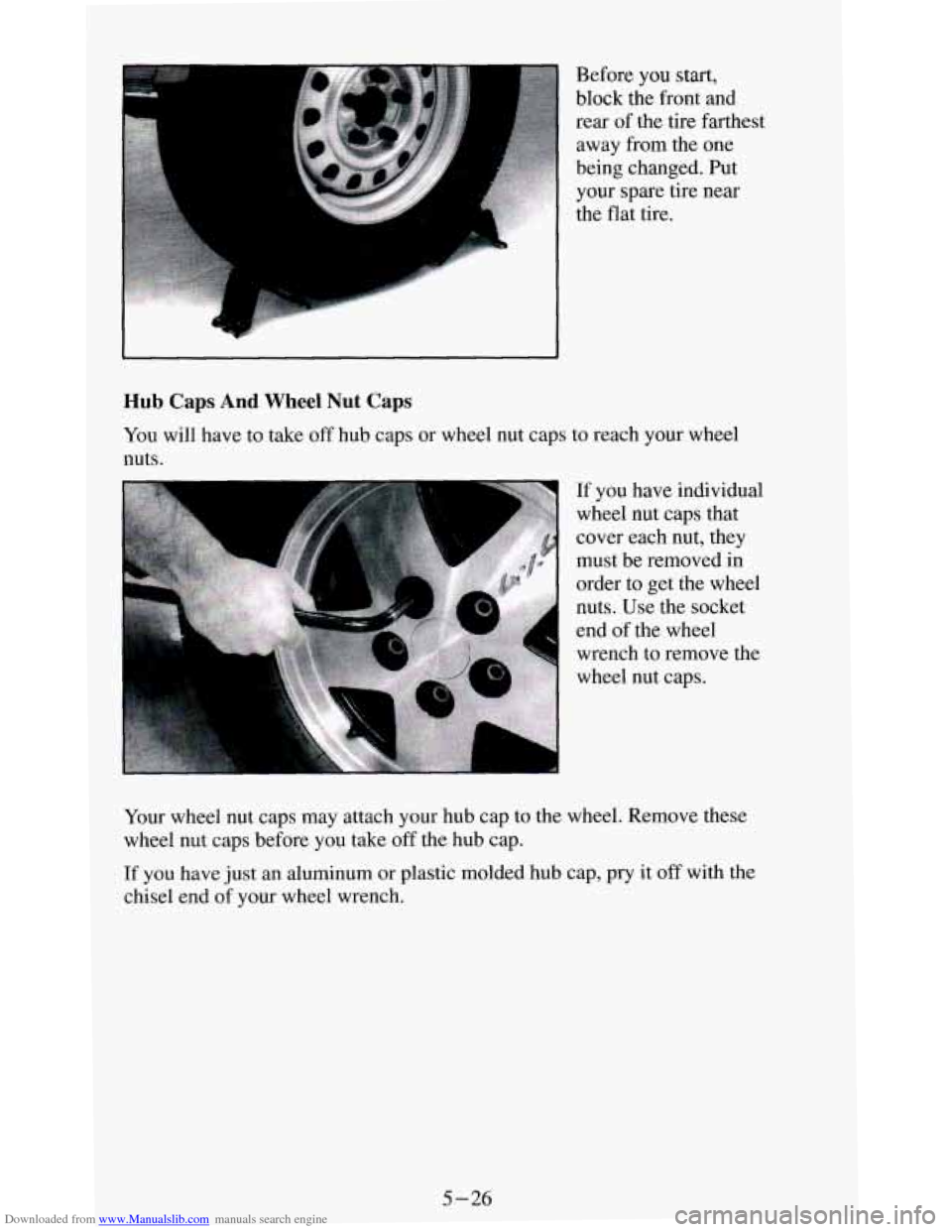
Before you start,
block the front and
rear of the tire farthest
away from the one
being changed. Put
your spare tire near
the flat tire.
Hub Caps And Wheel Nut Caps
You will have to take off hub caps or wheel nut caps to reach your wheel
nuts.
I --
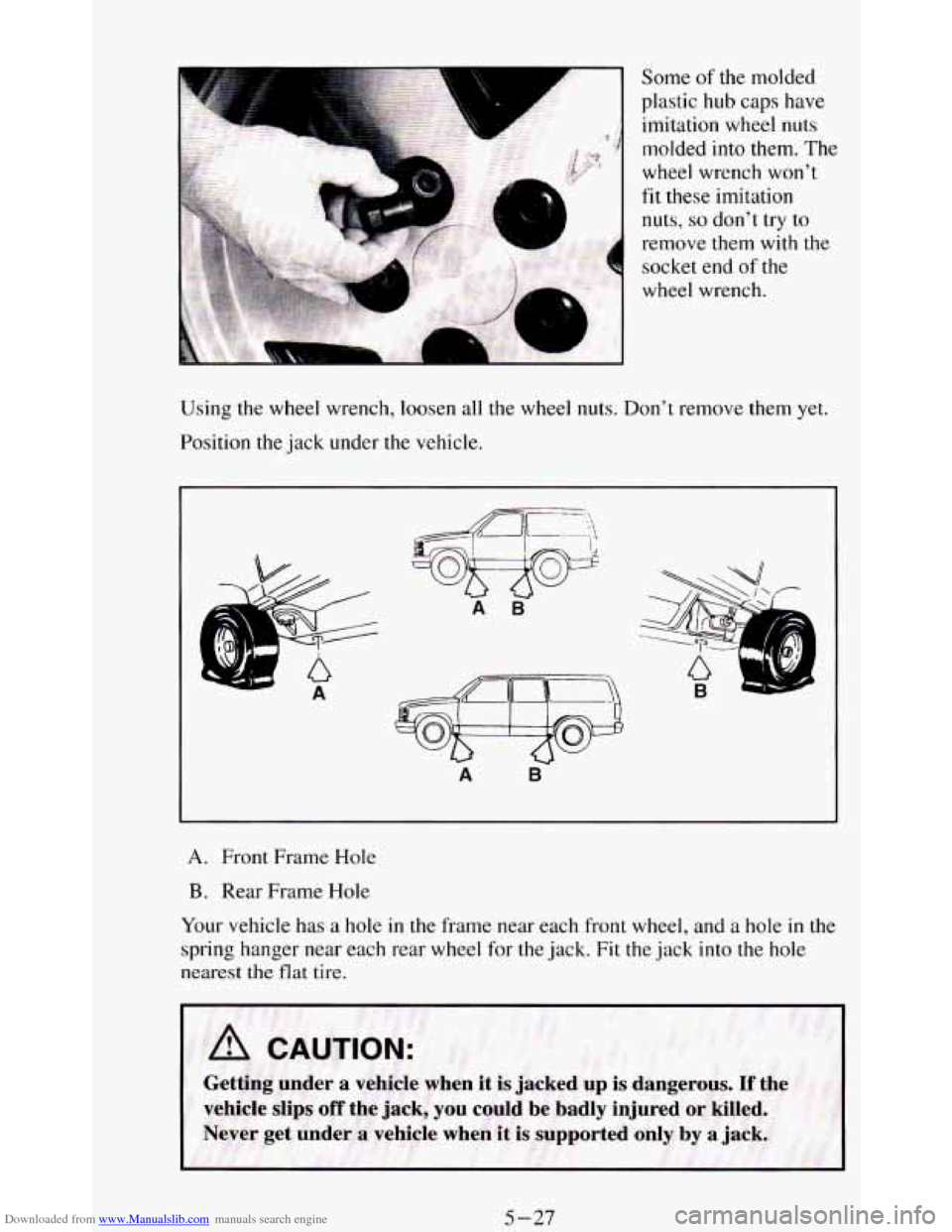
If you have individual
wheel nut caps that
cover each nut, they
must be removed in
order to get the wheel
nuts. Use the socket
end
of the wheel
wrench to remove the
wheel nut caps.
Your wheel nut caps may attach your hub cap to the wheel. Remove these
wheel nut caps before you take
off the hub cap.
If you have just an aluminum or plastic molded hub cap, pry it off with the
chisel end of your wheel wrench.
5-26
Page 229 of 348
Downloaded from www.Manualslib.com manuals search engine k , ...
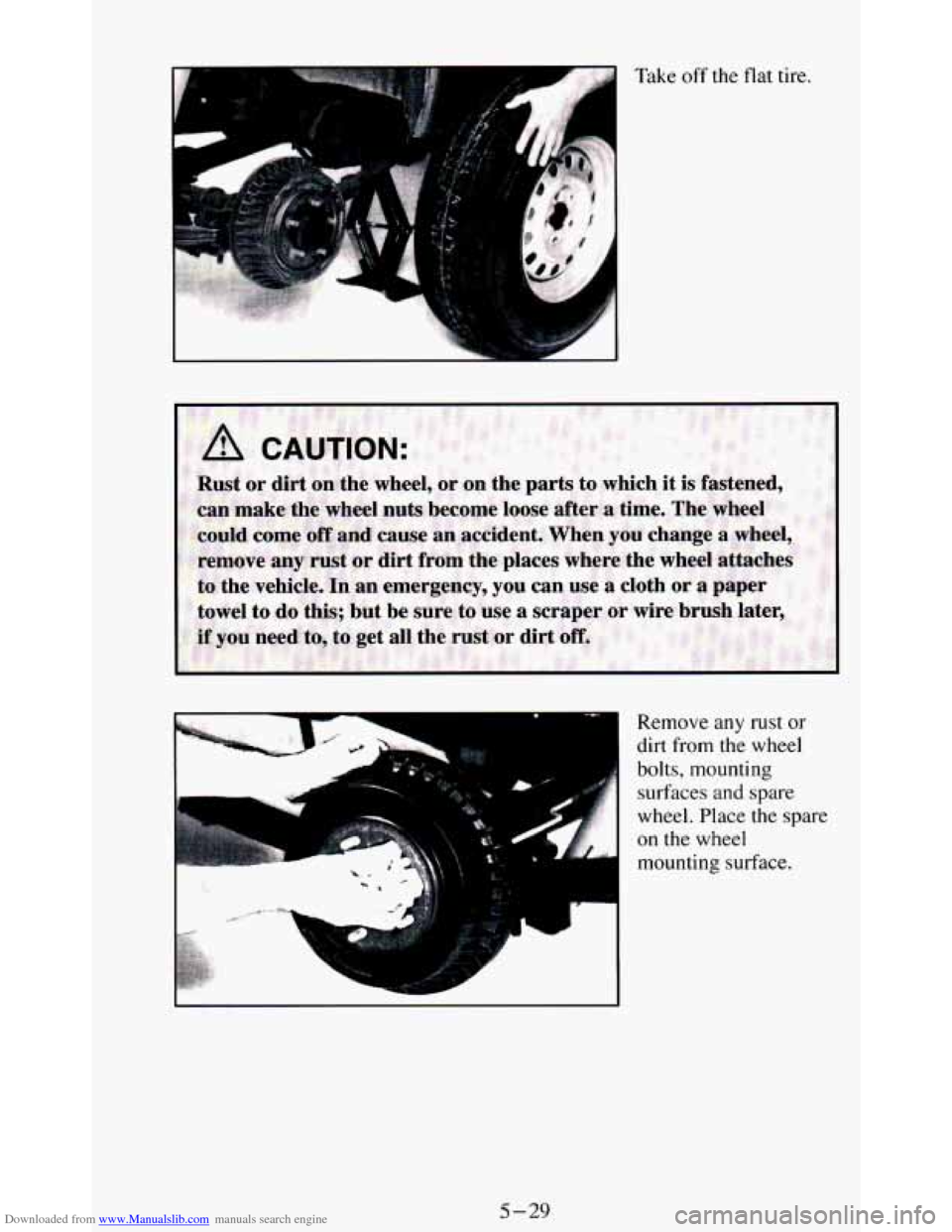
Some of the molded
plastic
hub caps have
imitation
wheel nuts
molded into them. The
wheel wrench won’t
fit these imitation
nuts,
so don’t try to
remove them
with the
socket end
of the
wheel wrench.
Using the wheel wrench, loosen all the wheel nuts. Don’t remove them
yet.
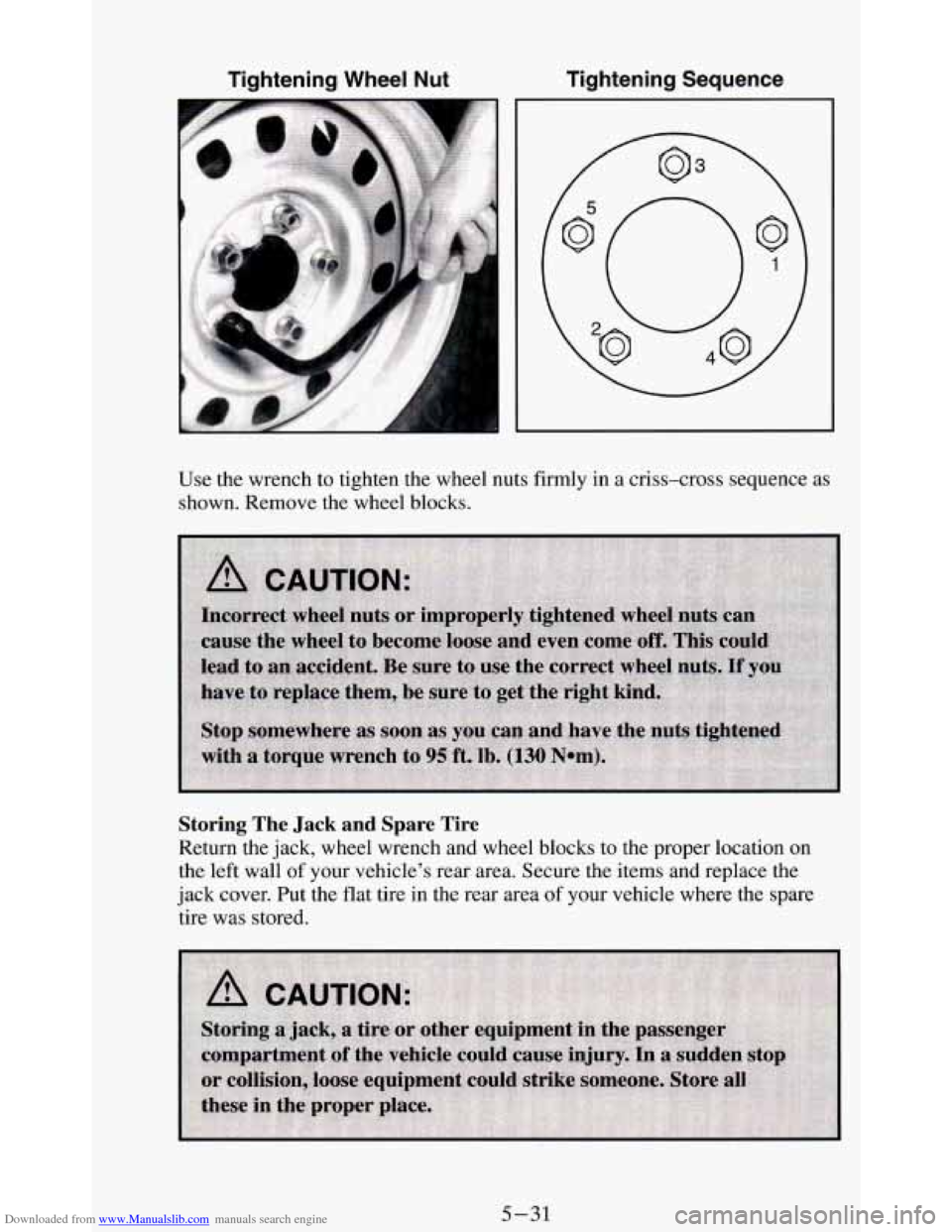
Position the jack under the vehicle.
ce,
A
A A
B-
A B
A. Front Frame Hole
B. Rear Frame
Hole
Your vehicle has
a hole in the frame near each front wheel, and a hole in the
spring hanger near each
rear wheel for the jack. Fit the jack into the hole
nearest
the flat tire.
5-27
Page 231 of 348
Downloaded from www.Manualslib.com manuals search engine Take off the flat tire.
L Remove any rust or
dirt from the wheel
bolts, mounting
surfaces
and spare
wheel. Place the spare
on the wheel
mounting surface.
5-29
Page 233 of 348
Downloaded from www.Manualslib.com manuals search engine Tightening Wheel Nut Tightening Sequence
Use
the wrench to tighten the wheel nuts firmly in a criss-cross sequence as
shown. Remove the wheel blocks.
Storing The Jack and Spare Tire
Return the jack, wheel wrench and wheel blocks to the proper location on
the left wall of your vehicle’s rear area. Secure the items and replace the
jack cover. Put the
flat tire in the rear area of your vehicle where the spare
tire was stored.
5-31
Page 275 of 348
Downloaded from www.Manualslib.com manuals search engine Loading Your Vehicle
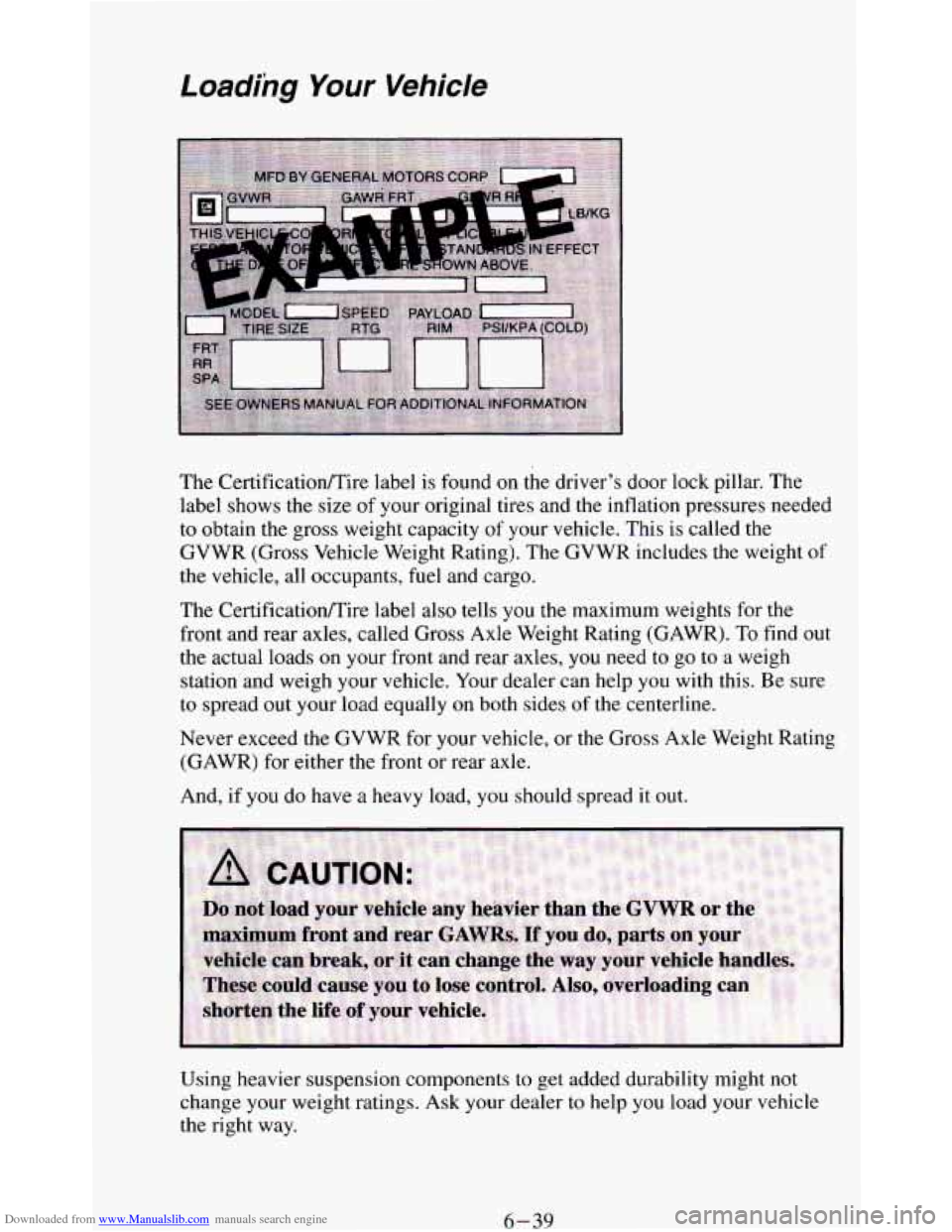
The CertificatiodTire label is found on the driver’s door lock pillar. The
label shows
the size of your original tires and the inflation pressures needed
to obtain the gross weight capacity
of your vehicle. This is called the
GVWR (Gross Vehicle Weight Rating). The GVWR includes the weight
of
the vehicle, all occupants, fuel and cargo.
The Certificationnire label
also tells you the maximum weights for the
front and rear axles, called Gross Axle Weight Rating (GAWR). To find
out
the actual loads on your front and rear axles, you need to go to a weigh
station and weigh your vehicle. Your dealer can help you with this. Be sure
to spread out your load equally on both sides
of the centerline.
Never exceed the GVWR for your vehicle, or the Gross Axle Weight Rating
(GAWR) for either the front or rear axle.
And, if you do have a heavy load, you should spread it out.
Using heavier suspension components to get added durability might not
change your weight ratings.
Ask your dealer to help you load your vehicle
the right way.
6-39
Page 278 of 348
Downloaded from www.Manualslib.com manuals search engine Tires
We don’t make tires. Your new vehicle comes with high quality tires made
by a leading tire manufacturer. These tires are warranted by the tire
manufacturers and their warranties are delivered with every new vehicle.
If
your spare tire is a different brand than your road tires, you will have a tire
warranty folder from each of these manufacturers.
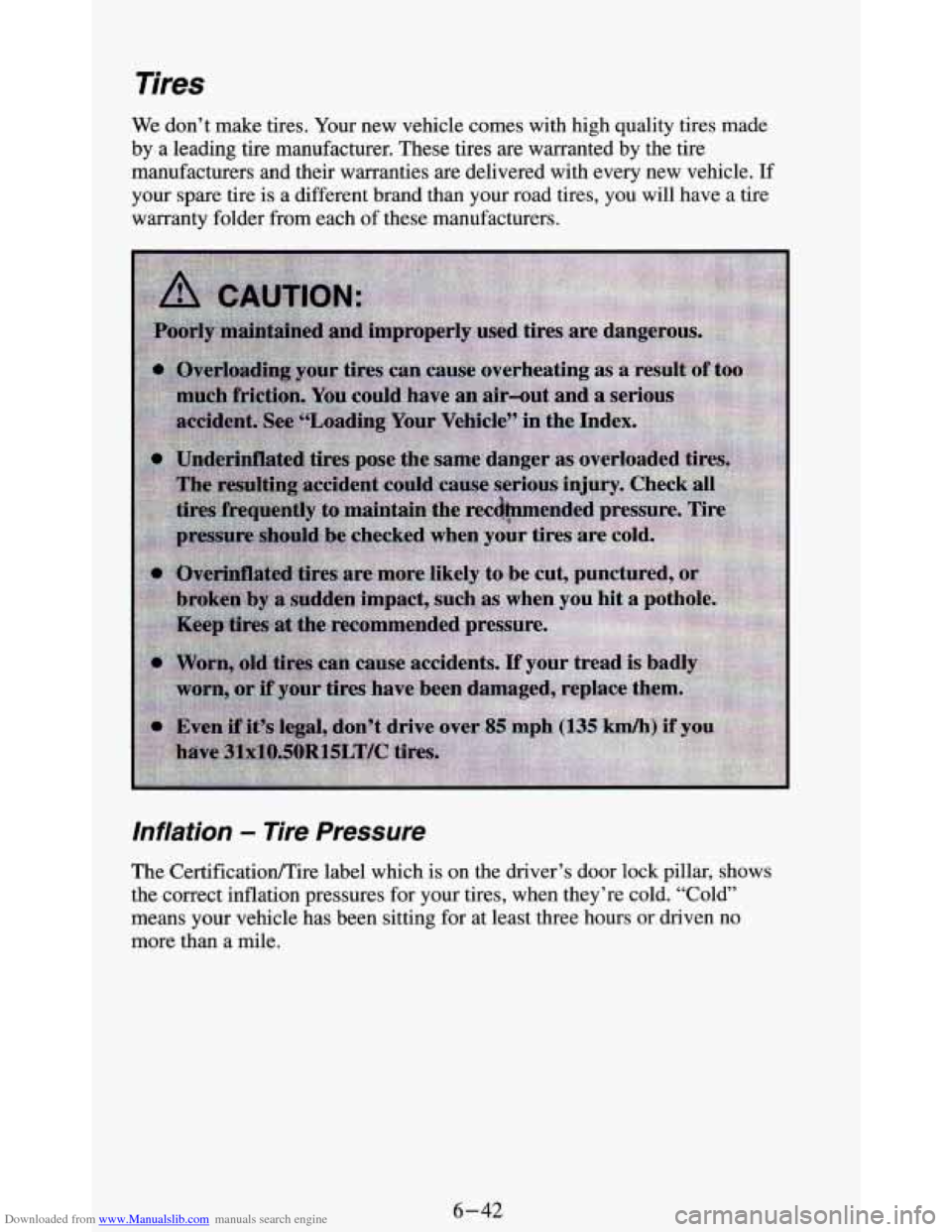
Inflation - Tire Pressure
The Certificatioflire label which is on the driver’s door lock pillar, shows
the correct inflation pressures for your tires, when they’re cold. “Cold”
means your vehicle has been sitting for at least three hours or driven no
more than
a mile.
6-42
Page 279 of 348
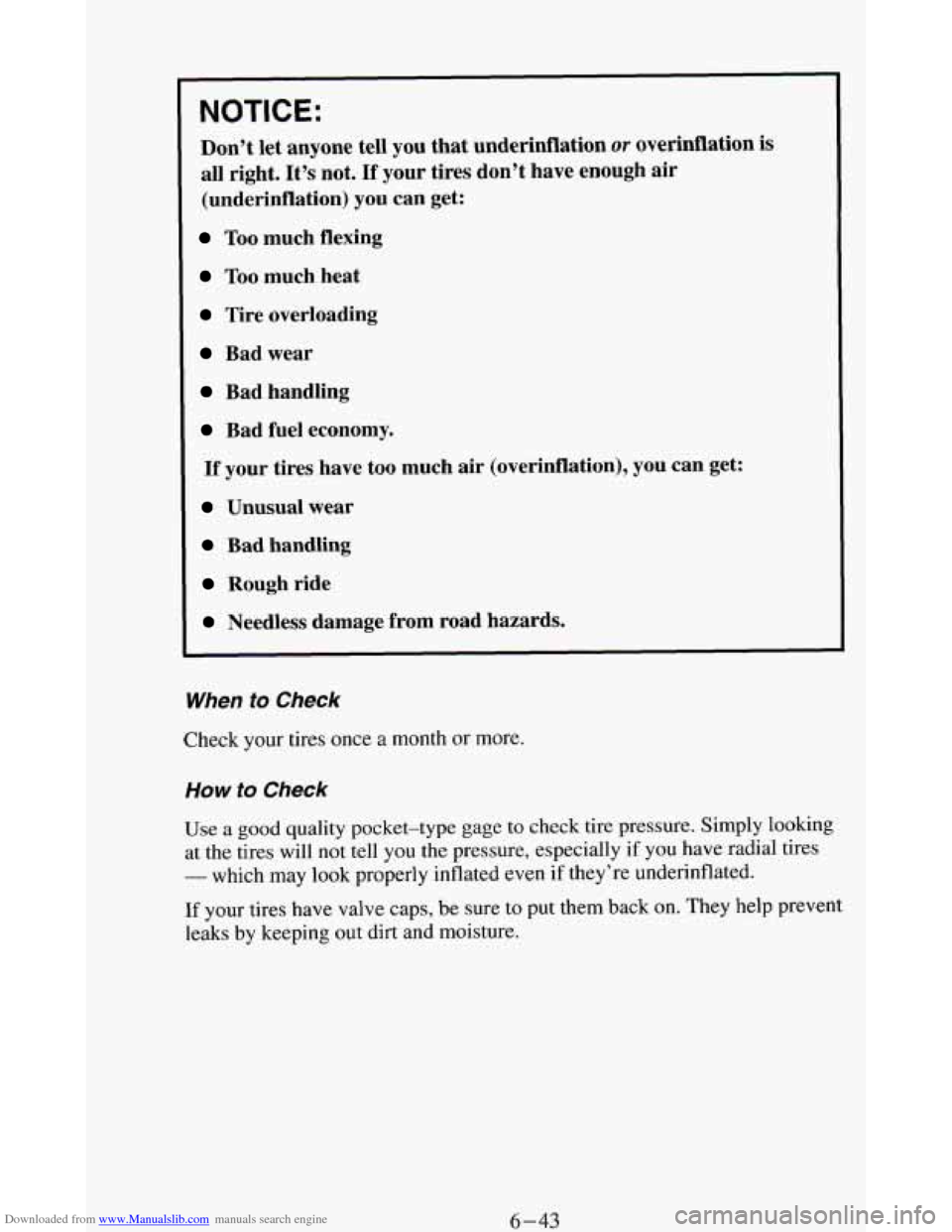
Downloaded from www.Manualslib.com manuals search engine NOTICE:
Don’t let anyone tell you that underinflation or overinflation is
all right. It’s not. If your tires don’t have enough air
(underinflation)
you can get:
Too much flexing
Too much heat
Tire overloading
Bad wear
Bad handling
Bad fuel economy.
If your tires have too much air (overinflation), you can get:
Unusual wear
Bad handling
Rough ride
Needless damage from road hazards.
When to Check
Check your tires once a month or more.
How to Check
Use a good quality pocket-type gage to check tire pressure. Simply looking
at the tires will not tell you the pressure, especially if you have radial tires
- which may look properly inflated even if they’re underinflated.
If your tires have valve caps, be sure to put them back on. They help prevent
leaks by keeping out dirt and moisture.
6-43
Page 280 of 348
Downloaded from www.Manualslib.com manuals search engine Tire Inspection and Rotation
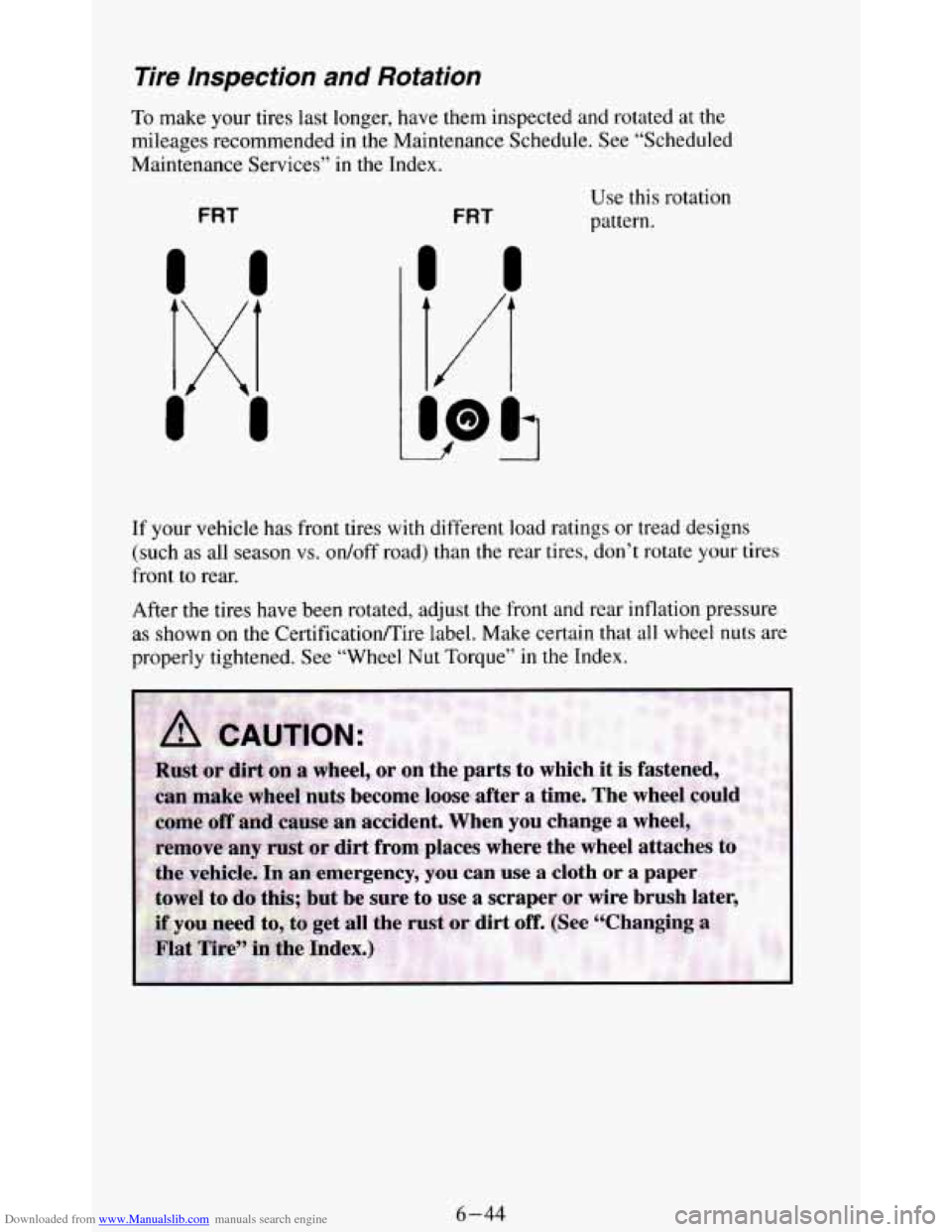
To make your tires last longer, have them inspected and rotated at the
mileages recommended in the Maintenance Schedule.
See “Scheduled
Maintenance Services’’ in the Index.
FRT FRT
Use this rotation
pattern.
U
If your vehicle has front tires with different load ratings or tread designs
(such as all season
vs. on/off road) than the rear tires, don’t rotate your tires
front to rear.
After the tires have been rotated, adjust
the front and rear inflation pressure
as shown on the CertificationEire label. Make certain that all wheel nuts are
properly tightened. See “Wheel
Nut Torque” in the Index.
6-44