Page 256 of 399
Downloaded from www.Manualslib.com manuals search engine SERVICE AND APPEARANCE CARE
Here you will find information about the care of your Cadillac. This section
begins with service and fuel information, and then
it shows how to check
important fluid and lubricant levels. There is also technical information
about your vehicle, and a section devoted to its appearance care.
SERWCE
Your Cadillac dealer knows your vehicle best and wants you to be happy
with it. We hope you’ll go to your dealer for all your service needs. You’ll
get genuine GM parts and GM-trained and supported service people.
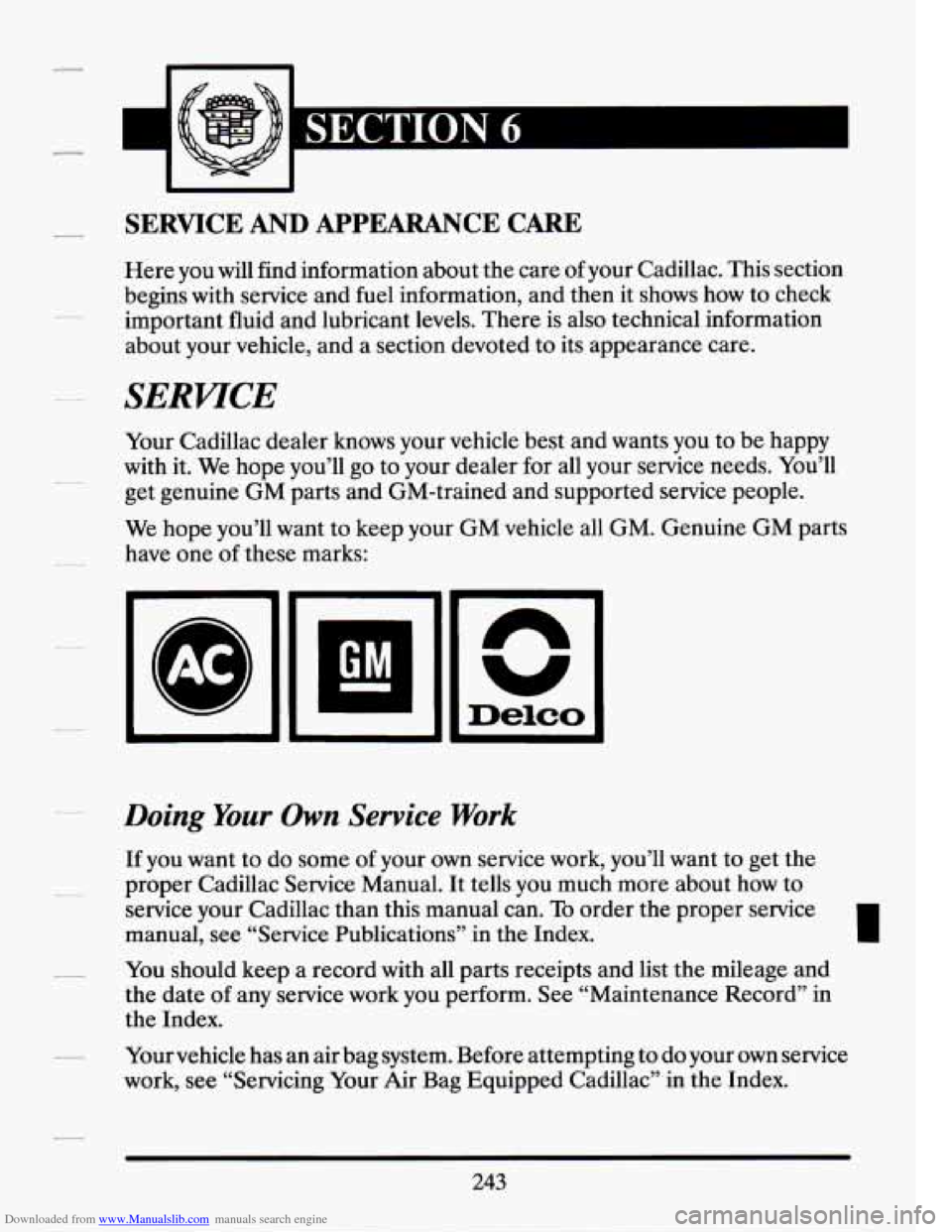
We hope you’ll want to keep your GM vehicle all GM. Genuine GM parts
have one of these marks:
n
Delco
Doing Your Own Service Work
If you want to do some of your own service work, you’ll want to get the
proper Cadillac Service Manual. It tells
you much more about how to
service your Cadillac than this manual can.
To order the proper service
manual, see “Service Publications” in the Index.
I
You should keep a record with all parts receipts and list the mileage and
the date of any service work you perform. See “Maintenance Record” in
the Index.
Your vehicle has an air bag system. Before attempting to do your own service
work,
see “Servicing Your Air Bag Equipped Cadillac” in the Index.
243
Page 257 of 399
Downloaded from www.Manualslib.com manuals search engine NOTICE:
If you try to do your own service work without knowing enough
about it, your vehicle could be damaged.
FUEL
Use premium unleaded gasoline rated at 91 octane or higher. It should
meet specifications ASTM D4814
in the U.S. and CGSB 3.5-92 in
Canada. These fuels should have the proper additives,
so you should not
have to add anything to the fuel.
In the U.S. and Canada, it’s easy to be sure you get
the right kind of
gasoline (unleaded). You’ll see “UNLEADED” right on the pump. And
only unleaded nozzles will fit into your vehicle’s filler neck.
Be sure the posted octane is at least 91. If the octane is less than 91, you
may get a heavy knocking noise when you drive. (In an emergency, you
may be able to use lower octane
-- as low as 87 -- if heavy knocking does
not occur.)
If you’re using 91 or higher octane unleaded gas and you still
get heavy knocking, your engine needs service.
7
244
Page 258 of 399
Downloaded from www.Manualslib.com manuals search engine What about gasoline with blending materials that contain oxygen
(oxygenates), such as MTBE or alcohol?
MTBE is “methyl tertiary-butyl ether.” Fuel that is
no more than 15%
MTBE is fine for your vehicle.
Ethanol is ethyl or grain alcohol. Properly-blended fuel that is no more
than
10% ethanol is fine for your vehicle.
Methanol is methyl or wood alcohol.
NOTICE:
Fuel that is more than 5% methanol is bad for your vehicle.
Don’t use it. It can corrode metal parts in your fuel system and
also damage plastic and rubber parts. That damage wouldn’t be
covered under your warranty. And even at
5% or less, there must
be “cosolvents” and corrosion preventers in this fuel to help\
avoid these problems.
Gusolines for Cleaner Air
Your use of gasoline with deposit control additives will help prevent
deposits from forming in your engine and fuel system. That helps keep
your engine in tune and your emission control system working properly.
It’s good for your vehicle, and you’ll be doing your part for cleaner air.
Many gasolines are now blended with oxygenates. General Motors
recommends that you use gasolines with these blending materials, such as
MTBE and ethanol. By doing
so, you can help clean the air, especially in
those parts of the country that have high carbon monoxide levels.
In addition, some gasoline suppliers are now producing reformulated
gasolines. These gasolines are specially designed
to reduce vehicle
emissions. General Motors recommends that you use reformulated
gasoline. By doing
so, you can help clean the air, especially in those parts
of the country that have high ozone levels.
You should ask your service station operators if their gasolines contain
deposit control additives and oxygenates, and
if they have been
reformulated to reduce vehicle emissions.
245
Page 260 of 399
Downloaded from www.Manualslib.com manuals search engine -
The test used to determine me city fuel economy estimate simulates a
7.5 mile
(12 km), stop and go trip with an average speed of 20 mph
(32 km/h). The trip takes 23 minutes and has 18 stops. About one fifth
of the time is spent idling, as in waiting at traffic lights or in rush hour
traffic. Two kinds
of engine starts are used: a cold start, which is similar to
starting a car in the morning after it has been parked all night and a hot
start, which is similar to restarting
a vehicle after it has been warmed up,
driven and stopped for a short time.
The test used to determine the highway fuel economy estimate represents
a mixture
of “non-city” driving. Segments corresponding to different
kinds of rural roads and interstate highways are included. The test
simulates a
10 mile (17 km) trip with an average speed of 48 mph
(77
km/h). The test is run from a hot start and has little idling time and
no stops.
To assure that the fuel economy numbers are most useful for consumers,
the EPA adjusts these laboratory test results to account for the difference
between controlled laboratory conditions and actual driving on the road.
The laboratory fuel economy results are adjusted downward to arrive at
the estimates on the fuel economy window sticker and the Gas Mileage
Guide. The
city estimate is lowered by 10 percent and the highway
estimate is lowered by
22 percent from the laboratory test results.
Experience has proven that these adjustments make the mileage
estimates correspond more closely to the actual fuel economy realized by
the average driver.
Even though these figures are adjusted, they still represent what the
average driver will get. Your fuel economy may be significantly higher or
lower, depending on how, when, and where your vehicle is driven. Here
are some things you can do to increase fuel economy;
Combine errands into one trip.
Turn the engine off rather than letting it idle for more than a minute.
Have your Cadillac serviced as described in the maintenance booklet.
Keep tires inflated to recommended pressures.
0 Anticipate traffic stops.
247
Page 261 of 399
Downloaded from www.Manualslib.com manuals search engine Here are some things that will lower fuel economy:
Quick acceleration.
0 Traveling at higher speeds. Traveling at 65 mph instead of 55 mph
lowers fuel economy by
15 percent.
0 Carrying unnecessary weight in the vehicle.
0 Rewing the engine. This is not necessary for your vehicle.
Operating your vehicle with the suspension out of alignment or with
the wheels and tires out
of balance.
Use of electrical accessories which require high amperage when they
Even things beyond your control such as weather conditions affect your
fuel economy. Driving up steep hills, in rain or snow, and into a strong
wind will lower fuel economy. In the lower left corner
of the fuel
economy window sticker from your vehicle is the range of city and
highway fuel economy you can expect to get from your Cadillac. If you
are doing everything to raise your fuel economy, but are still not within
this range, your vehicle may need service. Collect as much information
about your fuel economy as you can find, (miles driven, gallon's of fuel
used, etc.) and provide it your dealership for their review and assistance.
are
not needed.
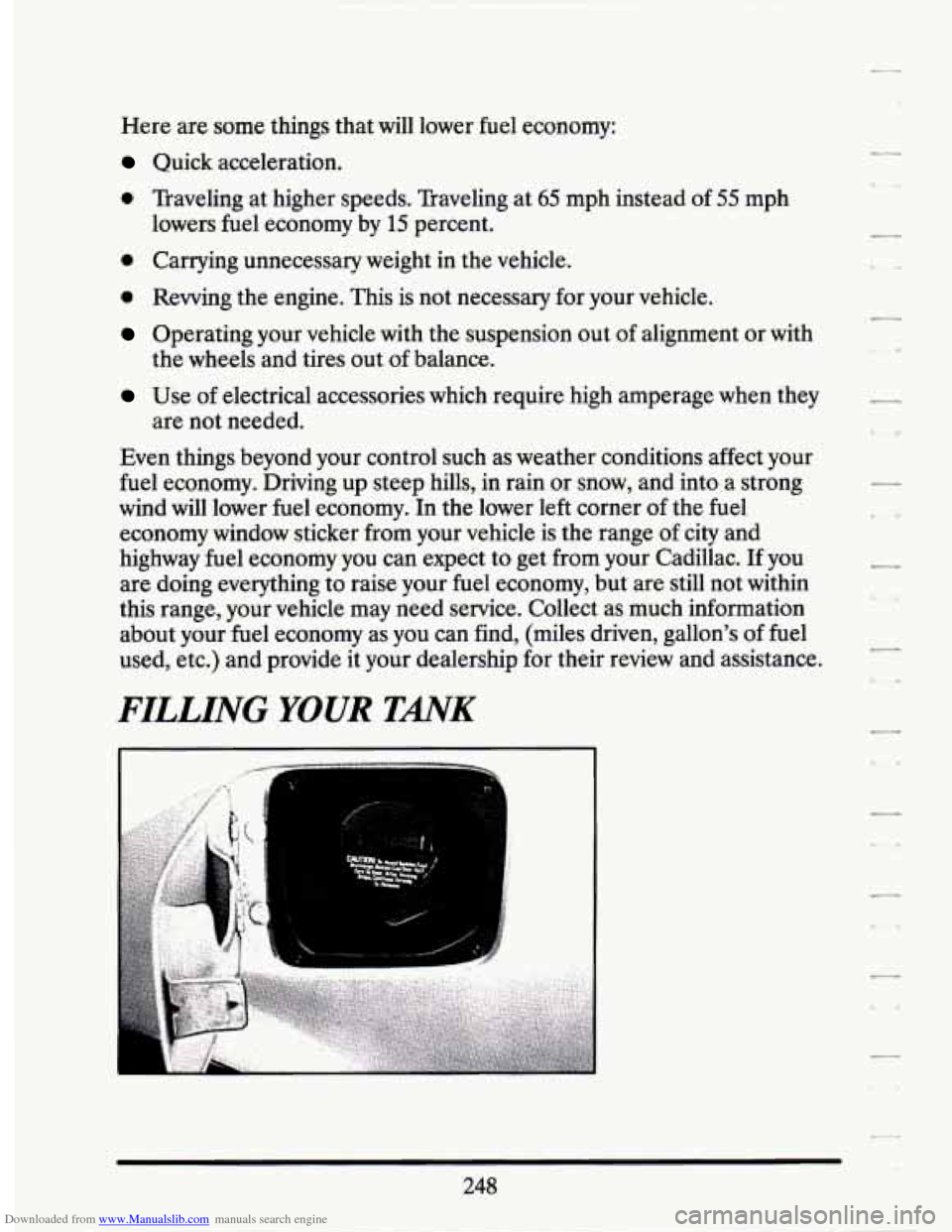
FILLING YOUR TANK
248
Page 273 of 399
Downloaded from www.Manualslib.com manuals search engine What to Do with Used Oil
Did you know that used engine oil contains certain elements that may be
unhealthy for your skin and could even cause cancer? Don’t let used oil
stay on your skin for very long. Clean your skin and nails with soap and
water, or a good hand cleaner. Wash or properly throw away clothing or
rags containing used engine
oil. (See the manufacturer’s warnings about
the use and disposal of oil products.)
Used oil can be a real threat to the environment.
If you change your own
oil, be sure to drain all free-flowing oil from the filter before disposal.
Don’t ever dispose of oil by putting it in the trash, pouring it on the
ground, into sewers, or into streams
or bodies of water. Instead, recycle it
by taking it to a place that collects used oil. If you have a problem
properly disposing of your used oil, ask your dealer, a service station or a
local recycling center for help.
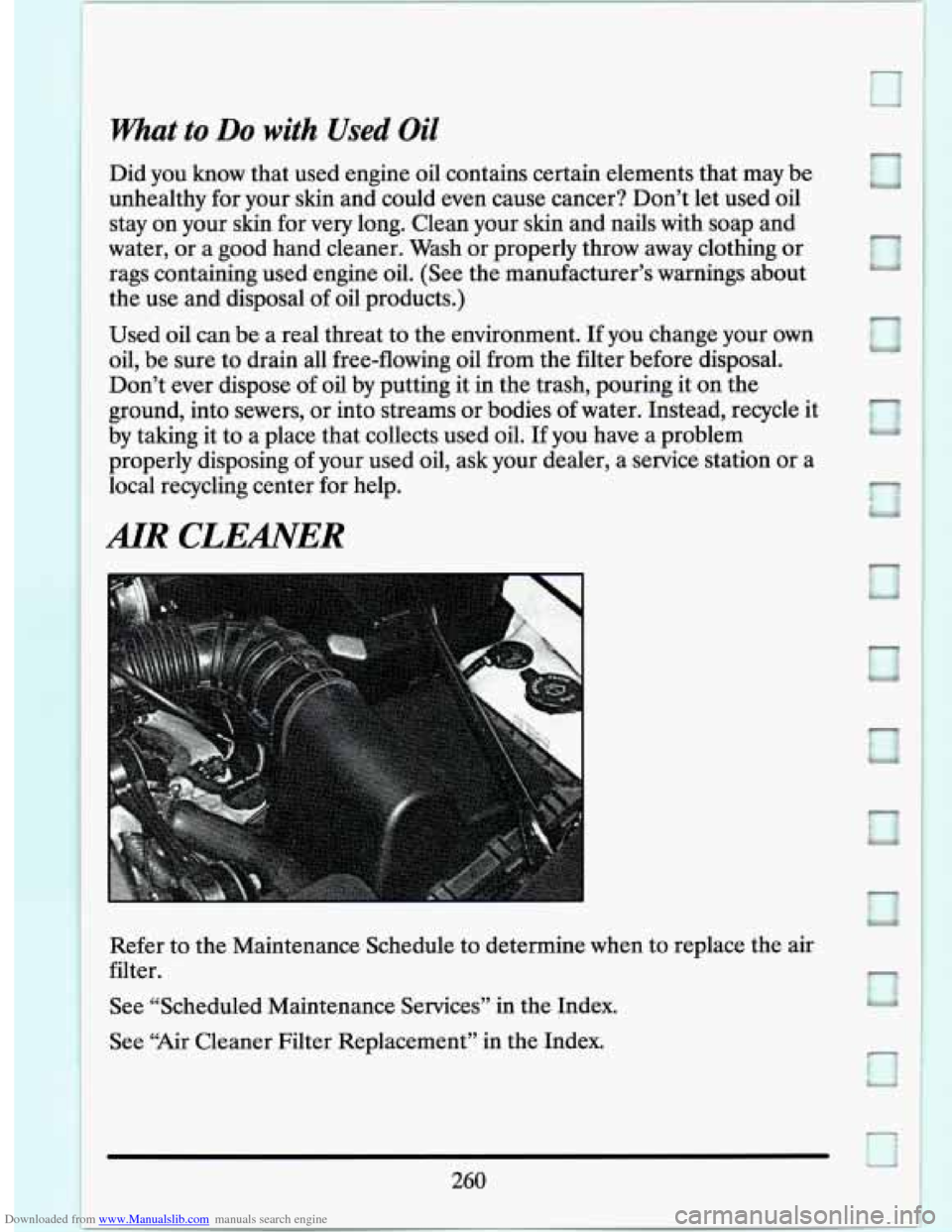
AIR CLEANER
Refer to the Maintenance Schedule to determine when to replace the air
filter.
See “Scheduled Maintenance Services”
in the Index.
See “Air Cleaner Filter Replacement” in the Index.
Page 274 of 399
Downloaded from www.Manualslib.com manuals search engine NOTICE:
If the air cleaner is off, a backfire can cause a damaging engine
fire.
And, dirt can easily get into your engine, which will damage
it. Always have the air cleaner in place when you’re driving.
AUTOMMTIC TRASAXLE FLUID
Men to Check and Change
A good time to check your automatic transaxle fluid level is when the
engine oil is changed. Refer to the Maintenance Schedule to determine
when to change your fluid. See “Scheduled Maintenance Services”
in the
Index.
How to Check
Because this operation can De a little difficult, you may choose to have
this done at
a Cadillac dealership Service Department.
If you do it yourself, be sure to follow all the instructions here, or you
could get
a false reading on the dipstick.
261
Page 290 of 399
Downloaded from www.Manualslib.com manuals search engine I€4L,OGEN BULBS
EXTENOR
MP HOUSINGS
NOTICE:
Your Cadillac’s lamp housings are designed with small vents so
moisture will be removed when the lights are on, or after driving
for a short time.
If an excessive amount of moisture is present
which does not clear, see
your Cadillac dealership for service.
HEmLIGHT BULB REMOVL
The following procedure tells you how to remove the halogen headlight
bulb. Follow either the
EXPORT or DOMESTIC illustration that best
describes your vehicle.
277