Page 267 of 398
Before closing the hood, be sure all the filler caps are on properly. Then
just pull the hood down and close it firmly.
ENGINE OIL
If the LOW OIL LEVEL light on the instrument panel comes on, it
means you need to check your engine oil level right away.
For more.
information, see Low Oil Level light in the Index.
You should check your-
engine oil level regularly; this is .an, added reminder.
It's
a good idea to check your engine oil every time you get fuel. In order
to get an accurate reading, the oil must be warm and the vehicle must be
om level ground.
t
E
-4
254
Page 268 of 398
To Check Engine Oil
Turn off the engine and give the oil a few minutes to drain back into the
oil pan. If you don't, the oil dipstick might not show the actual level.
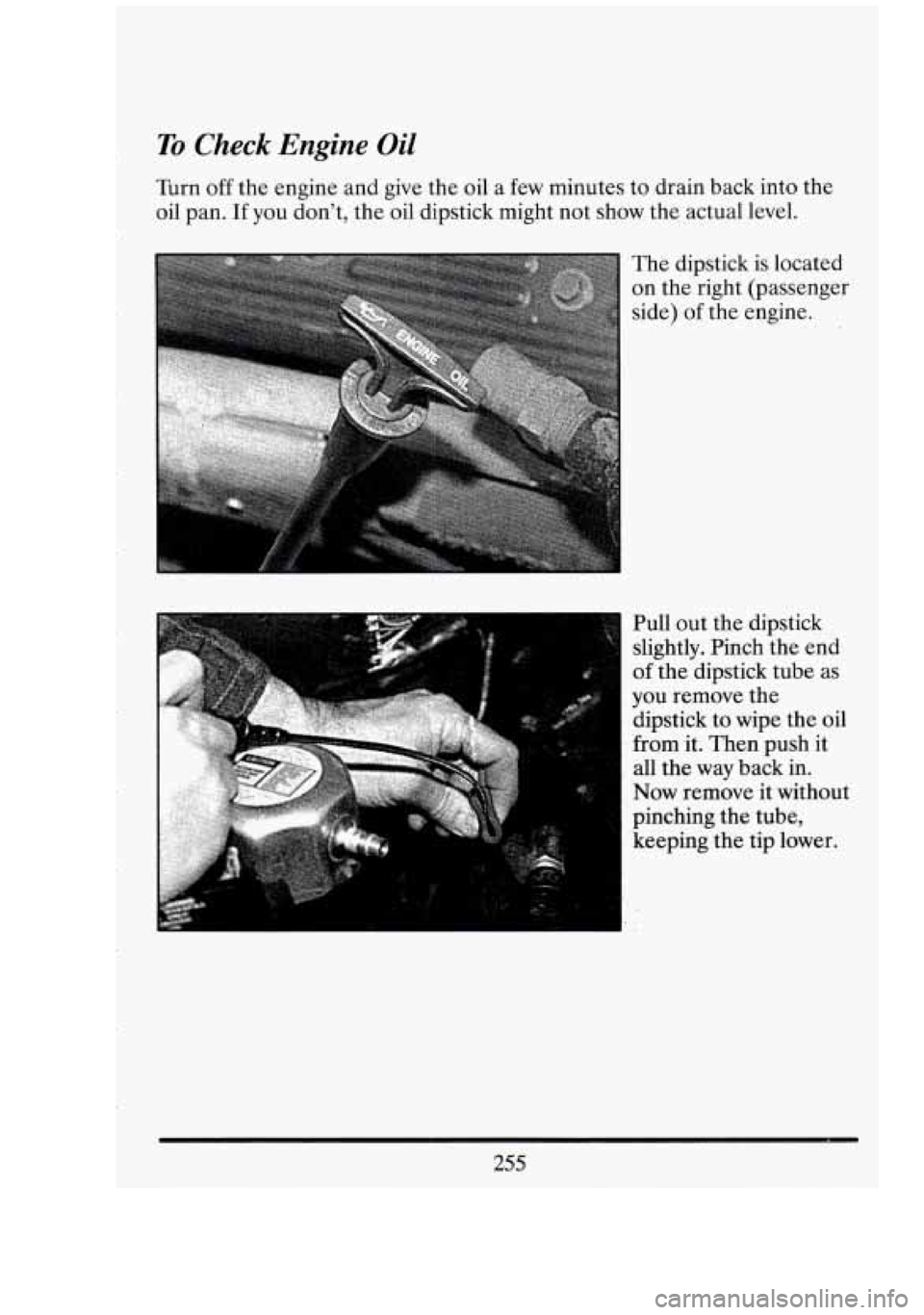
I Pull out the dipstick
slightly. Pinch the end
of the dipstick tube as
you remove the
dipstick to wipe the oil
from it. Then push it
all the way back in.
Now remove it without
pinching the tube,
keeping the tip lower.
Page 275 of 398
-NOTICE:
If the air cleaner is off, a backfire can cause a damaging engine
fire:And, dirt can easily get into your engine, which will damage
it. Always have the air cleaner in place when you’re driving. I
I AUTOAUTIC .TRANsIMISSION FLUID
‘When to Check and Change
A good time to check your automatic transmission fluid level is when the
engine oil is changed. Refer to the Maintenance Schedule to determine
when to change your fluid. See “Scheduled Maintenance Services” in
the Index.
How to Check
Because this operation can be a little difficult, you may choose to have
this done at .a Cadillac dealership Service Department.
If you do it yourself, be sure to follow all the instructions here, or you
cou.ld get a false reading on the dipstick.
I I Too NOTICE: much or too little fluidcan damage your. transmission. Too
much can mean that some of the fluid could come out and fall
on hot engine parts or exhaust system, starting
a fire. Be sure to
get an accurate reading
if you check your transmission fluid. i
I
Wait at least 30 minutes before checking the transmission fluid level if
you
have been driving:
When outside temperatures are above 90°F (32OC).
At high speed for. quite a while.
tll
il
3‘ I
CI)
262
Page 276 of 398
r
r
ec
In heavy traffic -- especially in hot weather.
0 While pulling a trailer.
To get the right reading, the fluid should be at normal.operating
temperature, which is
180 " F .to -200 " F (82' C to 93 " C).
To check transmission fluid hot: Get the.vehicle warmed up by driving
about
15 miles (24 km) when outside temperatures are above 50°F
(10" C). If it's colder than 50°F (10" C), drive the vehicle in "D" (3rd
Gear) until the engine temperature gage moves and then remains steady
for ten minutes. Then follow the hot check procedures.
To check transmission fluid cold: A cold check is made after the vehicle
has been sitting for eight hours or more with the engine
off and is used
only as a reference. Let the engine run at idle for five minutes
if outside
temperatures are
50 " F (10 " C) or more. If it's colder than 50 " F (10 " C),
you may have to idle the engine longer. Should the fluid level be low
during a cold checkj you must perform a hot check before adding fluid.
This will give you a more accurate reading
of the fluid level.
To check thefluid hot or cold
0 Park your vehicle on a level place.
0 With the parking brake applied, place the shift lever in "P" (Park).
0 With your foot on the brake pedal, move the shift lever through each
gear range, pausing for about three seconds in each range. Then,
position the shift lever in "P" (Park).
0 Let the engine run at idle for three minutes or more.
263
Page 277 of 398
Then, without shutting off the engine, follow these steps:
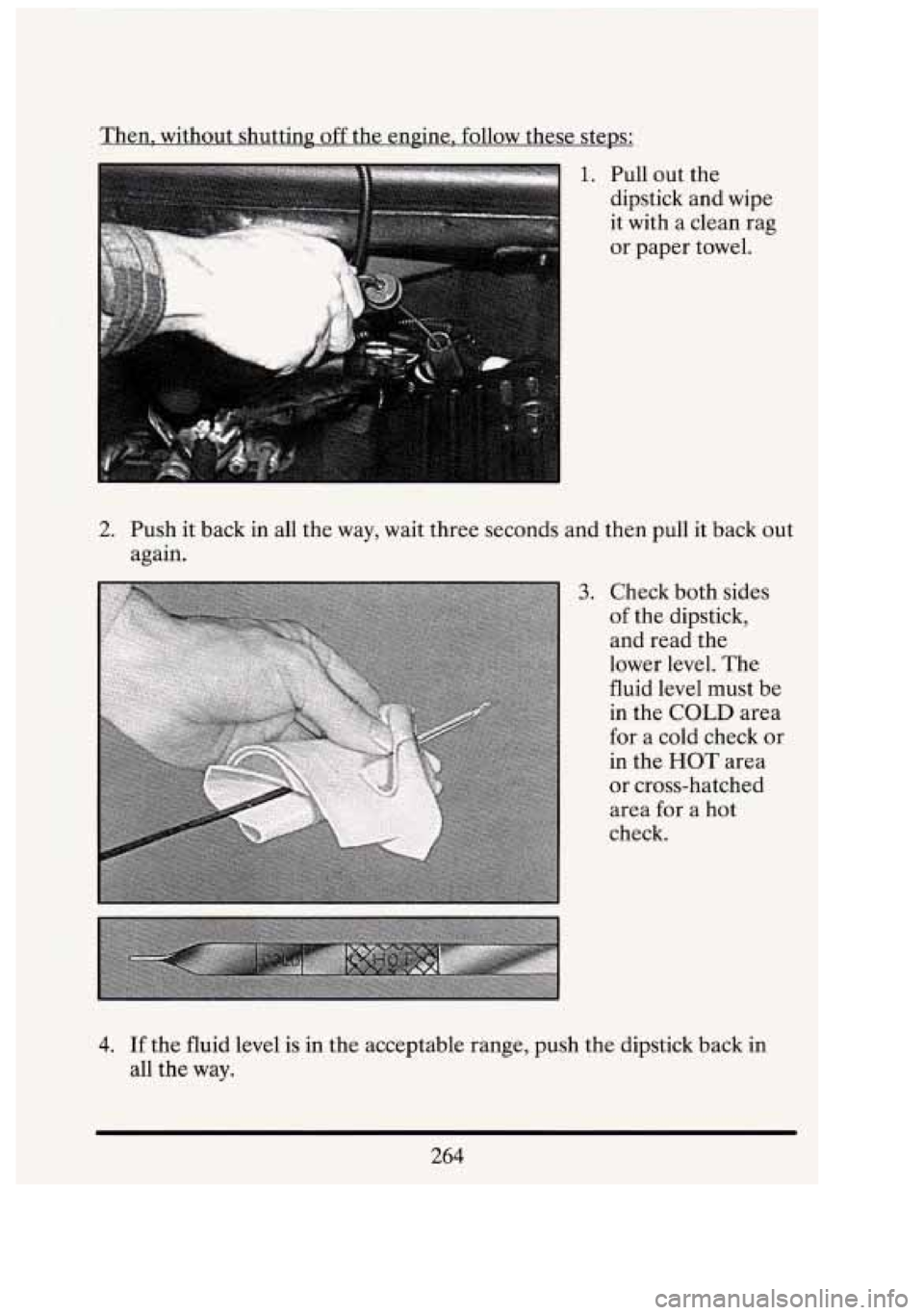
1. Pull out the
dimtick and wiDe
I I
it with a clean rag
or paper towel.
2. Push it back in all the way, wait three seconds and then pull it back out
again.
3. Check both sides
of the dipstick,
and read the
lower level. The
fluid level must be
in the
COLD area
for a cold check
or
in the HOT area
or cross-hatched
area for a hot
check.
-1
T
Ll
-i
4. If the fluid level is in the acceptable range, push the dipstick back in
all the way. T L
264
I
Page 281 of 398
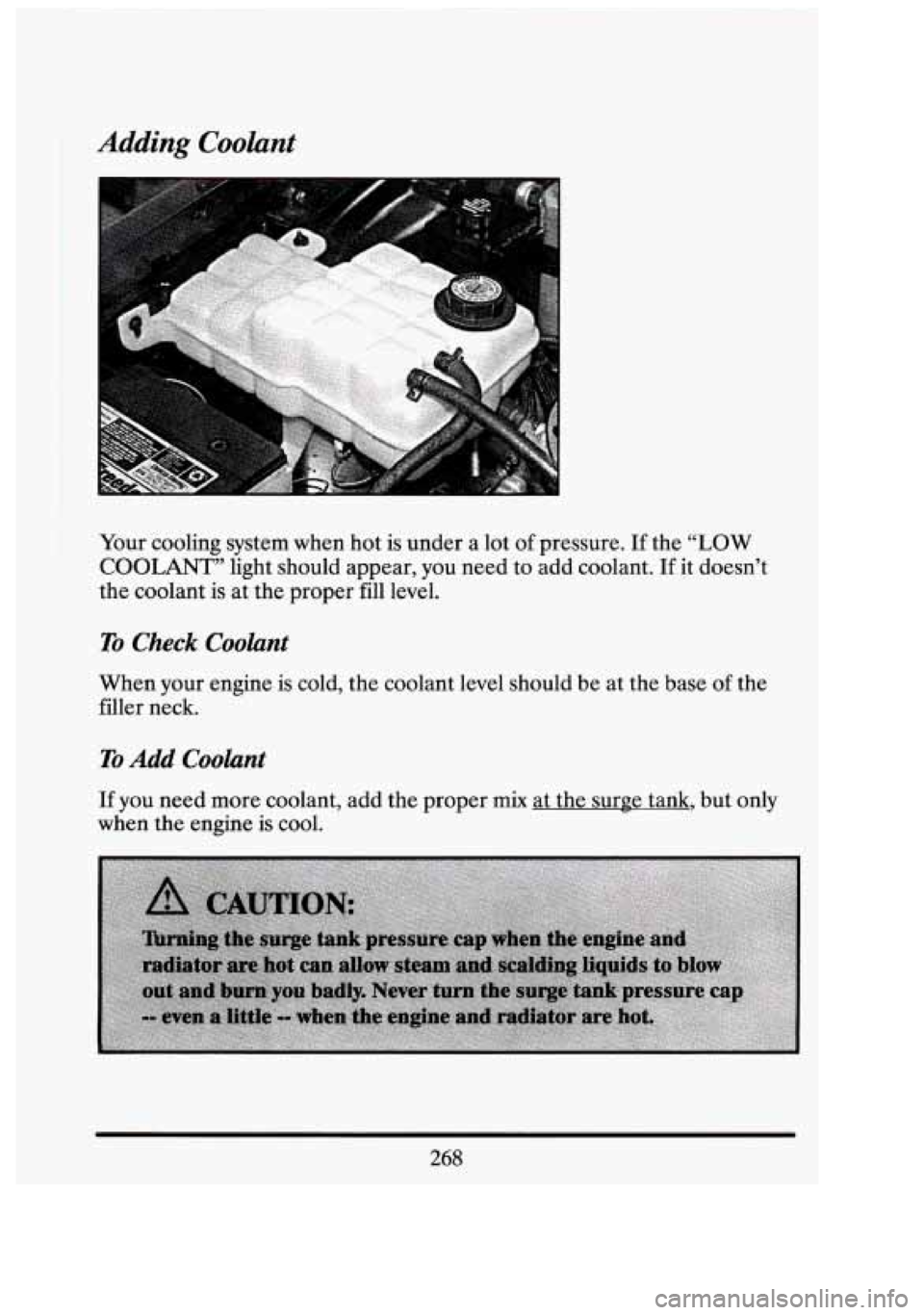
Adding Coolant
Your cooling system when hot is under a lot of pressure. If the “LOW
COOLANT” light should appear, you need to add coolant. If it doesn’t
the coolant
is at the proper fill level.
To Check Coolant
When your engine is cold, the coolant level should be at the base of the
filler neck.
To Add Coolant
If you need more coolant, add the proper mix at the surge tank, but only
when the engine is cool.
- I
dl
268
Page 283 of 398
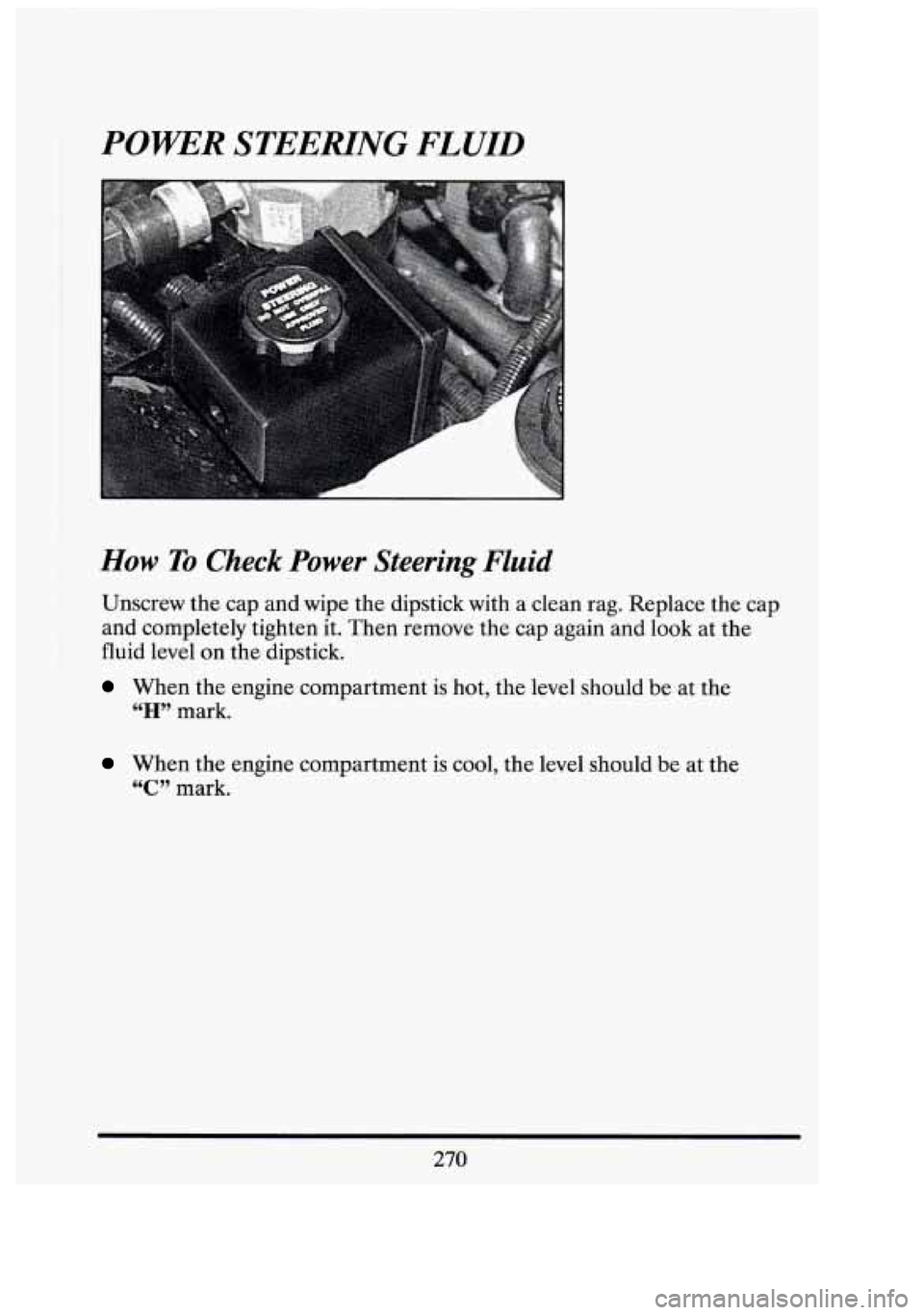
POWER STEERING FLUID
I
How To Check Power Steering Fluid
Unscrew the cap and wipe the dipstick with a clean rag. Replace the cap
and completely tighten it. Then remove the cap again and look at the
fluid level on the dipstick.
When the engine compartment is hot, the level should be at the
“H” mark.
When the engine compartment is cool, the level should be at the
“C” mark.
Page 287 of 398
I
You can check the brake fluid without taking off the cap. Just look at the
windows on the brake fluid reservoir. The fluid levels should be above
“MIN.”
If they aren’t, have your brake system checked to see if there is a
leak.
After work is done
on the brake hydraulic system, make sure the levels
are above “MIN” and below the top
of each window.
What to Add
When you do need brake fluid, use only DOT-3 brake fluid -- such as
Delco Supreme
ll@ (GM Part No.1052535). Use new brake fluid from a
sealed container only, and always clean the brake fluid reservoir cap
.before removing it.
NOTICE:
DOT-5 silicone brake fluid can damage your vehicle. Don’t
use it.
Don’t let someone put in the wrong kind of fluid. For
example, just
a few drops of mineral-based oil, such as
engine oil, in your brake system can damage brake system
parts so badly that they’ll have to be replaced.
Brake fluid can damage paint, so be careful not to spill brake
fluid on your vehicle.
If you do, wash it off immediately. See
“Appearance Care” in the Index.
Brake Wear
Your Cadillac has front-wheel disc brakes and rear drum brakes.
Disc brake pads have built-in wear indicators that make a high-pitched
warning sound when the brake pads are worn and new pads are needed.
The sound may come and
go or be heard all the time your vehicle is
moving (except when you are pushing on the brake pedal firmly).
274
131
I