Page 221 of 398
Downloaded from www.Manualslib.com manuals search engine P
h .4
r
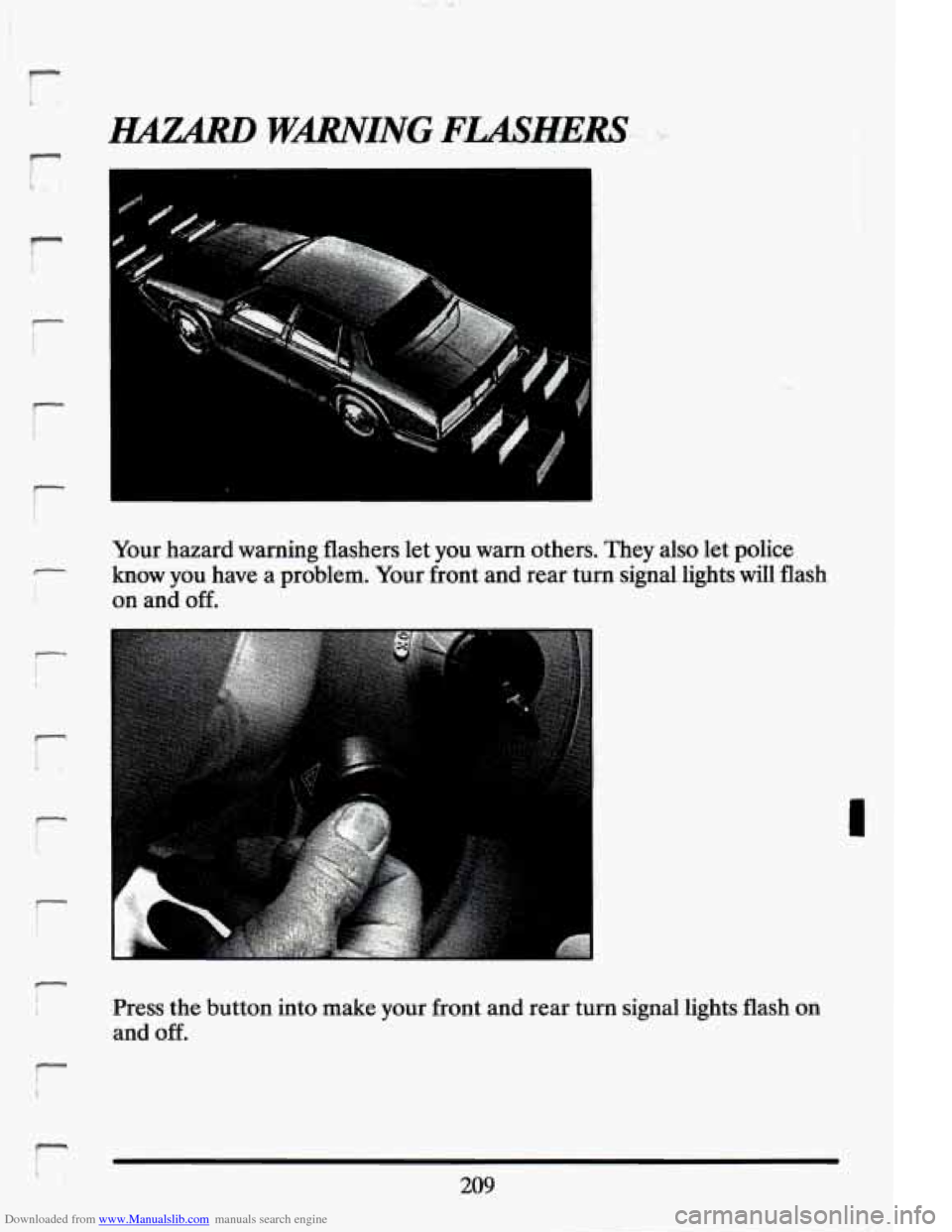
Your hazard warning flashers let you warn others. They also let police
know you have a problem. Your front and rear turn signal lights will f\
lash
on and off.
t T
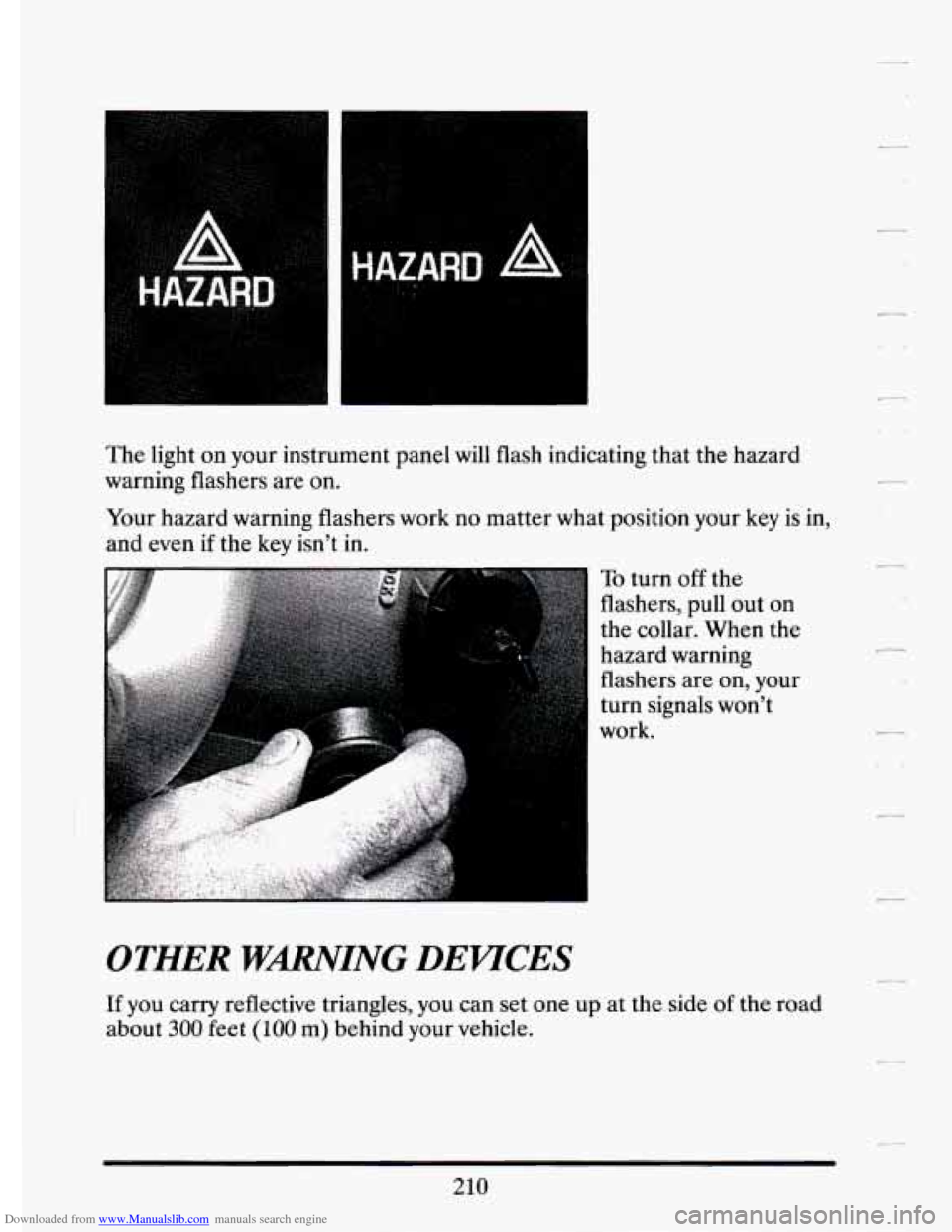
Press the button into make your front and rear turn signal lights flash on
and
off.
209
Page 222 of 398
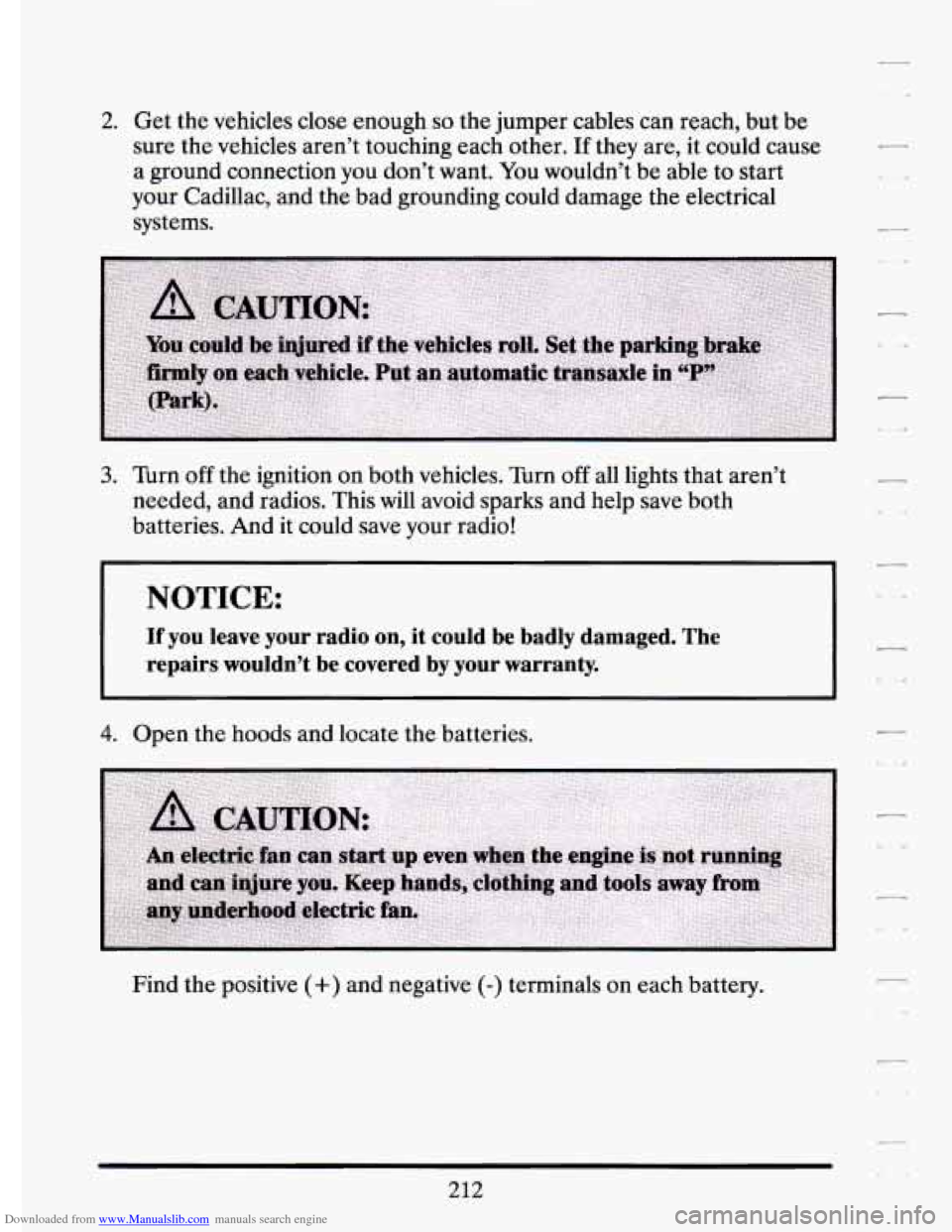
Downloaded from www.Manualslib.com manuals search engine The light on your instrument panel will flash indicating that the hazard
warning flashers
are on.
Your hazard warning flashers work no matter what position your
key is in,
and even
if the key isn’t in.
OTHER WMING DEWCES
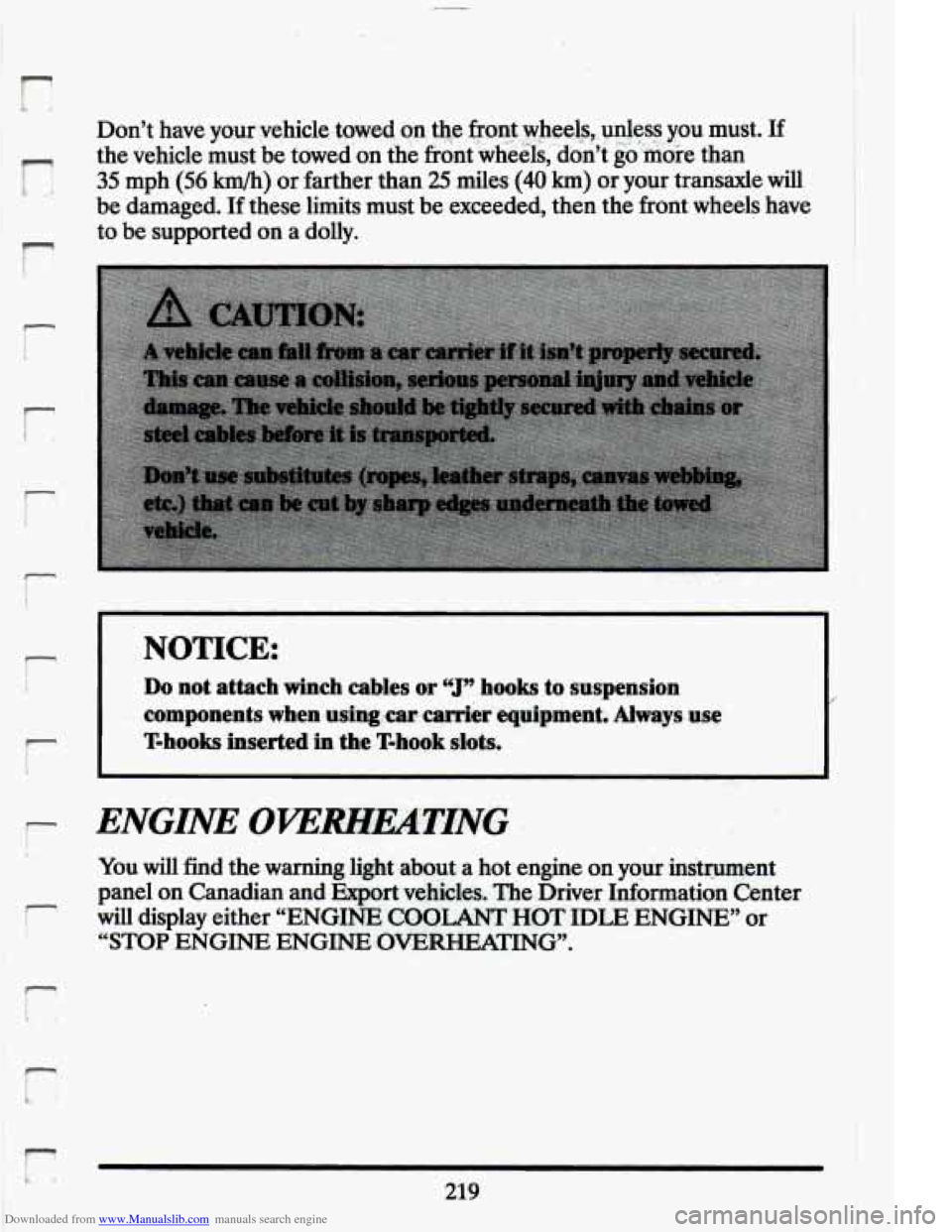
To turn off the
flashers, pull out on
the collar. When the
hazard warning
flashers
are on, your
turn signals won’t
work.
If you carry reflective triangles, you can set one up at the side of the road
about 300 feet (100 m) behind your vehicle.
210
Page 224 of 398
Downloaded from www.Manualslib.com manuals search engine 2. Get the vehicles close enough so the jumper cables can reach, but be
sure the vehicles aren’t touching each other.
If they are, it could cause
a ground connection you don’t want. You wouldn’t be able to start
your Cadillac, and the bad grounding could damage the electrical
systems.
3. Turn off the ignition on both vehicles. Turn off all lights that aren’t
needed, and radios. This will avoid sparks and help save both
batteries. And
it could save your radio!
I NOTICE:
I
If you leave your radio on, it could be badly damaged. The
repairs wouldn’t be covered by your warranty.
4. Open the hoods and locate the batteries.
Find the positive
(+) and negative (-) terminals on each battery.
212
Page 231 of 398
Downloaded from www.Manualslib.com manuals search engine r
Don’t have your.yehicle. towd. on $9 front.,wheelsy,unless you must. If
the vehicle must be towed’on the frontwheels,’don’t go’.moie than
35 mph (56 km/h) or farther than 25 miles (40 km) or your transaxle will
be damaged. If these limits must be exceeded, then the front wheels have
to be supported on a dolly.
I- I Do not attach winch cables or ‘1” hooks to suspension
NOTICE:
components when usingxar carrier equipment. Always use
T-hooks inserted in the T-hook slots.
/
i- L
r
f-
r
ENGINE OVlWHEATING
You will find the warning light about a hot engine on your instmment
panel on Canadian and
Export vehicles. The Driver Information Center
will display either “ENGINE COOLANT HOT IDLE ENGINE” or
“STOP ENGINE ENGINE OVERHEMTING.
219
Page 250 of 398
Downloaded from www.Manualslib.com manuals search engine COMPACT SPm TIRE
Although the compact spare was fully inflated when your vehicle was
new, it can lose air after a time. Check the inflation pressure regularly.
It
should be 60 psi (420 kPa). The compact spare is made to go up to 3,000
miles (5000 km), so you can finish your trip and have your full-size tire
repaired or replaced where you want. Of course, it’s best to replace your
spare with a full-size tire as
soon as you can. Your spare will last longer
and be
in good shape in case you need it again.
Your anti-lock brake system warning light may come on when you are
driving with a compact spare. See “Anti-Lock Brake System Wa\
rning
Light”
in the Index.
r
NOTICE: -
Don’t take your compact spare through an automatic car wash
with guide rails. The compact spare can get caught on the rai\
ls.
That can damage the tire and wheel, and maybe other parts
of
your vehicle.
Don’t use your compact spare on some other vehicle.
And don’t mix your compact spare or wheel with other wheels or tires.
They won’t fit. Keep your spare and its wheel together.
238
Page 252 of 398
Downloaded from www.Manualslib.com manuals search engine I
’
. NOTICE:
Spinningyour.wheels-can destroy par€s of your vehicle as well
as the tires. If you spin the wheels too
transaxle back and
forth, you ,can destroy your transaxle.
Rocking yourvehicle
to get it out:
First, tumyour steering wheel left and right. That will clear ,the area
around your front wheels. Then
shift back and forth. between “.R”
(Reverse) and, a forward gear, spinning the wheels.as-!itt€e.as possible.
Release-the accelerator pedal while you shift, and press lightly on the
accelerator pedal when
.the transde.is.in gear. If that doesn’t get you out
after .a
few txie-s,. you-may need to-be 6owed:out. If you do need to Be
towed out, see “Tiwing Your Vehicle’’ in .the Index.
1
I 240
I
1‘
i E
Page 257 of 398
Downloaded from www.Manualslib.com manuals search engine r
I’
r
i
i-
i r
There: are two;different fuel economy estimates ,for each vehicle., one for.
city driving
and one for highway driving ... To develop these two .estimates,. ;
separate tests .are used to represent typical everyday city and rural
driving.
The test used to determine the city fuel economy estimate simulates a
7.5 mile (12 km), stop and go trip with. an average speed of 20 mph
(32 km/h). The trip takes 23, minutes and: has 18 stops. About one fifth
of the time is spent idling, as in waiting at traffic lights or in rush hour
traffic.
Two. kinds of engine starts are used: a cold start, which is similar to
starting a car in the morning after it has been parked all night and a hot
start, which is similar to restarting a vehicle after it has been warmed up,
driven and stopped for a short time.
I
!
i j I i
The test used to determine the highway fuel economy estimate represents
a mixture of “non-city” driving. Segments corresponding to different
kinds of rural roads and interstate highways are included. The test
simulates a
10- mile (17 km) trip with an average speed. of 48 mph (77
km/h). The test is run from a hot start and has little idling time and no
stops.
To assure that the fuel economy numbers are most useful for consumers,
the EPA adjusts. these .laboratory test. results. to account for the difference
between controlled laboratory conditions and actual, driving on the road.
The laboratory fuel economy results are adjusted downward
to arrive at
the estimates on the fuel economy window sticker and the
Gas Mileage
Guide. The city estimate is lowered by
10 percent and the highway
estimate is lowered by
22 percent from the laboratory test results.
Experience has proven that these adjustments make the mile:age
estimates-correspond more closely to the actual fuel economy realized
by
the average driver.
245
Page 275 of 398
Downloaded from www.Manualslib.com manuals search engine The.following explains your cooling system and how to-add coolant when
it is low.
If you have a problem with. engine overheating,. see “Engine
Overheating’% the Index.
r The proper coolant for your Cadillac will:
0 Give freezing protection down to -34°F (-37°C). - I .0 Give boiling protection up to 262°F (128O C).
0 Protect against rust and corrosion.
r
r
r
? I
Help keep the proper engine temperature.
0 Let the warning lights work as they should.
What to Use
Use a mixture of one-half clean water. (preferably distilled) and one-half
antifreeze that ,meets “GM Specification
.1825-M,” which won’t damage
aluminum parts. You can also use a recycled coolant conforming to GM
Specification 1825-M with a complete coolant .flush and refill. Use GM
.Engine Coolant Supplement. (‘sealer) with any. complete coofant change.
If you use this mixture, you don? need to add anything else.
i
I L
263