1994 CADILLAC ELDORADO steering wheel
[x] Cancel search: steering wheelPage 191 of 398
Downloaded from www.Manualslib.com manuals search engine I
r
i .’
r
r
L
r
i
r I
Your vehicle has traction control system that limits wheel spin. This is
especially useful in slippery road conditions. The system operates only
if
it senses that one or both of the front wheels are spinning or- beginning to
lose traction. When .this happens, the system works the front brakes and
reduces engine power (by shutting
off fuel injectors) to limit wheel spin.
The “TRACTION ACTIVE” message will display on the Driver
Information Center when the traction control system is limiting wheel
spin. See “Driver Information Center Messages” in the Index. You may
feel the system working, or you may notice some noise, but this
is nomal.
If your vehicle is in cruise control when the traction control system begins
to limit wheel spin, the cruise control will automatically disengage. When
road conditions allow you to safely use it again, you may
turn the cruise
control back on. (See “Cruise Control” in the Index.)
The “TRACTION DISABLED” message
will display on the Driver
Information Center
if there’s a problem with your traction control system.
See “D,river Information Center Messages” in the Index. When. this
message is displayed, the system will not limit wheel spin. Adjust your
driving accordingly.
Braking in Emergencies
Use your anti-lock braking system when you need to. With anti-lock, you
can steer and brake at the same time. In many emergencies, steering can
help you more than even the very best braking.
179
Page 192 of 398
Downloaded from www.Manualslib.com manuals search engine STEEMNG
Power Steering
L_
c-
If you lose power steering assist because the engine stops or the system is
not functioning, you can steer but it
will take much more effort.
Steering Tips
Driving on Curves
It’s important to take curves at a reasonable speed.
A lot of the “driver lost control” accidents mentioned on the news
happen on curves. Here’s why:
Experienced driver or beginner, each
of us is subject to the same laws of
physics when driving on curves. The traction of the tires against the road
surface makes it possible for the vehicle to change its path
when you turn
the front wheels. If there’s no traction, inertia will keep the vehicle going
in the same direction. If you’ve ever tried to steer a vehicle on wet ice,
you’ll understand this.
The traction you can get in a curve depends
on the condition of your tires
and the road surface, the angle at which the curve is banked, and your
speed. While you’re in a curve, speed is the one factor you can control.
Suppose you’re steering through a sharp curve. Then
you suddenly
accelerate. Both control systems
-- steering and acceleration -- have to do
their work where the tires meet the road. Unless you have the traction
control system, adding the sudden acceleration can demand too much
of
those places. You can lose control.
What should you do
if this ever happens? Ease up on the accelerator
Pedal, steer the vehicle the way you want it to go, and slow down.
31 ~ :d limit signs near curves warn that you should adjust your speed. Of
course, the posted speeds are based on good weather and road
conditions. Under less favorable conditions you’ll want to go slower.
If you need to reduce your speed as you approach a curve, do it before
you enter the curve, while your front wheels are straight ahead.
-
e.4
180
Page 193 of 398
Downloaded from www.Manualslib.com manuals search engine ‘I
r td
r
r
!
-
I- t>
Try to adjust your speed so you can ‘‘d&xCY through.thecurve. Maintain a
reasonable,. steady speed, Wait to .accelerate until you are out of the
curve,
and then accelerate-gently into the straightaway.
.. .:r 5.
Steering in Emergencies
There are times when steering canbe more effective.than braking. For
example, you. come over a hill and, find a truck stopped
in your lane, .or a
car suddenly pulls. out from nowhere, ox a child darts out €rm betwe
you. You can avoid these pxoblems
by braking.
-- if you can stop in time. But sometimes you can’t; there isn’t
room. That’s the time for evasive action
-- steering around the problem.
Your Cadillac can perform verywell
in. emergencies like these. First apply
your brakes. It
is better to remove as much speed as you can from a,
possible collision. Then steer around the problem, to the left orright
depending on the space available.
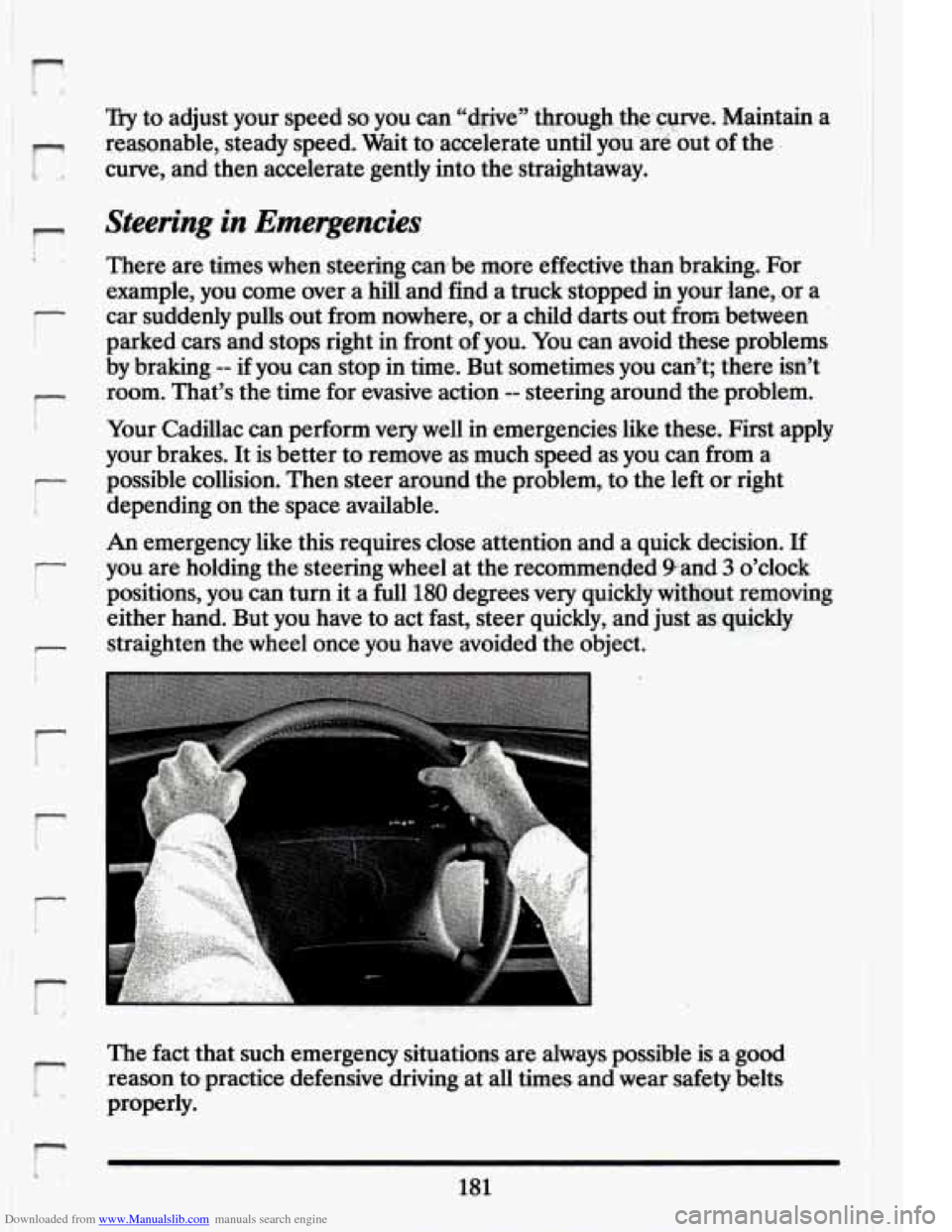
An emergency like this requires close attention and a quick decision. If
you. are holding the steering wheel’ at the recommended Pand-3’o’clock
positions, you can turn
it a full 180 degrees very quickly without removing
either hand. But you have to act fast, steer quickly, and just aslquickly
straighten the wheel once
you have avoided-:the object.
The fact that such emergency situations are always possible
is a.good
reason to practice defensive driving at all times. and wear safety belts
properly.
r c
181.
Page 194 of 398
Downloaded from www.Manualslib.com manuals search engine OFF-ROAD RECOVERY
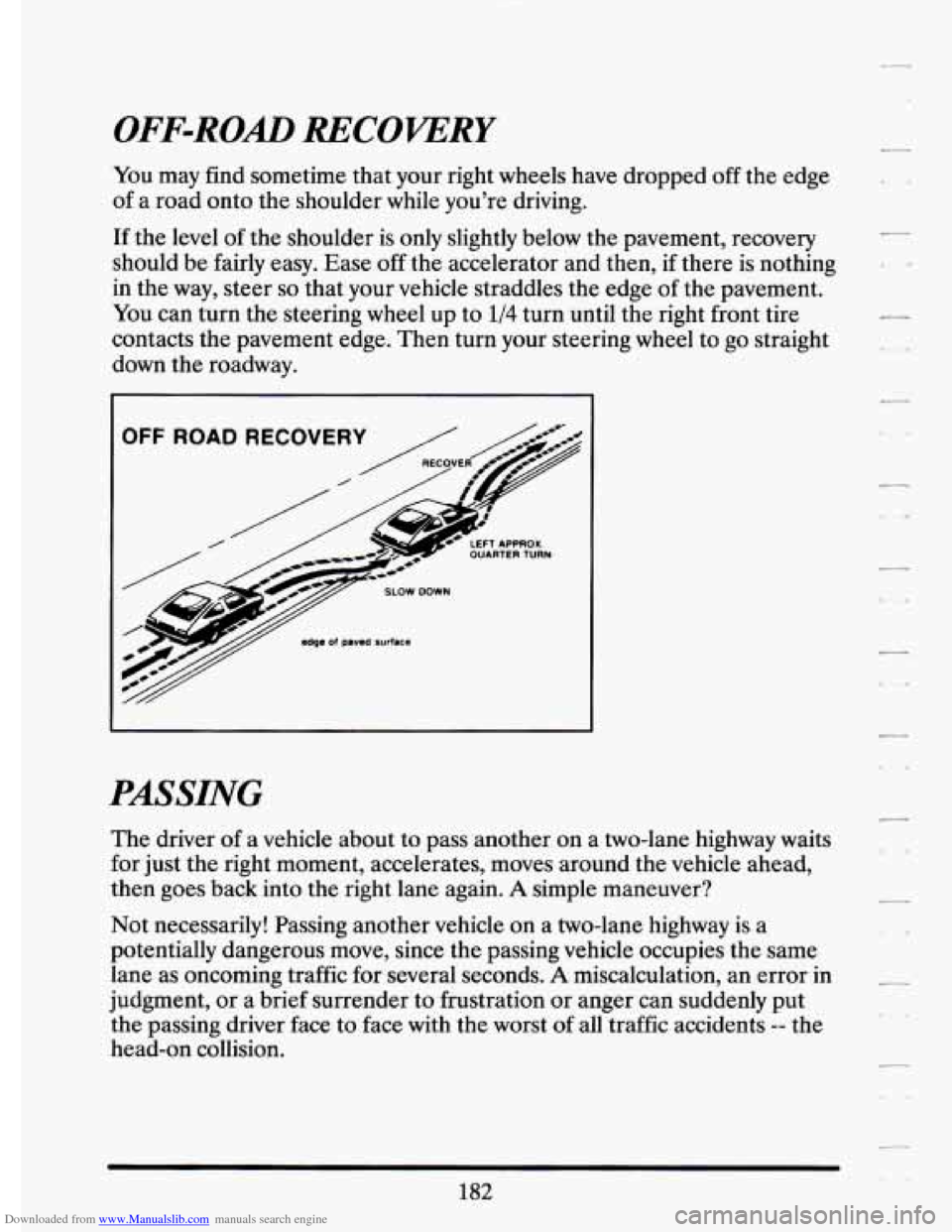
You may find sometime that your right wheels have dropped off the edge
of a road onto the shoulder while you’re driving.
If the level of the shoulder is only slightly below the pavement, recovery
should be fairly easy. Ease
off the accelerator and then, if there is nothing - -
in the way, steer so that your vehicle straddles the edge of the pavement.
You
can turn the steering wheel up to 1/4 turn until the right front tire
contacts the pavement edge.
Then turn your steering wheel to go straight
-
down the roadway.
-
PASSING
The driver of a vehicle about to pass another on a two-lane highway waits
for just the right moment, accelerates, moves around the vehicle ahead,
then goes back into the right lane again.
A simple maneuver?
Not necessarily! Passing another vehicle on a two-lane highway is a
potentially dangerous move, since the passing vehicle occupies the same
lane
as oncoming traffic for several seconds. A miscalculation, an error in
judgment,
or a brief surrender to.frustration or anger can suddenly put
the passing driver face to face with the worst
of all traffic accidents -- the
head-on collision.
182
Page 196 of 398
Downloaded from www.Manualslib.com manuals search engine Try not to pass more than one vehicle at a time on two-lane roads.
Reconsider before passing the next vehicle.
Don’t overtake a slowly moving vehicle too rapidly. Even though the
brake lights are not flashing, it may be slowing down or starting to
turn.
If you’re being passed, make it easy for the following driver to get
ahead
of you. Perhaps you can ease a little to the right.
LOSS OF CONTROL
Let’s review what driving experts say about what happens whe\
n the three
control systems (brakes, steering and acceleration) don’t ha\
ve enough
friction where the tires meet the road to do what the driver has asked.
In any emergency, don’t give up. Keep trying to steer and constantly seek
an escape route or area of less danger.
Skidding
In a skid, a driver can lose control of the vehicle. Defensive drivers avoid
most skids by taking reasonable care suited to existing conditions, and by
not “overdriving” those conditions. But skids are always possible.
The three types of skids correspond
to your Cadillac’s three control
systems. In the braking skid your wheels aren’t rolling.
In the steering or
cornering skid, too much speed or steering
in a curve causes tires to slip
and lose cornering force. And in the acceleration skid too much throttle
causes the driving wheels to spin.
A cornering skid is best handled by easing your foot off the accelerator
pedal.
If your vehicle starts to slide, ease your foot off the accelerator pedal and
quickly steer the way you want the vehicle
to go. If you start steering
quickly enough, your vehicle may straighten out. Always be ready for a
second skid if it occurs.
Of course, traction is reduced
when water, snow, ice, gravel, or other
material is on the road. For safety, you’ll want
to slow down .md adjust
your driving
to these conditions. It is important to slow dowr on slippery
surfaces because stopping distance will be longer and vehicle control
more limited.
184
Page 217 of 398
Downloaded from www.Manualslib.com manuals search engine n
F- I
r
r i
I r’ j’ IL i
Folbwing Distance ~ ..
Stay at Least ,twice as far behind the vehicle ahead as you would when
driving your vehicie without a trailer.
This can help you.avoid situations
that require heavy braking and sudden turns.
,Passing
You’ll need more passing distance up ahead-.when you’re towing a. trailer.
And, because y0u’re.a good deal longer, you’ll need to go much farther
beyond the passed vehicle before you .can return to
your lane.
Backing Up
Hold the bottom of the steering wheel with one hand. Then, to move the
trailer ‘to .the- left, just move that hand
to the left. To move the trailer to
the right, .move -your hand
‘to the right. Always back up. slowly and, if
possible, have someone guide you.
Making nrns
When you’re turning with a trailer, make wider turns than normal. Do
.this so your trailer won? strike soft shoulders, curbs, road signs, trees, or
other .objects. Avoid jerky.or sudden maneuvers. Signal well
in advance.
Turn sigreals When Towing a Trailer
When you tow a trailer, your vehicle has to have a different turn signal
.= flasher and extra wiring. The green arrows on your instrument panel will f
J I flash, whenever you signal a turn or lane change. Properly hooked. up, the
trailer
l&hts will also flash, telling other drivers you’re about to turn,
change lanes or stop.
flash for turns even’if the.bulbs on the trailer are burned out. .Thus, you
may think drivers behind
you are seeing your- signal when they are not.
’ Et’s important to check occasionally to be sure the trailer. bulbs are still
r
i When towing a trailer; the green arrows on your instrument panel will
t! working.
205
Page 230 of 398
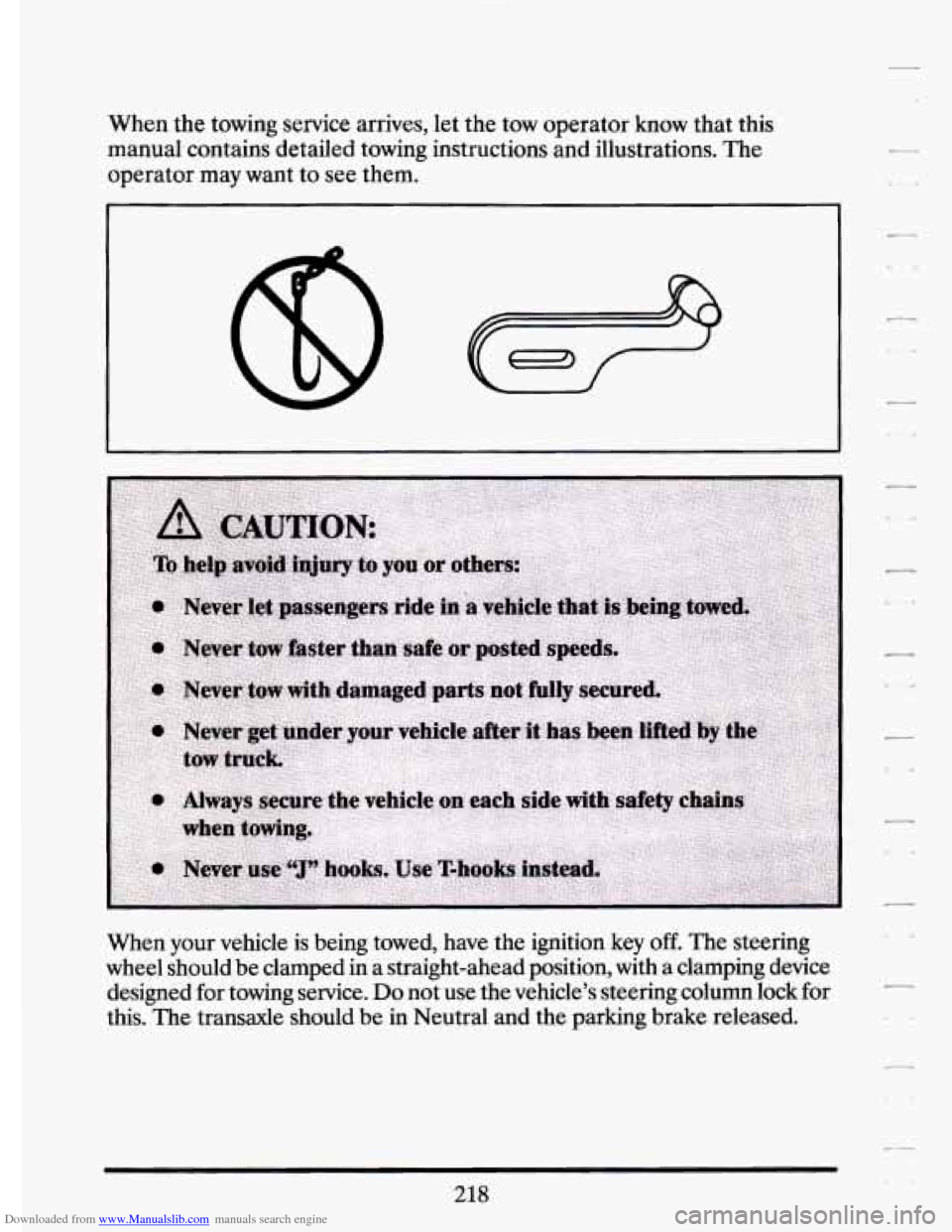
Downloaded from www.Manualslib.com manuals search engine When the towing service arrives, let the tow operator know that this
manual-contains detailed towing instructions and illustrations. The
operator may want to see them.
When your vehicle
is being towed, have the ignition key off. The steering
wheel should be clamped in a straight-ahead position, with
a clamping device
designed for towing service.
Do not use the vehicle’s steering column lock for
this. The transaxle should be in Neutral and the parking brake relea\
sed.
218
-.
Page 241 of 398
Downloaded from www.Manualslib.com manuals search engine !r
r
r
r L
I-
‘.. c ..e
IF A TIRE GOES FLAT
It’s unusual for a: tire to “blow out” while you’re driving, especially if you
maintain your tires properly. If air goes out of a. tire, it’s much more ‘likely
to leak out slowly.
But if you should ever have a “blowout,” here are a
few tips about what to expect and what to do:
If a front tire fails, the flat tire will create a drag that pulls the vehicle
toward that side. Take your
foot, off .the accelerator pedal and grip- the
steering wheel
firmly. Steer to maintain lane position, then-gently brake
to a stop well out of the traffic lane.
A rear blowout, particularly on a curve, acts much like a skid and may
require the same correction you’d use in a skid. In .any rear blowout,
remove your foot from the accelexator pedal. Get the vehicle under
control by steering the way
you want the vehicle to go. It may be very
bumpy and noisy, but you can still steer. Gently brake to a stop, well
off
the. road.if possible.
If a tire goes flat, the next section shows how to use your jacking
equipment to change a flat tire safely.
. . ._ .. . .
229